
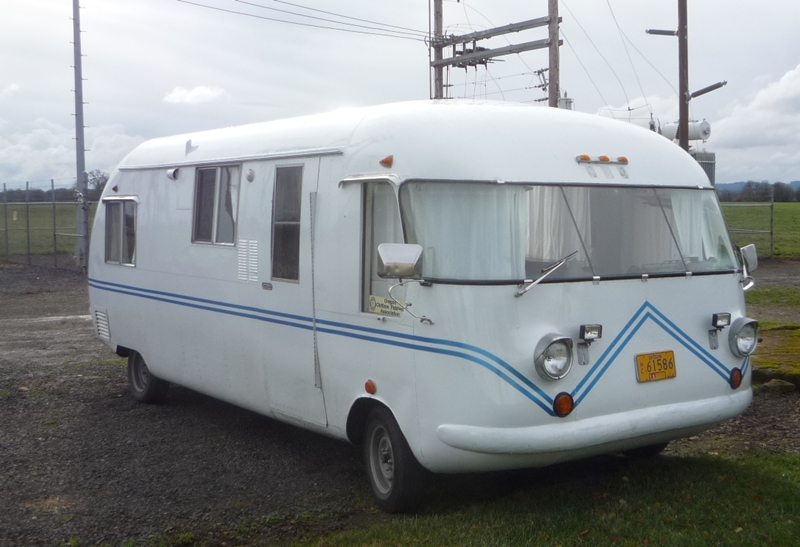
(first posted here on 5/30/2012)
In 1959, David Peterson, a professional aircraft designer, had a dilemma: he owned a travel trailer and a boat, but couldn’t tow them both at the same time. He dreamed of putting an engine under the floor of the trailer, and towing his boat with it. When the Corvair appeared that year, he decided to act on it. He rented a large garage, tossed out the trailer, started from scratch, and four months later out rolled the first Ultra Van, a full sized motor home, but weighing a mere 3,000 pounds. It was way ahead of its time then, and it still is today. Which probably explains why it was a commercial flop, as well as being my all-time favorite RV ever.

To help put the UV into perspective, here are a few basic stats: it’s a “full size” RV, 22 feet long, 8 feet wide with full 6’2″ stand-up headroom, yet it’s only 8′ tall overall. It has all the usual amenities of a Class A RV, including a large bedroom in the back, full galley, bathroom, etc. The production versions weigh about 3,400 lbs (dry), about the same as a new Camry. And it can get up to twenty mpg on the road.

It’s one of the all-time most brilliant marvels of space and weight efficiency; if Colin Chapman, Buckminster Fuller, Ferdinand Porsche or Gordon Murray had been asked to design an RV, this is what they would have come up with. David Peterson deserves to join their hallowed ranks.
If you’re getting the drift that I rather like the UV, you’re right. I’ve obsessed on them since my first sighting as a kid. I knew instantly that it was something different. Then I read an article about it in a Popular Mechanix or such: Wow! A Corvair-powered RV built like an airplane. How cool is that? Ultra Cool!
And as an RVer, the UV is truly my dream rig. And one I have spent way too much time imagining how to update and improve, never mind just own. Before we get to that, here’s the history and the details of my heart throb:

Peterson didn’t just transplant a Corvair engine under his travel trailer. He started from scratch, and designed the only RV (to my knowledge) that was built just like an airplane, where light weight is paramount. The UV is a true monococque (self supporting) structure of aluminum ribs with an aluminum skin riveted to it. The aerodynamic front and rear caps are fiberglass, and those bumpers are made of foam. There are four aluminum tanks for gasoline, water, gray water and sewage carefully integrated under the floor, and the bottom of the coach is fully sheathed in aluminum skin as well.

It’s important to understand that Peterson wasn’t just trying to build the world’s lightest RV. His goal was that the UV could also be used as a second car too, unlike the large and unwieldy RVs that were (and still are) being built on truck chassis. The UV was not that much longer than the big land yachts at the time, and its steering allowed a 50 degree inside wheel angle so that it was also very maneuverable. And of course, its fuel efficiency played into that too. Even if it wasn’t exactly going to be used daily, in any case, there certainly was no need to have a dingy car towed along behind.

In my obvious enthusiasm, I’ve jumped ahead of the story a bit, because originally Peterson had no plans to build his invention for others.

But he got pestered about it enough that he found some technical school apprentices, and built fifteen of them. They were priced at $7,000 ($50k adjusted). And those early ones had all of 80 hp, which feeding through the two-speed Powerglide meant a leisurely ride, especially with a boat in tow.

In 1964, a Wichita Kansas company bought rights to build the UV, in an attempt to properly commercialize it. But only some 330 Corvair powered UVs were ever built before production ended in 1969, for several reasons. One of them was that the Corvair was known to be ending its production, meaning no new engines. But the biggest reason by far was Winnebago.

In 1966, Winnebago revolutionized the RV industry by offering Americans the equivalent of the Big Mac Value Meal, an family-sized RV for half the price of the going rate. They did it the Henry Ford way: it was the first mass-produced production-line RV. And it was the polar opposite of the UV in every way: a cheaply framed box sitting on a cheap truck chassis; heavy, gas-sucking, ill-handling; and Americans snapped them up as fast as Winnebago could make them. Cheap, big and inefficient: the American mantra for success whether it’s with cars, houses, or a cross between the two.
The UV’s brilliance was also its downfall. Its airplane construction was intrinsically more expensive. If gasoline had always been at European levels here, there would likely be an UV dealer down the road today.

After 1964, Ultra Vans came with the bigger 164 CID Corvair engine (directly underneath these rear beds) in both 110 and 140 hp tune. Since a manual shift linkage was out of question, they still pumped through the Powerglide. For those more leisurely times, the Corvair engine did the trick, cruising happily up to 65 mph (on flat terrain). But by the late sixties Americans were getting power-hungry, even with their RVs.

So after the Corvair engine went bye-bye, Ultra engineers tested several alternatives. The Olds Toronado FWD power train was promising, and versions with it in the front and back (not both at the same time) were tried. These experiments led to to two new developments: the fwd Toro-powered fwd Tiara, which we’ll take a look at in separate post. But the Ultra experimental department kept at it, and finally hit on a solution to replace the weak chested Corvair: “Corvette” power! A 200hp 307 inch³ Chevy V8, actually, although some higher-performance 327s were known to be specified by those looking for more. The benefits of Chevy small-block power: take your pick of horsepower.

As best as I can make out from the iffy descriptions, the small block Chevy V8 sits in the back under a rear bed, and then sends its power to the rear through a Powerglide, then a marine V-drive sends it back forward to a Corvette independent rear suspension with disc brakes. Ultra sophisticated or ultra crude?
These so-called “Corvette” Ultra Vans have sparkling performance with their very un-RV like power-to-weight ratio. Mileage dropped to a still respectable 12 -15 mpg. Only 47 of these were made, of which some are still prowling the roads of America looking for stoplight drags with Chrysler 440 powered Winnebagos in order to settle an old score.

It was all in vain; the UV was getting ever-more ultra-expensive, and Ultra shut its doors in 1970. The 375 hp fwd Toronado-powered Tiara (above) had even more sparkling performance, with an unparalleled 16:1 lbs/hp ratio; Petersen said that if the Toronado had been available in 1960, there never would have been a Corvair UV.

His ideas were picked up by others, including the second-most radical RV ever built, the GMC Motor Coach (above). But Ultra was down and out.
Ultra Vans have an enthusiastic and loyal following, and some 200 of the 370 ever built are still on the road, or hoping to be soon. Obviously, there are challenges and limitations to Ultra Vanning: one has to travel lightly, since its total weight capacity is limited, especially with those little 14″ tires (early ones had 13 inchers!). This UV has obviously and wisely had its rims widened. There’s no air conditioner. The brakes are unassisted drums. The tanks and complex sewage system can become problematic. At least there’s no power steering to get leaky. You get the drift: this is for minimalistic RVers, which suits me fine.

As the owner of UV #366 shows to an extreme. A former pilot, he’s stripped his UV to the bare essentials in the quest to make what has to be the world’s lightest full-size RV.

No dashboard, just what looks like a bicycle speedometer. Who needs any other gauges anyway? And the steering wheel is down to one spoke. This guy is very serious about weight reduction.

OK, if I was single, I might be able to relate to this. But I don’t think I’d get very far with Stephanie with this degree of minimalism; like not even past the front door. But I respect what he’s after, and I’d bet his UV weighs in at under 3000 lbs.
When I was young, I shared Peterson’s dream: whenever I saw an Airstream trailer, I imagined turning it into a self propelled sleek and low RV. I became aware of the UV in the sixties, having seen their unique shape and read about them. Simply put: this is the RV I am most obsessed with, and have been for decades. The idea of a sub-4000 lbs but roomy RV, one that has great traction and doesn’t need power steering, and has a superbly low center of gravity, and a Corvair engine: in an alternate life, where I don’t have a dozen old houses to attend to, I’d live in a little new house with a big garage, and create my own customized Ultra Van. I’ve played out many re-powering scenarios: a Porsche air-cooled six with a Tiptronic with 911 suspension and brake upgrades was a long favorite (there is at least one 911-powered UV out there).

Now I lean more to maximum mileage: a Subaru turbo-diesel boxer (sold in Europe) is the current candidate. But how to change the rotation, after flipping the drivetrain 180 degrees? Or maybe a 140hp Jetta/Passat TDI with six-speed automatic would fit between the rear wheels without intruding into the living space too much. That’s the one I’ve been MMing the most about.
I’m convinced a UV would hit 25 mpg easily with a modern turbo-diesel. The big question is, could it hit 30 mpg? Possibly, with a few aerodynamic tweaks and such. That’s the kind of mind-games that sometimes keeps me awake at night. Its low clearance and lack of off-road capability, as well as the huge amount of time and energy it would take has so far kept me from Ultra-insanity.

Nothing remotely as advanced of an RV body structure has been attempted since UV shut down in 1970. I’m rather intrigued with the idea of whether a modernized update on the UV would be able to find a market today. Perhaps one using some little turbo-diesel, or the Prius’ hybrid drivetrain, or even an all-EV version, since every campground has electric hookups. No more fuel cost whatsoever! With perhaps a 100 mile range, one would be forced into leisurely excursions, but isn’t that the point? Solar panels on the roof and on a pull-out awning for charging batteries in undeveloped sites. My imagination runs rampant, like David Peterson’s. The trick is knowing whether to act on them, or not.
























This brings back memories. My late great uncle in Florida had one of these. I remember him affectionatley calling it “The Whale”
I hadn’t thought about these in a long time. Thanks.
Well I should have read this before I read the forklift one.
I think something like a Camry with an aluminum or fiberglass box on top of an elongated chassis would go for quite a while on not very much fuel. Wife and I were into camping when she got sick. She is better now (a lot better) but we haven’t gone back. Donkeys, llamas, chickens, and ducks are hard to find baby sitters for. Can’t take them with you. The bus now does storage duty.
I will try to get some pictures of the renault powered winnebago if you want them. Can’t hope to write this good an article but will donate pictures if the guy will talk to me. Tell you when I know something.
I’ve already done a CC on the LeSharo; it’s over at TTAC: http://www.thetruthaboutcars.com/2010/05/curbside-classic-1985-winnebago-23mpg-lesharo-turbo-diesel-rv/
I’ll bring it over sometime soon. Too,many RVs here today already!
From Airstream, the worst idea for an RV ever.
I’m wondering why Airstream never ventured into this realm? Yes, I know they had a Class B camper-van, but that doesn’t count. BTW, does the Ultra Van have a shower-bathroom combination?
Airstream did build Class A motorhomes (see comment above). But they were just traditional construction, sitting tall on a truck/RV frame. For that matter, so were their trailers: they all sat on a steel ladder frame. Airstreams looked like airplanes, but weren’t built like them.
Wasn’t there a 30 MPG diesel BMW powered Rv in the 80’s?
Yea the Vixen motorhomes. They were built in Detriot by a former Pontiac and DMC engineer. Only made like 600 of them.
They were all 21 feet long, advertised as garagable, and came powered by a BMW diesel 5-speed manual setup or the LN3 version of the 3800 out of the H-body (which is how I know about it)
Maybe they will get a CC someday.
A vixen if my old memory serves right. Advertised as fitting into a standard garage. Had a pop top too?
Let’s do a little back-of-the-envelope on a UVEV:
Nissan Leaf has a 24 kWh pack, weighs 3350 pounds (batteries included) and has 70 to 100 mile range. Same weight as the Ultra Van.
Lithium iron phospate batteries for EV use weigh about 25 pounds per kWh. (They cost about $400/kWh retail.)
24 kWh is about 600 pounds, you get 100 lb. from the motor swap, leaving you at +500 lb. Make it a bigger pack to account for aerodynamics and a little more range, you’re up to say 800 lb. UVEV is now about 4200 lb.
Sounds like a practical proposition. Like you say, charge for free at RV parks. Zero-cost travel forever.
The only downside is having to stay at RV parks and hook-up campgrounds. We avoid them assiduously. Next calculation for you: how about solar panels on the roof that could triple in size as swing-out or slide-out awnings. How long would it take to recharge? For those really not in a hurry!
Looks plausible, again just on a quick w.a.g.
Suppose you want to go 1500 miles per month, at say 0.3 kWh/mile (maybe optimistic). That’s 4500 kWh/month. This solar calculator says:
System specifications for: Portland, OR
Solar Radiance:3.99 kWh/sq m/day
Avg. Monthly Usage:450 kWh/month
System Size:2.34 kW Roof Size:233 sq. ft.
That’s average Oregon sunshine over a whole year, etc.
Free travel off the grid forever…….
EV motorhome: I’m surprised no one has done it yet. Here’s my chance to outdo Neil Young! I’ll be famous! Put solar panels on the roof and bum around the country with zero carbon footprint. A solar cooker too; wouldn’t want to be caught with a propane bottle 🙂
With photovoltaic panels just use a microwave.
A solar UVEV, or SUVEV, would definitely make the news. NPR anyway. It looks like it might be practical too………
PS: Note I did a quick edit on my first set of calculations, hoping nobody saw the massive goof I first posted. How bad is 4200 pounds vs UV’s stock 3400?
4200; marginal, but doable. Maybe not top up the water tank, or strip out the interior like the guy with UV #366. Or beef up the suspension a bit.
Seriously, I’ve mulled over this idea for years…
All it takes is money and time.
Hey Paul! Look what turned up at Hemmings:
http://www.hemmings.com/classifieds/rvandtrailers/unspecified/unspecified/1439220.html
Just $4K.
My Dad often enjoyed kidding Mom about transportaiton choices. When it came time to buy a new car, he’d say, “Maybe we should get a Cadillac this time.” (Of course, Dad’s actual car of choice was typified by our ’61 Ford Fairlane, 6 cylinder, 3-on-the-tree, with no options other than a radio) Mom (always the good, practical, middle-class Pennsylvania Dutch girl), would answer “You do and I won’t be seen in it.” She was always concerned about being seen as putting on airs.
At some point in the ’60’s, Dad suggested (kidding, I’m pretty sure) that we should get a motor home for vacations. Mom’s reaction was swift: “You do and you’ll go on vacation by yourself.” She had this funny idea that being on vacation meant she should be on vacation too.
I always thought an RV would be cool (and these seem to be especially cool, but then I was just a kid. I wouldn’t have had to put up with driving the thing or cooking, cleaning, washing, etc.
Yeah, my wife had the same reaction to a VW camper, and for good reason too.
You’d think the RV companies would have known better than all those photos with the happy wife doing all the cooking and cleaning chores she should have left home. Maybe that’s why they went broke.
LOL! Exactly. We didn’t live large on vacation (mostly local motels rather than Holiday Inns or Ramadas, diners/cafes for breakfast and dinner, picnics at Interstate rest areas for lunch), but Mom did get a vacation out of the deal. Dad did know how to keep the women in his life happy.
Actually, he could do arithmetic too, and could figure out that it would take a whole lot of nights in motels and cafe meals to pay for an RV.
Local motels, local diners and lunch outside is full of local character. Why travel if all you do is eat and sleep in the chains that are all alike.
Caption contest!
“Say, honey; if only I could remember how these seats folded into a bed we could make this a romantic evening.”
“Guess where my drive train is located.”
“Did I mention that both this RV and I are equipped with Powerglide action?”
Betsy seemed fascinated by the monocoque concept.
Walt’s #366 weighed about 2,700 lbs empty. He sold the coach several years ago and retired, but he still has a weight scale printout showing 2,960 pounds operating weight. This is about the same operating weight as a Corvair Monza (and significantly less than the Corvair truck series GVWR of 4,600 lbs).
Walt and his Tin Tent clocked a quarter mile of 19.575 sec at 65.24 mph at Mountain Park Dragway in 2004 – on a barely warmed over 95 hp Corvair engine.
Ultra #366 (above) weighed roughly 2,700 lbs empty. With a slightly warmed-over 95 HP Corvair motor, it scored a 19.575 second quarter mile at 65.24 mph, at the Mountain Park Dragway in 2004.
I owned UV #338 for 16 years, from 1991 to 2007. It’s now owned by Ed and June Lindsey of Pensacola, FL.
One point for your electric powered concept. The dry weight of the empty coach is about 3400lbs. When you add fluids (oil, gasoline, fresh water) and passengers (in my case two adults and a 150lb Newfoundland dog) and food, dishes, clothing, camping items, etc., and a 2.8KW generator and an 8000 BTU air conditioner, and tools and some parts, you can end up with a 5700lb vehicle weight or about a 60% increase.
You can find more information at the Ultra Van Motor Coach club (our national organization) website that I started in 1995.
http://www.corvair.org/chapters/ultravan/
I owned Ultra #338 for 16 years, from 1991 to 2007. It’s currently owned by Ed and June Lindsey of Pensacola, FL.
One point about the electric-powered concept. The dry weight of the Ultra was about 3400 lbs. Add fluids (oil, gasoline, fresh water), passengers (in our case – two adults and an 150 lb Newfoundland dog), food, clothing, camping gear, tools, parts, a 2.8KW generator, and an 8000 BTU air conditioner on the roof and we were at 5700 lbs – a 60% increase.
You can learn more about Ultra Vans from the national club (Ultra Van Motor Coach Club) website that I created in 1995.
Link to UV page
Ultravans or Vixen Rv,s bothare great vehicles before their time.
“Before their time”. I’ve heard that countless times when describing great ideas. Why they were never continued is beyond me. They could’ve passed the baton on to someone else to continue.
Found while car shopping:
http://sfbay.craigslist.org/sby/cto/4185750674.html
About a year ago, I acquired Ultra Van unit #359 with the idea of restoring it. As it turns out, I just have too many projects and two or three of them have to go. The unit was previously painted with house paint. The good news is the surface was not properly prepared and it will come off quite easily. There is no question, it is rough, but the electrical, plumbing, and propane systems seem to all be there. It is powered by a 110HP corvair engine. It is registered “Non-Op” and will have to be towed. I found that a 20′ bed car trailer works great to tow it on. It weighs 3,500#. For details about Ultra Vans, go to http://www.corvair.org/chapters/ultravan/
Asking $1,000 OBO
(408) 930-4065
I’ve heard of the Ultra Van, but although I’ve seen pictures of the vehicle, I’ve never seen one in person. If one were available for sale at the right price and the condition were right (runs and drives under its own power, everything works the way they’re supposed to, etc.), then I’d buy one. I find a 66 Ultra Van to be far more attractive overall than the 66 Winnebago. The Ultra Van look like a full-sized Twinkie on wheels, where as the Winnebago looks like a slab sized box, nothing round about it from any angle. It’s cheap looking, and probably built worse than that.
It’s too bad the Ultra-Van didn’t catch on. David Peterson had a great idea, a Corvair-based RV, with a rear-mounted boxer engine. The problem, it seems, was that it was priced too much for most RVers could afford.
As someone who has been a pretty hard-core RV enthusiast for going on 15 years, I can say “dry weight”, with an RV, is a near worthless number, unless you know GVWR for it, too.
Our 40′, really 39′ 8″, 1999 Fleetwood Bounder 39Z has a GVWR of just under 25K lbs., but I know, for a fact, it weighs, with full fuel, fresh water, and propane tanks, but nothing else besides me, 22,250.
Carrying capacity for this machine, minus what it needs to move and be more than a rather large, slow, car, is 2,600 lbs.
Turns out, this low number is due purely to the crap Michelin RV tires on it. Not brakes, suspension, axles, nothing. Tires.
On the RF, we were within 40 lbs. of being overweight, per Oregon state truck scales, so I asked my wife to if she gained ten lbs., make certain only one of the two cats was in her immediate vicinity.
New tires rectified this issue, and I guarantee, when we travel, we’re decently over both GVWR and GCVWR.
The second more because instead of a 3,400 lb. 1999 Suckazuki Grand Vitara, we now ‘toad’ a 1998 5.9L Grand Cherokee, which has at least 1K lbs. on it.
I’ve researched the Freightliner chassis, the Meritor axles, etc., even though we’re technically over the limits, this machine, at posted, is only about 65% “used”. It’s slackin’. The Freightliner XC is a serious in-town chassis. Over the road, just a’cruisin’, it’s slackin’.
TL;DR, the Corvair engine isn’t going to be of much use, unless it’s a generator, with more than 5K lbs. being pushed around.
And when I say “hard core RV enthusiast”, I mean my wife and I sold the house, packed the coach, and traveled for six years.
49 states, 9 provinces, one territory, about 100K miles, not any regrets other than we didn’t get to ship it to Australia for another year’s worth of travels.
http://i394.photobucket.com/albums/pp29/mckellyb/P1000755_zpsf19b7b1c.jpg
And trust me, 40′ of ‘straight job’ with an attached car (means you can’t reverse, too many pivot points) means, if you make a wrong turn in San Francisco, you regret it.
Need some advice on how to pull an engine on my Tiara. Can anyone help? Restoring my new found love
It’s unforgivable that the Ultra-Van never sold in large numbers. It may not be for everyone, but I find it more attractive than the 1966 Winnebago. I believe that a more modern Subaru boxer engine would be a good replacement for the original Corvair air-cooled boxer engine.
Subaru engines are popular replacements for later VW campers, but I’m wondering about how engine rotation differences are ironed out. Mid-engine placement would be the easy answer if it weren’t for the massive changes needed under the floor.
Being a minimalist in the camper department my objection to the UV is its width – any vehicle too wide for my street is too wide, period, nor would it fit in my driveway. When I’m sketching out a camper design – a sometimes hobby of mine – I dimension it to fit a 6′ person standing, sitting, and lying down, the latter very seldom crosswise. I will admit that what I come up with is seldom a significant improvement over the venerable Microbus …
This is a rear-engined vehicle. I wouldn’t think there’s be much of a problem with placing a Subaru engine under the rear of the vehicle.
I’m thinking a rear mounted 5.3L LS4/4T65 powertrain out of one of those oddball Impala SS’s would move an Ultra Van around just fine.
I can imagine a Subaru Outback 3.0 boxer engine being used as powertrain for the UltraVan.
Look up an early Revcon, has aluminum body with Airstream roots and Toronado front wheel drive. Just add 6.2.
I would imagine for an RV like this a Toronado V8 engine would’ve been perfect, or possibly a Corvette. IMHO, it’s *way* better looking than a Winnebago of the same vintage.
Just last week I saw one making its way down I5 into Seattle, I just caught a glimpse of the plate and couldn’t make out the state other than to know it wasn’t a WA or OR plate. So presumably it was on a summer road trip.
The American Pickers stumbled upon one of these in New Hampshire recently. It had been sitting for years. The guy wanted 10,000 dollars for it. Mike offered him 8,000 and he turned it down. I think they were both nuts.
As a devoted light weight RV fanatic, I jumped for joy when I saw an UltraVan pass me on I-81 near Harrisburg, PA several years ago. Later, I was actually able to talk with the owner of a BMW Vixen parked outside the Kellog-Hubbard library in Montpelier, VT. (He was in a hurry so I didn’t get that much info from him, except that he was quite satisfied with it).
But, Paul, you may not need to go to the trouble and expense of crafting a modern day version for your NeidermyerVan.
In looking over your desired specs, I noticed that they are not all that different from the specs on my home built RV that I have been using as my daily driver for lo onto 27 years.
I started with a brand new 1988 Toyota cab and chassis, extended WB, dual rear wheels ($7400 cash). Then I built a camper on the back with a bed area overhanging the cab ($1100 in materials).
It weighs 4400 lbs fully loaded and measures 8′ 1″ tall, 73″ wide, and about 18.5 feet long. Inside standing height is 5′ 10″. It rides on 14″ tires (6 of them) and has a whopping 116 HP (the regular Toyota 22RE four) engine with a 4 speed manual transmission. Also, power steering (no leaks) and excellent brakes. I originally got 23 mpg highway. Now I am getting about 22 and 17.5 around town. GVW is 5500 lbs, so I am way under in rolling trim.
It is self-contained except for a shower stall (lights, fan ventilation, sink, stove, cooler, house battery, propane tank). It has dual rear doors, so it can be used, within limits, as a box truck to haul building materials, etc. It has hauled plenty of that over the years. It has only one window because my original design intention was to enable stealthy parking (“camping”) in urban areas (I did research at University libraries). But this does not make it the cave one might expect. 12v LEDs light the place up like a casino in Vegas.
I wouldn’t say it drives like a Camry, but close enough. At 76 yrs of age I have no problems at all driving it anywhere or any distance. However, now that average interstate speeds are 75 – 80 mph, a slower vehicle (I drive 55 – 60) can be a problem on the highway. Over the years I have had virtually no mechanical problems with it and parts will be available for many more years to come. It still doesn’t leak in heavy rainstorms!
Paul, I even anticipated your desires for a home base. I have what I call my “docking station” in Florida (225 sf of living area, plus modest shop space) and my “docking station” in Vermont (350 sf of living area plus plenty of shop and storage space and a separate office). All self-built. (It is easy to build like this in VT, not so easy in FL, where the “interests” are not keen on people taking life into their own hands).
So you can kiss those UltraVan fantasies goodbye Paul. Just look around for an old Toyota motorhome (many manufactures used this chassis; ’91 was the last year). They sell cheap and usually have relatively low mileage. This, because they were way too heavy, vis-a-vis the engine, for American driving expectations. Manufacturers larded them up with all the “comforts” that their clients presumably wanted. Pull out all that silly stuff, get the weight way down, (give a pep talk to Stephanie) and your dreams will come true.
I am with you on the Toyota motorhome thing. I always felt a good ‘ol Chinook, with a 4.3 Chev V6 and 700R4 swap, would be a great package.
The GMC is one of my all-time favourite automotive shapes, but this is (yet another) CC piece on an obscure and fabulous creation. Nice one Paul.
I agree. It’s an unforgivable shame that GM didn’t pick it up and run with it. I can see it being the next GMC Motorhome. It might’ve been more expensive than a Winnebago, but I think it’s more attractive than a Winnebago and was of better build quality.
It is surprising, on the surface, that there never was a RV with the 215 Buick aluminum V8. Carl Kiekhaefer, founder of Mercury Marine, even dabbled with these engines. This was right at the time he was introducing the Mercruiser stern drive; he could have had the industry’s first all aluminum, V8 stern drive package. But, those in the know, knew GM was going to kill the engine. Kiekhaefer wanted to buy it, but had nowhere to put the line. By this time he had sold the company to Brunswick anyway, who would have said hell no! Pin setter machine sales were in a slump, and Brunswick was not in a good financial position at that point. In fact, Mercury was their most profitable division.
Great article!
I have been in love with Ultras for a few years and I am bound and determined to refurbish /customize an Ultravan in this life. Any near Indianapolis, or low priced in the US… please contact me at Síle Rose @facebook or [email protected]
Always looking for info on UV #308. Anyone know anything?
Thanks!
Maybe a promaster / ducato with the diesel option ?
My father (Egon) had UV240 from the factory new in 1966 and full-timed for years… eventually shipping it to Europe and continuing for 3 yrs before selling it in Morocco. In the 1990’s I acquired UV252 and enjoyed her for quite a few years…
It’s a shame that GMC didn’t pick up on the Ultra-Van and run with it. While I like the idea of a front-wheel drive GMC Motorhome, I would think that the Ultra-Van would’ve made more sense, since it’s smaller, and lighter weight, the engine is near the rear of the car, driving the rear wheels. The only problem now would be the engine. I don’t think that the V8 Olds Toronado would’ve worked for such a small light-weight vehicle. Possibly a V6 engine sounds like a better idea.
Too weird. Just found one of these in front of a shop here in Bellingham. I have some pics in my phone.
I pretty much doubt that it was possible to make a longer road trip in those seats. My back even hurts when I just look at this.
Absolutely no competition for a Winnebago, in which seats you can ride all day long.
It’s surprising the Corvair engine seemed to do ok in something this big. With the Powerglide (what my first 2 cars were) it must have taken a while to get up to speed.
For a vehicle like this, I would imagine a Subaru boxer engine and possibly a 4-spd. automatic would make a great combination.
I find the UltraVan way more attractive than the Tiara. The Tiara looks like a box the UV was shipped in. And with the Boxer engine at the rear, I imagine it’d be quieter than if the engine was underneath the driver and passenger.
FB marketplace Vancouver, $8500 CAD
I’m with you. Maybe we could get Elaph or Protean to sponsor a conversion? 4 hub motors each providing 75 HP. Adjustable ground clearance from 2 inches to 2 feet. Horizontal parking. Sure the batteries would increase the weight, but the low center of gravity would be an advantge 😉