
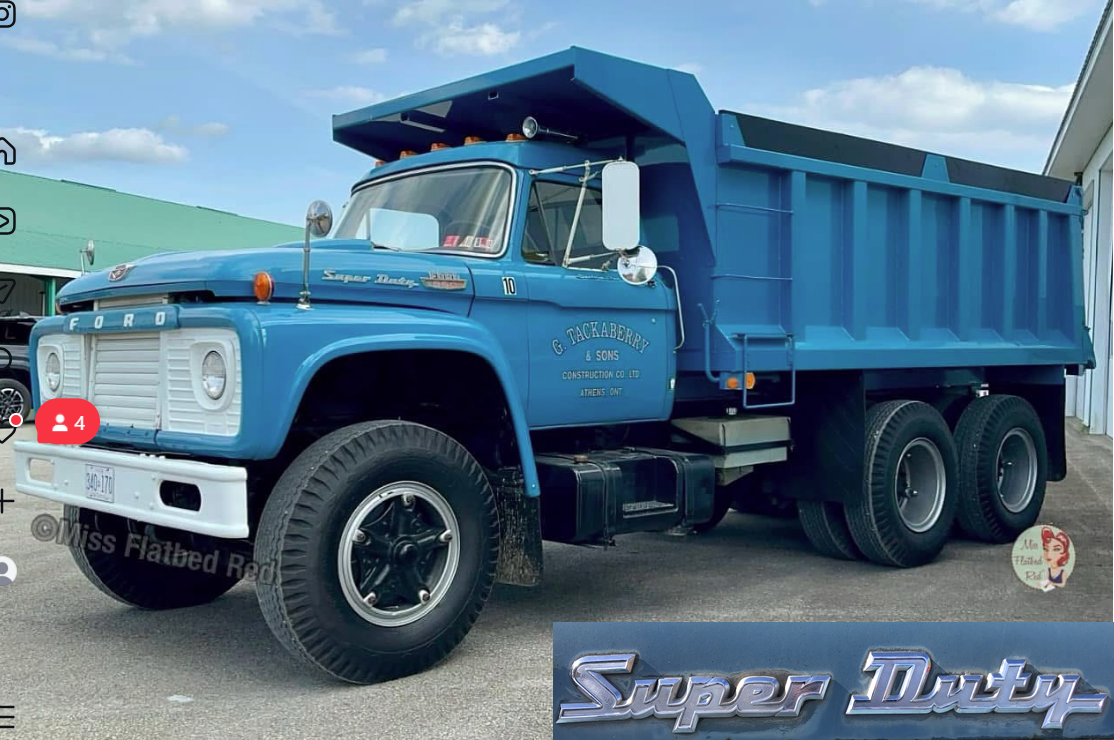
(2007, updated and expanded 2026) It was a successful launch, and I was going for the record books. The 534 cubic inch Ford Super Duty V8 bellowed and roared through the two short pipes exiting under my feet. The wide-open Holley four barrel noisily sucked the cool morning air. The air-scooped hood rose and dropped on one side with each banging shift, a visual testament to massive torque. As my speed approached record territory, I had my hands full keeping the snorting beast under control. I glanced down on the big round speedometer and confirmed my victory:
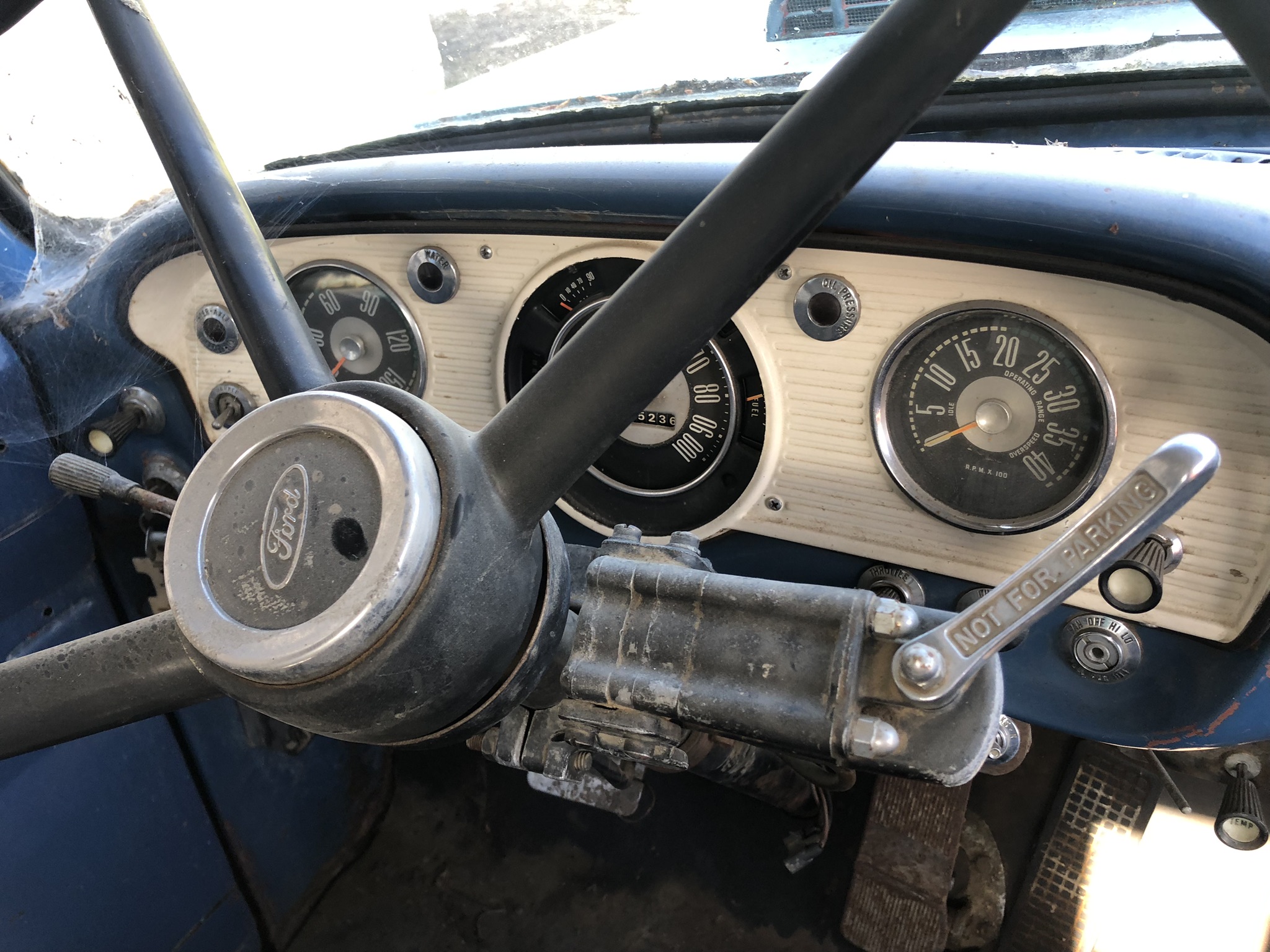
I was abusing a 1966 Ford T-900 (or was it a F-950?) Super Duty dump truck loaded with some 10 tons of gravel down a narrow country road. Normally, the Metro Pavers fleet would top out at maybe sixty-five. But Number 8 had an erratic engine governor, as well as an Allison six-speed automatic. Every so often, when you first floored it on take-off, the governor didn’t engage. And it stayed that way, until you backed off. Which one invariably did, when the speed and noise got too intense. How fast did it go that morning? The needle was bouncing so erratically behind the gravel-dusted speedometer pane, it was hard to tell. Eighty-five? Ninety? It felt like at least a hundred.
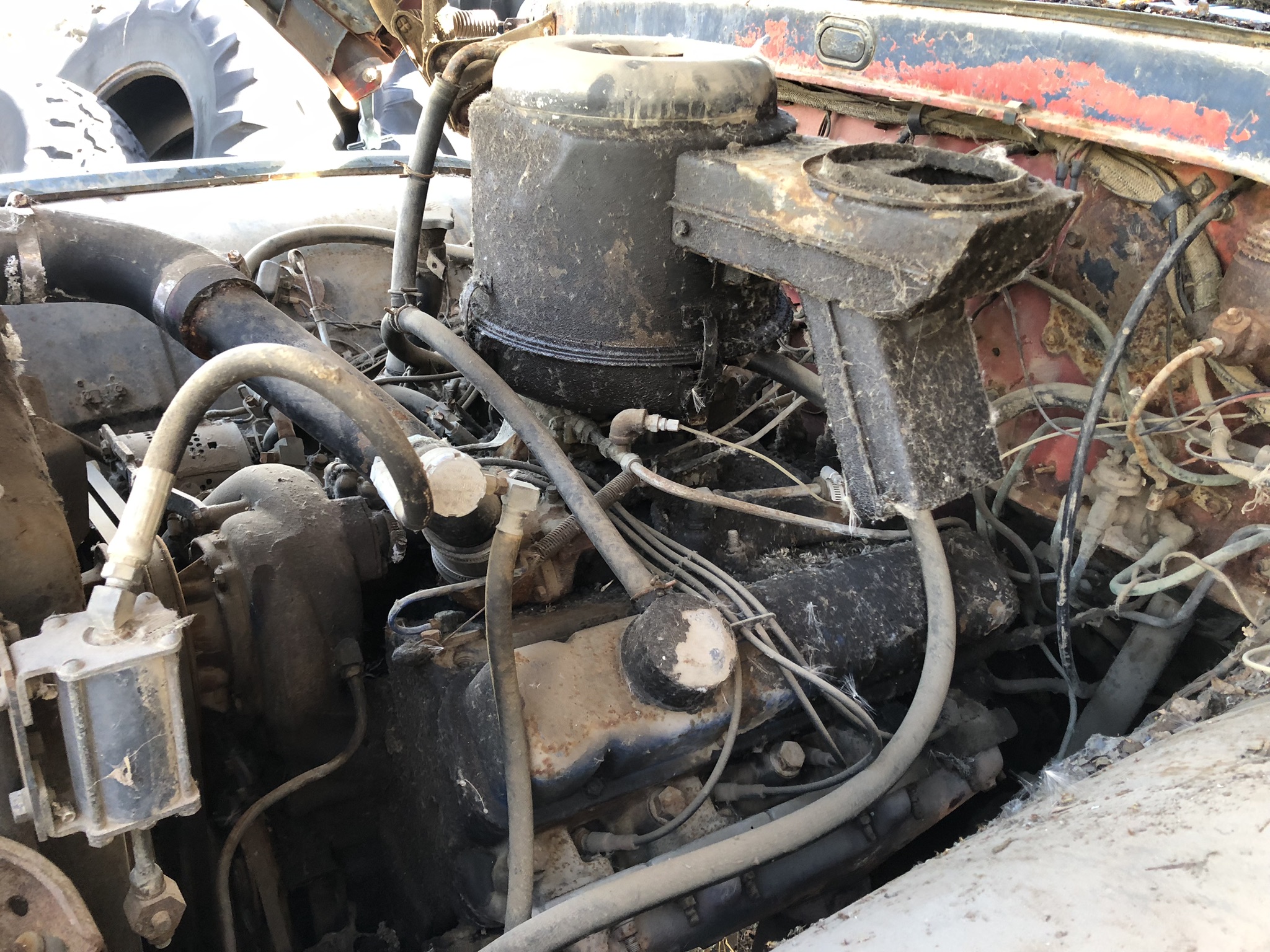
These unpredictable moments of Holley-anarchy were the equivalent of turning on a bottle of nitro or a turbo (or both) and an irresistible invitation to explore the true top end capabilities of the giant hot-rod Ford, as long as the engine held together. The odds of an untrammeled blast were about one in ten; kinda’ like playing the slots. The best odds happened when the go-pedal was stabbed as quickly as possible, seeming to catch the governor off-guard. The random inevitability of a noisy payoff kept me on my toes (literally), and helped break the rapid-growing ennui of hauling gravel all day.
And that screwy governor sometimes went to the other extreme: holding the effective throttle back to about one-half or so. Maybe it was keeping the secondaries from opening. The truck topped out at forty-five when it did that. Fun times.
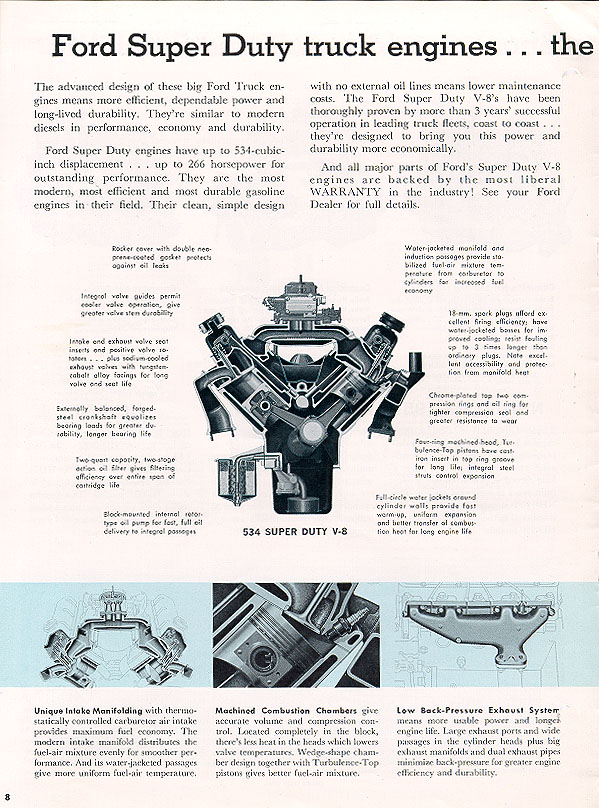
I’m not really sure whether this truck actually had the biggest 534 inch version of Ford’s Super Duty V8 line. If it did, it was rated at 277 hp @ 3400 rpm (governed). There was also a 477 incher rated at 260 hp, and the 401 with 226 hp. The Super Duty V8s were super huge blocks, as that big Holley four-barrel sitting on this one makes clear. And it was no genuine hot-rod, designed for heavy-duty truck and stationary engine use, back when diesels were not yet ubiquitous in large trucks. They used a flat-top head on a wedge-shaped cylinder, quite similar to the big block MEL (Mercury-Edsel-Lincoln) V8, and a bit like the Chevy 348 and 409 engines. One could say it was something of a super-sized MEL.
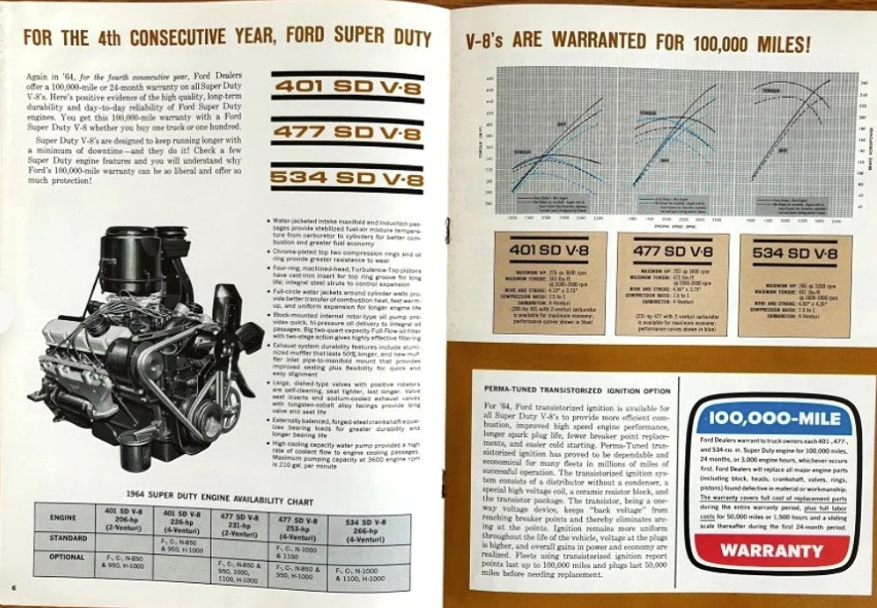
These Super Duty V8s arrived in 1958, designed at a time when big gasoline engines were still commonly used, all the way up to the largest over-the-road semi trucks and such. Ford warranted them for 100,000 miles, a testament to their rugged design and tough components.
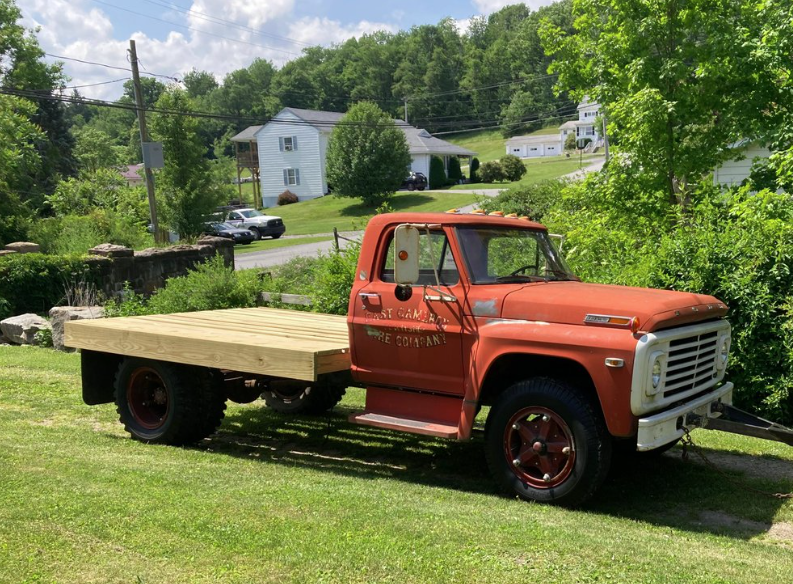
Ford trucks play a recurring theme in my life; from my first truck drive to my most recent (yesterday). My initiation to Ford-truckin’ arrived via the usual baptism by fire. I was a seventeen-year old car jockey at the local Ford dealer. I had noticed a big red F-700 cab-chassis when I came to work after school. A salesman walked in and asked if anyone knew how to drive a truck. Without hesitation, I said Yes! The cab looked just like an F-100. How hard could it be?
The salesman imparted his minimalist directions: “follow me”. I had no idea where we were going or what I was doing. Man, everything sure looked small from way up there. Was that warning alarm ringing away a novice driver detector, or something to do with air pressure?
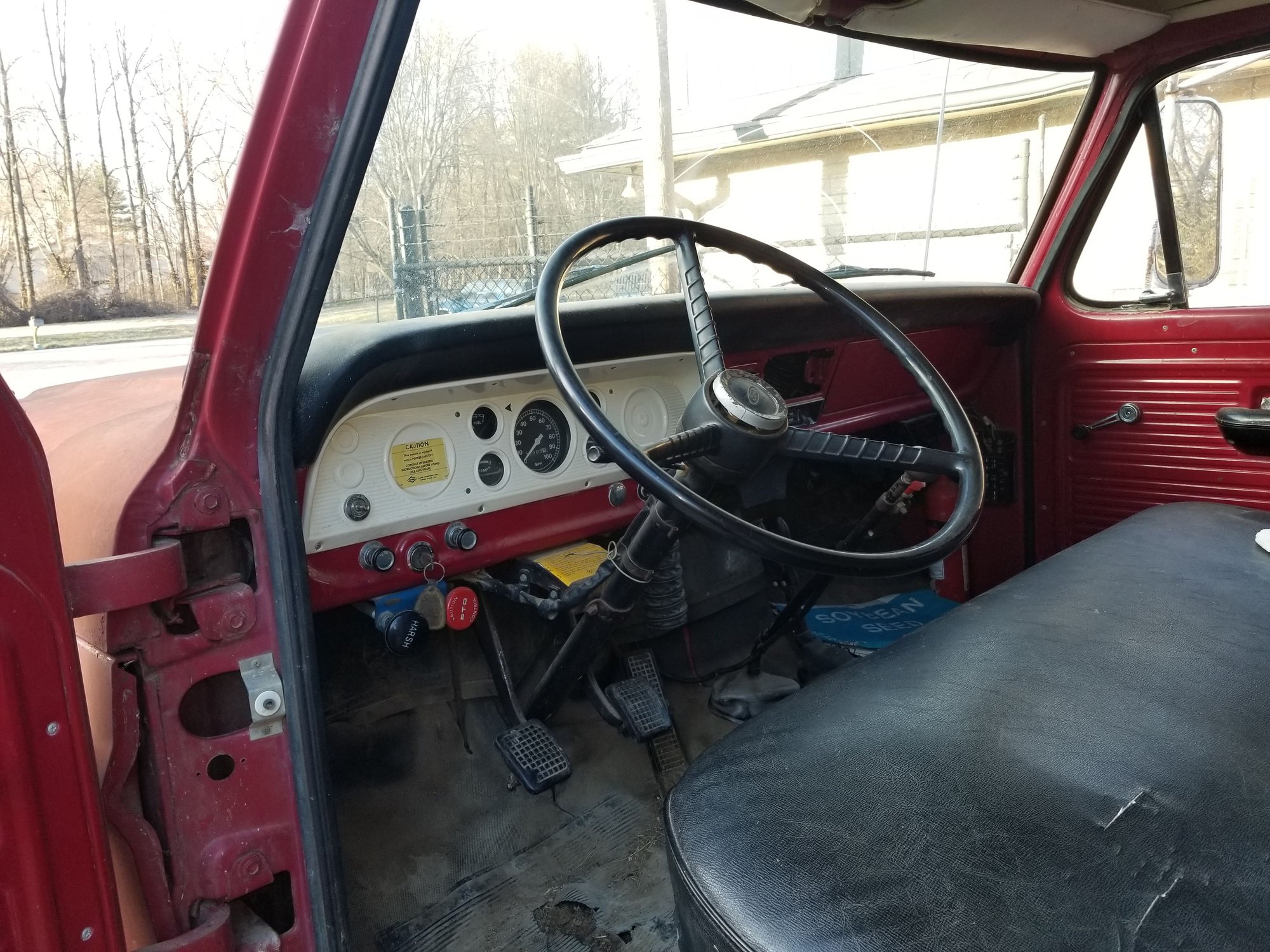
I found the first of ten gears (a five speed and two speed axle), and released the heavy clutch. A groan and shudder, and then… nothing. The engine stalled; painfully. I finally found the air parking-brake release and set off. The first order of business: keep the big rig in my lane while sorting out the 10 gears. Once I figured out how to stop locking the unloaded rear wheels with the grabby air brakes, people stopped staring at me.
The dealership was just a few blocks off the Beltway, and our route included that and the very curvy Jones Falls Expressway, which dumped us in the heart of downtown Baltimore, to where its future bed or body awaited it. I sweated bullets keeping up with him. I had no idea where we were supposed to be going; just stay on his ’71 LTD tail, but don’t compress it. It was another righteous, riotous rite of passage. And I’m still good at following someone without losing them.

A couple of years later in Iowa City, I grew tired of washing dishes (surprise, surprise) and answered an ad for a dump-truck driver. Inexplicably, I, a twenty one-year old long-haired kid, walked into the dusty office of Metro Pavers without a commercial license, and was hired on the spot, at $3.00 per hour ($22 in 2026 dollars), double the $1.45 I was making washing dishes. Serious Progress!
CDL? The Highway Patrol was called, and a female state trooper (which was a bit of a surprise) showed up at Metro Pavers to give me the driving test. There was just one problem: The Metro Paver trucks all had no passenger seat. The guy in the office found an old rickety wooden chair in the back of the dusty dispatch office, whose legs were rudely shortened with a dull handsaw. I was not going to let this opportunity pass me by. She gave me a look of utter disbelief. I gave her my best killer smile. Yes, she was a real trooper to perch on that wobbly chair while I drove her around the neighborhood. Mission accomplished.
It was mostly fun driving those gnarly old Ford Super Duty’s (back then that name was reserved for Ford’s biggest commercial trucks). But the day I lost my air brakes wasn’t a lot of laughs.

I had just loaded a full load of gravel at the quarry. In my youthful bound back in the cab, my long leg must have hit the air-brake toggle switch. The low air-pressure warning alarm was broken, as was almost everything else on these already elderly trucks used only during the summer paving season.
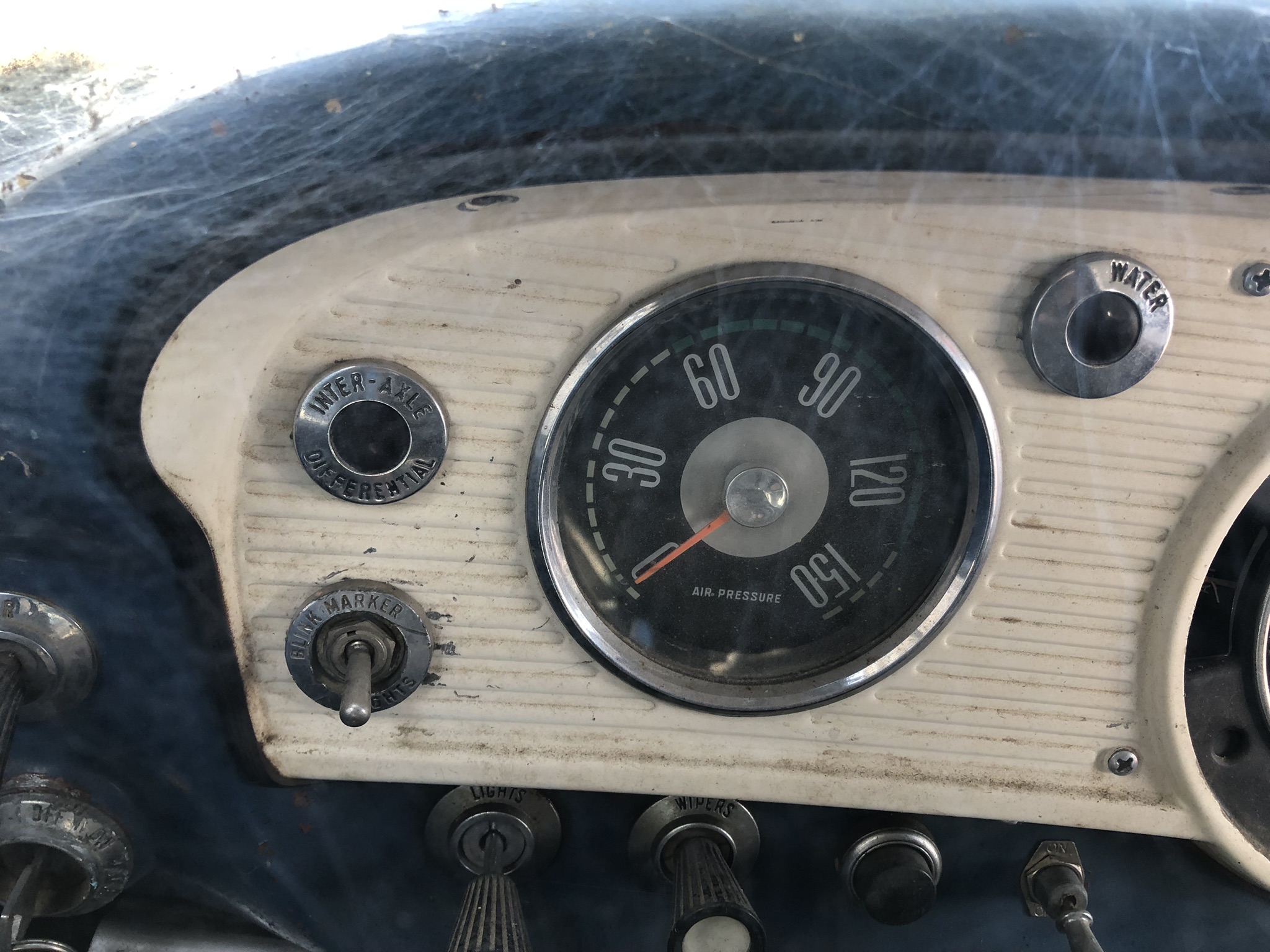
I never noticed that the air pressure gauge was dropping, thanks to a leak no doubt. What kid looks at gauges, except the speedometer?
By the time I approached the stop at the highway, the brakes were dead, and I realized my predicament. Trees blocked the view in both directions. I seriously considered bailing out. But I stayed with my truck and just rolled into the rural highway, hoping for the best. It’s a good thing traffic was lighter back then.
I still rent a dump truck (Ford, of course) every now and then. Today’s turbo-diesels have a wonderfully intense but short torque curve. And the transmissions now offer blazing quick clutch-less shifts.
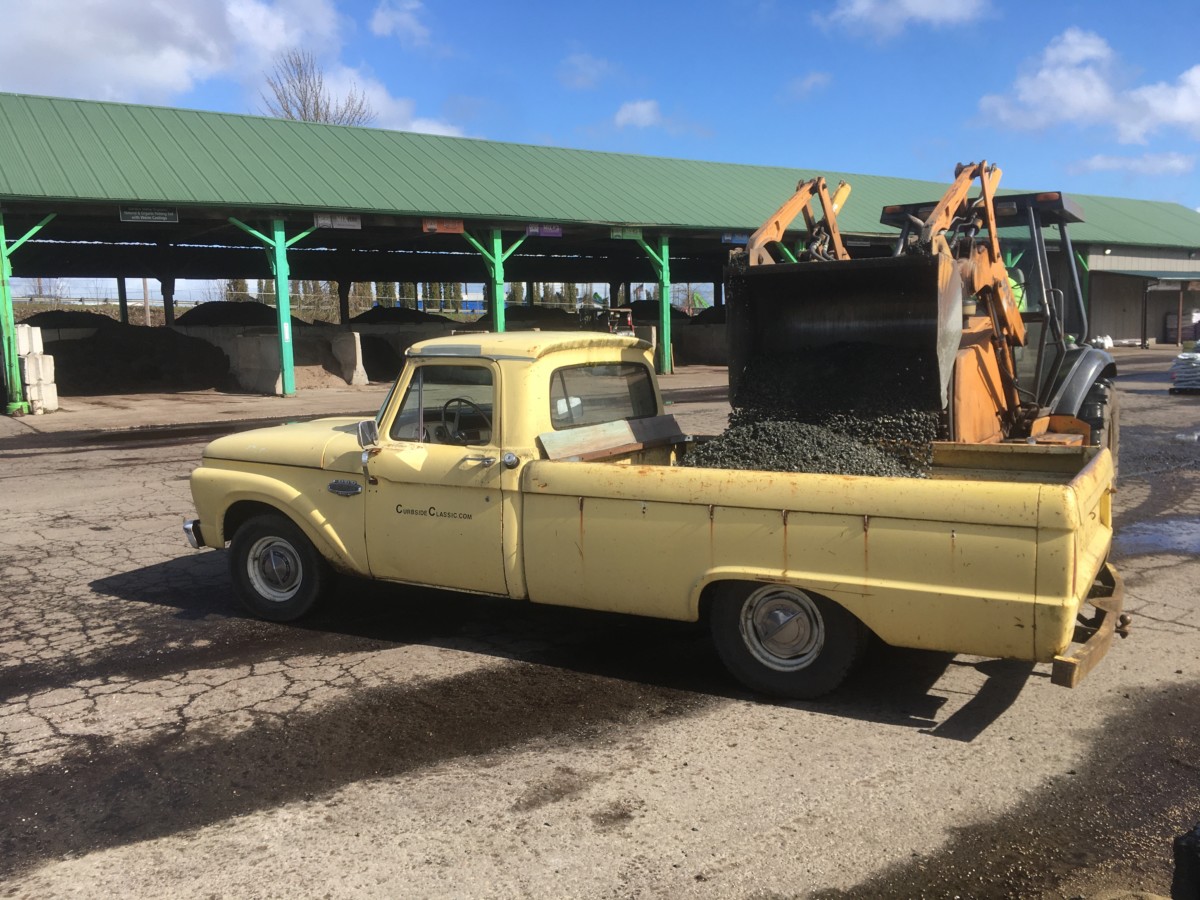
My ’66 Ford pickup with its manual steering, non-power brakes and three speed (plus two speed transmission) keeps my skills in shape. It has the exact same cab as those hoary old Super-Duties, just a whole lot closer to the earth. And I’m still hauling gravel in it. Explains a few things, eh? I’ve even hit ninety with it, but it wasn’t loaded with gravel. So the old record stands. Back then, Super Duty really meant something.
Related CC reading:
Vintage Truck of the Day: 1956 Ford F900 – First Year For Ford’s Legendary HD Truck Hood Scoops
Truck Stop Classic: 1984 Ford LTL-9000 – Fords Don’t Come Any Bigger Than This by Eric703























I like the twin hood scoops.
Twin hood scoops meant Detroit Diesel engine equipped. Single hood scoop meant Cat/Cummins diesel or gas engine. Scoops faced the windshield because it was discovered that a slight power increase was achieved from the higher air pressure area of the windshield compared to front facing as was done on the ’50s large trucks.
Metro is still around, down off S. Gilbert.
Semi-related note: I did some work at L.L. Pelling (asphalt contractor near North Liberty) and they had a couple of old Diamond Reo dumptrucks parked out back—they looked to be in show condition. Really handsome trucks.
Nice post!
I find it strange that Ford and GM got out of the heavy trucking business and left the field open for Daimler-Benz. Apart from PACCAR (Kenworth, Peterbilt), there is no American truck manufacturer. More strange is GM’s withdrawal from the medium truck and bus business, an industry it helped define with the iconic art-deco DD engined `GM bus’. All Ford and Chevy have now are ridiculous truck station wagons (thanks to CC commenter impalafleetta, I know what to call alleged SUVs), and pickup trucks.
Ford actually sold their heavy line to Daimler Trucks and they were re-branded Sterling around 1996-97. IIRC the Ford figured there was more money in having the Louisville Plant make F250-450s and Excursions. During the SUV boom of the late 90s they likely had better margin on a $45k F250 than a $90K Aeromax.
AFAIK Navistar (International) is also an American Company. While the corporate HQs are overseas Mack/Volvo & Daimler (Freightliner, Western Star) both have a large manufacturing footprint in the US.
Navistar was bought by Volkswagen, since spun off into some weird global conglomerate the name of which I can’t remember. Like how Chrysler now has some name that sounds like a plague bug.
The truck building business became more specialized, globalized, and increasingly competitive. There’s very little (if anything) in a medium to large truck that is common to an automobile. That wasn’t the case in decades past. Trucks used to share engines and other components (cabs, automatic transmissions, etc) with pickups and cars. That’s all history.
Without that synergy, the Big Three needed to decide whether it really made sense for them to stay in a very competitive and also very cyclical industry. Big truck sales swing hugely, depending on economic factors, much more so than cars.
I actually think they made the right choice, by focusing on their core auto business. The Big Three threw off dozens of non-core businesses over the decades; partly to raise capital and because of the reasons just stated. What’s locomotives, refrigerators, boats, radios, etc…got to do with cars? Industries are generally more focused now, due to globalization and to maximize capital investment and its return. I realize conglomerates like Tata are defying that general trend; it’ll be interesting to see if that continues to work for them twenty or thirty years from now.
[Ian: Forgot about Navistar. My bad. But Mack/Volvo and Freightliner being American is a lot like Toyota cars being American. You could say so, but I won’t agree. :-)]
There’s a very big synergy between all types of business: materials and money. Trucks share metallurgy (engine blocks, rust-proofing), technology (diesel engines and turbos appeared in trucks first), and capital with cars. Diesel-electric locomotives laid the groundwork for hybrid cars, radios were the initial electronic components in cars, refrigeration and air-conditioning are inseparable…. the list could go on and on. I think Lutz said something to the effect that GM was sitting on EMD’s diesel-electric know-how and yet lost the hybrid field to Toyota, as one of the great failings of GM, among many others.
Its not just Tata, albeit they’re the most visible. It is also Daimler (Mercedes-Benz cars & trucks), VW (MAN, Scania), Toyota (Hino), Hyundai (all the way up to ships), FIAT (Iveco). The only major auto manufacturers *not* in the truck business are GM and Ford (Fiatsler has Iveco now). There is no `general trend’ towards more focussed business. Its just GM and Ford, and they have very poor results to show for it. Tata, on the other hand, have gone from strength to strength for more than 140 years.
The only reason GM sold off other leading businesses (as far as I can see) was to mask capital loss in the underperforming car business. Sort of like burning timber from the ship to feed the furnace. No idea about Ford.
Diesel electric locomotive didn’t lay the groundwork for hybrids! Porsche built a gas-electric hybrid car in 1901; decades before the first gas-electric locomotive. Anyway, the parallel hybrid system as is commonly used (Toyota, Ford) has nothing in common with locomotives, not even in principle. Even the “serial-hybrid” Volt has a “transmission” that does allow the engine to direct some of it’s torque directly to the wheels, unlike a locomotive.
Diesel-electric locomotives are portable diesel power plants, feeding an electric locomotive. Lutz was blowing it out of his ass when he said what he did about GM having the technology for hybrids in their locomotive division; as usual.
Although it is obviously true that many truck manufacturers are owned/aligned with auto manufacturers, the reasons (in my opinion) are not because of any considerable technology transfer. Many of the best truck makers were independent until recent years (Mack, Paccar, MAN, Deutz, Saurer, etc.) The reasons they have mostly become consolidated and owned by corporations that also make cars are for other reasons.
Of course there are similarities between the car and truck business, and it certainly make much more sense for a large car maker to own a truck maker than a window shade maker. But I still stand by my assertion that the once high-communality of components between trucks and cars is gone, and that truck makers, (if large enough and have access to capital) can be independent; likewise car manufacturers.
Having said that, of course you’re right about the primary motivations for GM to get out of trucks: they were in decades-long decline, and capital needed to be raised through sales and applied to propping up their failing auto business.
Didn’t know about the 1901 Porsche! Thanks for the added knowledge.
However, an independent truck maker seeking merger because of lack of capital is different from an established heavily capitalised auto maker also building trucks. Of this category are Daimler-Benz, Hyundai, Iveco/FIAT. PACCAR has been independent and heavily capitalised for a long time now, while only MAN and Scania are the recent entrants into the VW Borg. I’ll neglect smaller makers, as well as Russians (KAMAZ) and Czechs (Tatra) for now. Of the three auto makers with trucks, Daimler, FIAT, and Hyundai have had trucks since almost the beginning, and have suffered no damage for it. The cyclical business hogwash was probably spread by GM PR to disguise its downward spiral. It was, and is, very, very wrong to dispose of business units in such a fashion when a company is cash-rich. If GM’s car business was faltering, it should have fixed *that*, rather than sell off units to mask capital problems. Hyundai’s ship-building has no bearing on its car production, and neither should GM have sought synergies in locomotives and cars or refrigerators. This `core business’ concept is a sham. It does not work at the huge scale of companies like Toyota today or yesteryears’ GM.
[Does GMC make any cabover trucks anymore? Just asking because of this video: http://www.youtube.com/watch?v=9g3hZZO25vQ where at 0:24 you can clearly see a modern-ish cabover with GMC branding. Could be an Isuzu underneath…]
Where do I find parts for my 69 F950 dump truck for restoring?
I fell for 1958 T-850 dump truck in the winter of 1959. I was a grease monkey after school at the Ford Dealers lubrication center ( before the Jiffy lube days) I got to remove the snow plows and take them into the shop thaw them out and service them for work. Fell in love with the immense torque of the 534.
Well its a long story about the class 7 & 8 super Heavies. GM couldn’t cut it, they really never could, but their massive size and profits allowed them to muddy the heavy truck segment. By the time they started to offer really heavy duty durable product it was just too late, GM was toast. Now they are Backed by Super China Dollars thanks to Richard Nixon so they maybe back.
This Left Ford and International pretty much to the heavies to themselves oH YES DON’T FORGET THE SMALL PLAYERS, Peterbuilt, Mack, Freightliner, Kenworth, Diamond T, Reo, Western Star, & White. In steps SEC and FTC hey Ford and International, especially International, you can’t have a monopoly. Huh yes the days before Reagan Republicans made Monopolies okay. SO AFTER much court room drama, Ford left the heavies and what was left of International became Navastar. Volvo, Freightliner Mercedes mergers, Peterbuilt got new owner. And Hedge funds from all over merged what was left. Yep Nixon, Reagan, and Junior’s administrations let these foriegn folks lay off good americans so the companies could be PROFITABLE meaning CEO’s and Fund Managers could get incredibly rich.
It was Reagan’s Justice Department anti-trust action that broke up GM. AT&T too.
I have experience with the bigger Ford trucks, from fixing fire trucks. I recall that the 534 had an odd sound, like something wasn’t “right”, but they ran fine. There wasn’t much trouble with them, back before the alcohol in the gas.
In the 60s, Ford & GMC had big gas engines, trying to compete with diesel trucks.
Part of fixing fire trucks includes hooking them up to a water source and testing the pumps. The Fords tended to vapor-lock less than the GMCs.
The pump testing place had steel plates to put under down-facing exhaust pipes, to prevent them from melting holes in the asphalt.
We often had to jam a screwdriver into the carb linkage to get the secondaries to open, in order to get them to meet the requirements of the test.
I knew people who made their living with their own Ford dump trucks; cheaper to buy than a diesel & held up well.
I haven’t seen one on the road for years.
It got to the point that “thermal reactors” & converters cause the exhaust to get so hot (sitting still & pumping) that they would cause fires with leaves & other debris under the truck; not quite staying on the mission of putting out fires.
It also became pretty impossible to make a gas-powered ambulance (squad); the short-nose squads (with the front of a dog-house van) would boil the brake fluid in the master cylinder & heat up the rivets holding the insulation onto the doghouse enough to melt uniforms of medics who rested legs or arms on the doghouse.
Ok, so I’ve always wondered. Would the doors off a ’66 F150 swap with the doors off a ’66 F900?
Undoubtedly. That’s one of the main benefits the big manufacturers had, using the same basic cab in many configurations. The small truck companies had to buy, beg or borrow cabs, since tooling up a complete cab was very expensive back in the day (probably still is).
There were many smaller truck companies that essentially assembled trucks almost exclusively out of parts from various suppliers. Even recently, that was not uncommonly the case.
Bedfords were like that the JO and TJ shared the same cab just bigger wheel arches on the TJ and bigger powertrain.
Need help to find a web site to buy parts for my 69 superduty dump truck F850,900
what ever it is no emblem on side of hood.
I have 1968 Ford Super Duty with 534 engine, used parts available if that would help you.
Hello! I purchased an old 1968 f850 super duty 534 converted to lp. I have not been able to really find any information on this truck and or where I might find parts for it! I was hoping to be able to restore it as best I can, however I am losing heart. It starts right up and seems to drive out nicely– tie rod ends will be a necessity for sure, at some point. I had no idea one would need to have a CDL license and all the extra expensive safety and insurance necessities,,, as I had simply hoped to use it only on rural roads and property. No wonder I got a seeming great price. Sir– If you or anyone could steer me or advise me where I may begin to find knowledge and or manuals etc. parts— I would be reinvigorated to do what I can to save this old beast! Again– THANK YOU FOR YOUR TIME AS WELL AS YOUR CONSIDERATION!! Les
There may be a way around the CDL requirement depending where you live. There are some farm use exemptions and the truck is an antique so there may be some collector exemptions as well. I think some Ford C series trucks came with the 534 so some engine parts can come from there.
Dad bought 62 f1000 with 534 to pull lowboy also had 62 f100 both were same cab later years raised cab roof to allow for air ride seat. Loaded truck got 1 mpg
id like to know more about those super duty engines. Like would one make a good choice for a resto modded pick up?
A bit too big & heavy, methinks. (ie ~1000lb)
Talking about hi power mods for these trucks is kind of like a top fueler Bug; the vehicles were never designed for such use. They are commercial vehicles. People who run commercial vehicles (like me) are interested in only one thing: cost per ton/mile.
These big V-8s were great motors. We had many over the years, both Chevy and Ford. The Fords were the best trucks you can imagine. In ALL my life, I have NEVER heard of ANYONE doing ANYTHING to ANY of these engines. This means very little down time and if there is a problem, fixing it is easy. It’s gas and spark.
We have gone to diesel due to fuel prices but if gas were ever 60 cents a litre again, I would have a big block gas 5 ton in a heart beat. They have absolutely no headaches.
I doubt we can even buy a truck over 3500GVM with a petrol engine any more except possibly Chevrolet but of course those arent serious trucks as they cant carry anything all the Japanese cabover puddle jumpers are all diesel and@$2.16.9cents per litre who the hell wants a gas powered truck?
I worked at a company that had an Isuzu cabover from the late 1990s with a GM V8 in their fleet.
Here is a newer version.
All Isuzus here are diesel
Until recently, GM had their 8.1 litre V-8 in their five ton series, single axle. I think it’s gone now as GM is no longer in the truck business.
Gas power has some great advantages, Bryce, mostly complexity and ease of driving. These old trucks were dead simple and very easy to drive as you had a good 3000 rpm to play with. Made training drivers much easier.
There are a few Isuzus getting around these days with a V8 on lpg as it is cheaper than rebuilding the diesel – having said that the excise to be introduced on lpg soon might change the equation.
I recently drove a 10yo Hino moving truck (10k lb GVM) with a 2.0L TD, even with the tall pantech body it would sit on 65mph and keep up with traffic no problem.
Fast forward to September 2026. Gas at $4.40/gal, diesel at $7.04/gal. Not much business case for a diesel now, especially with all the extra costs that go with it.
To the best of my recollection, there isn’t much in the way of speed parts available though you can get a lot more out of the engine if you’re willing to throw money at it. Just as it is with most things engine related, it all about time, money and energy devoted to attaining what you’re after. Since I cannot remember if the 534 is an FE or MEL type design, I cannot suggest much specifically. However, almost without fail the first priority is to open up the breathing which translates into swapping out the intake and carb. Look into another cam and ditch the cast iron exhaust manifolds for headers. Reworking the valve train will help as well – I’m referring to more efficient roller rockers, etc. I could go on and on but I’ll stop now. Actually, now that I’m thinking about it, the SD engines were their own design at least with the block, cranks, rods & pistons, etc. The heads are slanted at an angle in relation to the block too. You MIGHT be able to utilize an old school aftermarket intake made for these engines or adapt one… But I have no info there. It is possible that some of the parts Ford had for other engine designs will bolt on with no or little/few modifications – research is your friend here. I do know that a dual turbo charged version of the 534 was supposedly installed in boats that purportedly put out 400HP with a whopping 650+ foot pounds of torque. Most impressive for the 50s & 60s. The problem of course is getting those parts and restoring them back into service. I should mention one other thing. This engine is one of the heaviest Ford built. Supposedly was 900+ pounds WITHOUT the extra parts for the twin turbo setup. That’s not good for speed. Due to the size and weight of the engine, one would also have to take into account the mods needed to stuff it into a normal sized car or truck. Don’t forget about the trans… what are you going to bolt onto it for a gearbox? Yes, the big three are really kicking in here, aren’t they?!?
The bottom line here is that if you’re looking at an FE compatible block or at least partially so then you’re going to be a lot better off. TONS of parts are out there. MEL based? Not nearly as much… not even close. While I haven’t looked, I doubt you’ll find any new speed parts for MEL design engines which means getting vintage parts… getting whatever WAS made back in the day. That design wasn’t ever built for speed though – those engines were low RPM, higher torque units installed in larger, heavier cars from the factory and they were built for cruising while doing so in comfort. That doesn’t mean that you cannot improve them – it’ll just take more of the big three to get it done. Time, money, energy. As for the SD, you very well may be looking at nothing but vintage parts or creating your own. For a seriously heavy, low revving engine… I would urge caution big time if you are to think about going down the road of attempting to improve on it. Take all things into consideration! Do your homework via research – the WWW and a search engine is your best friend as is your phone. You may be able to find out all you need to know in a few hours of reading and via a small number of phone conversations.
Best wishes! – Brian in TX
The SD engine family is not related to either the FE or MEL family. It’s significantly bigger and has unique characteristics. No parts designed for the FE or MEL will fit.
Also, they have quite small valves and ports, as well as tortured manifolds. And there’s no aftermarket hi-po parts available. One could clean up the ports, custom build headers, and a have a cam ground, but this was never designed to be anything but a slow-revving truck and stationary engine.
Having said all of that, I’m sure someone’s done it. google is your friend.
A guy I picked for in Shepp Victoria had a TJ Bedford 300 cube6 with headers mild cam and 4 barrell Holley with 14 bins of pears aboard he could cruise at 60mph the thing drank gas but it went hard
Speaking of cams – some of the old school manufacturers of cams retain the data for all the cams they make which they can look up in their files. I’ve actually inquired about a specific grind based on the number listed in a magazine article from the 1970s or 80s… and to my surprise they had that cam already on a shelf! It never hurts to ask.
As for what they can do for any given engine, they also often can simply pull up the data they have for the engine based on what they did in the past. What I mean is that someone may have already gone down the path you’re looking to go down and they can make recommendations based on prior experience. Again, it doesn’t hurt to ask. Moral of the story? I think everyone gets the moral of the story.
– Brian in Texas
Something like this-
http://www.heavyequipmentforums.com/attachment.php?attachmentid=46110&stc=1&d=1249871296
Or this-
http://www.amcarguide.com/custom/blastolene-b-702/
?
I too got my first trials in a big ford, in my case it was a ’86 (I think?) Econoline 350 cutaway with a big cube on back and a 460 in front. The A/C didn’t work, it was really loud, and the vinyl seats scorched unclothed skin in the summer.. but wow that 460 really had some legs and howled like a banshee due to the – what I assume was a C6 – 3 speed auto. Even with the back loaded to the brim full of metal shelving for a new warehouse, it had no problem holding 90mph on rural two lane highways uphill.
Shortly after that company got a brand-new 1994 GMC 3500 cube van, powered by a non-Vortec TBI 350. It quickly garnered the nickname “the gutless wonder” to those of us who drove the 460’s. It’s first trip was with me at the helm, with the back loaded full of saline solution. Foot planted to the floor on the same highways, the poor new 350 barely could hold 40 uphill, and all I could think of was the 460’s.
They got a couple Vortec-powered GM’s to finally retire the Econolines in ’96, and while the Vortec 350’s were a bit up on power compared to the awful TBI 350, all of us still missed the legs of the 460 Fords. At least the Vortecs could hold 60+ on hills, and bounce off the 90mph speed limiter at will on straights.
Now many years later I do IT consulting for the same company, and they now lease new Econoline cutaways again. Having an excuse once to drive one I’ll admit I was impressed with the new 5.4 and low gearing, but it still lacked the big power of those old 460’s.
I haven’t seen one of these in years. Those big SD Fords had a very distinctive sound (and smell. They all ran very rich), and made pretty good power for the day. As noted above they were damn near indestructable, and the exhaust manifolds did indeed turn a dull red after an extended time of full throttle use.
I believe a company called “Seamaster” sold a turbocharged marine version that made around 400 bhp for use in large yachts and such. They were also popular as irrigation pump engines up until gas prices made them impractical.
Historical artifacts now, but it was a good engine in it’s day.
PS-I used to work on equipment for the guy who owned the dump truck in the black and white shot. Rollo Ceccon out of Princeton BC. I knew that door decal looked familiar….
Air pressure releases the brakes it doesnt apply them without air pressure the brakes lock solid just sayin
Not quite true. Positive air pressure does activate the service brakes. The emergency/parking brake function is a separate mechanical/spring-loaded mechanism that should not release without sufficient pressure (about 45 psi) or automatically engage if pressure drops below that level. But that’s not the mechanism that engages the service brake.
This incident did happen as I described; no artistic license was applied. I had noticed before that the low-pressure warning alarm wasn’t working. Undoubtedly, the emergency brake function wasn’t working either, or at least not properly.
Now I didn’t say I had zero braking: the gravel road leading from the quarry to the highway was a gradual downhill. I had some braking action on that decline (which probably is what lowered the pressure in the tank), but when I tried to increase the braking for the stop, the brakes did not respond as they should have with additional braking force.
It’s possible that there was some pressure left, enough to keep the emergency brake from engaging. Or the emergency brake was non-functional, (or its threshold too low) which wouldn’t surprise me, given the ragged shape these trucks were in. The low air pressure alarm was definitely dead. That alone should have been enough to keep the truck off the road, or be subject to a hefty fine.
It all happened in a few seconds, but after I swung in the road, I did notice that the air pressure was very low on the gauge. And that the switch to deactivate the compressor was in the off position, which I must have hit as I jumped in the truck. Why there even was such a switch is somewhat beyond me. Maybe for servicing the air system, or? But as soon as I flipped the switch, air pressure built up, and the brakes worked fine after that.
That’s how it happened. I would have rather it didn’t, because it scared the shit out of me. I very seriously considered bailing; the truck was only doing about 15 mph at the time. I just swung into the road, spilling some gravel in the process. Not a fun moment. If someone can explain what happened better, I’m all ears.
11 years later….
Until 1973, spring brakes were not standard equipment. Meaning that unless the system was completely void of air; the vehicle could & would roll.
I have a 1972 trailer that doesn’t have spring brakes. It’s only used for yard storage and only moves every couple of years or so. I always hook it up, because the newer drivers don’t understand that trying to back under the trailer will push it if the rear tires are not chocked (or hook up the service airline and apply the trailer brake).
Ive had the brake pedal suddenly go dead and just drop to the floor luckily on the highway with no stops anticipated I just eased down on the pedal to drop some revs for a downshift to slow into a corner suddenly no resistance I found somewhere to pull over and stop and discovered a stray clevis pin on the floor no split pin in it the pin had simply worked its way out fortunately not when I was relying on brake performance.That truck a former fuel tanker Mitsubishi Fuso 380 hp V8 had excellent exhaust hrakes for general use the foot brakes really only used in town or for parking.
Something not available on gas engined trucks are engine brakes another reason they arent suitable to modern times
Hi Bryce
Back in the late 70’s I was owner driver carting topsoil in a Commer TS3.
Going down the old Ngauranger Gorge fully loaded the air compressor failed.
No Brakes!!! Lucky for me a green light at the bottom.
Actually, the Ford MEL engine family used a similar combustion chamber design with a deck surface 10º off perpendicular.
I have a 1964 Ford Firetruck that has 21,750 miles on it and came equipped with a 534 heavy duty engine,a 1000 gallon tank with 750 g.p.m pump. Interior is perfect I am thinking of selling it any idea of how much it is worth?
With all the engine and drivetrain options for a big truck, I’d like to know how buyers made an intelligent choice as to what they needed. Folks here have said “give me a 2.0l diesel and lots of gears” and othes have said that 460 and 534 gas engines cant be beat.
There must be a scientific way of figuring this stuff out.
I was wondering if you could give me a lead on parts for the front end.
Just wondering if anyone knows where I could buy a set of front fenders for a 1964 Ford or Mercury F600.
Could anyone tell me where I could find a front grills for 1961-69 Ford Superduty? New or good old ones. Thanks
Ford still makes the f650 and f750 , really International trucks with Ford cabs in Mexico >But Ford is moving the production of these trucks to Ohio. These 2016 models are all new and all Ford, The gas engine is the Ford v10 , and the diesel is Fords own 6.7 in several horsepower ratings.
The old(Super Duty) f850 , f950 and f1000 were rated up to 30,000 GVW , F1100 36,000, considered extra heavy duty trucks.
The present F750 is rated at 31,000 . optional 37,000
But these are called Medium Duty trucks , guess the world has changed
The first picture I see is of a T-850D going by the “Diesel” script placed next to the series badge. Models such as this, which were first sold in 1963, would have a Cummins V6-200 “VIM” engine or, starting in 1967, a Detroit Diesel 6-71.
thats funny a ford with a gm engine…a 6-71
Why not? Many GM high torque cars came with Ford 3 speed toploaders if you ordered it with base transmission. The Muncie wouldn’t hold up to a 389, 421, 394, etc. It was cheaper to just buy a good design vs building your own for such a small take rate.
Looks like these all use the same hoods as the equivalent generation light-duty trucks, in addition to the cabs.
Just bought a 1961 F600 engine 292 Dump truck..Seems I’m in need of a Brake BOOSTER,,It’s mounted under the frame.Every time I find one it says it’s unavailable..Was wondering being a welder of some 40 years if I find one close could I adapt it to work. There are 2 mounting holes on the stem of the original.There seems to be no pressure on the unit itself…ANYONE out their have any ideas,,,yes I’ve tried many bone yards with no luck…..IT is a OKLAHOMA truck so it is well worth the effort…Has low mileage and NO RUST….. SINCERELY, ((DAN THE WELDER)))
Dan-
Just in case it might be useful even after 2+ years, you might want to contact these guys:
http://boosterdeweyexchange.com
I’ve yet to hear of anyone that wasn’t satisfied with their rebuild work, including me. While I haven’t had them rebuild anything for me in a number of years, I wouldn’t hesitate to give them a call. After all, it doesn’t hurt to make a call to find out if they can hook you up. I would have digital pics ready to send in advance… might save some time. HTHs! -Brian in Texas
The first semi tractor our family business acquired was a 1964 Ford C900 cabover. Like most of our fleet, it was worn out before we got it. It had the fiberglass sleeper and was powered by the 401 cubic inch “Super Duty” V8 engine. It had a 5 speed transmission and a 2 speed single rear axle. It was rather thirsty, the best MPG you could expect was about 4 and that would drop to about 2 with a heavy load in hilly terrain. It was not very powerfull either. It would bog down to about 20 MPH going up the mountains on the Pennsylvania Turnpike with a loaded trailer.
The Ford C Series cabover had a very complicated shifting linkage that went out the floor of the cab and eventually got to the transmission. Lots of moving parts that wore out. Shifting it was much like a stick in a bucket of tar. By the time you found the next gear you had lost most of your forward momentum.
We had a number of adventures during the 4 or so years it was with us, including losing a flatbed trailer loaded with structural steel because of a worn out fifth wheel that didn’t latch properly. The sleeper cab also provided temporary sleeping quarters for an employee after his wife threw him out.
The C900 met it’s demise by backfiring through the carburator while being serviced with the cab tilted forward. That set the top of the engine on fire, which spread to the cab, which spread to the garage. By the time the fire department got it put out the truck was burned to a crisp. The fiberglass sleeper was completely melted and the tops of the tires were burned off. The garage had substantial damage but could be repaired.
So, then we got a real semi – an International Fleetstar with a 6-71 Detroit Diesel and a 10 speed RoadRanger. More about it another day.
We also had a tandem axle F800 that looked much like the lead photo in this article. It had been a cylinder delivery truck for a welding supply business. But no “Super Duty” engine here. It had a 391 V8, a 5 speed main, and a 3 speed auxiliary. It was bought for the agricultural operations of our family business and fitted with an 18 ft grain body. What a mistake that was. It could barely move with a load of wet shelled corn. It lasted one season and was sent on it’s way. The bed was re-fitted onto a tandem axle GMC 9500 with a Detroit 6-71. Now that truck would haul some grain! But, again, a story for another day.
The Super Duty V-8’s stayed in production until ’80 or so and one reason was Ford’s FT391 was not competitive with other truck V-8’s of the time, notably the G.M. 427’s. The Super Duty was designed for heavy duty trucks, but in the mid-70’s Ford introduced a ‘475’ version for medium duty trucks. The Ford ‘Lima’ 429 truck V-8 made the Super Duty completely obsolete.
For reasons unclear the City of Los Angeles decided to buy a bunch of Econoline passenger vans with the 460 , dual AC and (IIRC) C6 slush boxes .
Once I was driving my old boss some where and he said ‘this thing has a 460 that really gits ~ give it a try’ he was scared when I drifted it up a sharp freeway on ramp and merged doing over 85 MPH .
I remember these Super Duty Fords, as mentioned very good stout trucks that easily hauled three yards of gravel with a gas engine .
When Ford dumped their Medium Duty line of C – series trucks we had a large fleet of them Sterling wasted no time violating their parts agreement so many were sent to salvage for want of basic parts .
Loosing brakes whilst underway with a load is terrifying, it might be a light load or small car on the trailer but you’re *instantly* aware of how heavy the rig is and how quickly the next corner or stop light is approaching .
-Nate
My only experience in Ford mediums was driving 2 C8000’s as fire trucks for the dept I was on. Too bad they were Cat 3208’s. Lol