
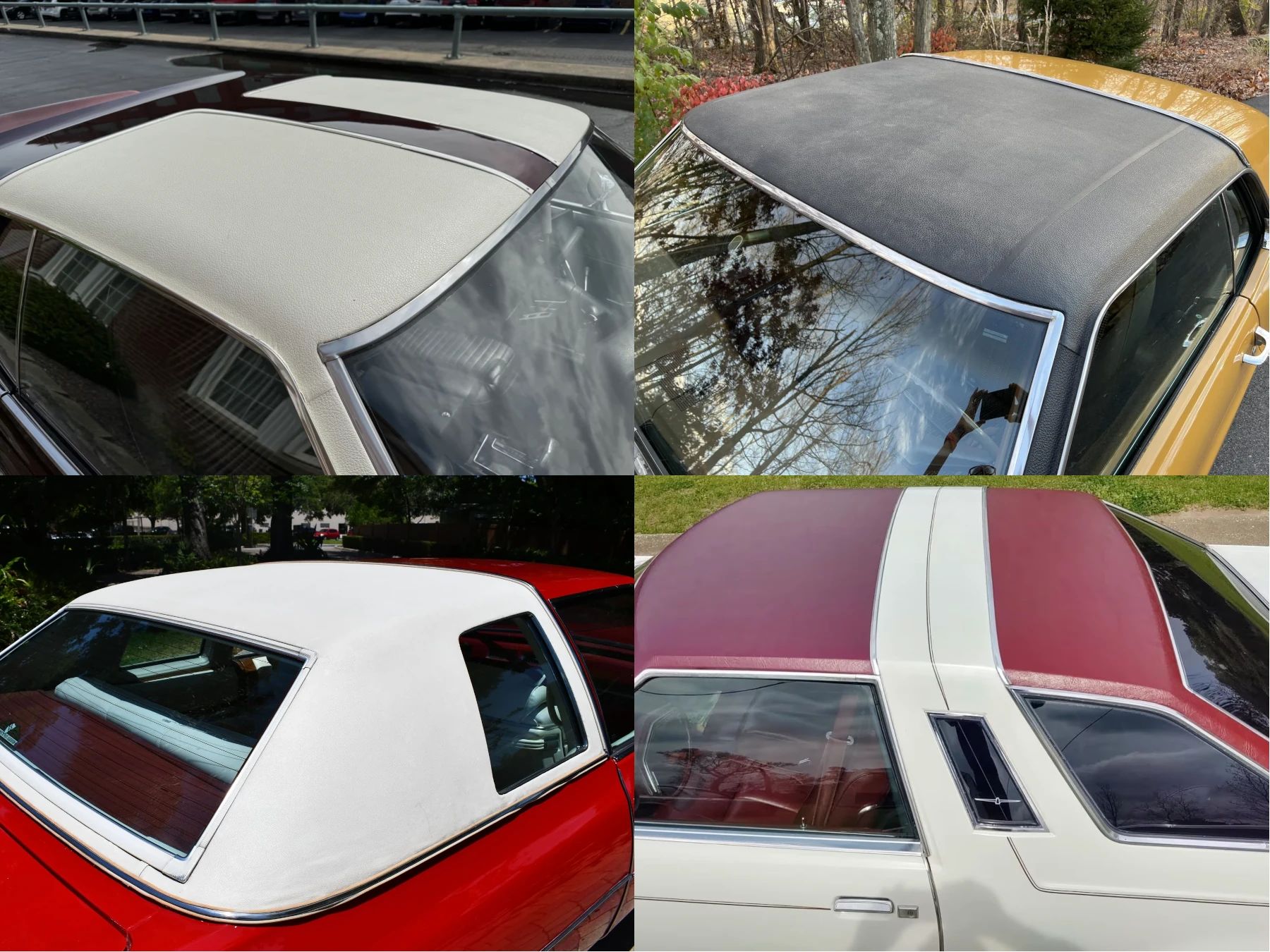
Between 1970 and 1979, almost 38.1 million American cars — over 40 percent of all domestic production — were built with padded vinyl tops. As vinyl roofs became more and more common, manufacturers began to offer them in a multitude of distinct styles, including landau, halo, canopy, and carriage roofs. Here are some of the most common vinyl roof styles of the ’70s.

Full Vinyl Roof
The most common style in the ’60s and early ’70s was the full vinyl roof, with the padded vinyl area extending over almost the entire roof surface area, up to the chrome window reveals.
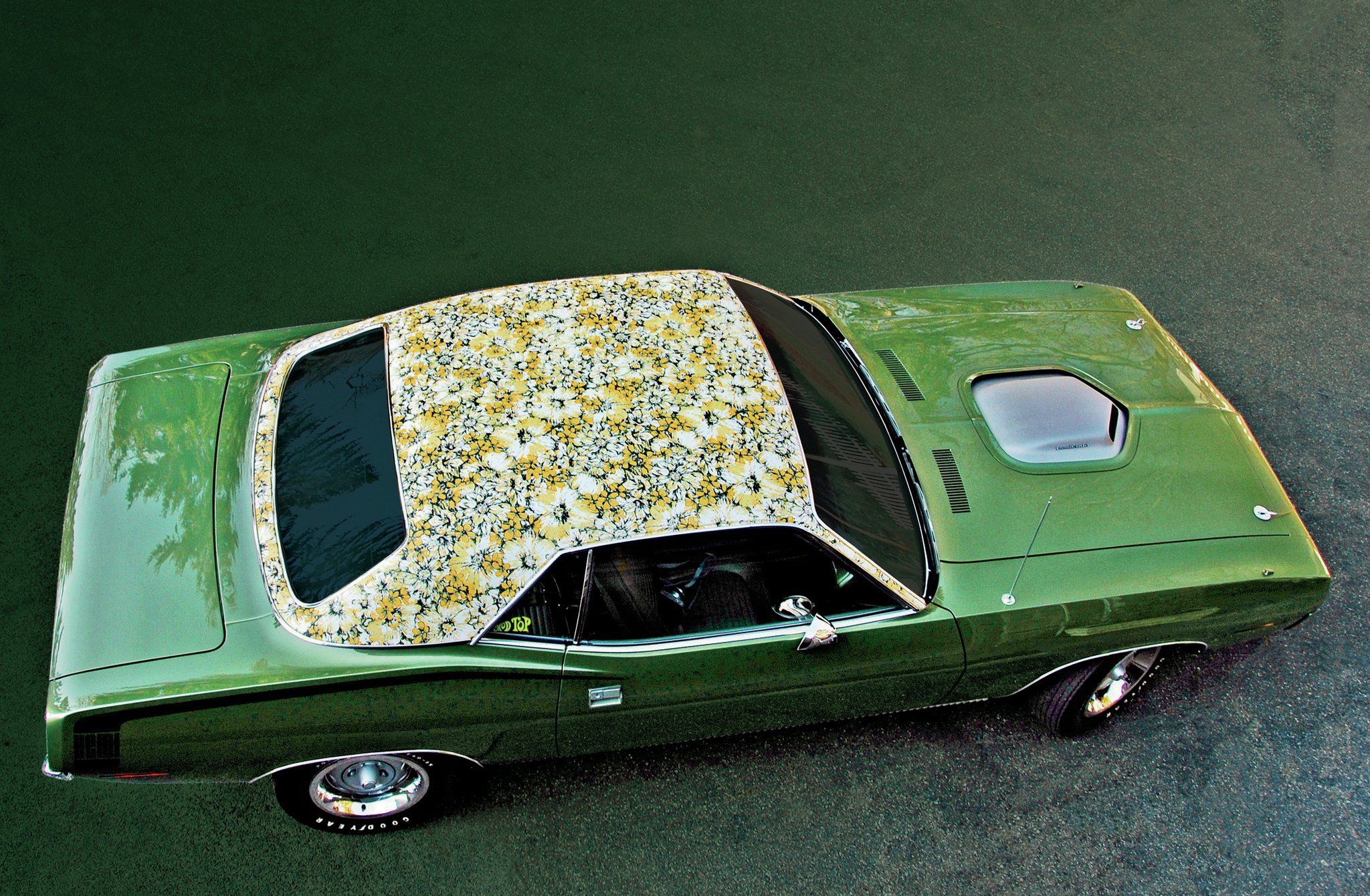
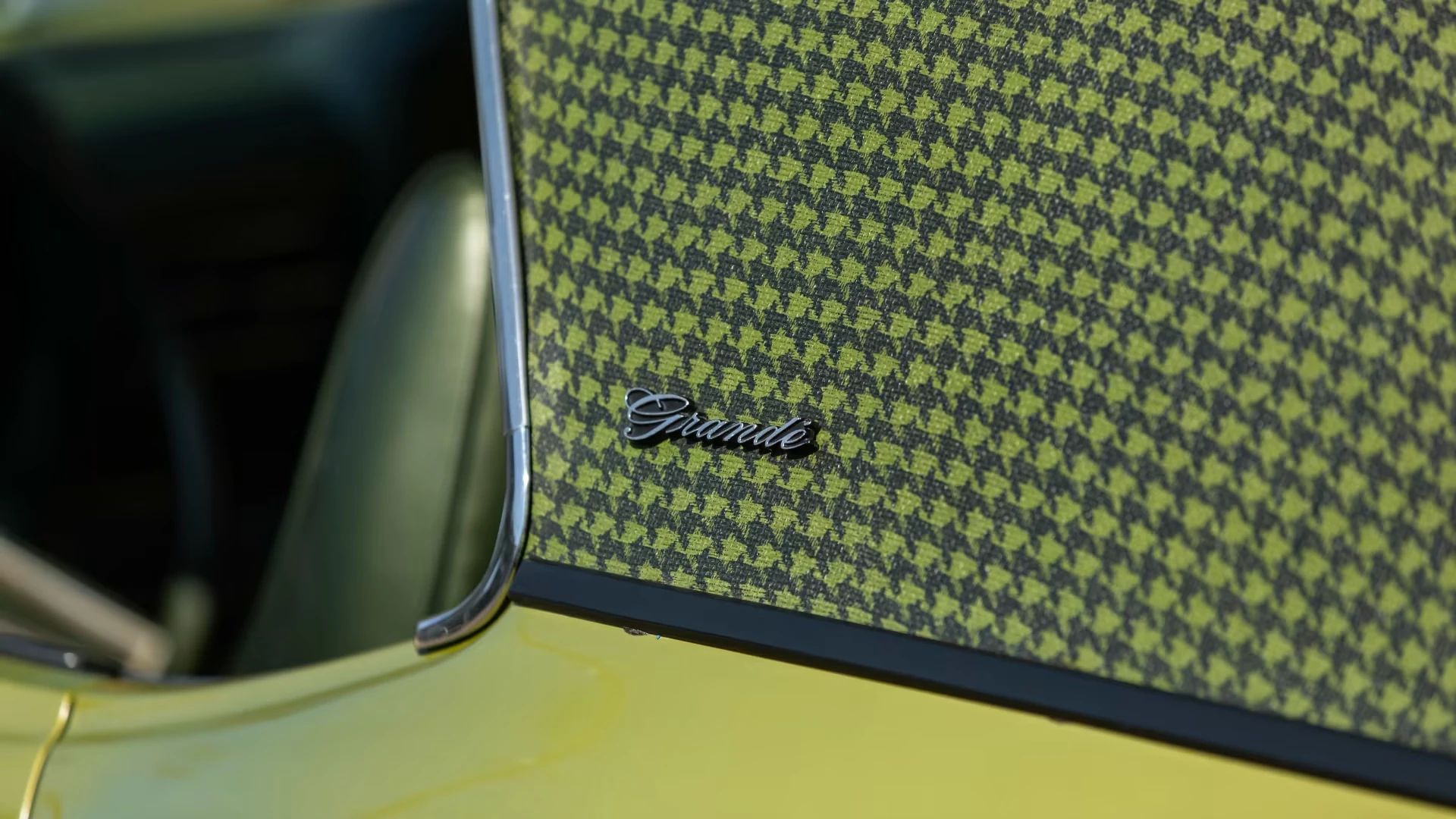
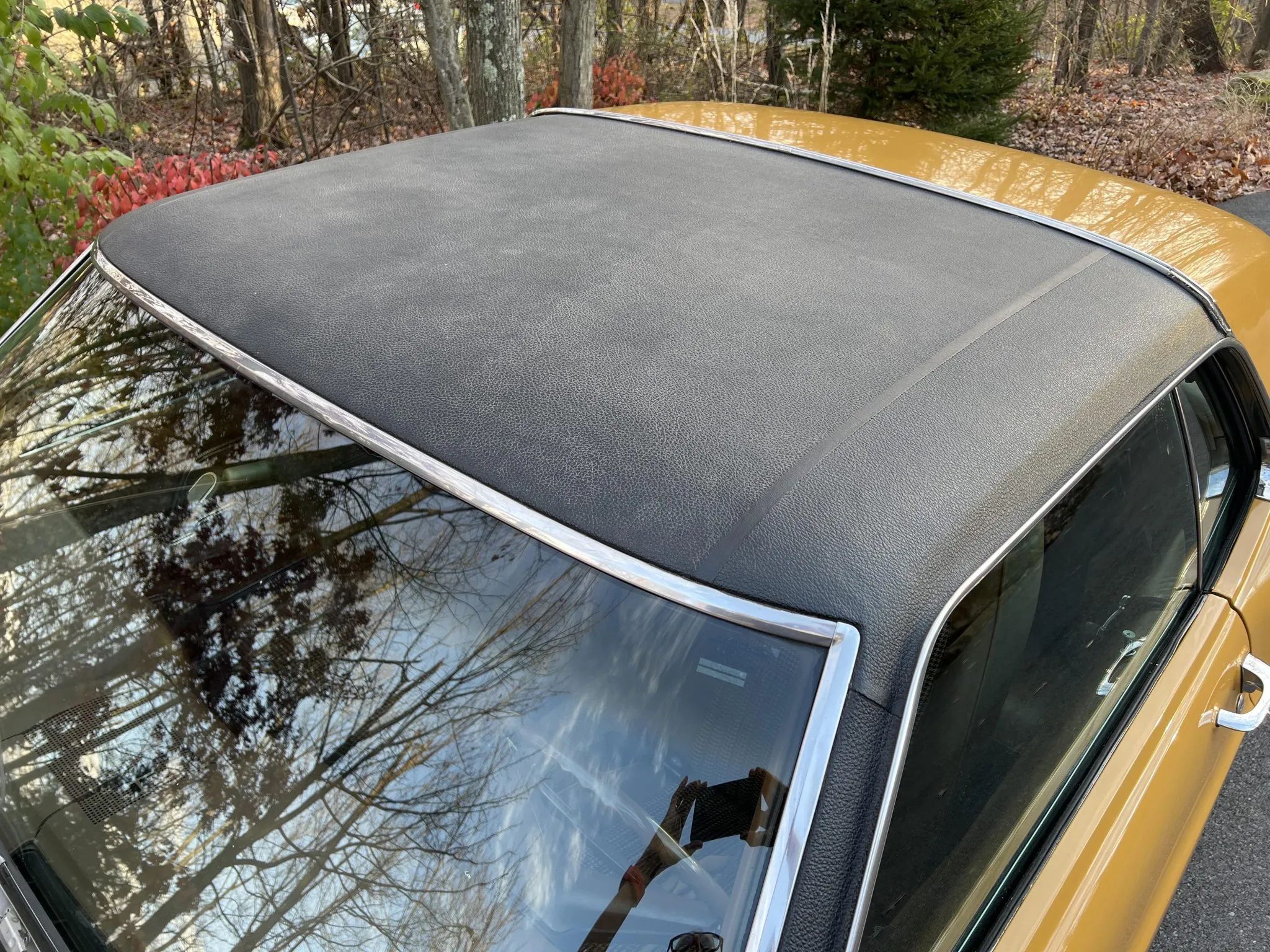
The vinyl tops of the 1970 Hemi ‘Cuda and Ford Mustang Grandé pictured here have unusual patterns — floral “Mod Top” for the ‘Cuda, houndstooth check for the Grandé — but the style of the vinyl roof coverings themselves was otherwise typical of this period.
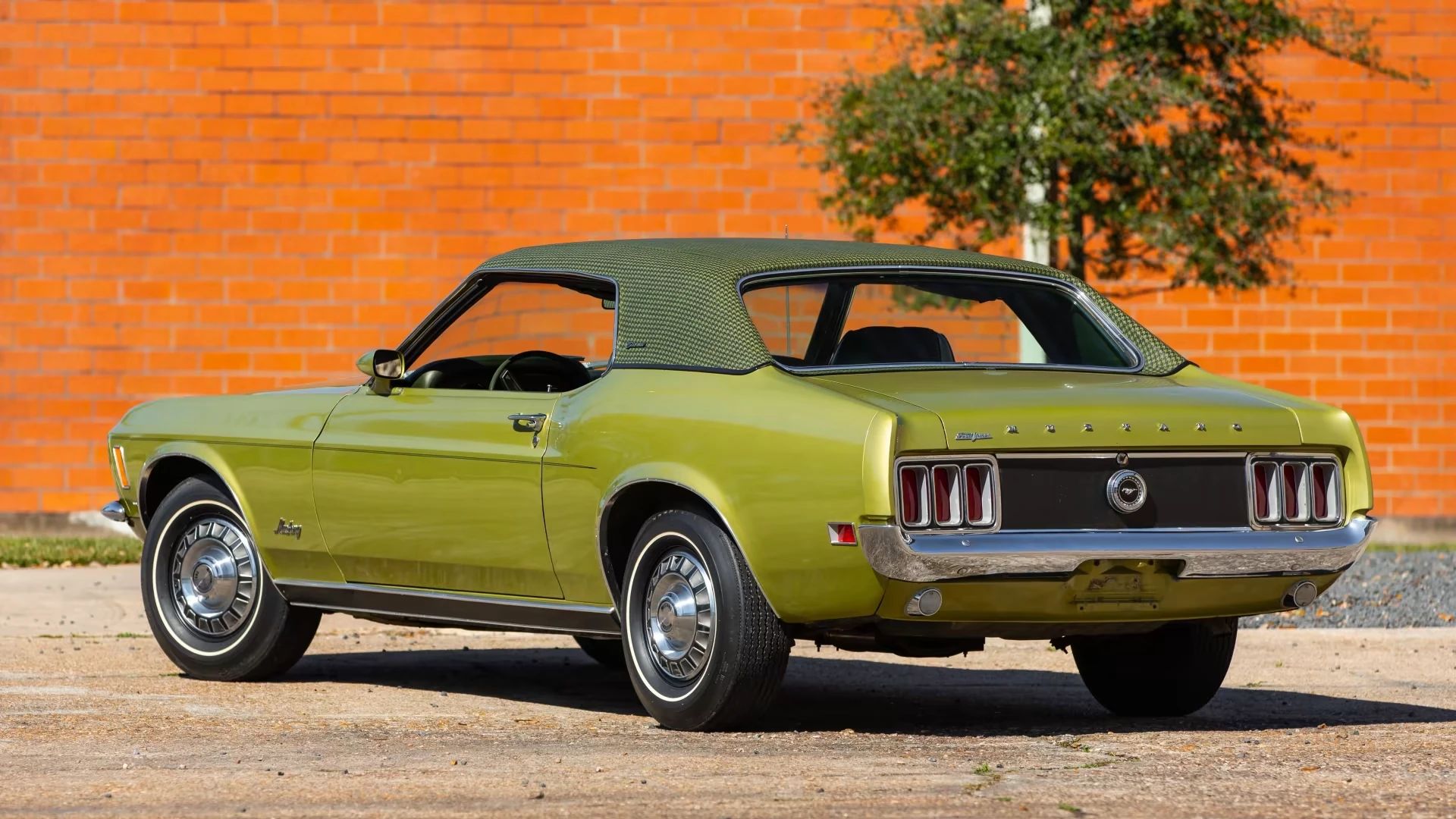
Note that the vinyl covering extended through the A-pillars:
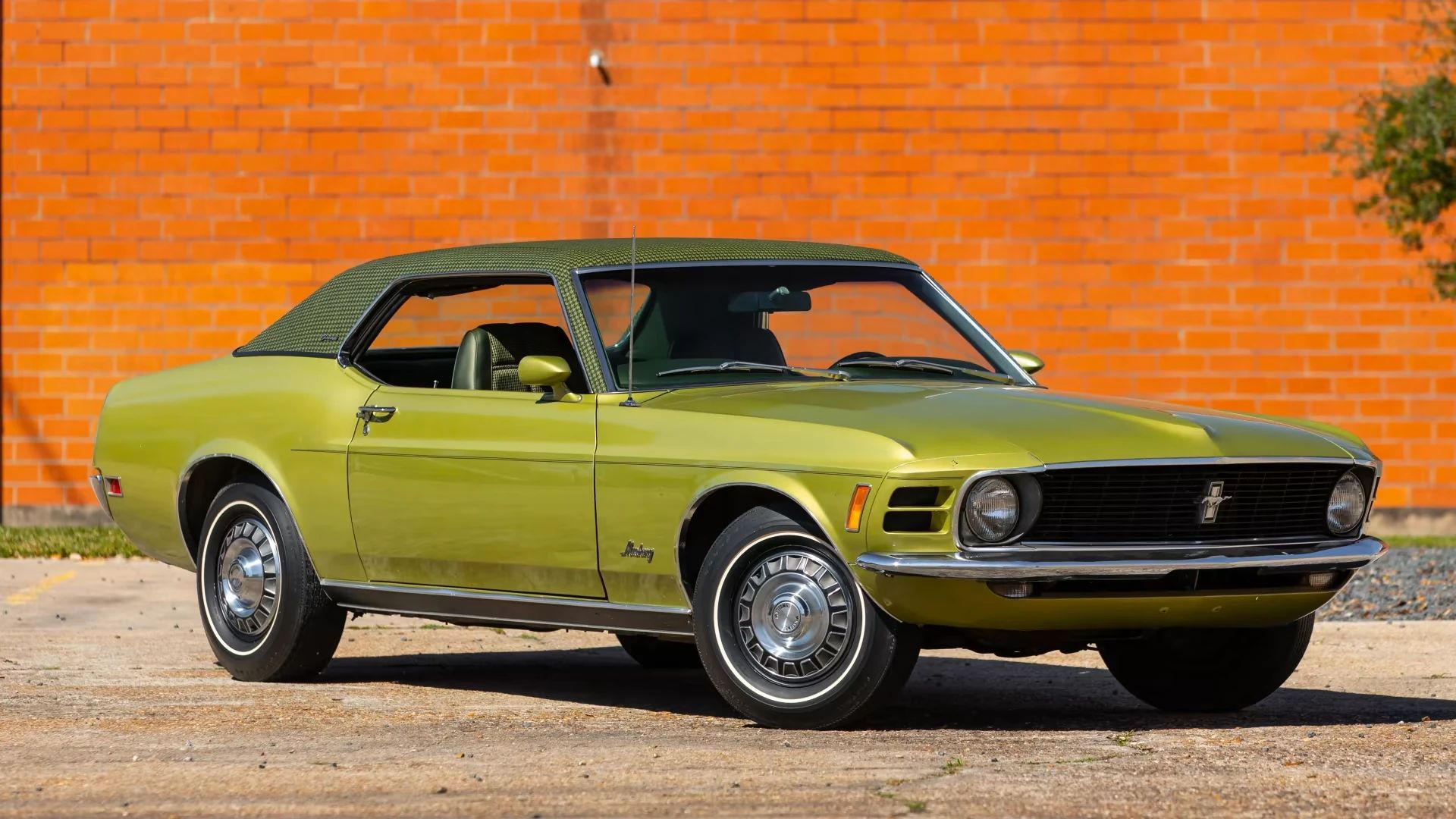
This houndstooth pattern also showed up briefly on the Mercury Cougar, but patterned vinyl tops like this didn’t survive long into the ’70s — most buyers apparently preferred solid colors.
Halo Vinyl Roof
Not all vinyl tops extended all the way to the side window garnishes or the windshield reveal — some left an exposed “halo” of body color around the edges of the vinyl covering. This style was generically known as a halo roof, although some manufacturers still called these “full” vinyl roofs to distinguish them from half-tops.
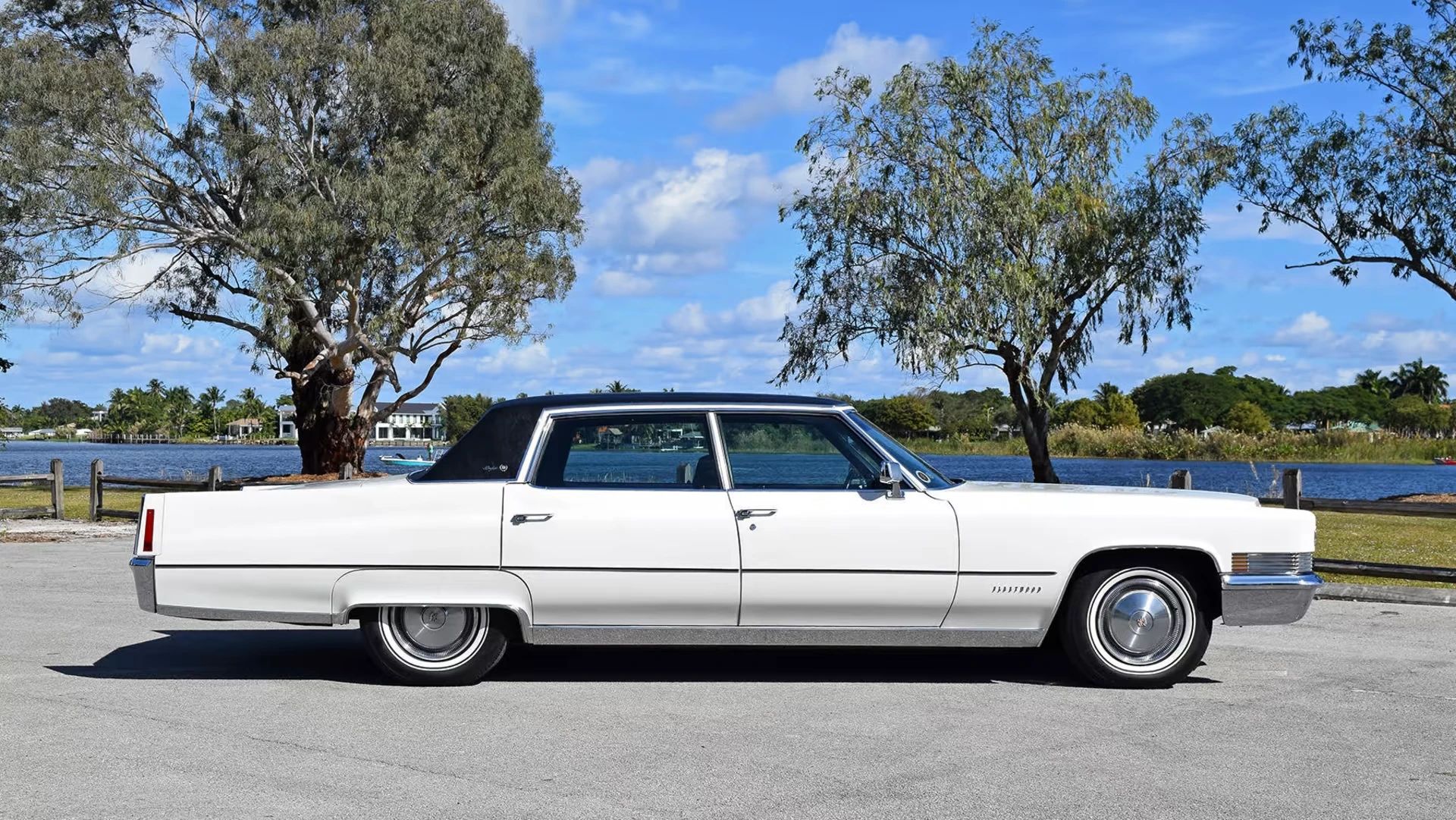
Depending on the model, the halo roof might or might not extend all the way forward to the windshield molding:
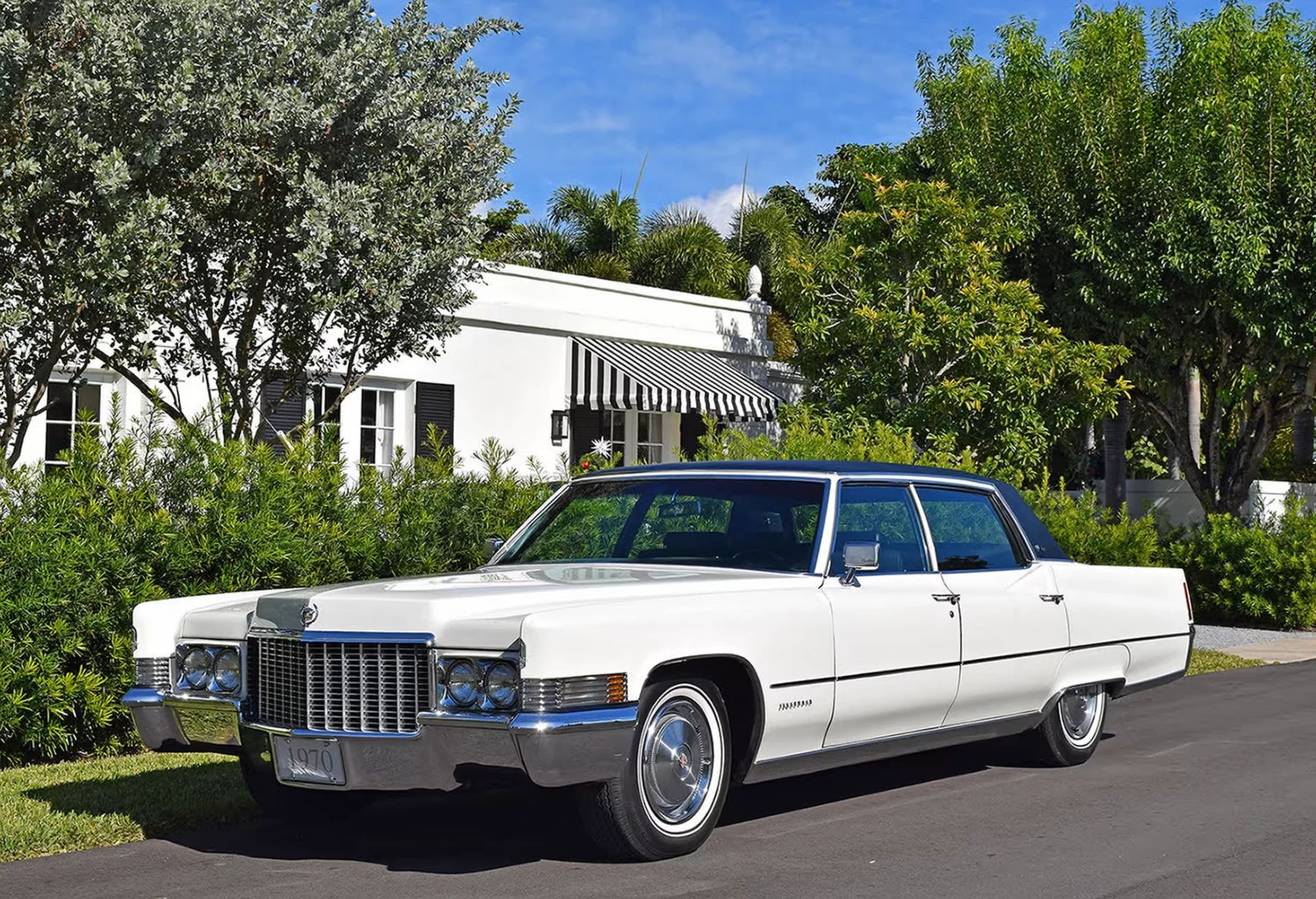
On pillared body styles, a halo roof typically also left the B-pillars exposed.
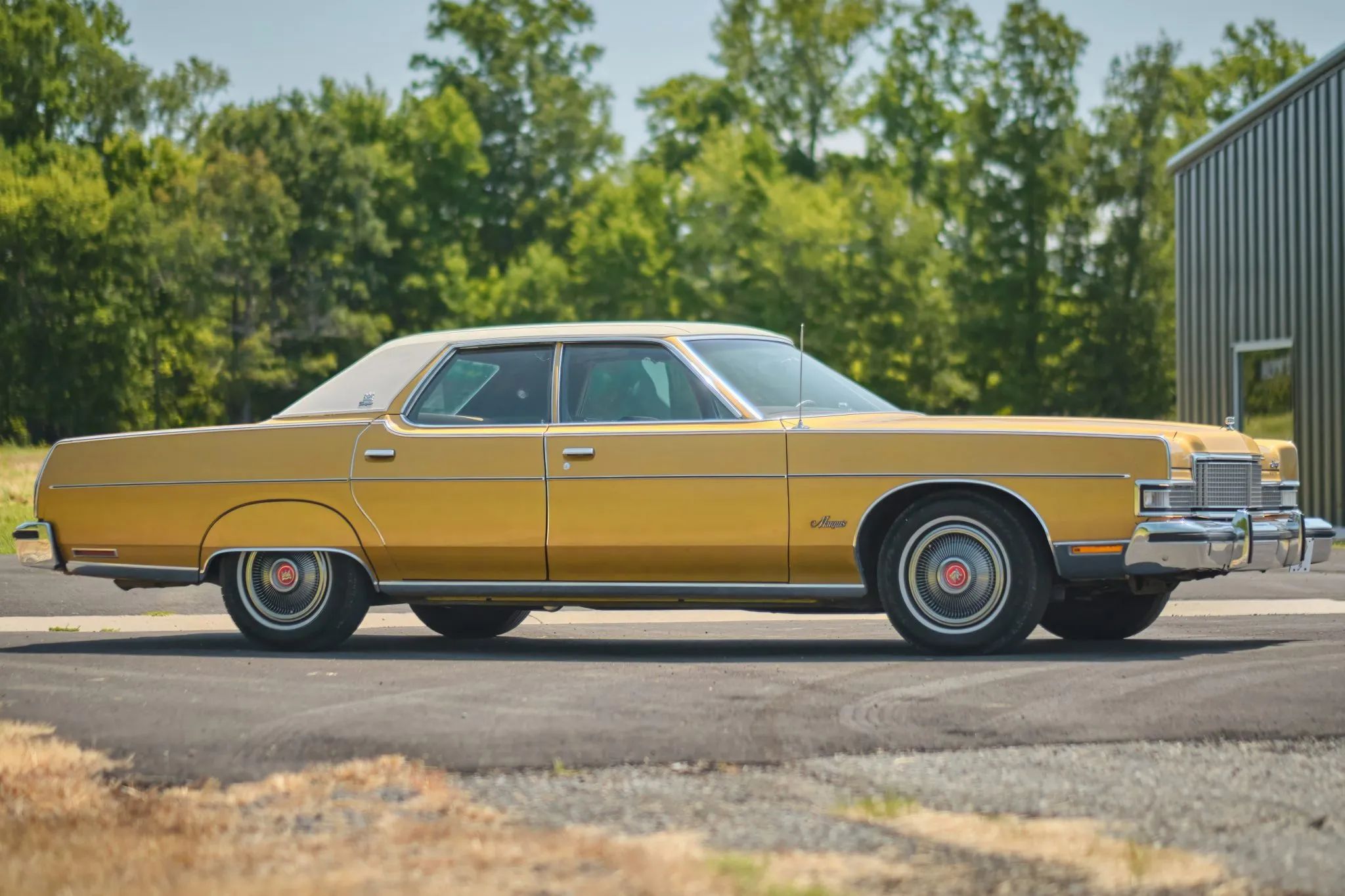
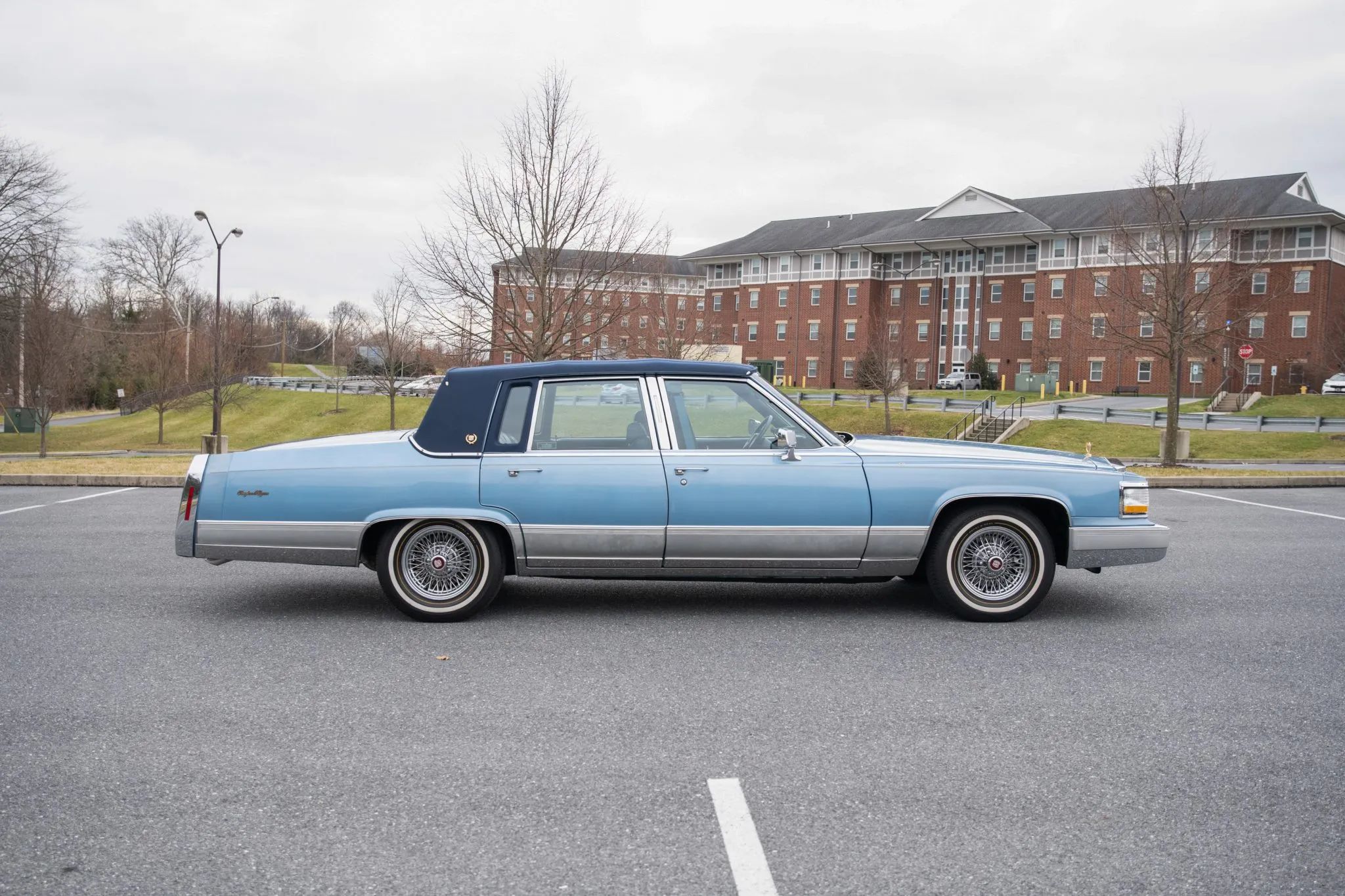
The width of the “halo” area varied quite a bit. On a big Ford or Mercury, there was a much smaller exposed area than on the Cadillac pictured above:
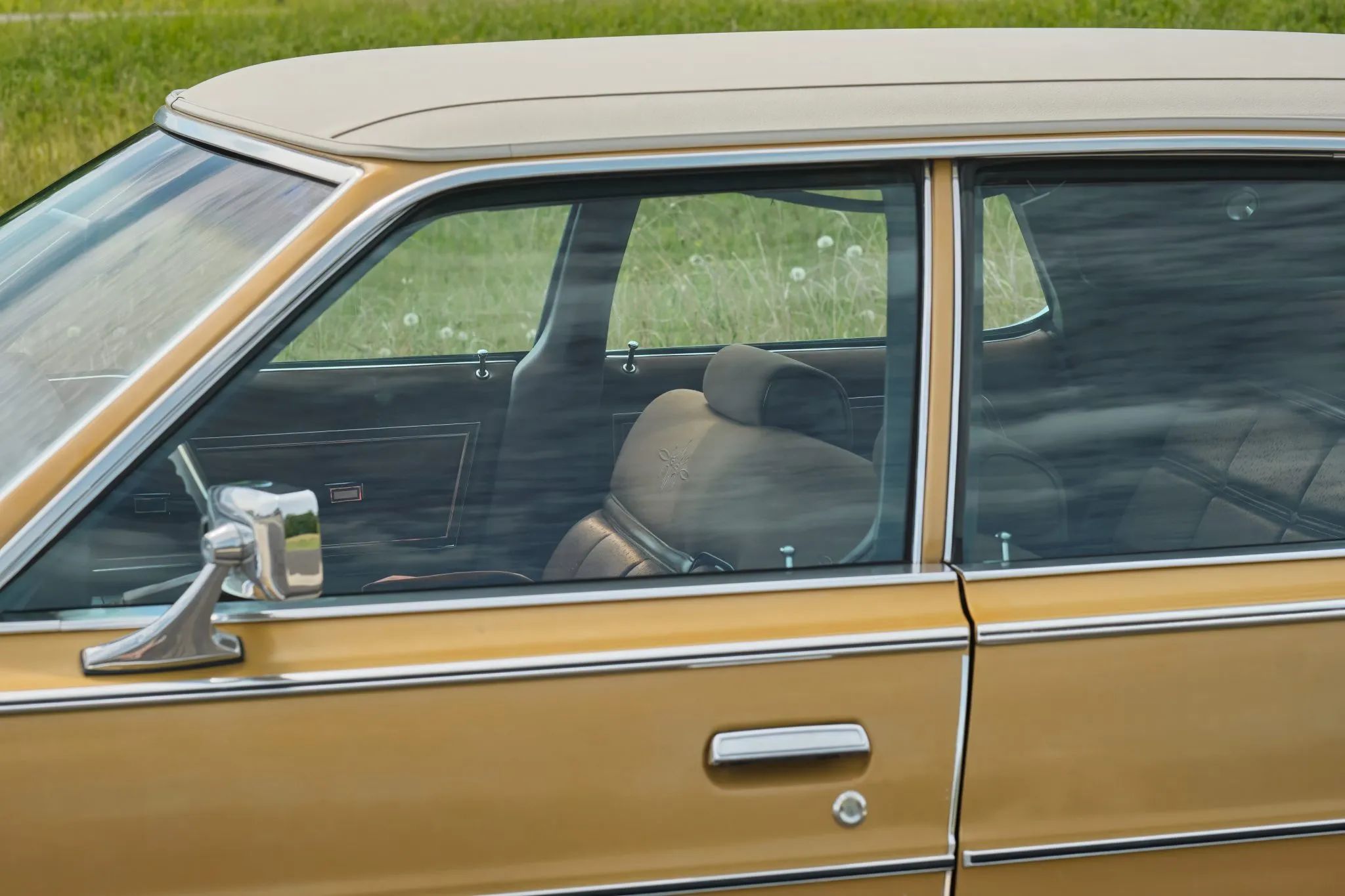
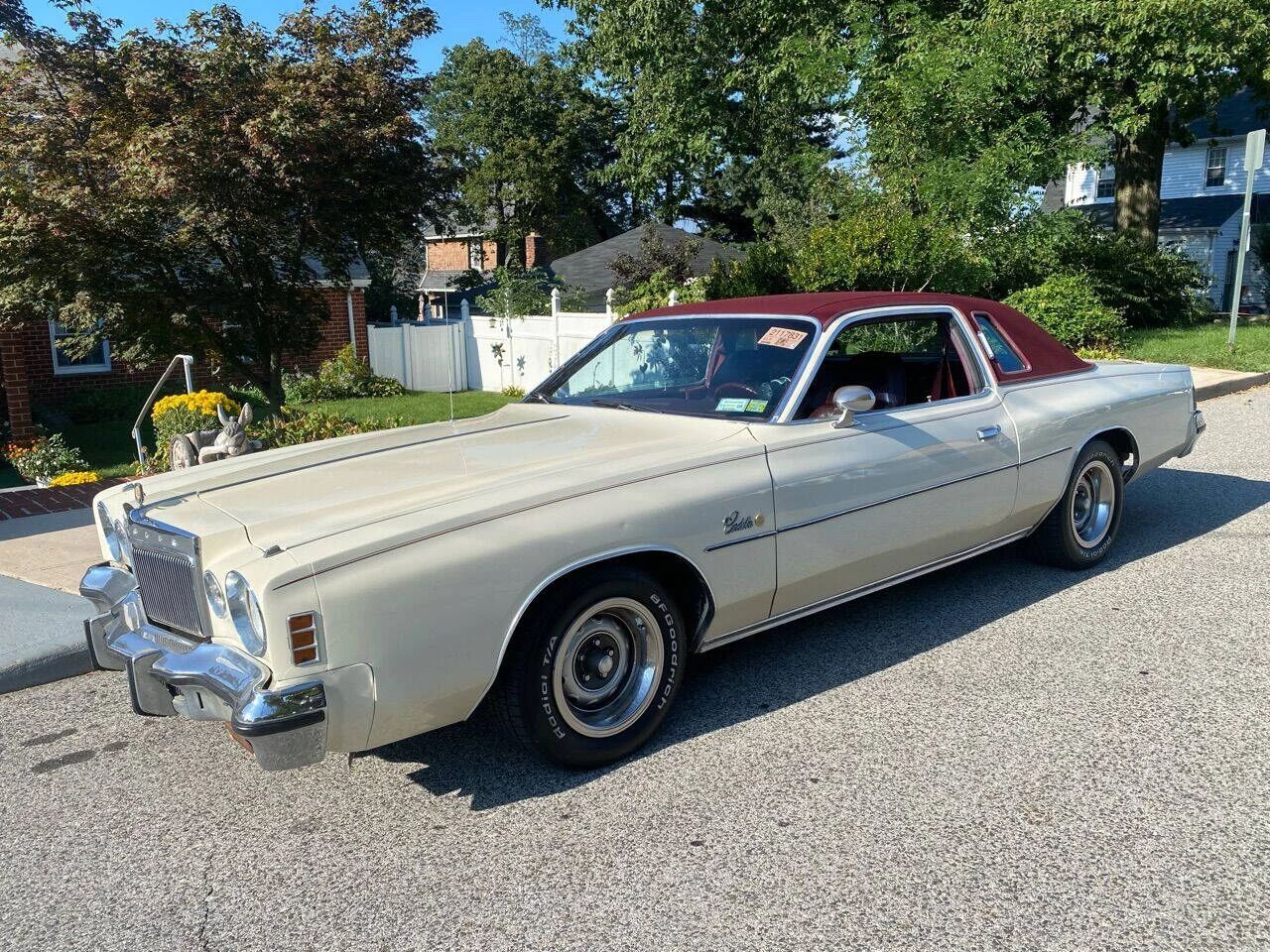
On a first-generation Chrysler Cordoba with a halo roof, the vinyl roof extended to the windshield molding and formed a triangular point at the top of each A-pillar, but the pillars themselves were uncovered, leaving an exposed area that arced over the side window and back into the door:
On big Chryslers, the halo roof also extended all the way to the windshield frame, but the A-pillars were fully chrome-plated, so they didn’t continue either the body color or the color of the vinyl top:
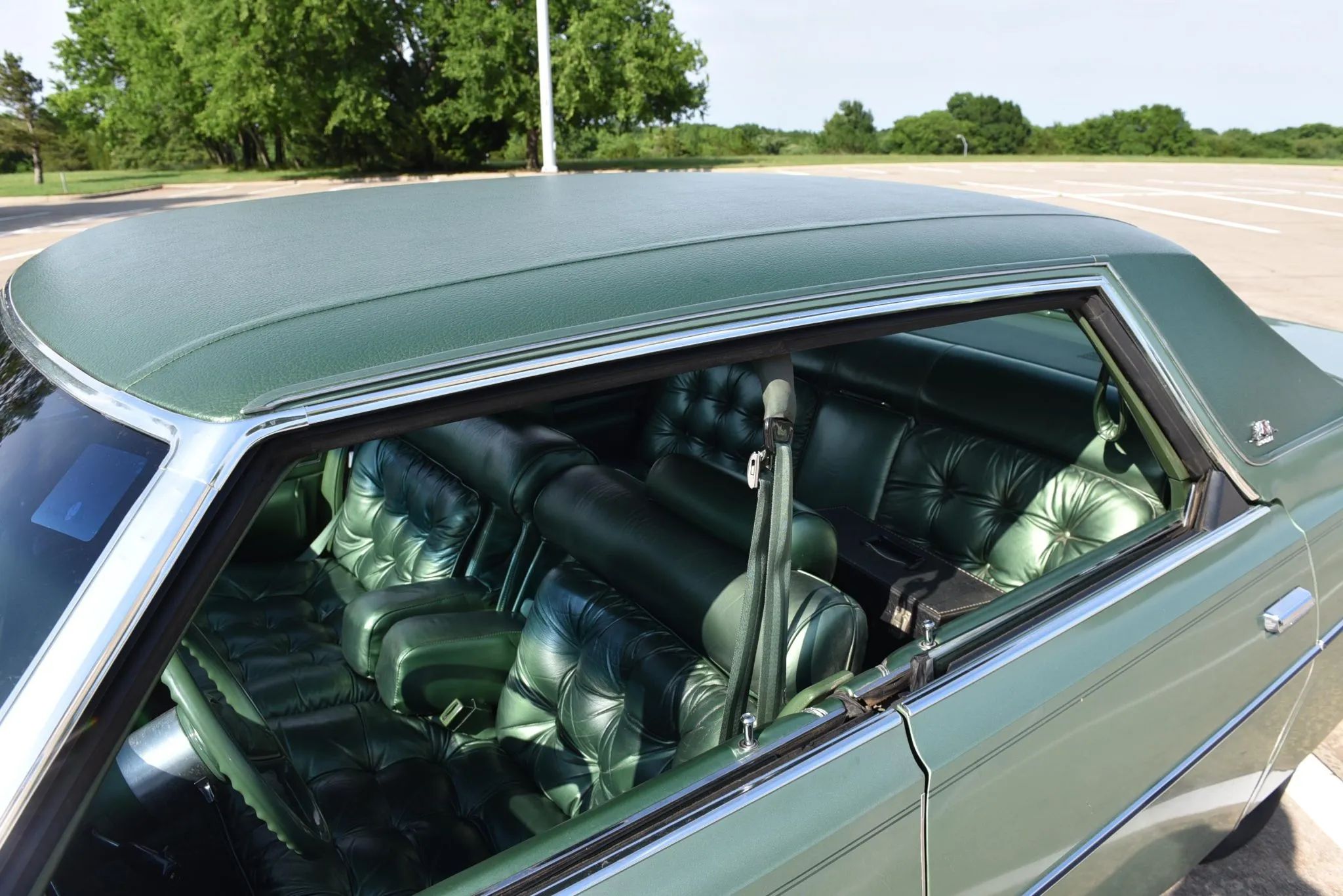
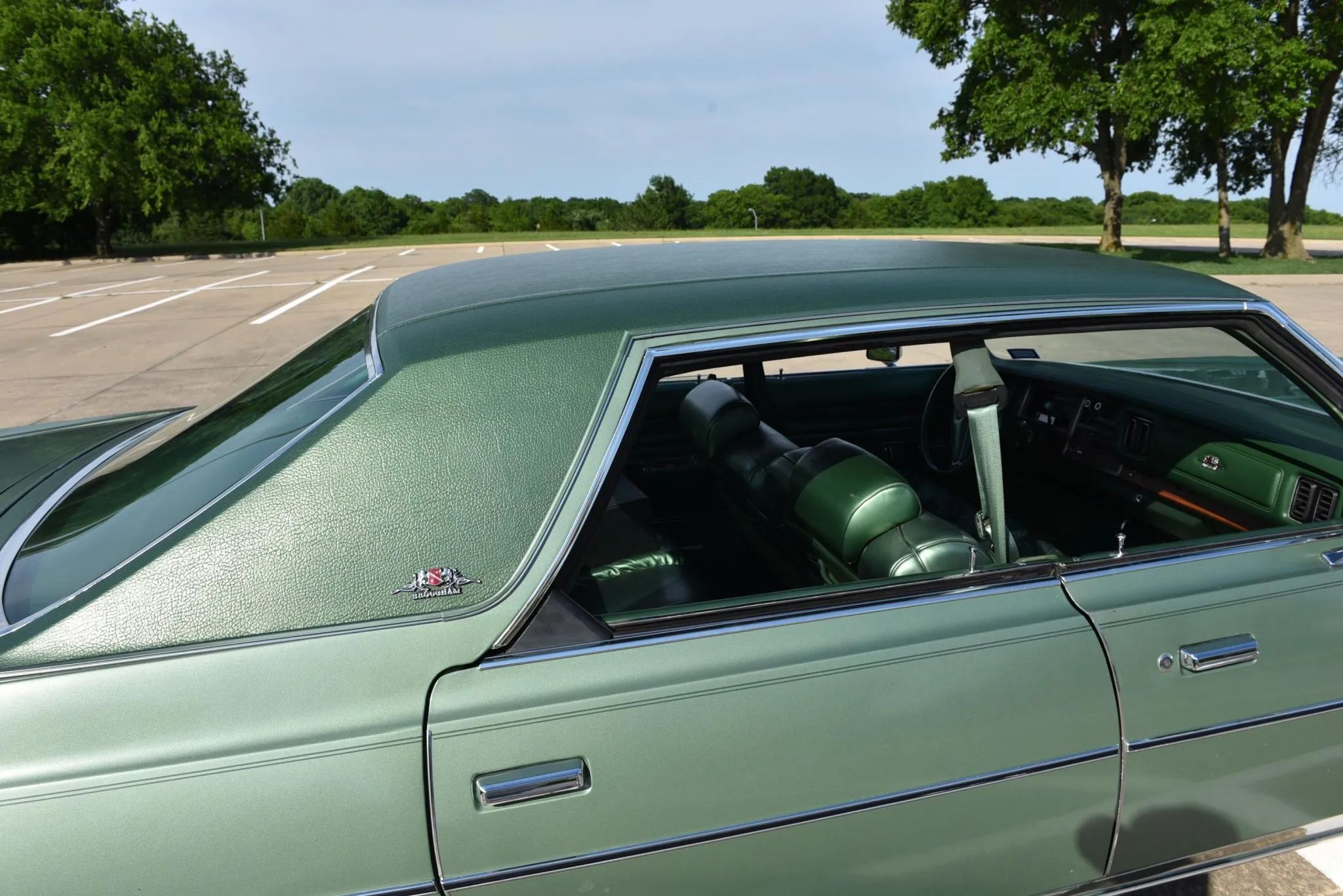
The exposed area between the side window garnish and the edge of the vinyl covering was widest behind the rear side window and narrowed as it approached the windshield:
Landau Vinyl Roof
Probably the most popular vinyl roof style of the ’70s was the rear half-roof, sometimes called a landau roof.
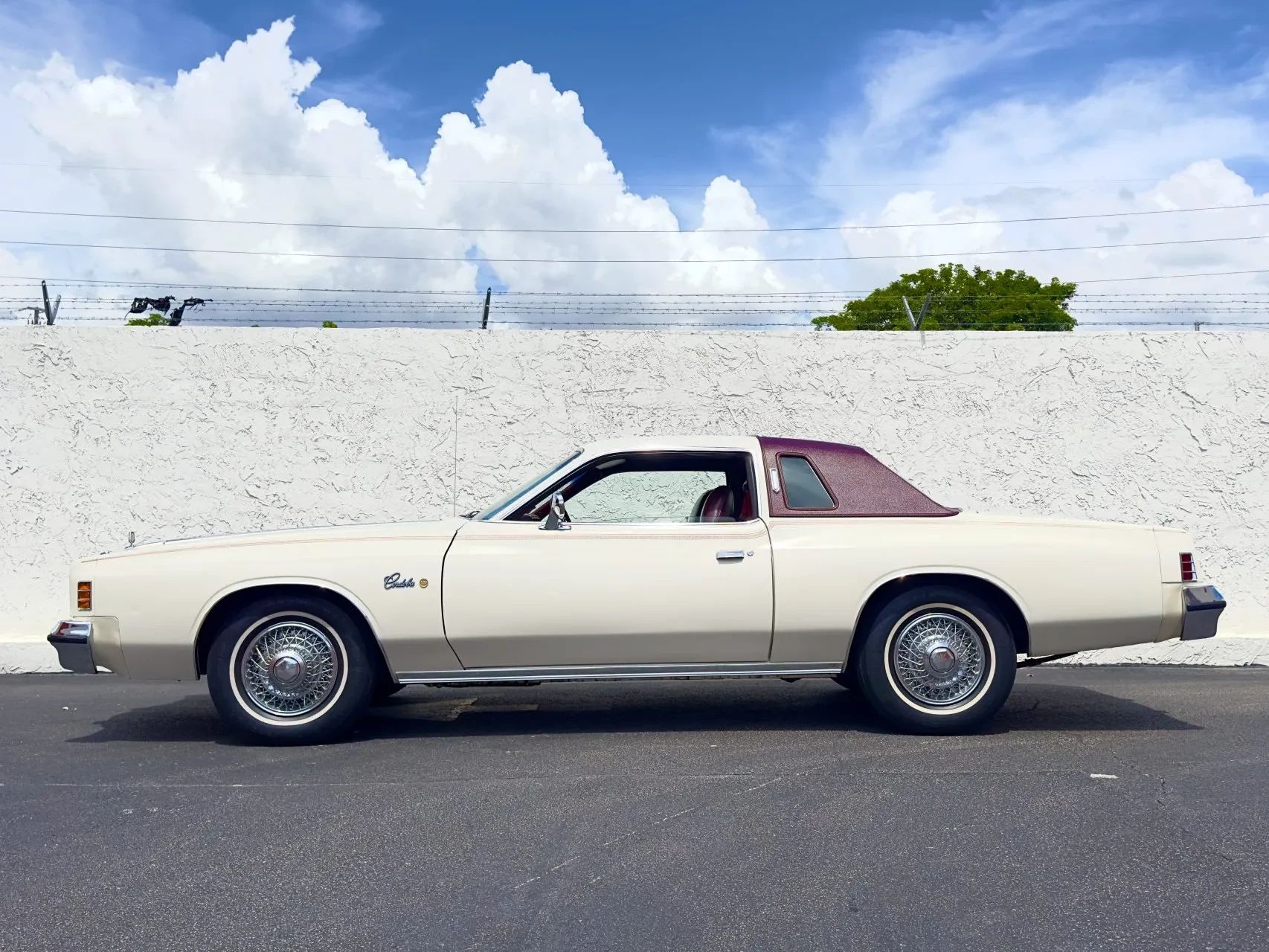
Although the term has been much abused over the years, a landau was originally a type of four-wheeled horse-drawn carriage, popularized in the early 18th century by the Emperor Joseph I of Austria, who used a carriage of this style to inspect his troops during the siege of the Bavarian town of Landau. As Lennart W. Haajanen’s Illustrated Dictionary of Automobile Body Styles explains, “Landauer” carriages had two folding hoods, raised and lowered with landau bars.
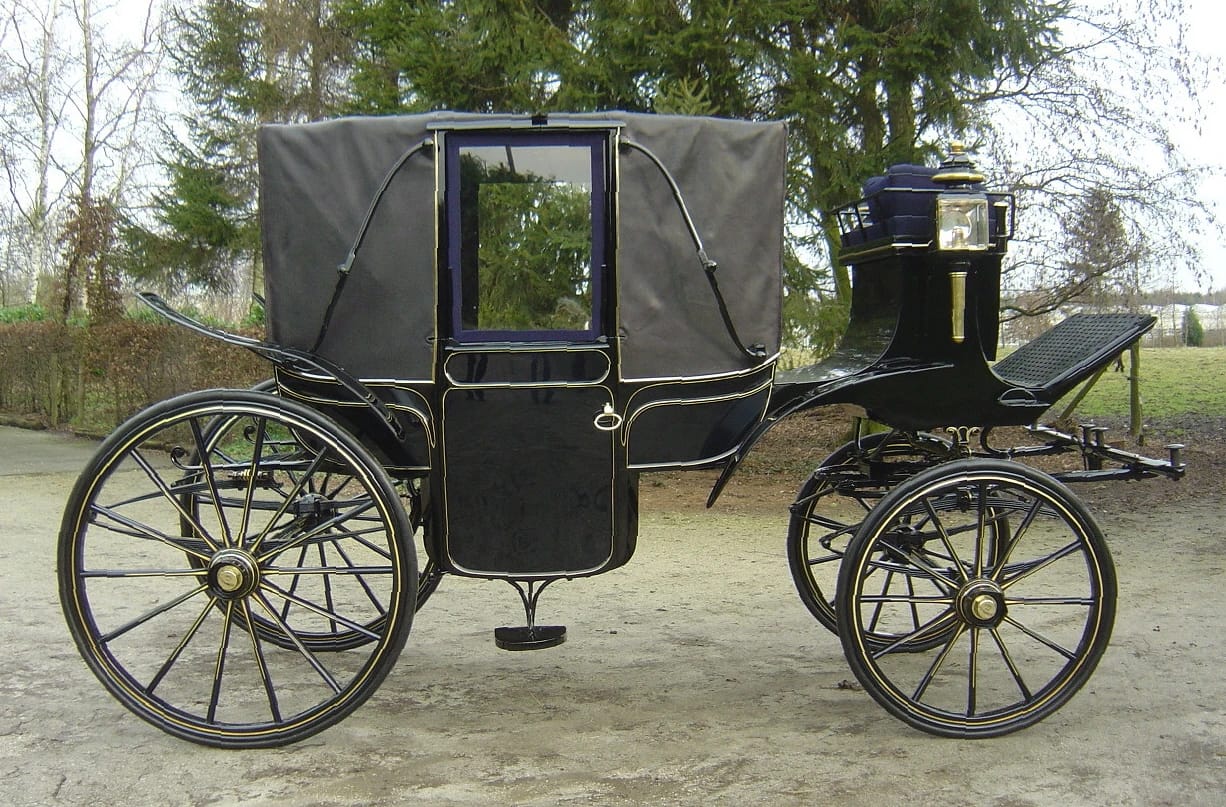
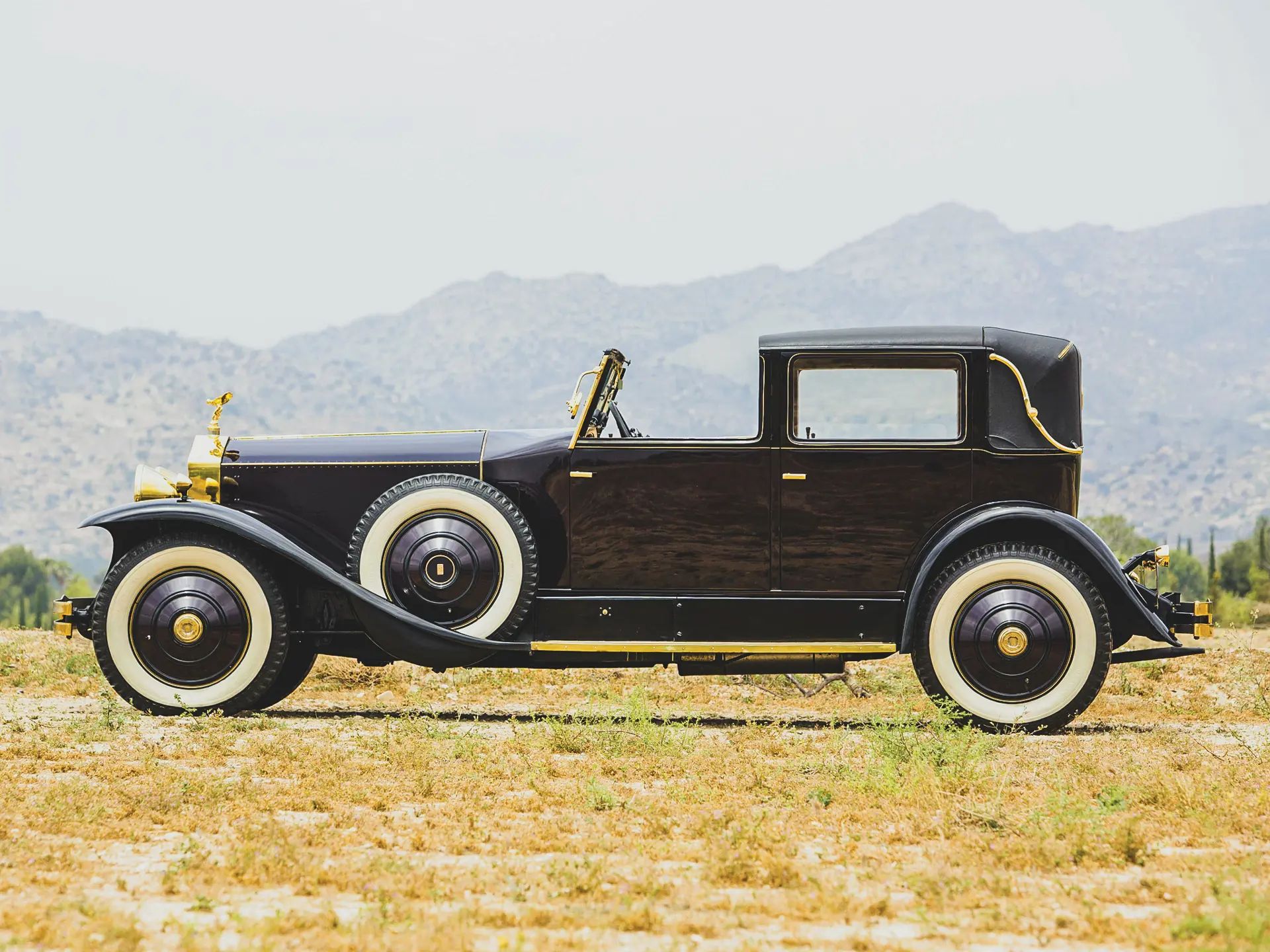
In passenger car terms, what came to be called a landau really owes more to a smaller style of horse-drawn carriage called the landaulet (Landaulett in German), which had only one folding hood rather than two. An automotive landaulet was a formal car, typically a limousine or taxi, with a folding top section behind the rear doors so that passengers could take the air. Like a landau carriage, a landaulet usually had landau irons to raise and lower the folding hood, which was a task for the chauffeur.
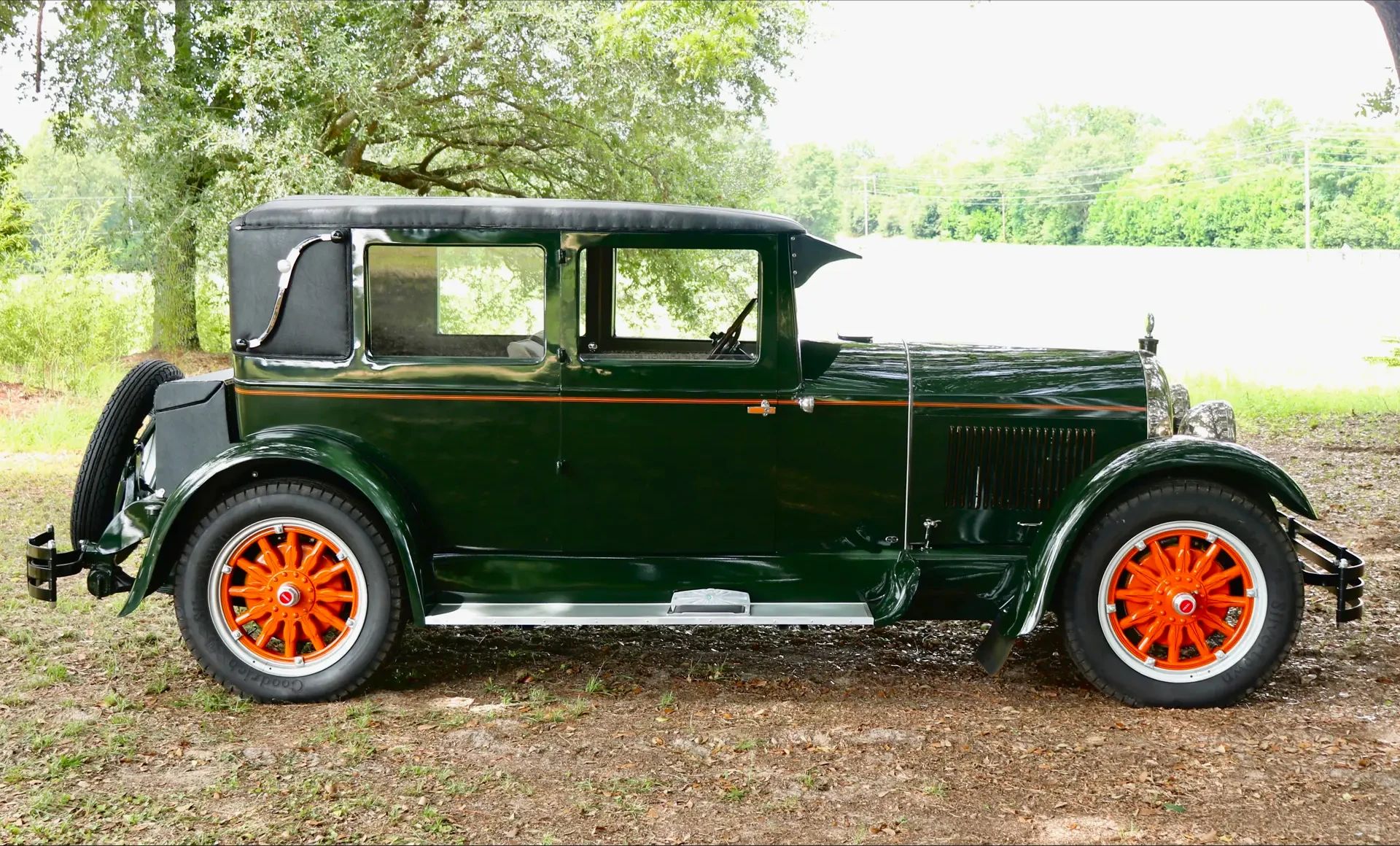
Many formal cars, like limousines and hearses, are still faux landaulets, typically retaining nonfunctional landau bars for symbolic and decorative value. Sedans imitating this practice were old news long before Ford started sticking landau S-bars on the Thunderbird in the ’60s — here’s a 1926 Kissel with a simulated landaulet roof and decorative landau irons:
In the ’60s and ’70s, Cadillac offered a factory landau roof option for the Fleetwood Series 75 limousine:
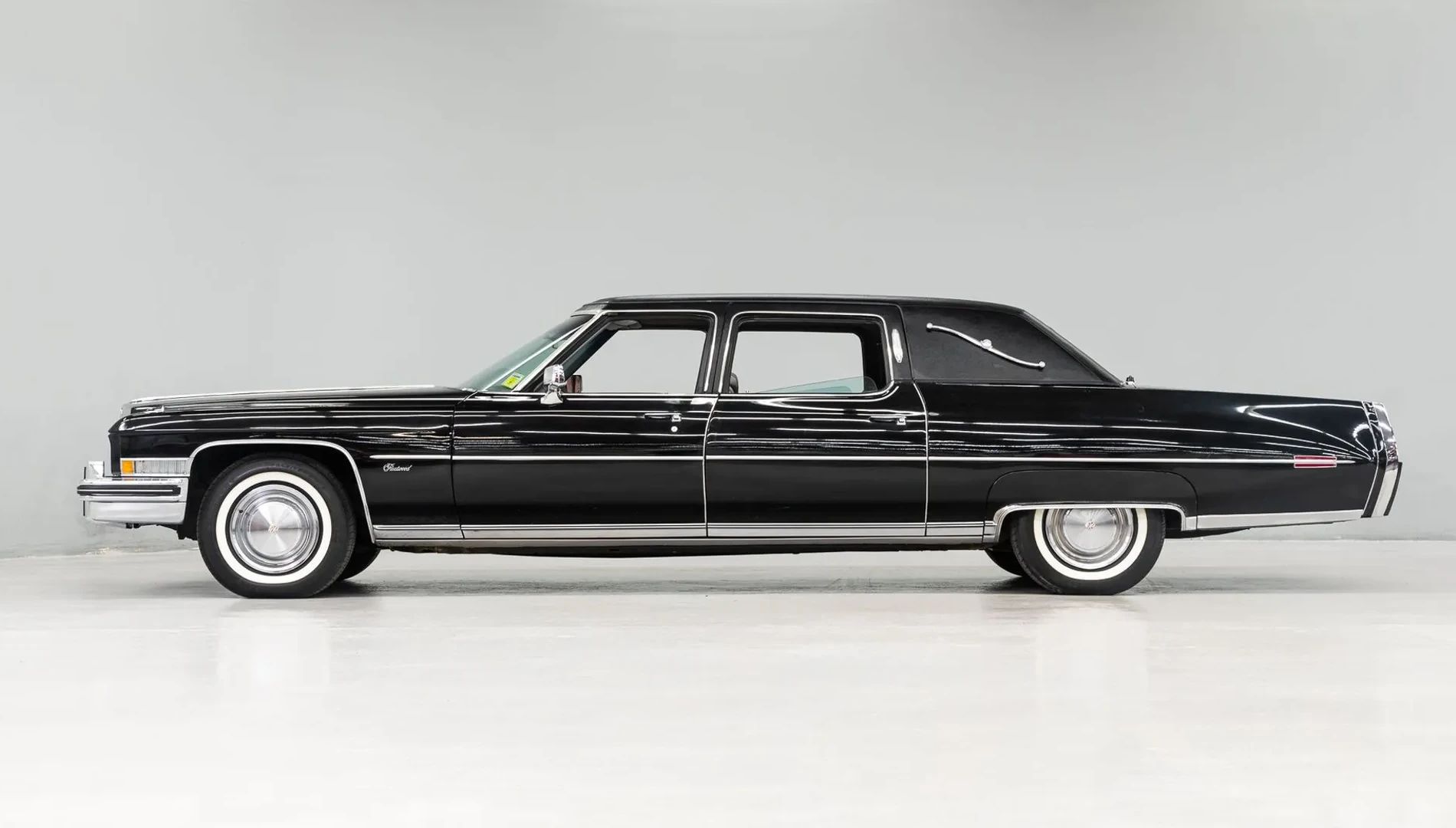
This option was available with or without the landau irons, and with either a standard back window …
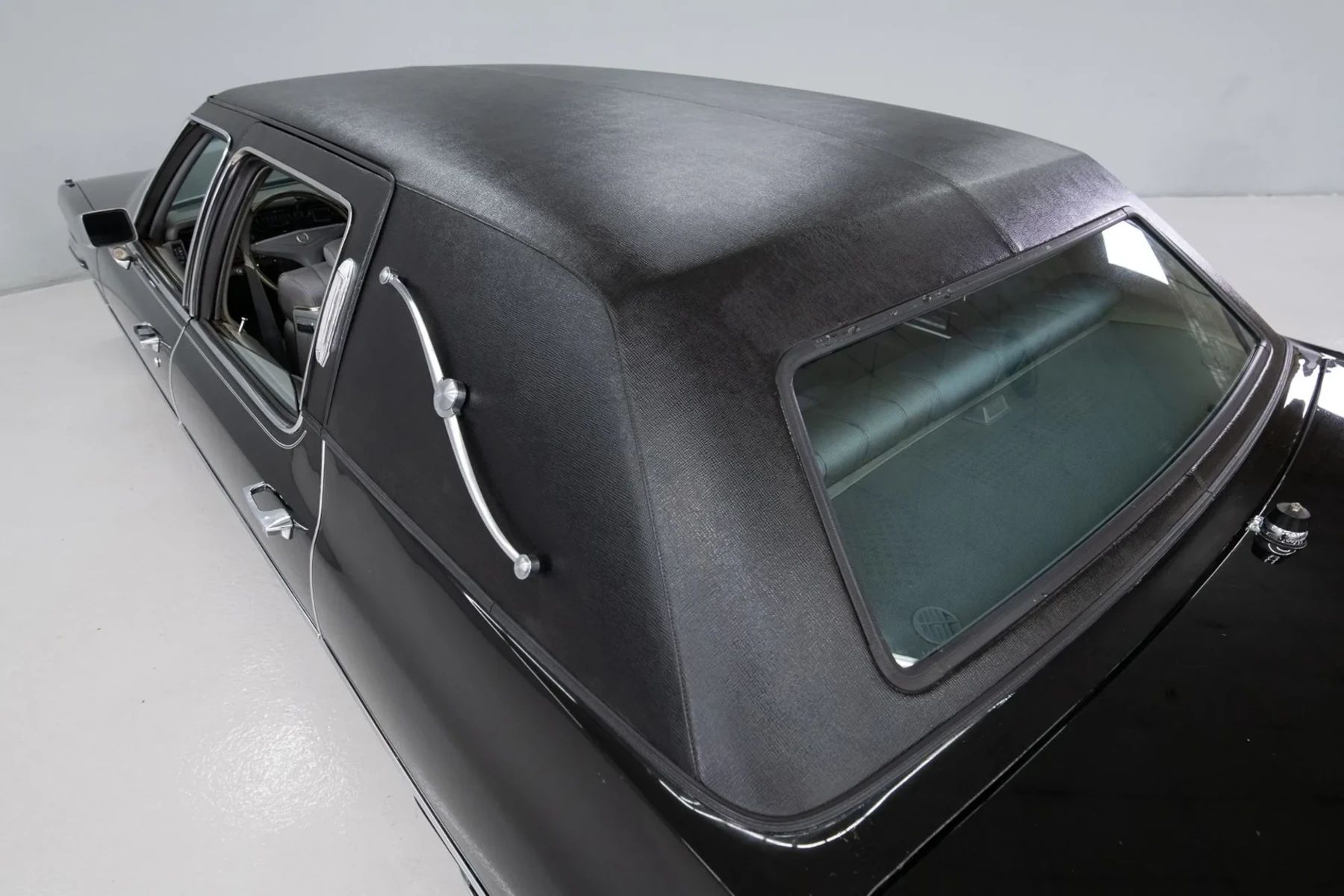
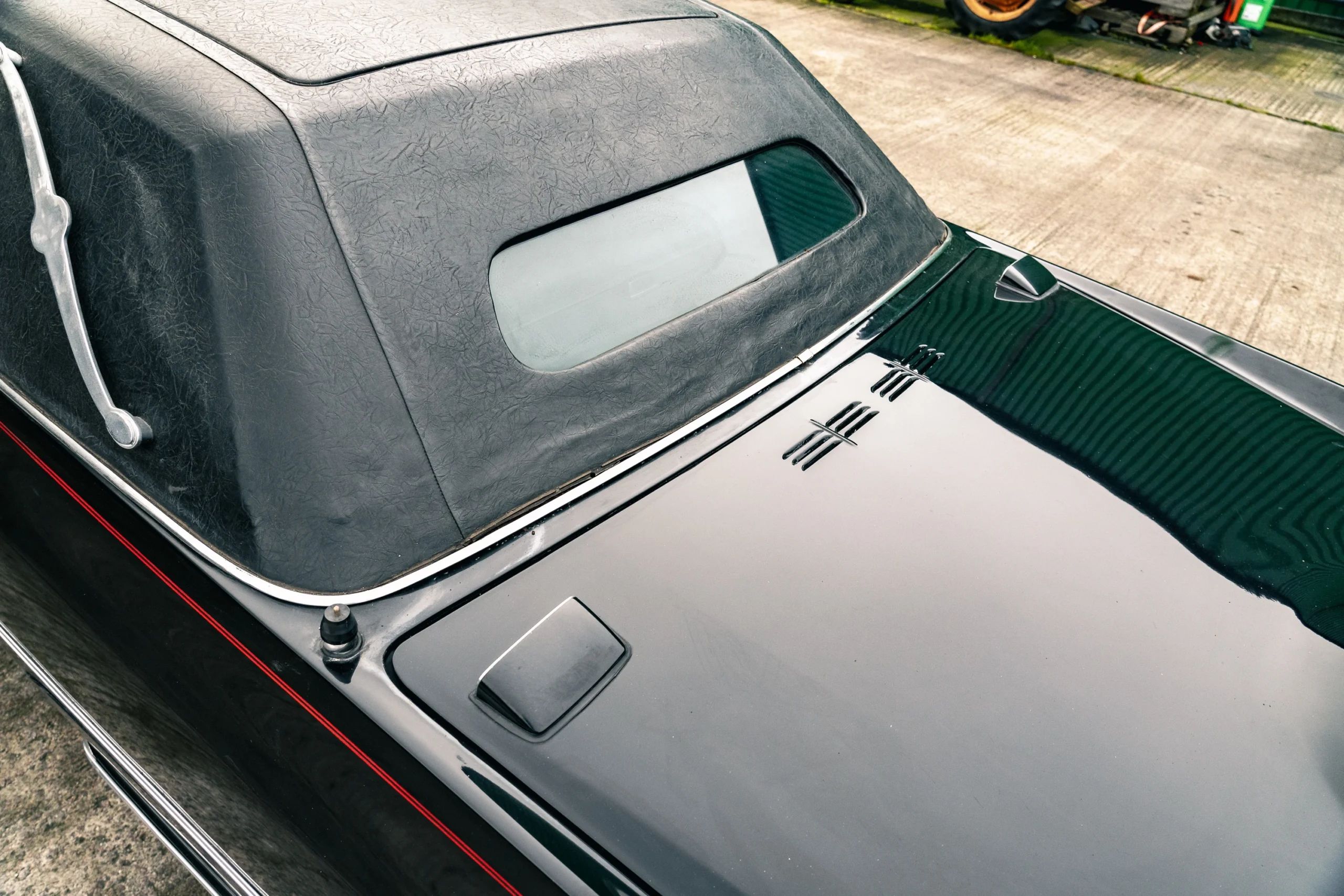
… or with a smaller backlight:
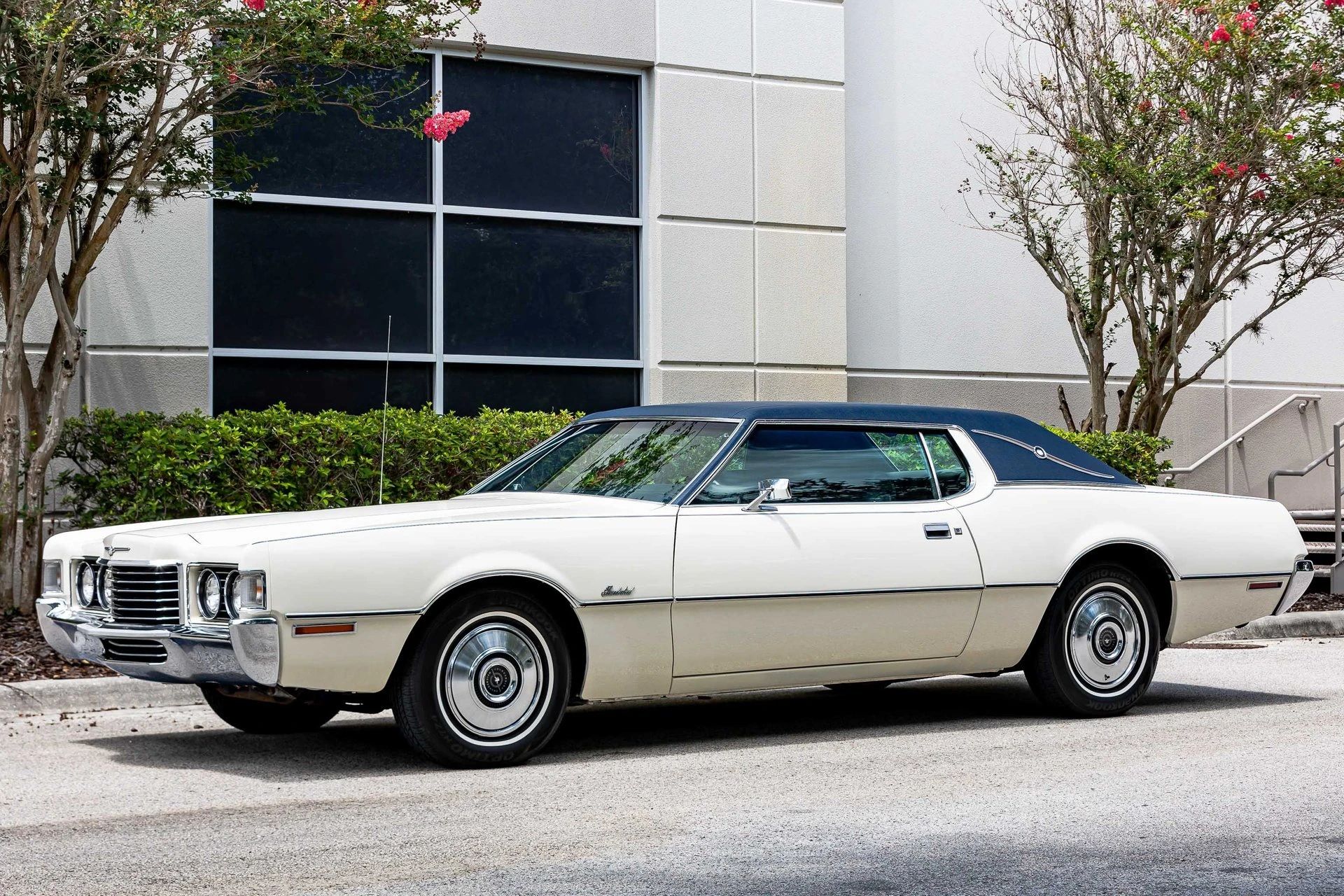
This style is what Ford was imitating with the popular Thunderbird Landau, which remained available, complete with simulated landau bars, through 1976.
However, by the mid-’70s, the term “landau” was more frequently used to refer to a vinyl top covering only the rear half of the roof, usually with small fixed rear quarter windows rather than landau irons. By far the most popular iteration was the Chevrolet Monte Carlo Landau:
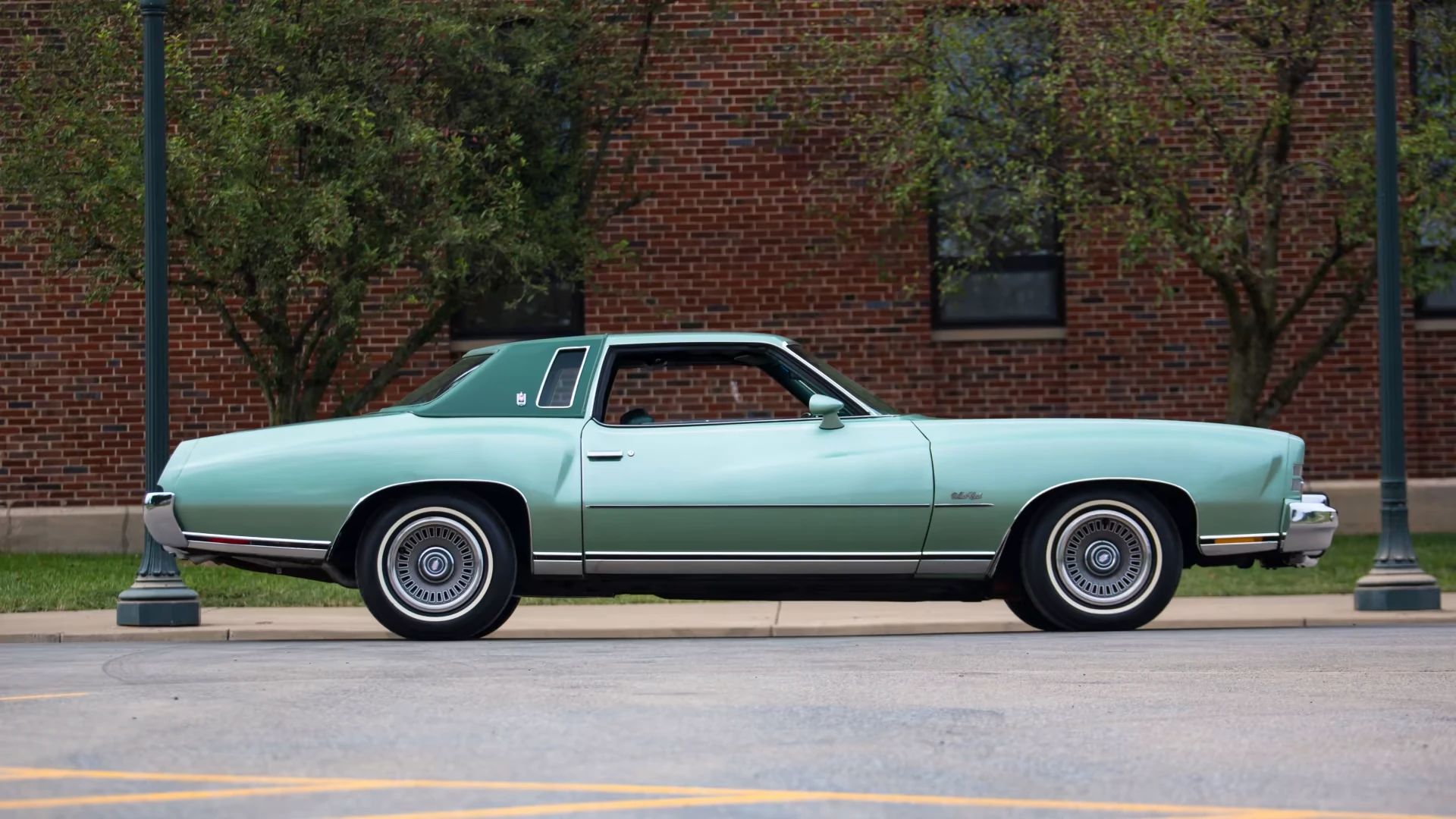
While many U.S. automakers offered rear half-tops like this, not all used the term landau. Cadillac called this style of vinyl top a “Cabriolet roof,” first offered as an option for the Eldorado hardtop in 1972 …
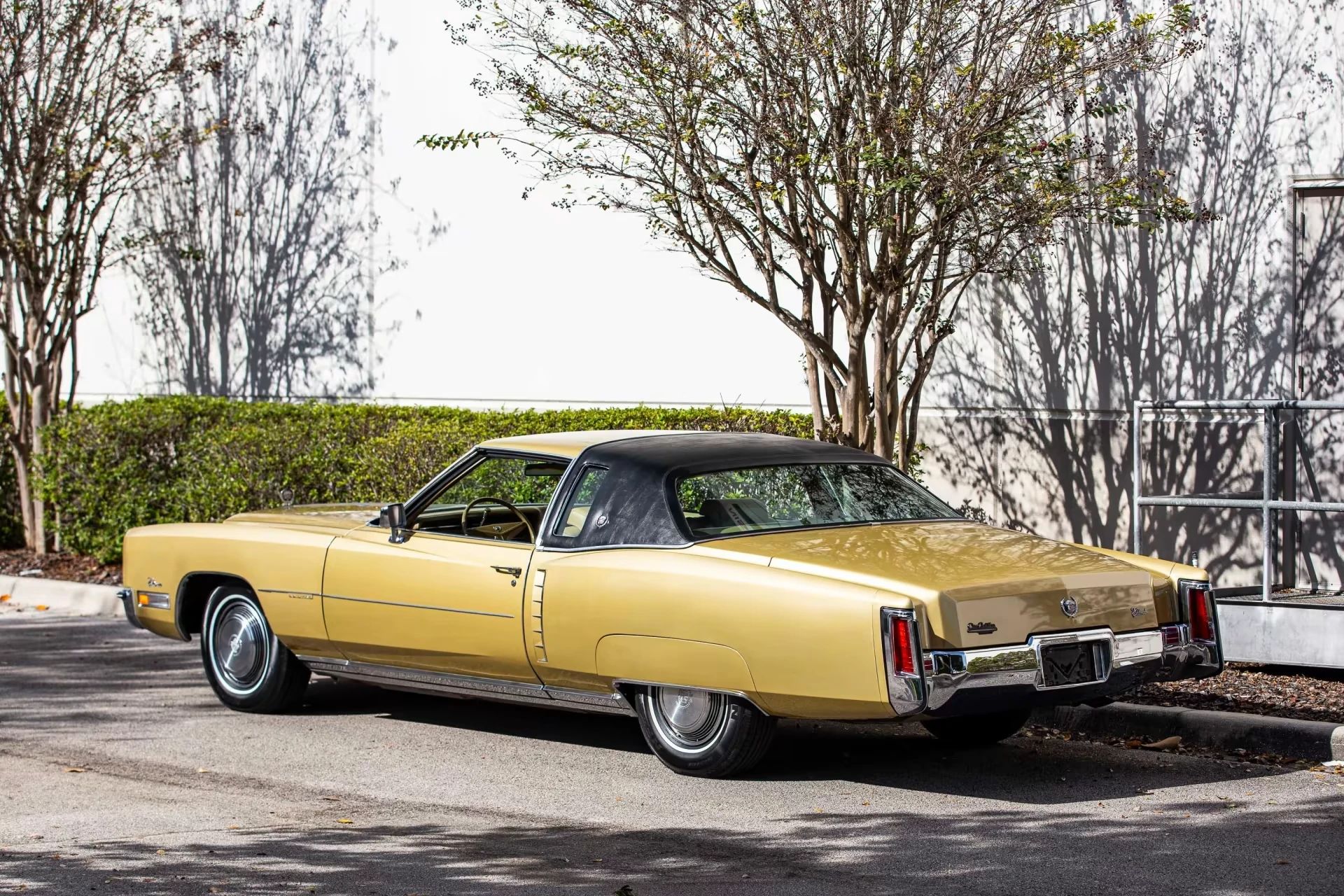
… and then for the Coupe de Ville beginning in 1974.
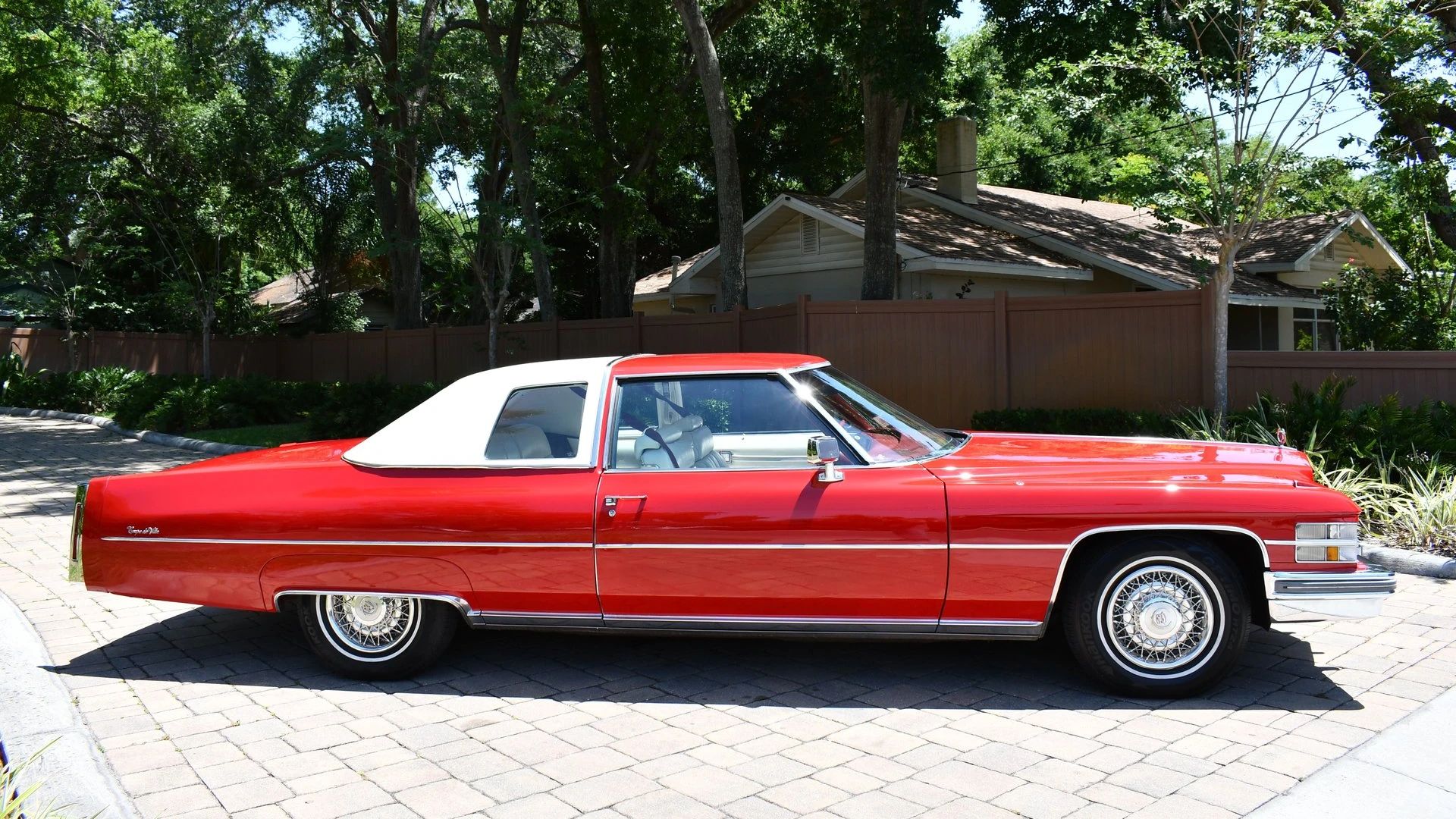
Note that the vinyl top has its own chrome border all the way around:
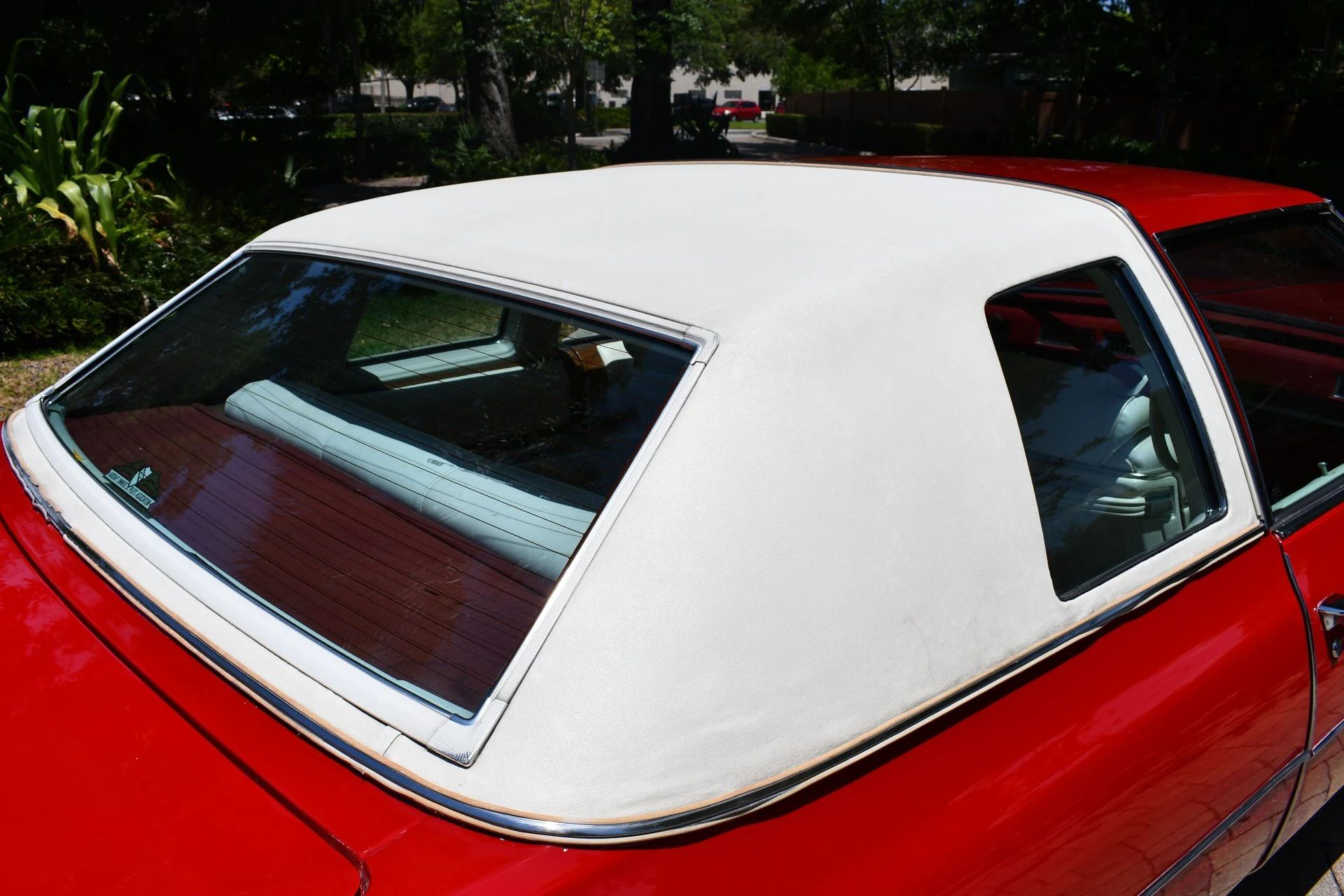
This roof style was offered on most larger GM two-door models throughout the late ’70s, almost completely supplanting the traditional two-door hardtop.
Canopy Vinyl Top
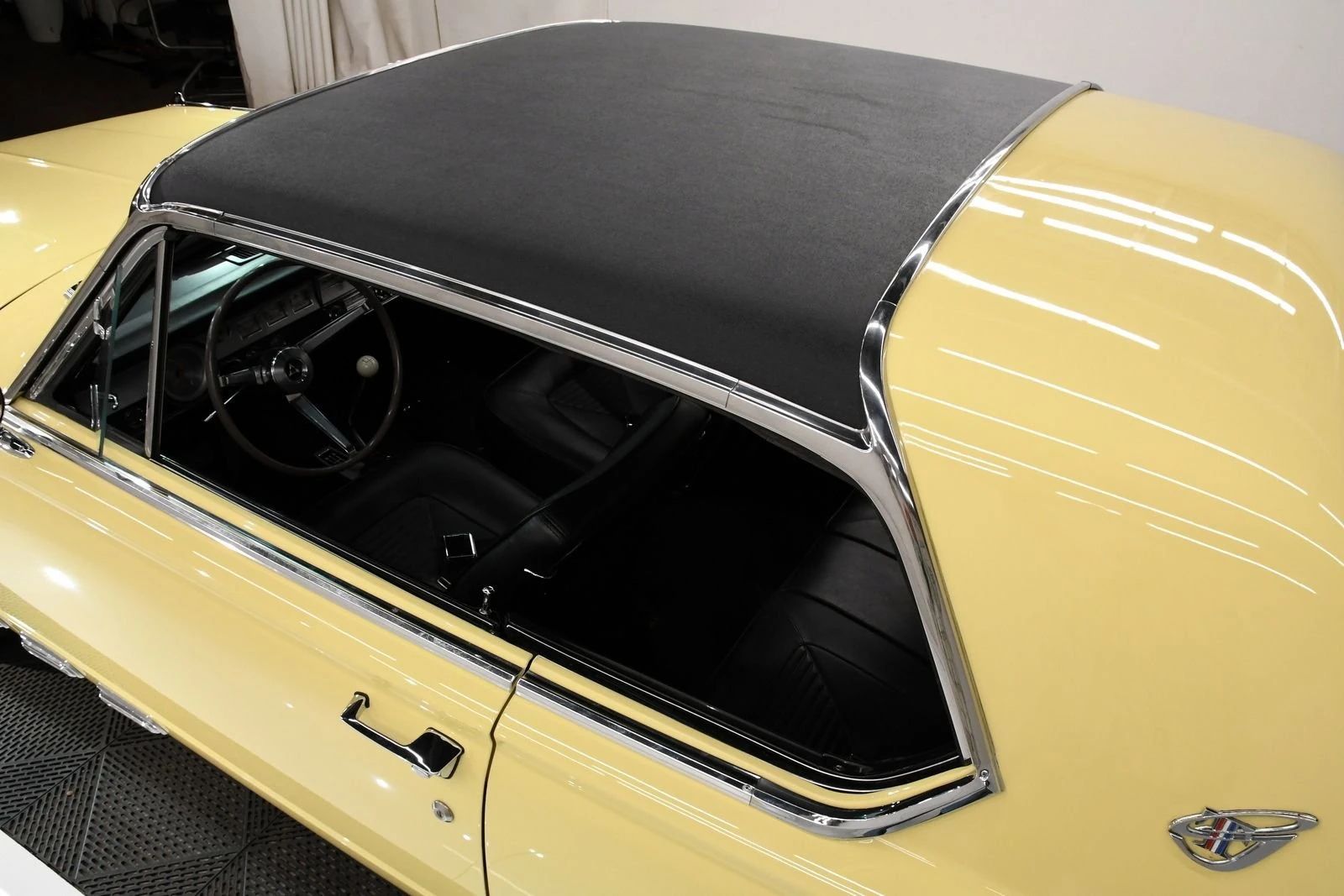
Essentially the opposite of the landau-style top, the canopy-type vinyl top covered only the front portion of the roof, leaving the rear and the sail panels exposed. This style had shown up a number of times in the ’60s, perhaps most notably as an option for the 1965 Dodge Dart GT:
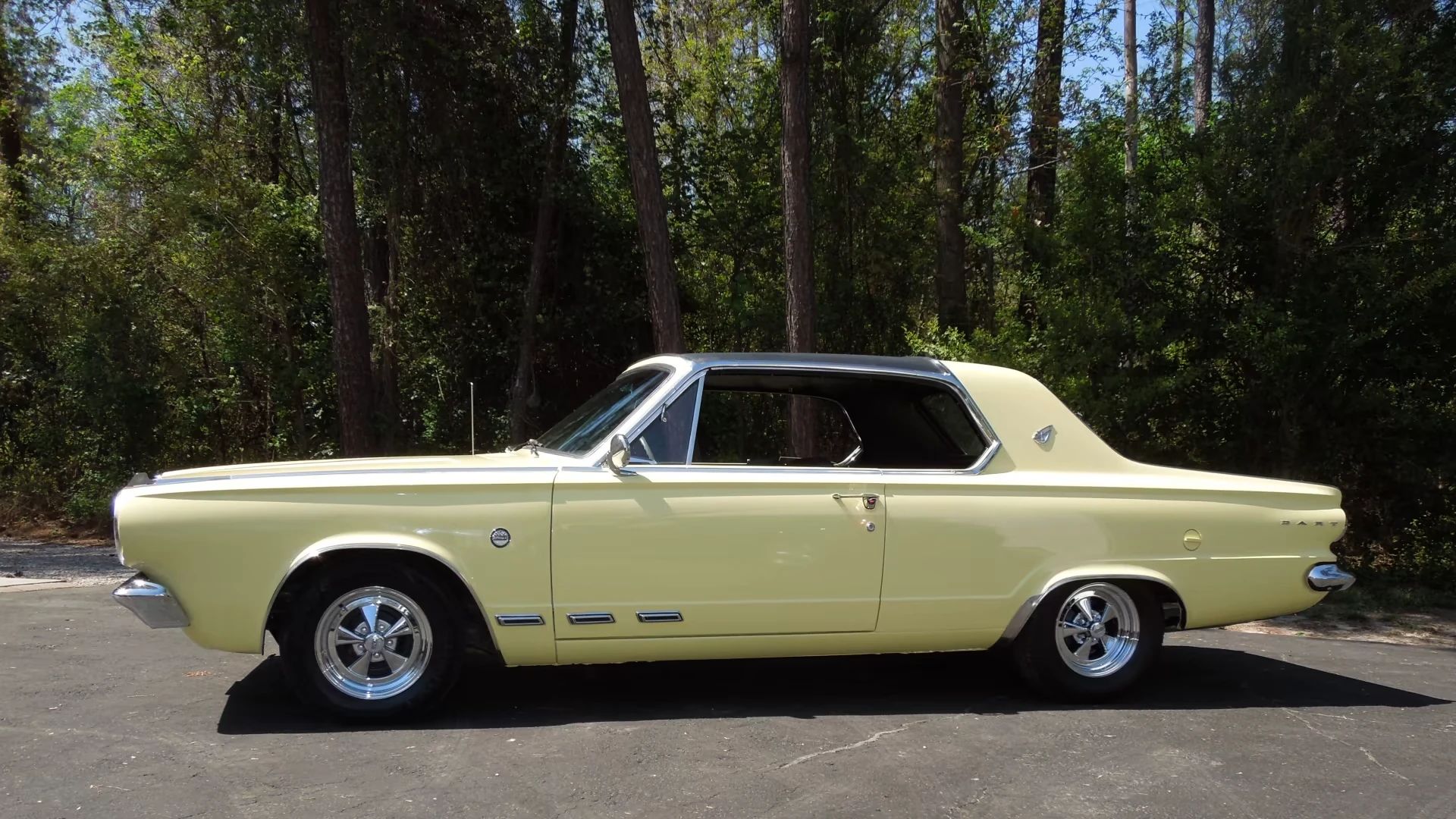
Unlike most ’70s canopy roofs, the Dart GT’s optional vinyl top terminated at the windshield header, giving what Motor Trend called “a sedanca de ville effect.”
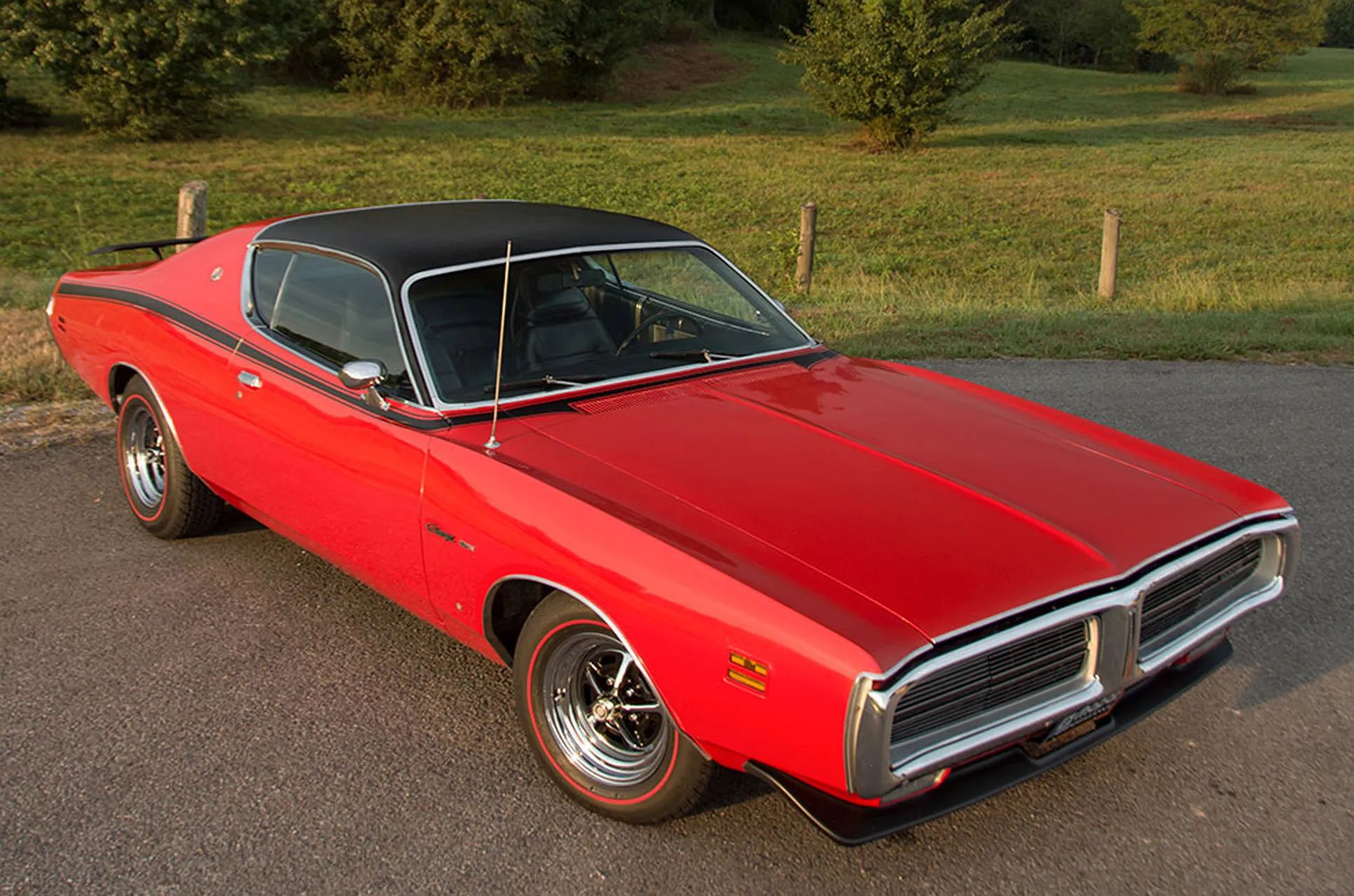
By contrast, a ’70s canopy vinyl roof usually extended all the way to the windshield reveal, and covered the A-pillars as well as the upper roof panel:
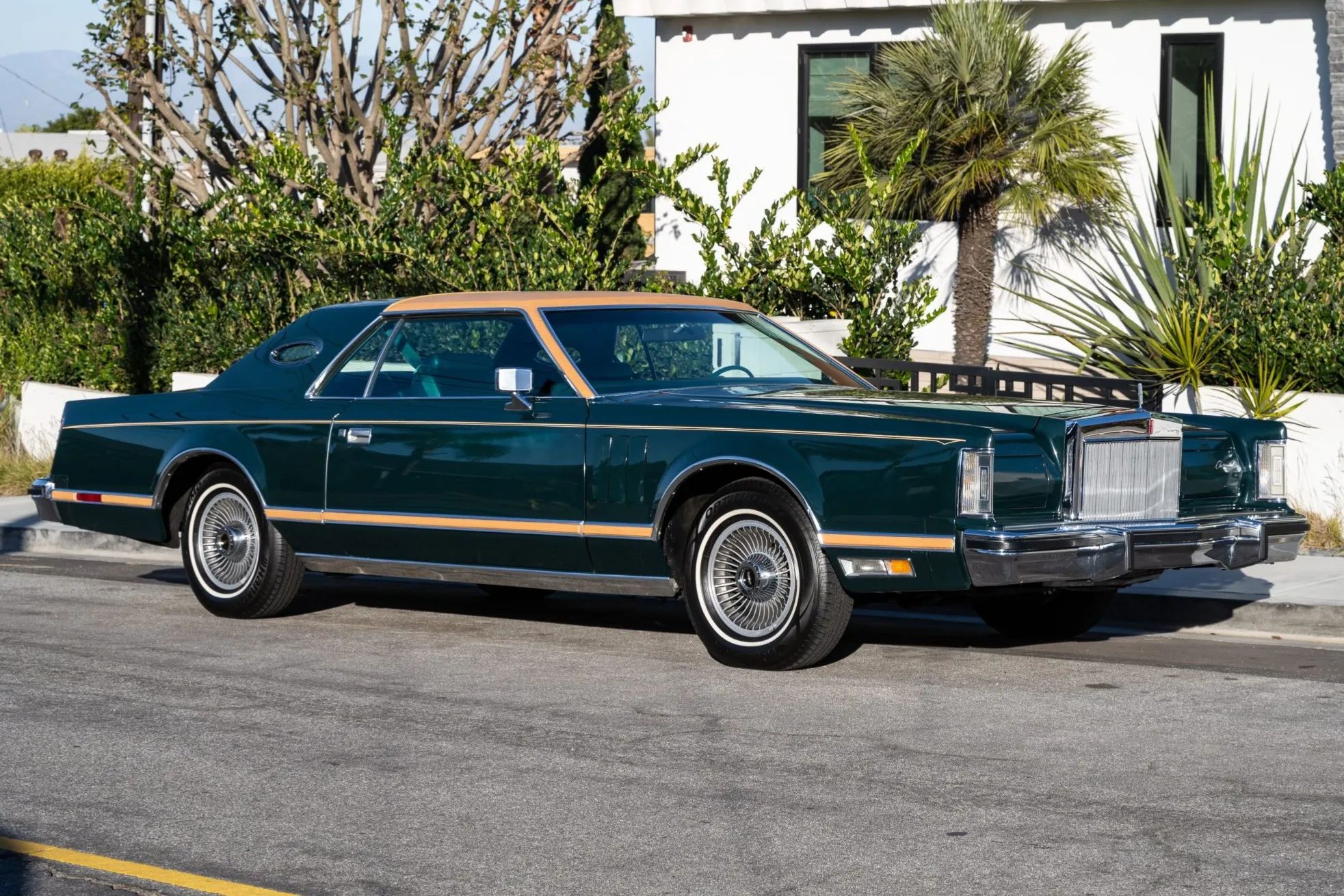
Not all automakers called this style a canopy top — Lincoln called it a “forward half vinyl roof,” which was descriptive if not very mellifluous.
Just to be contrary, Ford, which also offered this style of vinyl top on the 1970 Mustang Grandé, described it as a “Landau” vinyl roof covering …
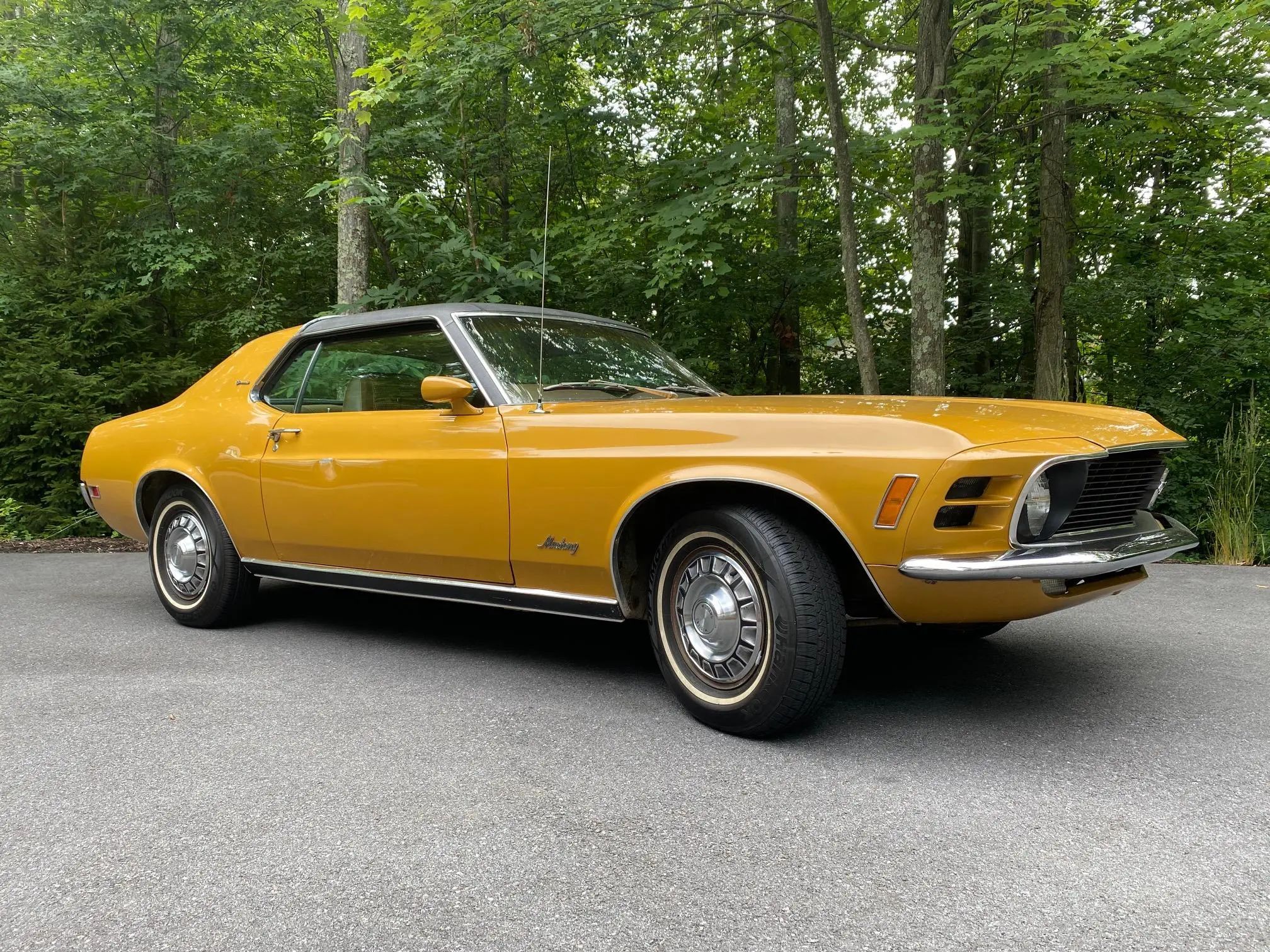
… although the Mustang “Landau” roof was what Chrysler would have called a canopy vinyl top:
One rather repulsive variation on this theme was the padded canopy top offered on some senior Chrysler two-door hardtops, with thickly padded vinyl surrounding fixed quarter windows. This option first showed up in 1974 as the Crown Coupe package, for the Imperial, and the St. Regis package, for the Chrysler New Yorker Brougham. It was an American Sunroof Corporation conversion, since adding the top and the fixed quarter windows was more elaborate than Chrysler cared to deal with on the regular assembly line.
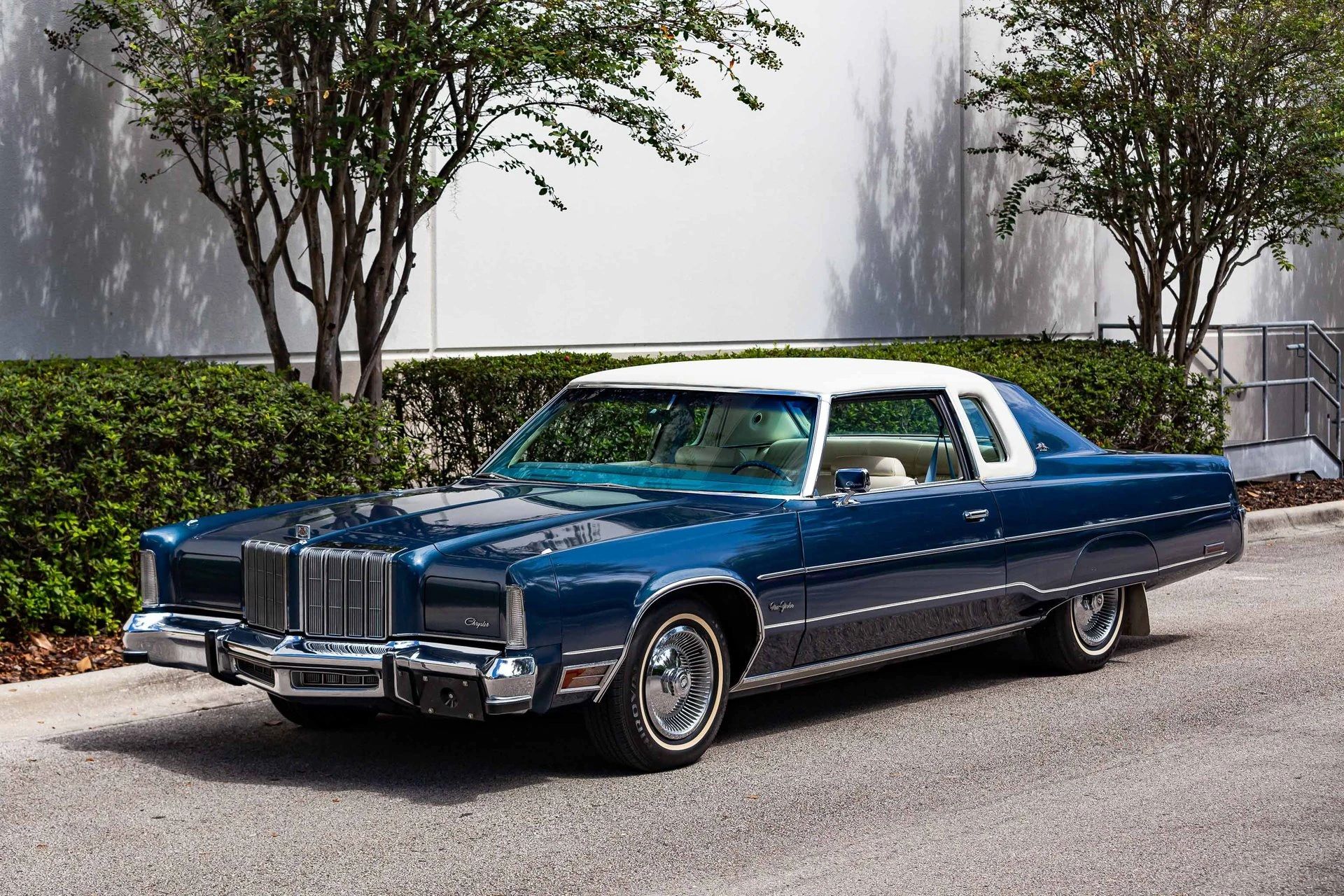
Even trying to keep an open mind about the period aesthetics of these options, something about the puffiness of the padding around the quarter windows triggers my gag reflex, although the late Imperial/New Yorker Brougham otherwise looks nice in this color, and I love this particular car’s blue-and-white interior treatment. An acquired taste, to be sure.
Carriage Roof
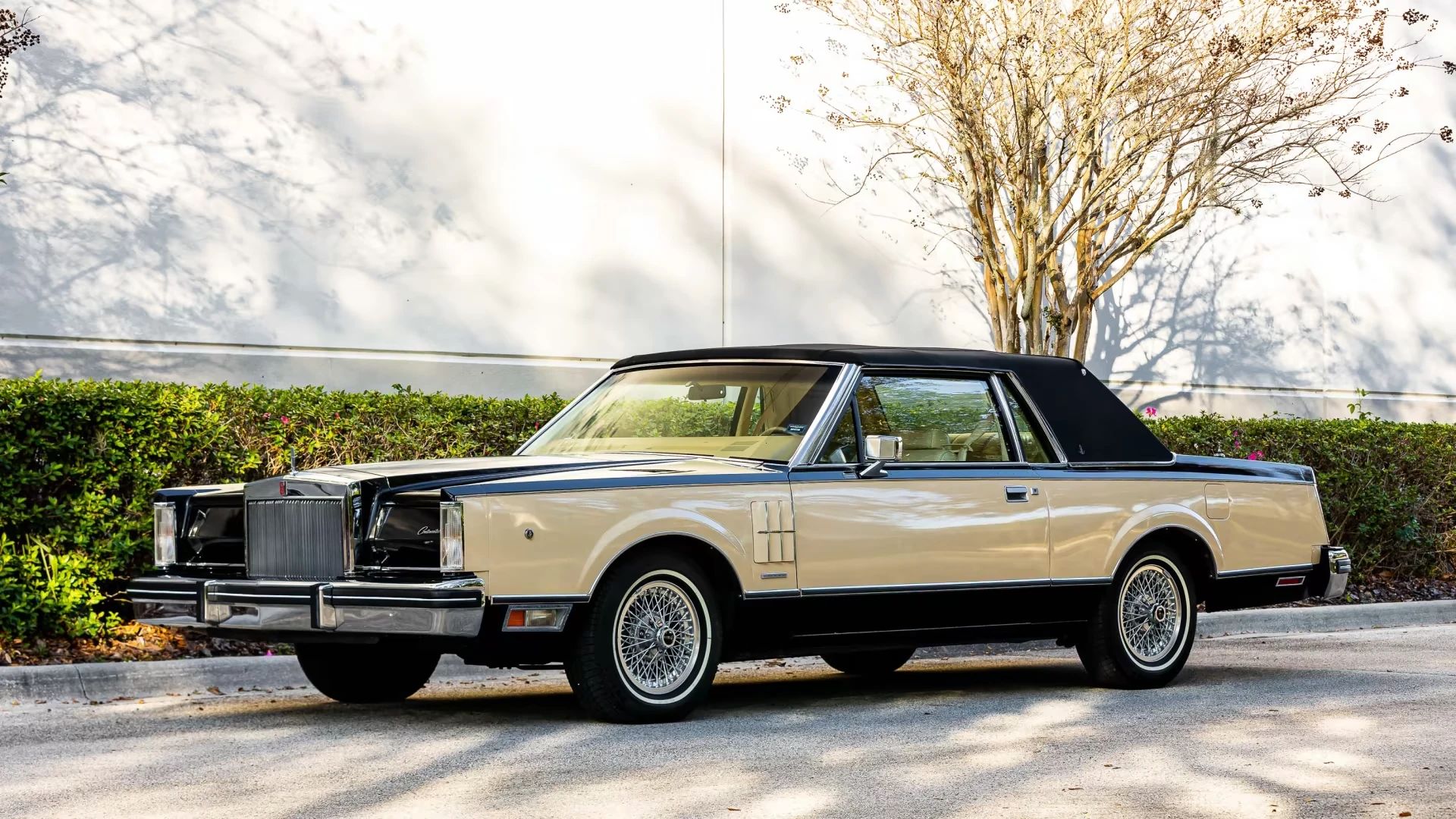
Starting in 1978, Lincoln offered the Continental Mark V with an optional carriage roof vinyl top, which deleted the Mark’s signature opera windows and made the two-door hardtop look like a convertible with the top up:
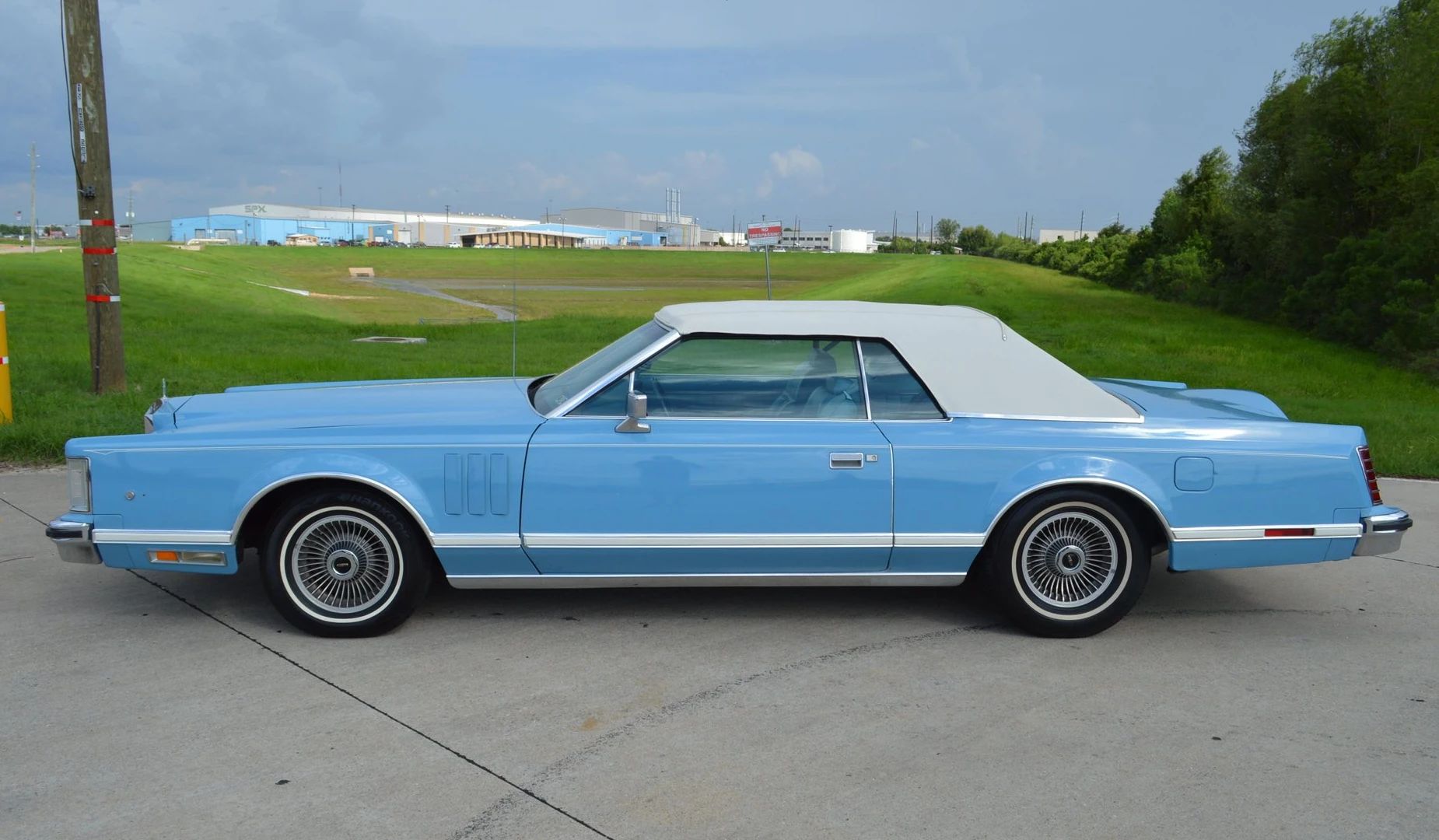
I have a suspicion that this $900 option might have been inspired by the popularity of aftermarket convertible conversions. Although U.S. automakers hadn’t offered any factory convertibles since 1976, since the future of the convertible was still in regulatory limbo, that didn’t stop some well-heeled buyers from obtaining pricey aftermarket conversions. The carriage roof wasn’t that, but it did take a close look to tell the difference.
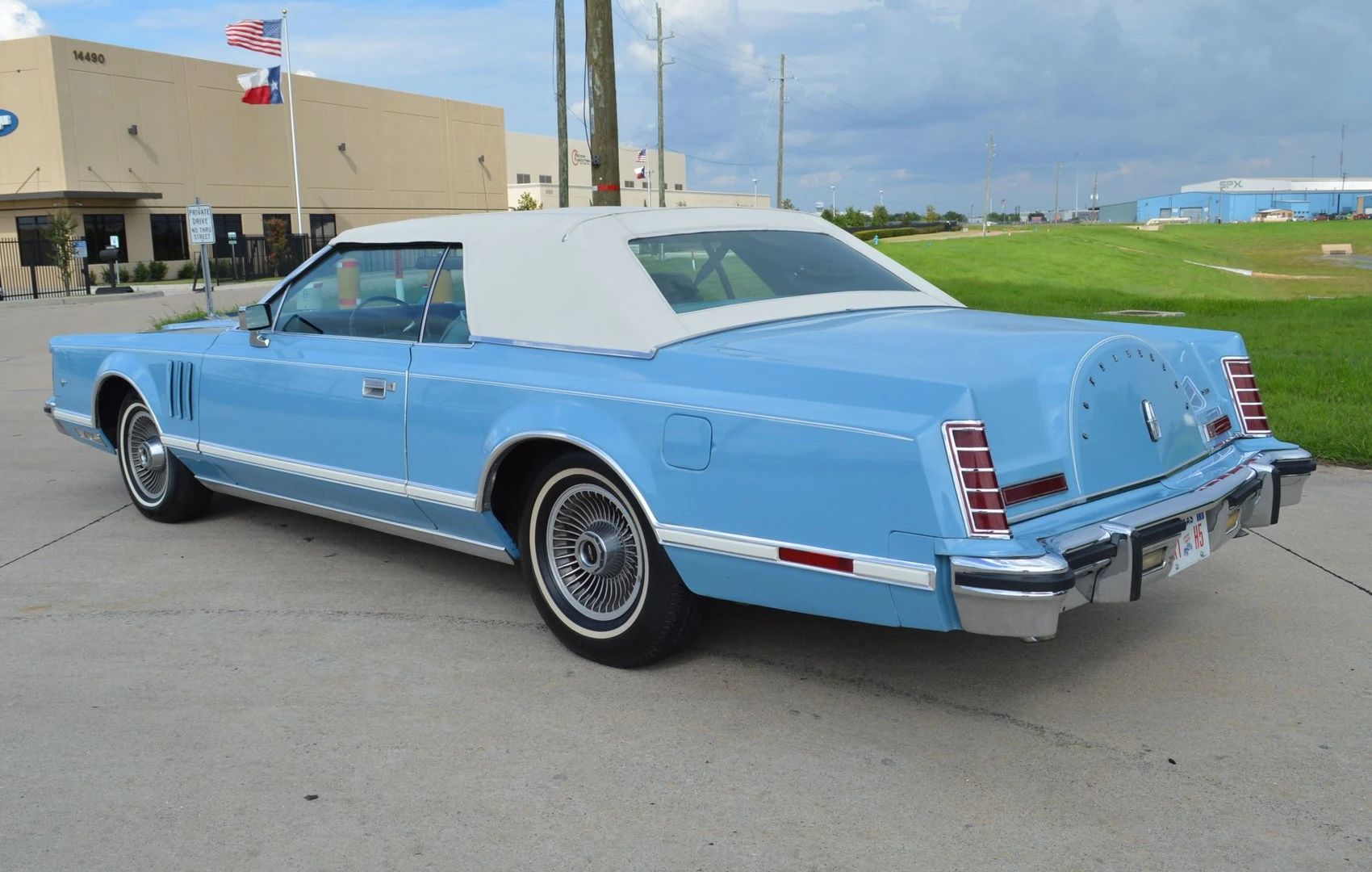
This style of vinyl top persisted into the ’80s on a few models, and you’d still see occasional aftermarket installations well into the 21st century.
Split Vinyl Roof
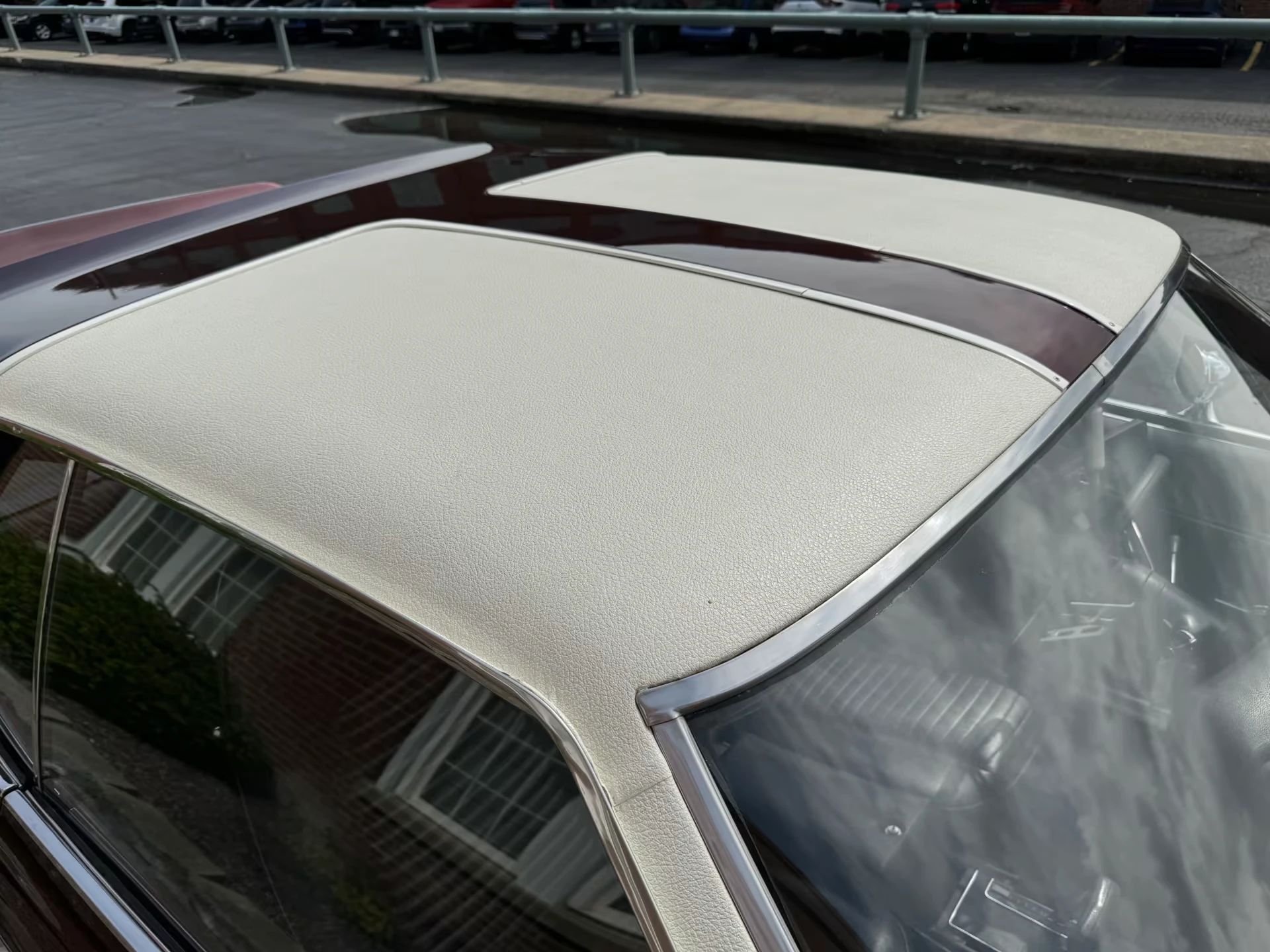
Another variation sometimes seen in this era was the split vinyl roof, where the vinyl section was divided into two parts. One example was the longitudinally split vinyl top offered on the 1971–1974 AMC Javelin and AMX:
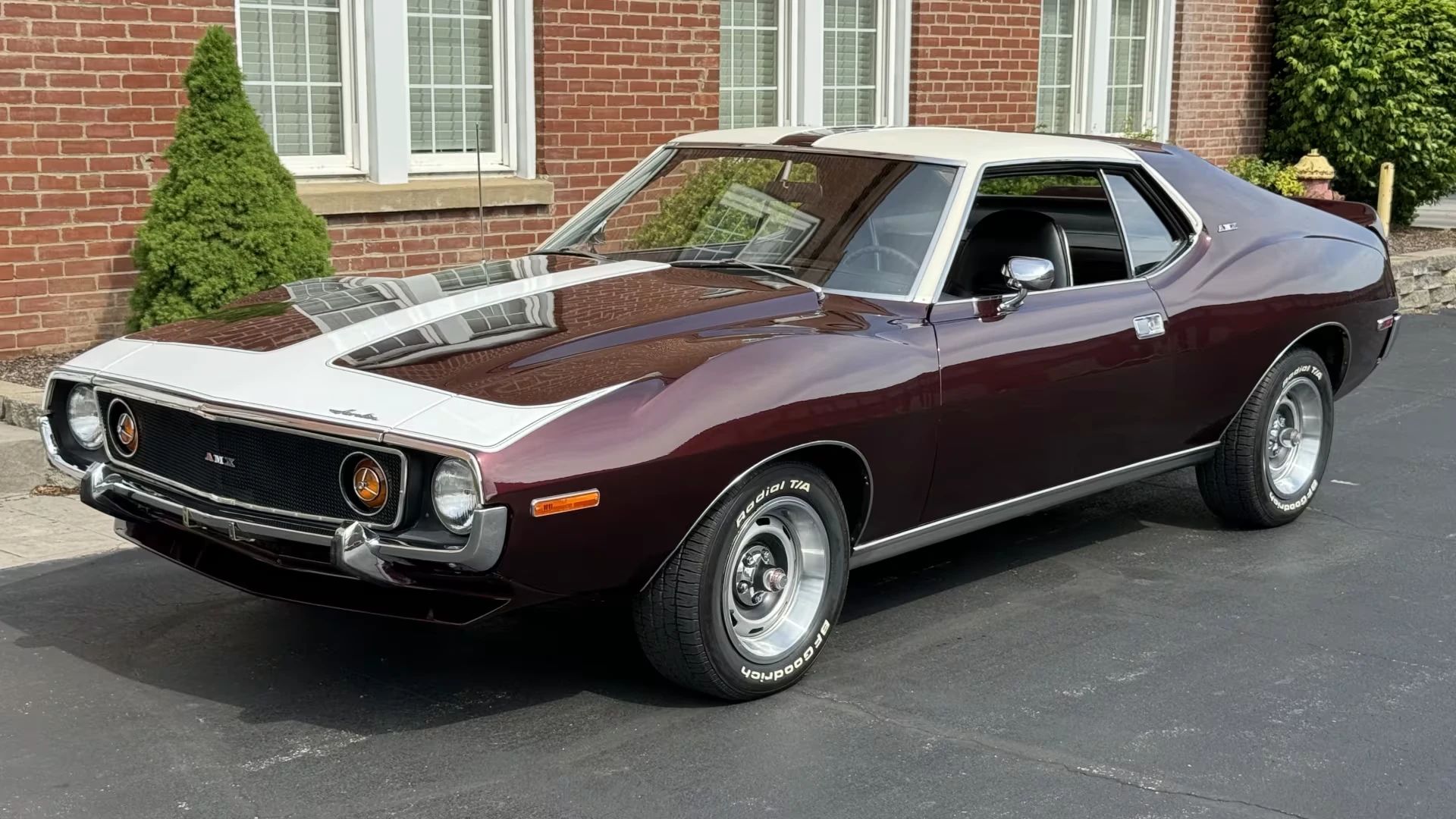
The AMC top was similar to a Chrysler canopy roof, except that there was an exposed section through the center of the roof, with chrome moldings around the edge of each vinyl section. If the vinyl covering hadn’t continued down through the A-pillars, this would have looked like a vinyl simulation of the removable T-tops that became popular later in the decade. It was an unusual effect, but it didn’t catch on, and I don’t know of any other domestic automakers that offered this kind of split roof.
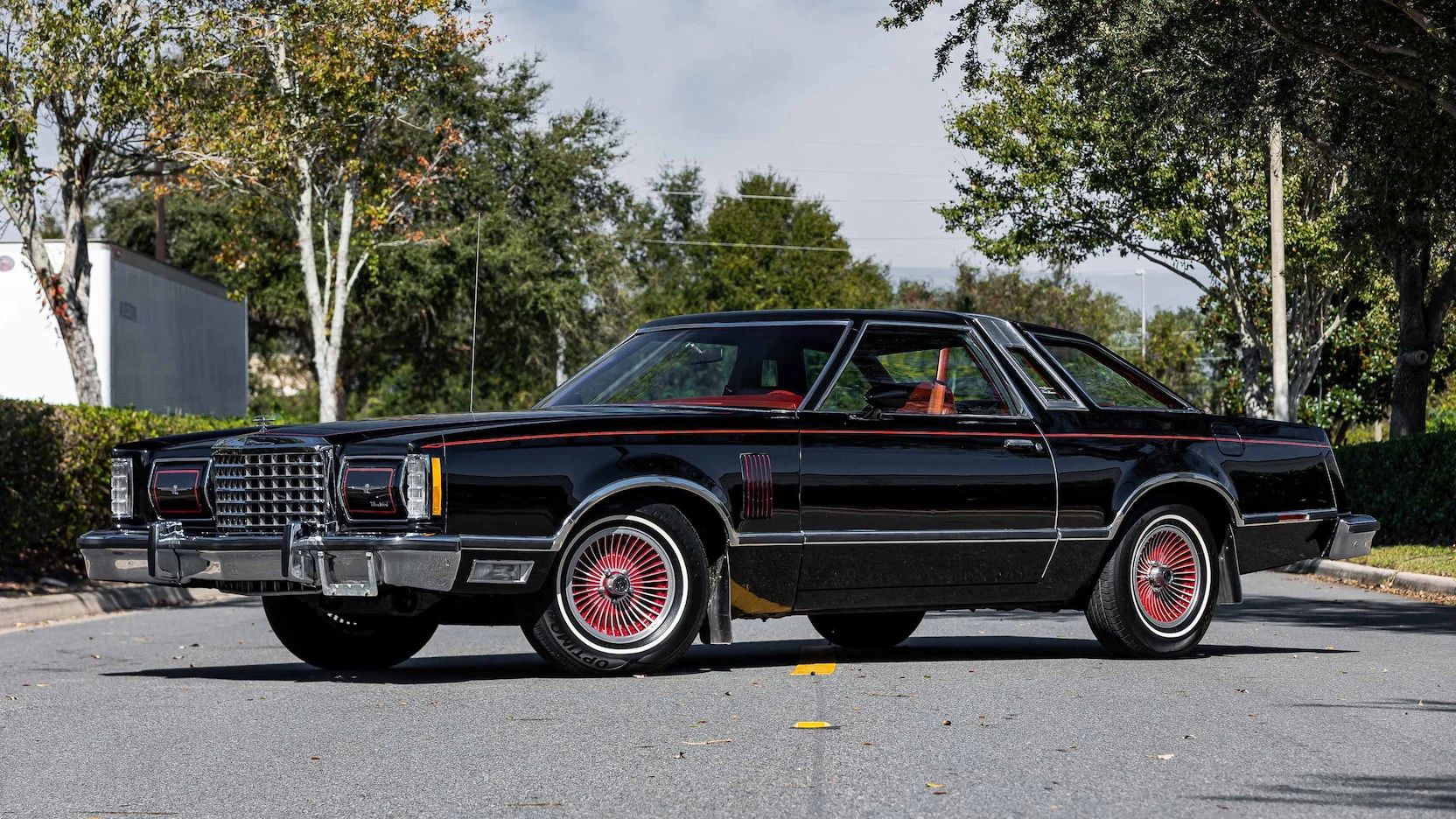
Far more popular was the split vinyl roof offered on the 1977–1979 Ford Thunderbird:
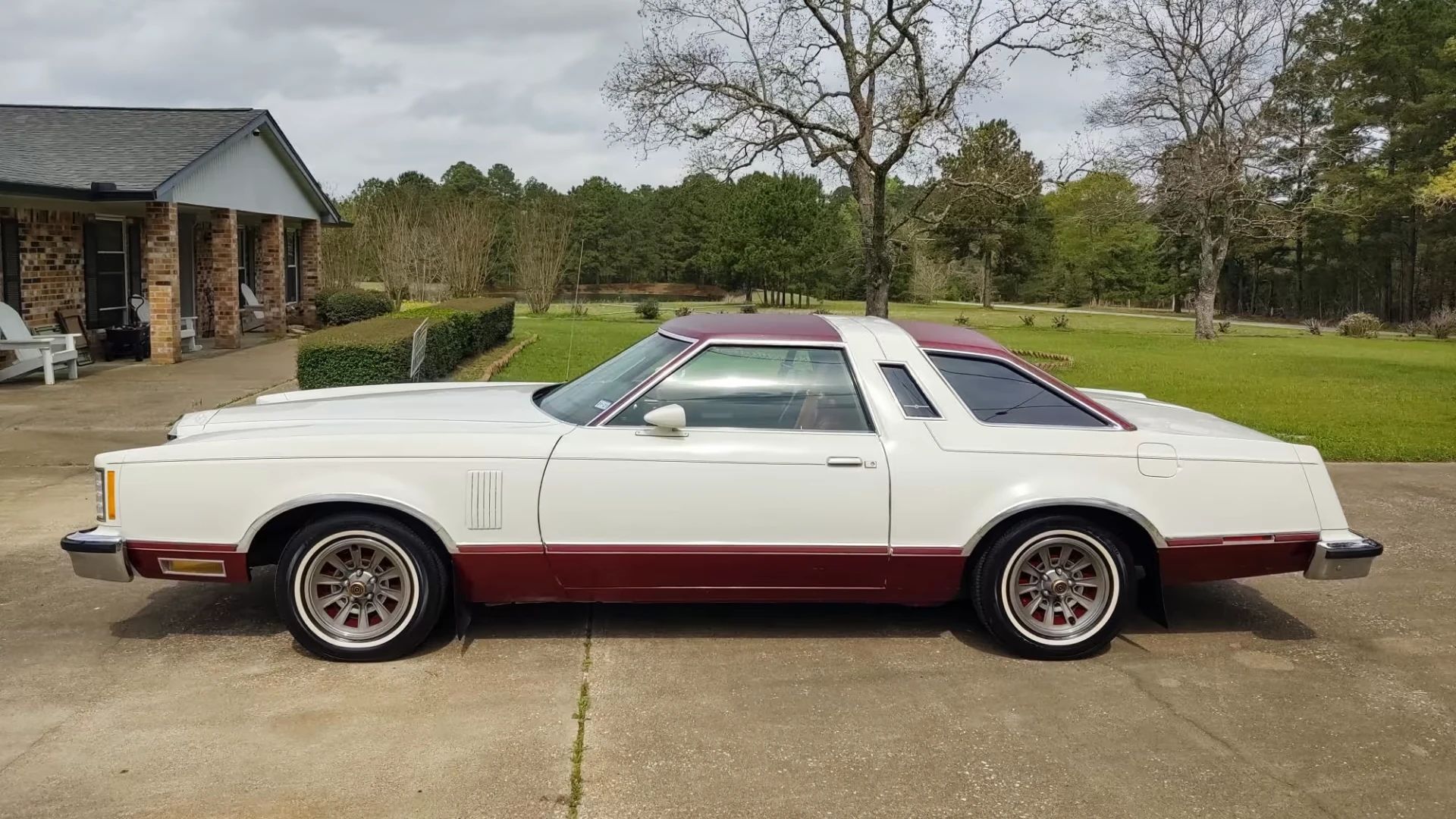
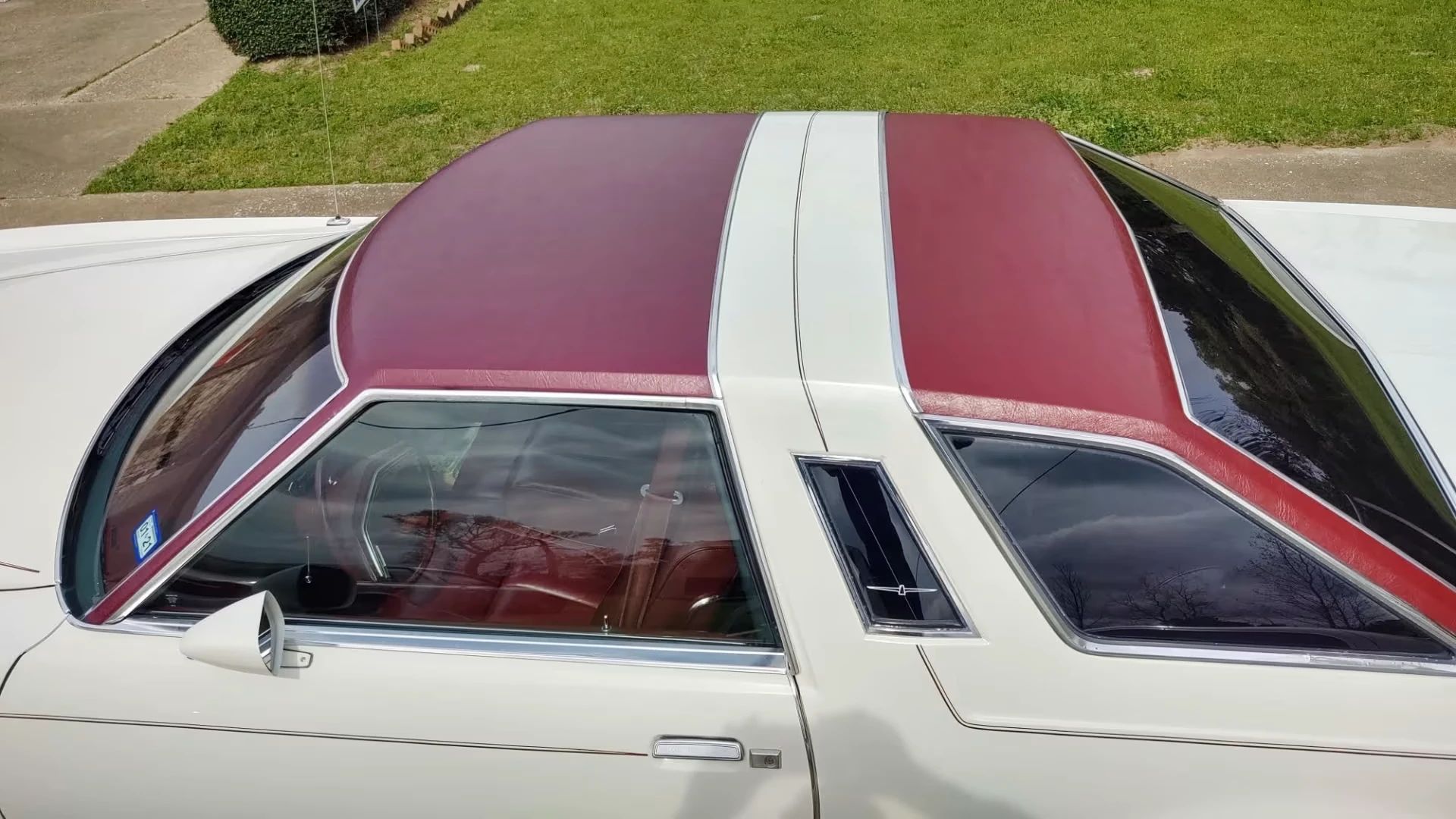
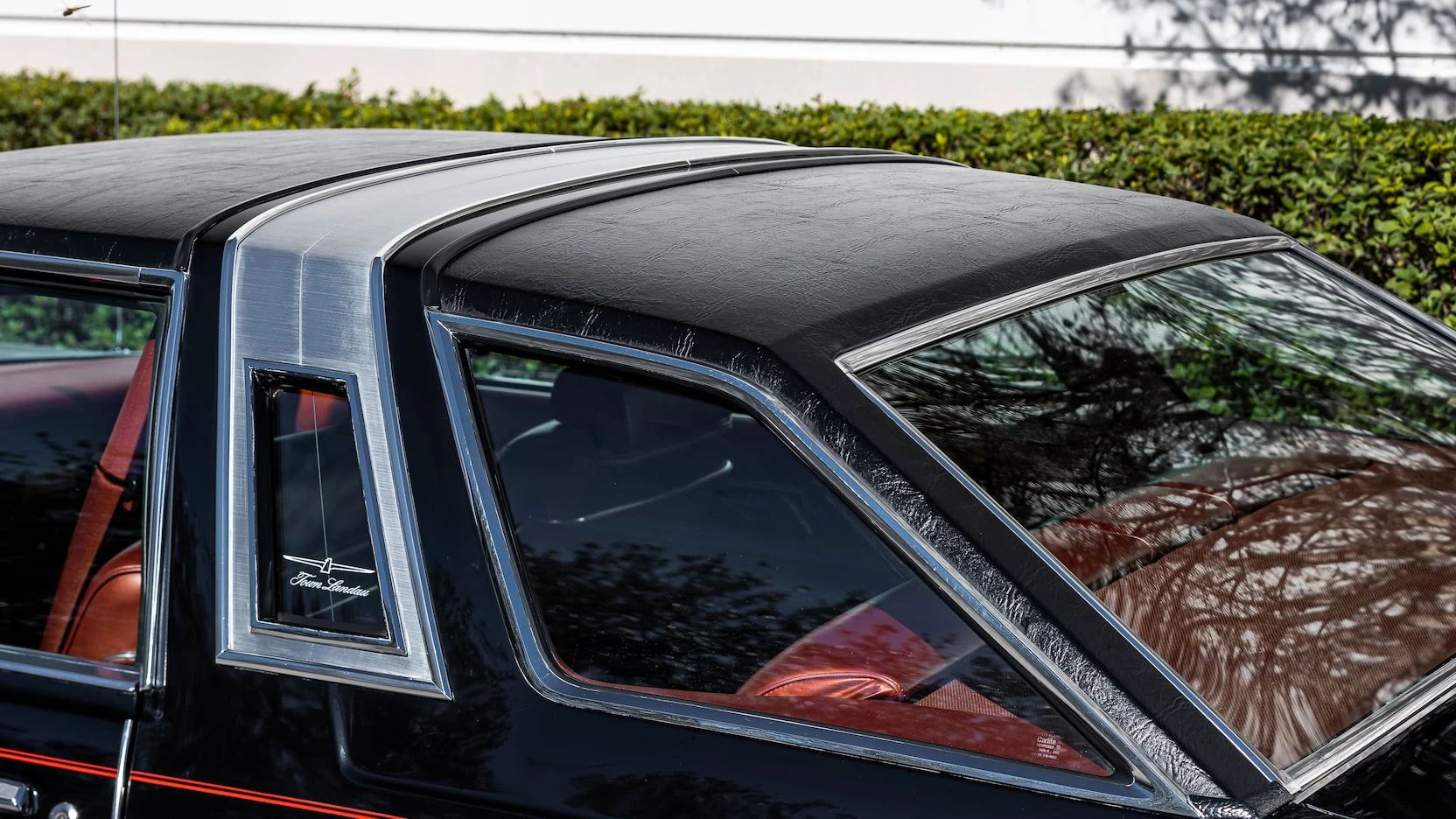
Its two-piece vinyl roof basically combined a canopy top AND a landau top, separated by a body-color wrap-over bar with its own small fixed inset windows:
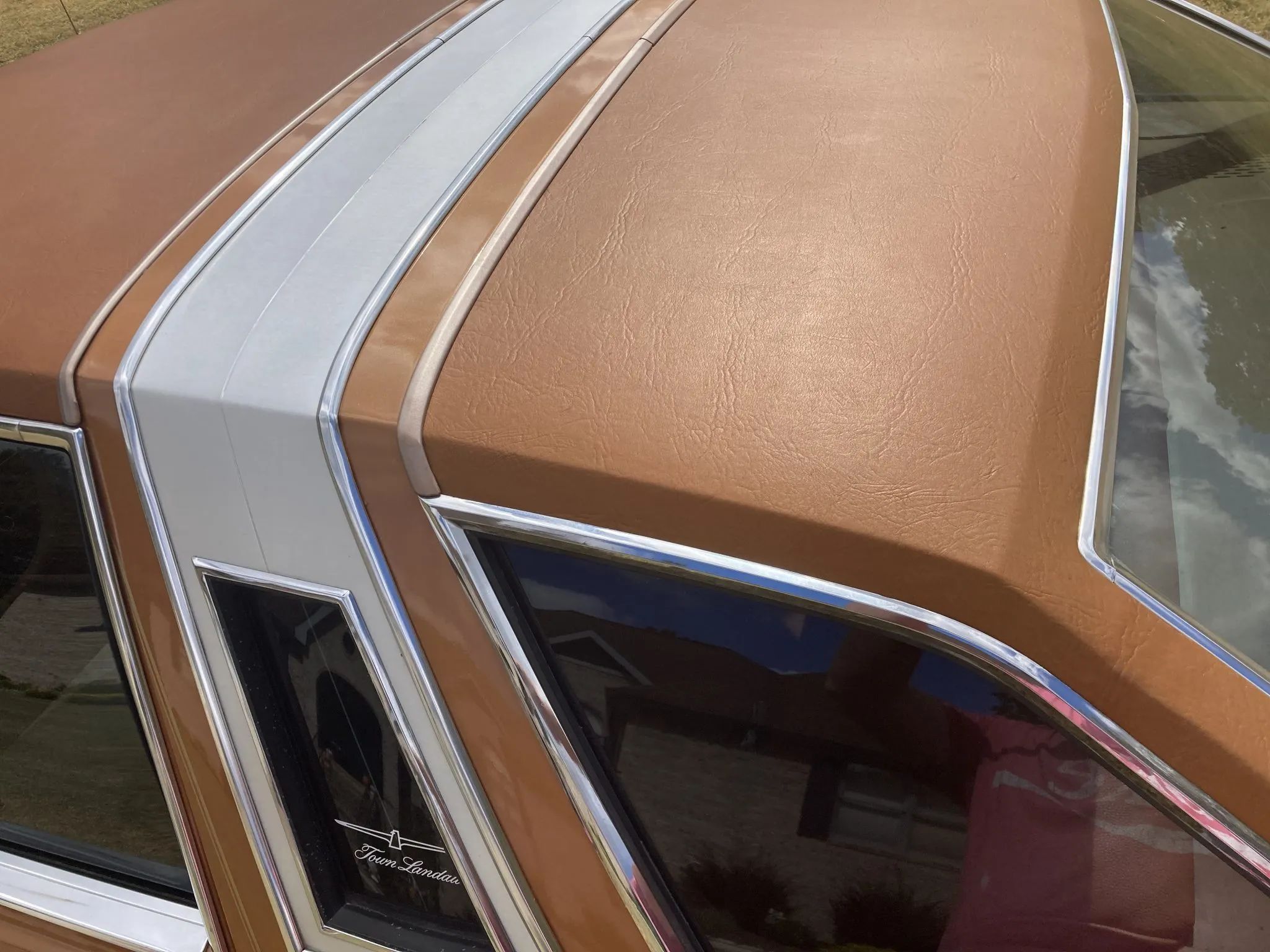
If that wasn’t fancy enough, from mid-1977, there was the Thunderbird Town Landau, which added brushed aluminum trim to the wrap-over bar, also using color-keyed rather than chrome moldings to separate the bar from the adjacent vinyl roof sections. (The vinyl top was still technically optional even on the Town Landau, but very few 1977–1979 Thunderbirds went without it.)
Even for a ’70s Thunderbird, this was deliriously overdecorated, but Ford was trying to distract people from the Thunderbird’s resemblance to the Ford LTD II on which it was now based.
As you can see, the selection of vinyl tops on offer in this era was vast and bewildering, even without getting into the nuances of different vinyl grains and stitching, and I’m probably skipping over some variations.
These options were so incredibly popular in the ’70s (installation rates on domestic luxury cars were typically over 90 percent) that there was a real appetite for novelty, no matter how over the top. The sole point was to be able to order your ostentatious brougham with something your neighbor’s or golfing buddy’s car didn’t have, even if they shopped at the same dealer.
Within just a few years, though, the popularity of vinyl roof coverings had fallen off so dramatically (except among Gold Coast retirees, Texas oilmen, and aging cocaine traffickers) that many of these distinctions had faded beyond recall.
Related Reading
Most Colorful Vinyl Roofs Of The 1970s: Dramatic Two-Tone Effects In Contrasting Colors (by me)
Automotive History: The History of the Vinyl Roof, Part 1 – Origins (by Tom Halter)
Automotive History: The History of the Vinyl Roof, Part 2 – Peak Vinyl (by Tom Halter)
Automotive History: The History of the Vinyl Roof, Part 3 – Topping Things Off (by Tom Halter)
Cadillac, Lincoln, And Imperial Interiors Of The 1970s: Almost Every Color Of The Rainbow (by me)























The stylists clearly knew which old forms they were imitating, but those old forms were so far back in time, and so rare when they were new, that very few buyers would recognize the throwback.
Seems like an inside joke, almost a prank.
The Continental tire was a more immediate throwback when it first came out, since the rear spare was still common around 1934. The retro Beetle and retro T-bird are also familiar to buyers of all ages.
They really weren’t that far back. A 50-year-old luxury car buyer in the ’70s was born in the 1920s, and the ’20s and ’30s luxury cars that were the reference points were no older in the ’70s than a ’70s car is today. While buyers might not have seen fancy laundaulets or limousines up close, they had certainly seen them in movies and in magazines, associated with the rich and glamorous. The ’70s was also awash in ’30s nostalgia: There was a whole litany of coffee table books about ’30s fashions, cars, and movies. It was big business, and the popularity of neoclassical styles, whether cars like the Lincoln Continental Mark III or the real retro atrocities like the Excalibur, speaks for itself. These were clearly not obscure reference points for contemporary buyers.
Great work. Very thorough. KELLEN
Great series, Aaron. Having grown up in the seventies, I was always fascinated by the plethora of vinyl top choices. As I mentioned in a comment I posted on part one, only two of my cars had vinyl tops.
The ‘73 LTD 2-Door Hardtop would’ve looked wrong without it, and the ‘79 Futura looked great with its split vinyl tops, emulating its larger stablemate, the T-Bird.
One of my favorites of the era was what Chrysler did with the ‘73 or ‘74 Charger SE, with the front half of the roof covered. To my eyes, these tops looked great in white, with the rest of the car in dark red paint.
I must admit though, I don’t think I’ve ever seen a Javelin done up that way.
(Apologies if this is a repeat comment… I tried to comment from my iPad and it kept hanging up.)
Oh man, I love those 1970 Mustangs with those ’70s colors and ’70s tops. They’re a little cheesy, but they look good.
I do LOVE that “Gold” color on the Mustang. I think I had a Matchbox the same color, as every time I see it, I get an odd flashback type feeling. Do love the color regardless.
Not dead yet…
The 1965 Chrysler New Yorker had some different vinyl top variations. Just the C pillar had vinyl on the coupe and four window sedan and there was a split top option on the wagon.
Great article and comparisons! If I were to choose a favorite style, it would be the Canopy Top – I think those tops often added some stylistic intrigue to the designs, rather than just looking like add-ons.
Though what I really find fascinating are foreign cars that were wold with vinyl roofs. Few models actually pulled that off well.
An interesting question would be what event marked the beginning of the end for the vinyl roof. My guess would be the all new Ford Taurus/Mercury Sable in 1986. A new, dramatic, clean sheet of paper design – no vinyl roof was offered on any of its models. Its success paved the way for the elimination of the vinyl roof on many of its competitors subsequent redesigns.
Of course there were the aftermarket applications, all which were hideous.
Dud one get missed, or is it a variation on a variation? Chrysler used it on both the M body and the R body.
I am trying to remember which luxury cars had those fiberglass extensions with big padded vinyl roofs. (Chrysler for sure.)
My neighbor’s son had a series of Mustangs, including one with the houndstooth vinyl top. My dad had a light green 1973 Mercury Montego with a dark green vinyl top and interior. I didn’t like it then but now I am a little amazed at the sheer variety of color combinations available.
Definitely the fake convertible tops appealed to a particular customer base. I had a college scholarship, and the group that funded it always invited me to their luncheons. An older wealth lady picked me up in her white Cadillac coupe with navy fake top (with metal bows and canvas top). As I drove an actual convertible at the time, I thought it was kind of silly.
Its a great article , but I still don’t like em.
The first photo sums it up.
You have your windshield, nicely trimmed with stainless, and instead of nice shiny clean paint on the pillar between the moldings, you have ugly cheap dull vinyl with a big lumpy seam part way down.
Hate the things with a passion.
I’m with you. I prefer paint on my large metal surfaces.
I saw a houndstooth roof on a Volvo 164, which was definitely aftermarket, and probably a bad idea. the only imports I recall with factory vinyl roofs were the Plymouth Sapporo and Dodge Colt Challenger captive imports like the picture and some Toyota Cressidas that were probably aftermarket https://www.curbsideclassic.com/blog/cc-for-sale-1982-toyota-cressida-elegante-pre-lexus-luxury-in-the-toyota-of-broughams/
I just remembered the Jaguar XJ12C and XJ6C had vinyl roofs to hide the the welded seams from fabricating the coupe roof
Those split vinyl rooves (roofs) had to be the worst idea ever. About the only thing they didn’t try was a checkerboard pattern. Excellent article.
Only one I truly like is the full vinyl roof. It works for luxury cars, it works on muscle cars and it even works on the handful of foreign cars that used vinyl tops. Personally I wouldn’t want one for the rot traps that they are but they do have a two tone paint effect that can really set a car off, and the point of transition is less contrived with chrome trim(usually). Canopy tops and landau tops drive me nuts because if I’m imagining them as retractable tops they’d both look incredibly silly “open”
The rise and fall of them is ultimately the most interesting, there are a very select few 60s cars like the mentioned Dart that had them when almost nobody else did but none I can pinpoint as the flashpoint where ALL CARS MUST HAVE THEM which was the case right by start of the 70s. The Thunderbird Landau? The LTD? Mark III perhaps?
Likewise I can’t pinpoint the car that really killed them either, seemed like the last true factory fittings with them were probably Cadillac and Lincoln but there was a lightswitch moment for the rest of cars well before that. I saw the Taurus mentioned but I think it was the nail in the coffin more than anything, Ford was committed not to install them even on cars like the Cougar that had a formal roofline as early as 1983 and the same can be said of many formal roof GMs as well that never had factory landau tops either.
I understand the downfall, fads done to excess breeds backlash even if there are appealing aspects of the trend, a perfect and parallel example is Disco music. I’m firmly a rock guy but even I like a whole bunch of Disco hits from the 70s just like I like a bunch of cars from the 70s even though I’m more of a muscle car guy. But the overapplication and the array of questionable executions showcased here make it so easy to understand why it came to a close. Unlike Disco, where ardent fans of blame events like Disco Demolition as it’s killer, vinyl tops don’t really have a significant point to mark their end, yet they seemed to die off from being mainstream right around the same time.
It may be surprising to learn that the popularity of vinyl tops began to dip in 1979 and then nosedived in 1980–1981, before the Taurus or Aero Bird ever went on sale. Ford felt at the time that the early ’80s economic downturn had accelerated that, since if you were looking at a 20 percent APR on a new car loan, the extra cost of the vinyl top suddenly became very skippable.
I think that the death knell for the vinyl top was when the auto makers decided that that they no longer cared if the roof seems were visible or not. The cheapest imports in 1965 had a better finished roof than most luxury cars today.
I never was too fond of vinyl roofs except for a couple of cars. The Dart GT looked much better with the canopy roof than without. And I always liked the unique split roof on Dad’s AMX. Of course, with the 401 under the hood that car had its charms to a young man.
The canopy vinyl roof treatment that I remember most was on the Plymouth Duster. I think it was included with the Gold Duster package (or some kind of end of year spring special).You couldn’t swing a dead cat without hitting a Duster with a canopy vinyl roof in the seventies.
The ’65 New Yorker wagon had a vinyl roof with an unusual split . https://www.curbsideclassic.com/automotive-histories/automotive-history-the-history-of-the-vinyl-roof-part-2-peak-vinyl/
So many 1970s cars just don’t look right to me without a vinyl roof, even if I now find a slick-roof version more attractive.
Unless I am missing one, I think both Chrysler and Studebaker were pioneers of the canopy roof on the New Yorker Salon and the later GT Hawk.
(1) The ’70s really were the nadir for… pretty much everything? Like, I get why ’70s aspirational cars were like they were: If you were buying them in the ’70s, you grew up in the ’20s, so you wanted what you didn’t have – a soft ride, silence, smoothness, and mass. Then the kids who grew up in the ’70s bought BMWs because *they* didn’t have responsiveness, acuity, performance, and purpose. But still, the taste…
(2) I recently saw a 2010-ish Subaru Legacy with a vinyl roof. I’m not sure how big the intersection of “people with ’30s nostalgia” and “people who choose to buy a Subaru Legacy at some point” is, but it’s not zero.