
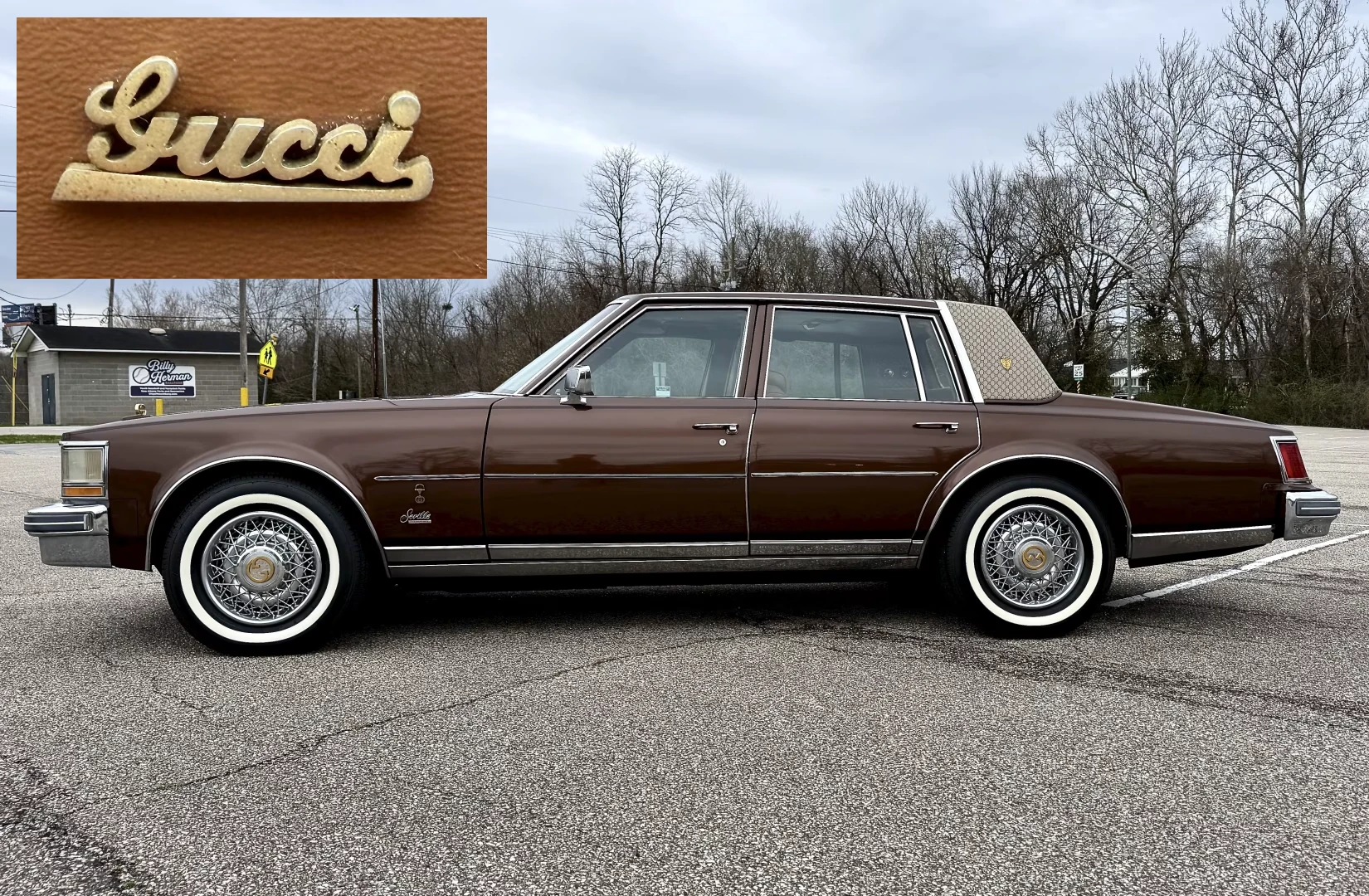
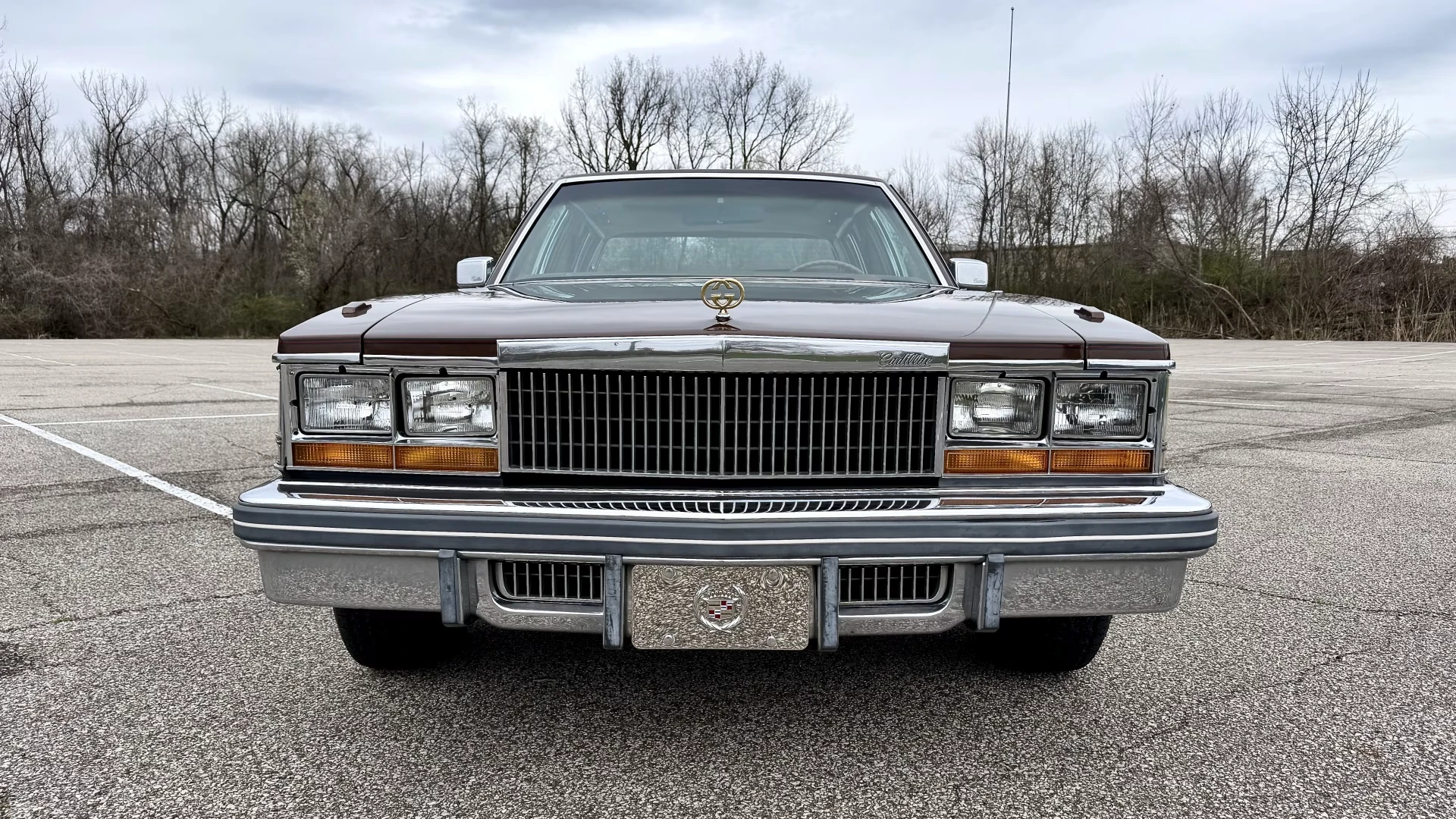
Many people know that Lincoln and AMC offered an array of designer edition cars in the ’70s, but Cadillac stuck to its own non-designer special editions. So, what, then, is this Gucci-badged Seville? Some Florida dealers decided Cadillac was missing a bet and approached the designer directly to create their own limited-production special editions. This rare 1979 Gucci Seville is powered by the infamous Oldsmobile 5.7-liter diesel.
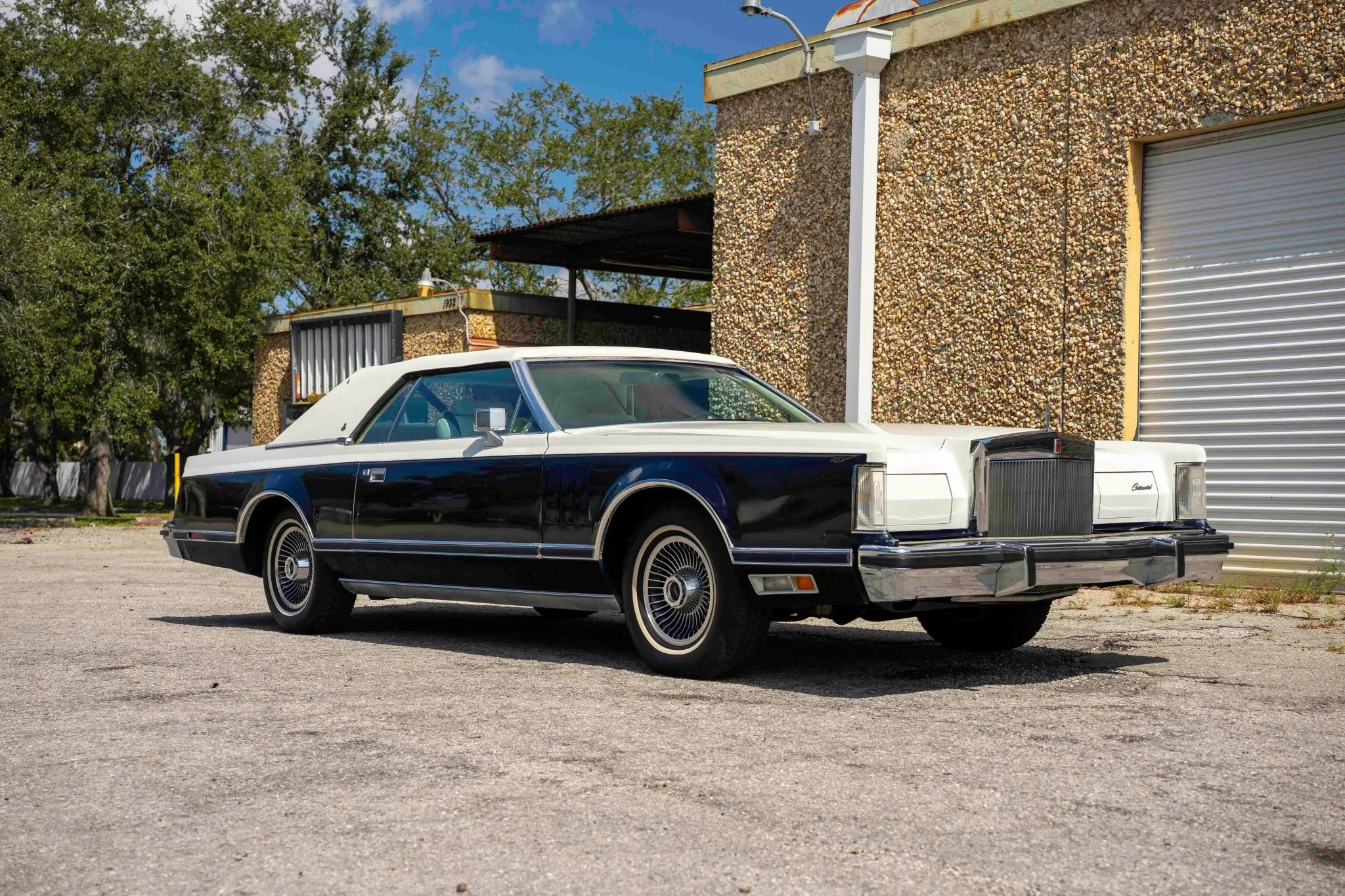
In a January 1979 New York Times article, business writer Pamela G. Hollie proclaimed it “the year of the signature car.” Special editions tied to well-known designers weren’t new for Detroit — AMC had introduced its first designer edition, the AMC Hornet Sportabout Gucci, for 1972 — but by decade’s end, it had become a very lucrative business.
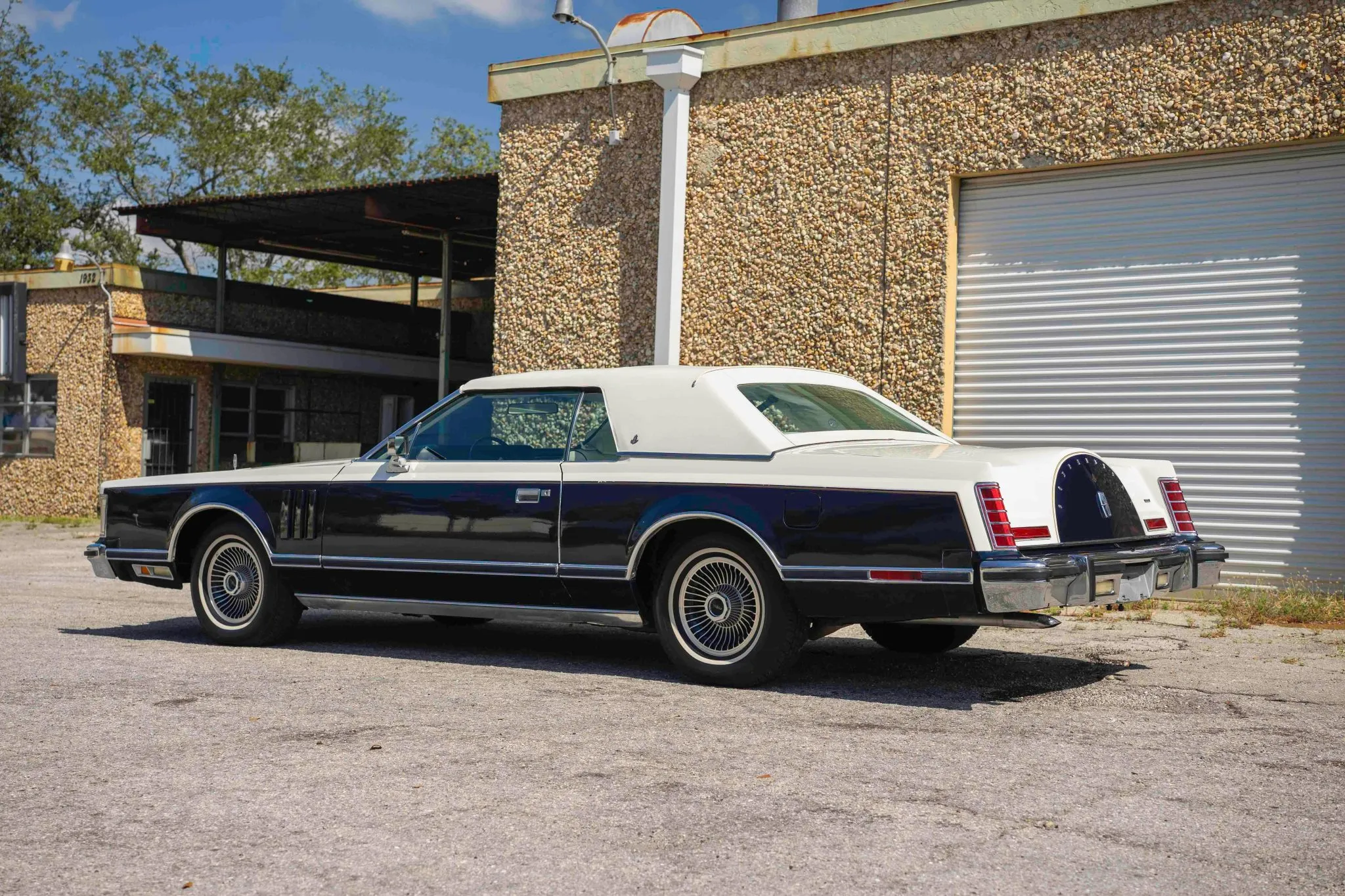
Ford reported in early 1979 that roughly one in four 1979 Lincoln Continental Mark V buyers were ordering one of the four Designer Series options (Bill Blass, Cartier, Emilio Pucci, or Givenchy), with suggested retail prices that ranged from $1,525 to $2,775. Even at the time, some people sneered at them; Paul Goldberger, critic for The New Yorker and New York Times chided these signature editions as “empty status — sheer promotion, not quality.” However, the investment costs were minimal, the profits were high, and many designers were happy to cooperate and collect their royalties (which at least some took in the form of new cars).

Cadillac hadn’t really dipped its toes in that particular pool. They’d offered some rather gaudy special editions, like the D’Elegance, Talisman, Custom Biarritz (above), and Elegante, but those hadn’t been branded signature editions like the Lincoln and AMC cars. I don’t know exactly why not; GM had once had obscure corporate policies about not naming products after living people, which might have been a factor, or Cadillac may just not have wanted to pay royalties for the use of designer names.
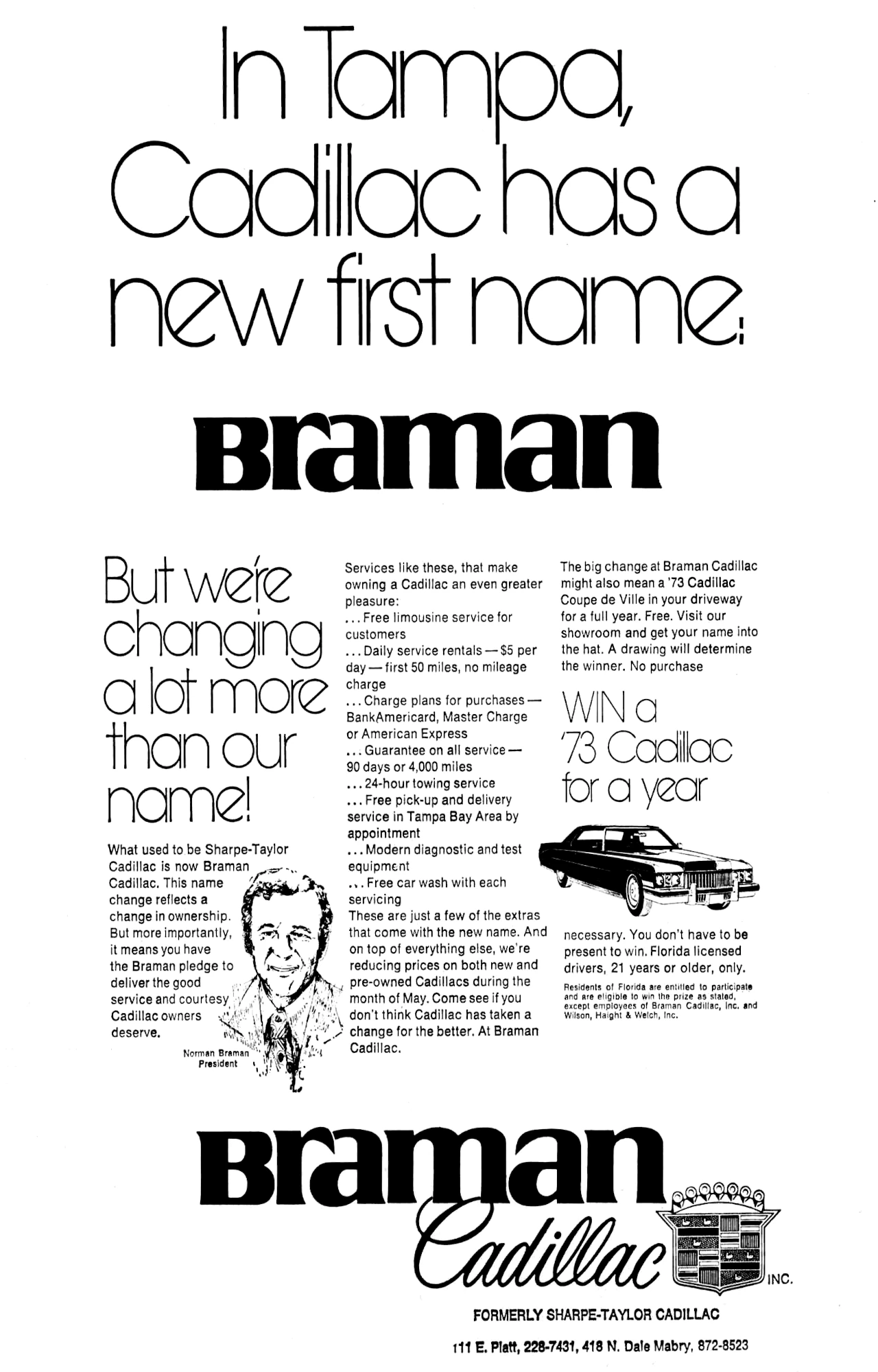
By 1978, Florida Cadillac dealers Norman Braman and Edward Leibowitz had decided this was leaving money on the table. A few words about Braman seem in order: The son of Jewish immigrants in Philadelphia, he had become an executive in his father-in-law’s Bargaintown USA chain. A series of corporate mergers had left Braman very affluent, so he stepped down in 1969 and moved to Florida. In 1972, he bought Sharpe-Taylor Cadillac, a Tampa Cadillac dealership, renaming it Braman Cadillac in mid-1973. Ed Leibowitz, Braman’s brother-in-law, also became a Cadillac dealer, owner of Tampa’s Bay Cadillac.
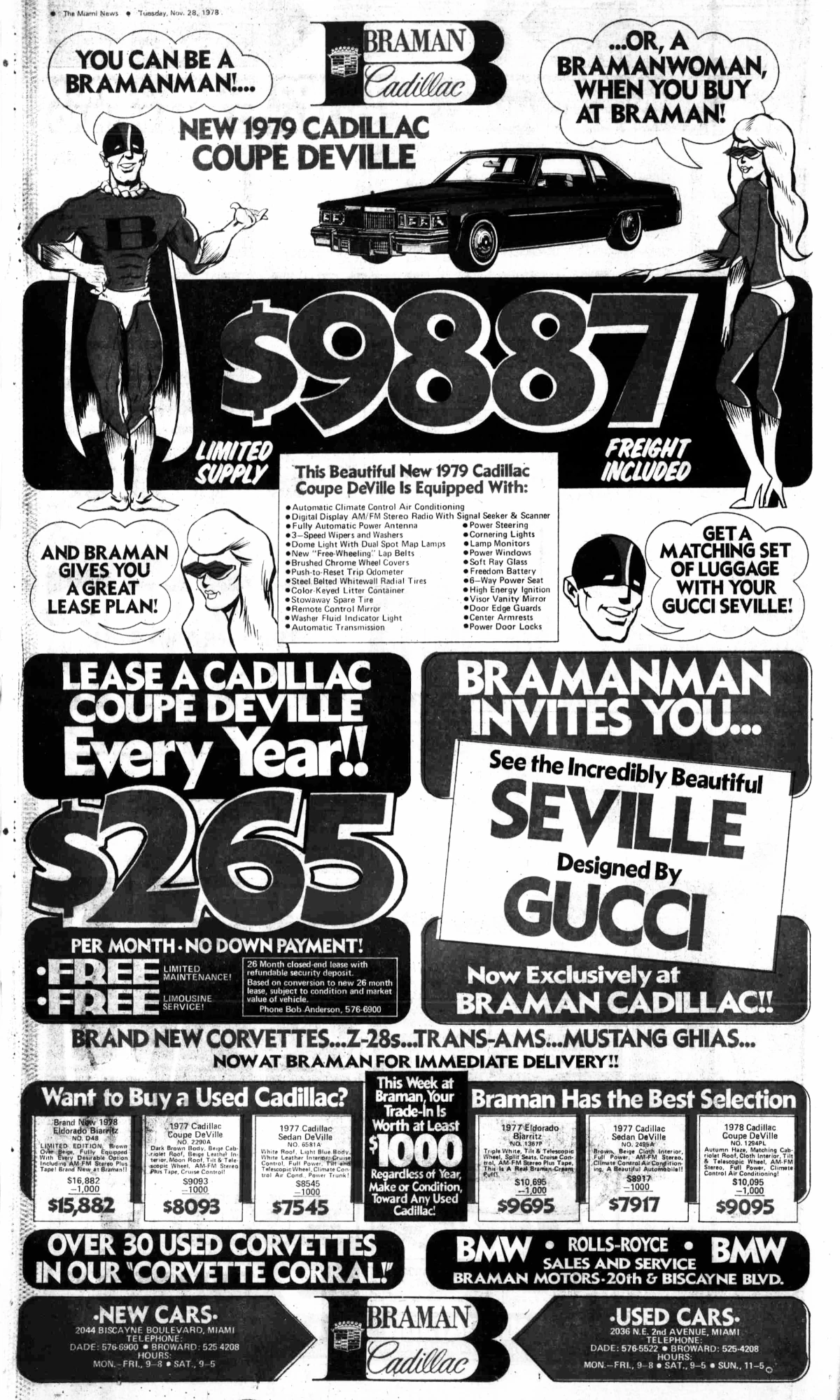
By 1978, Braman owned an array of dealers in Tampa and Miami. Noting the growth of luxury imports, he bought out C.R. Berry Motors, a Miami BMW and Rolls-Royce dealer, and moved it next door to his Cadillac dealership. He later picked up Fiat-Lancia and Toyota franchises as well. However, his Miami Cadillac dealership seems to have been the big cash cow: Forbes reported that its 1978 sales totaled $75 million, making Braman one of the world’s biggest Cadillac dealers.
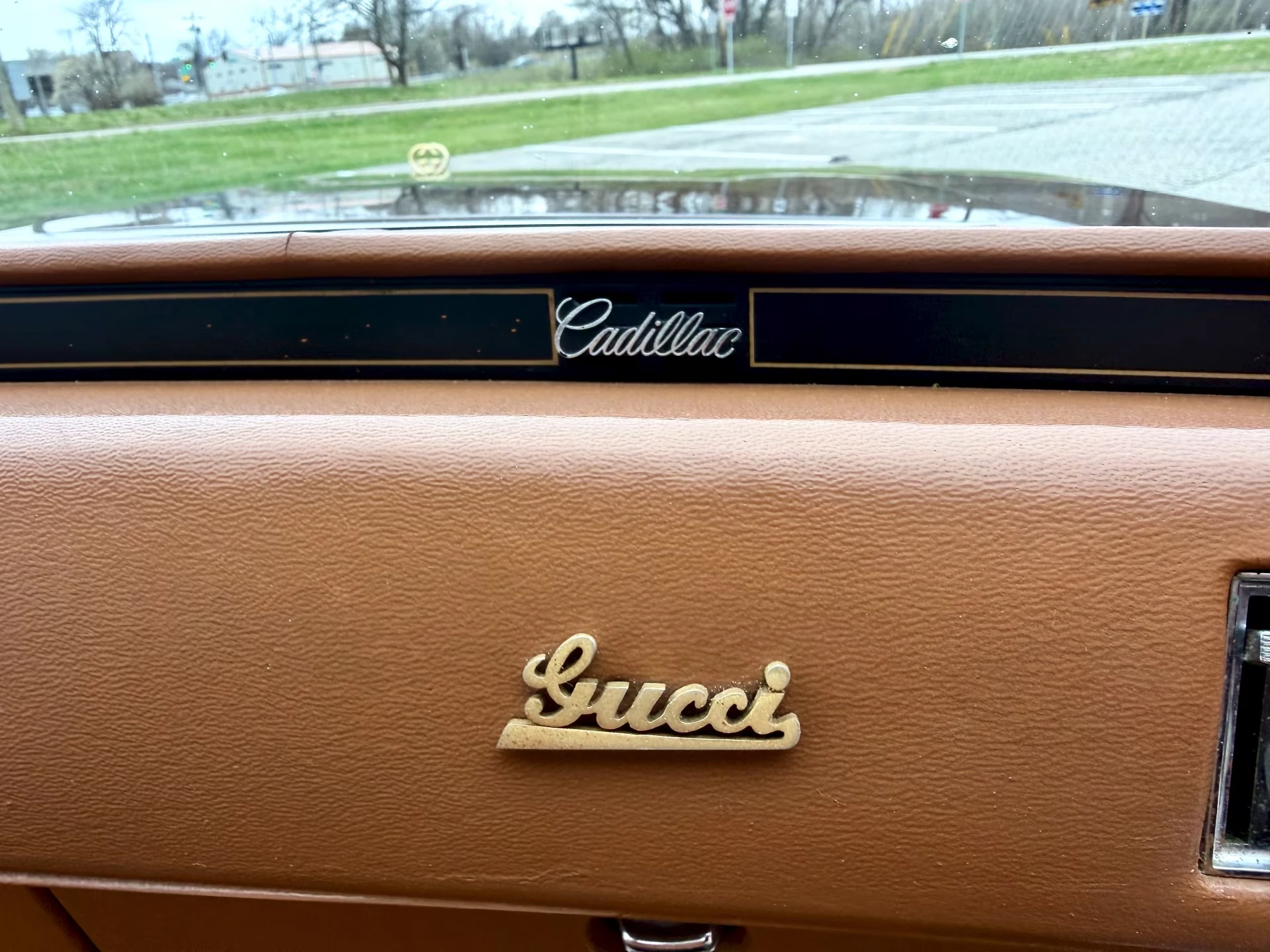
Braman had also become friends with Dr. Aldo Gucci, the same Italian fashion designer who had lent his name and trademark colors to the 1972 Hornet Sportabout. Gucci was amenable to lending his name and trademarks for a special edition of the Cadillac Seville, especially since, in Hollie’s words, the royalties Braman offered were “handsome enough to make car designing more interesting than fashioning belts or shoes.”
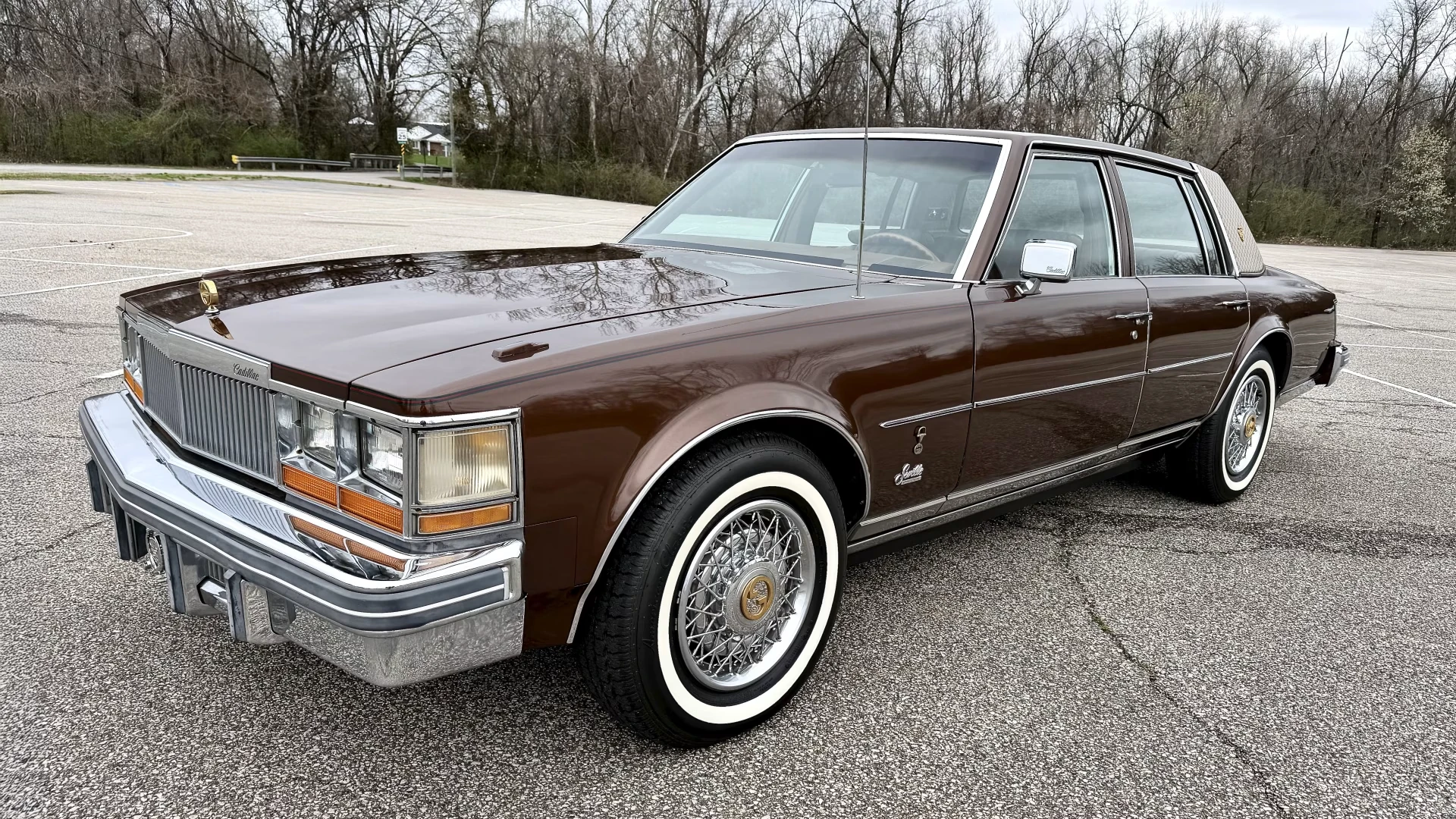
The Gucci Seville was not made by Cadillac, but it was series-produced, sort of. Braman and Leibowitz formed a corporation called International Automotive Design Inc., based in Miami, and leased a 24,000-square-foot warehouse near the Bay Cadillac lot in Tampa for the conversions. “We had a choice of doing it either in Detroit, Miami, or Tampa,” Leibowitz told the Tampa Tribune. “For control purposes, we eliminated Detroit. And because we had no room at the Miami dealership for expansion, we decided on Tampa.” He added that since Tampa was farther north than Miami (by 280 miles), the Tampa location would also make it a little cheaper to ship finished cars to other interested dealers.
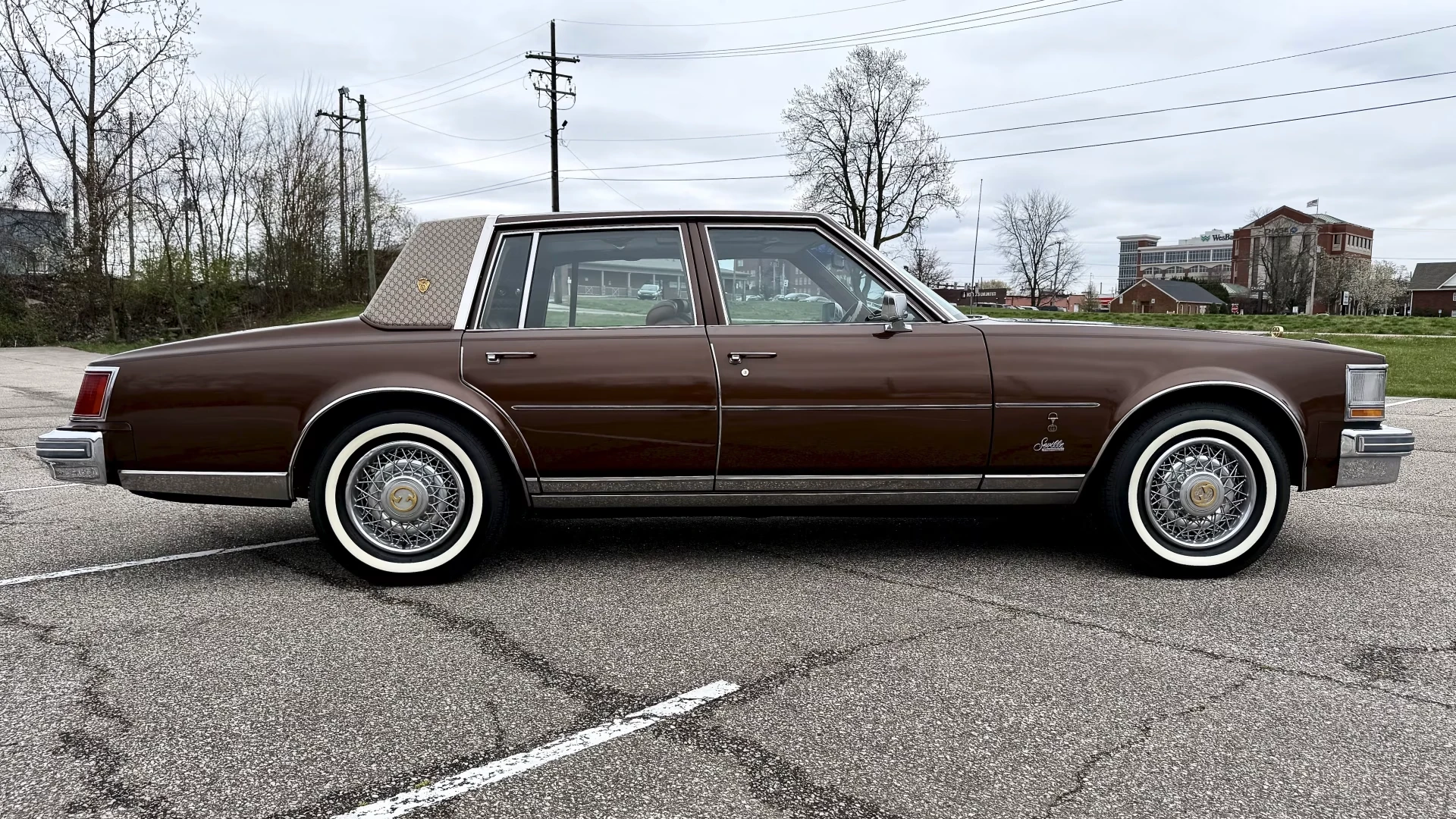
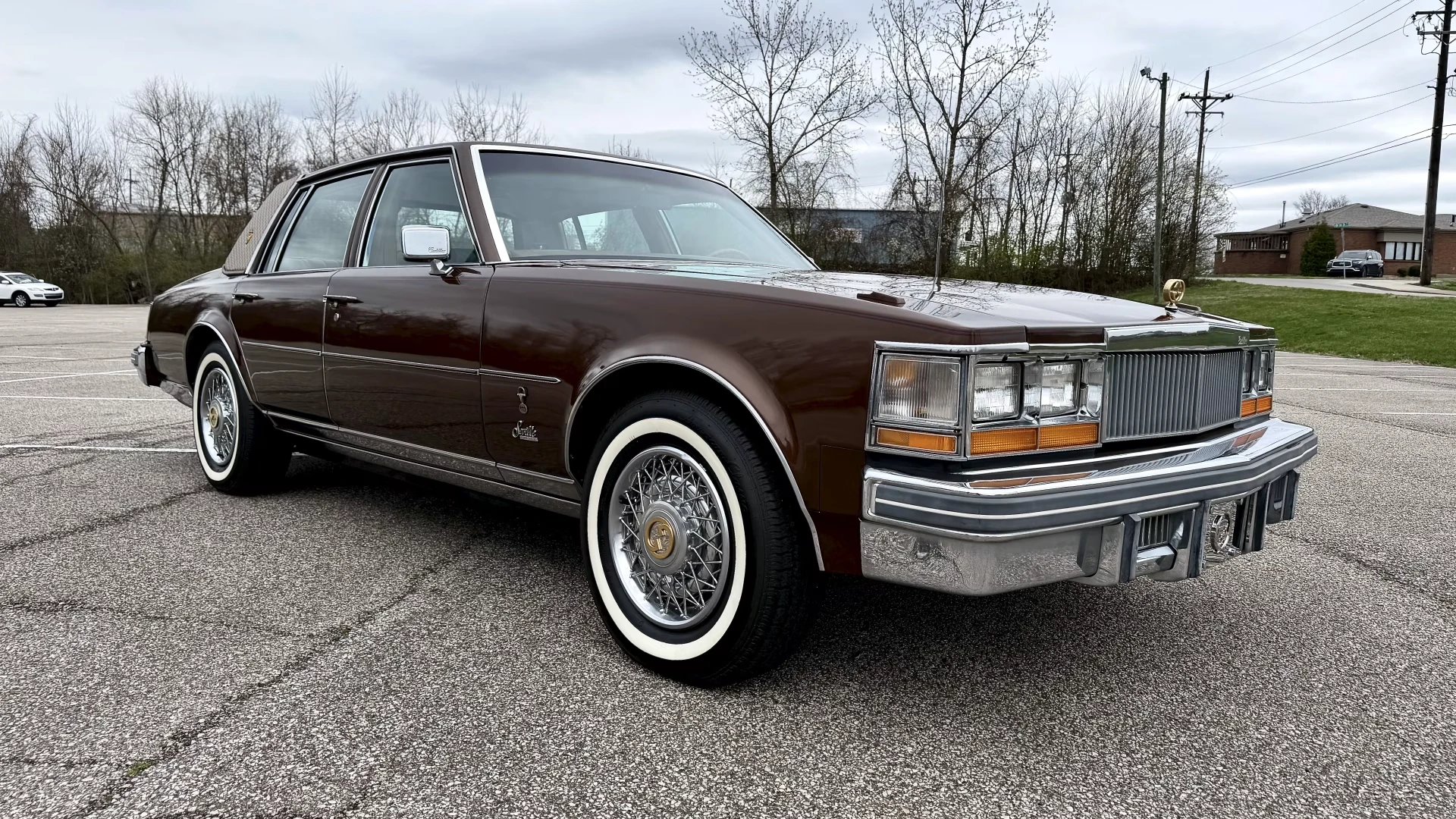
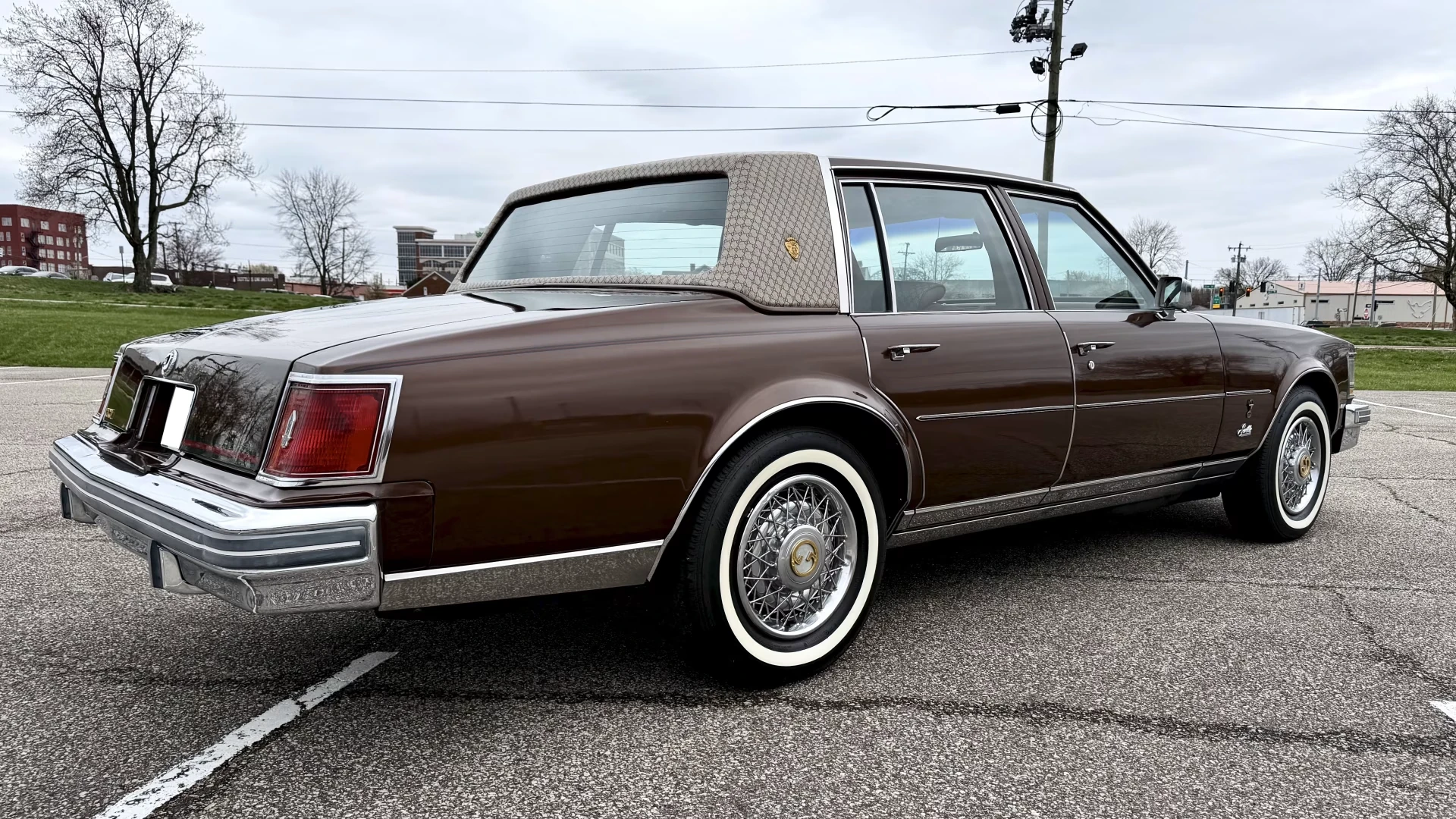
Gucci Editions were produced in three colors: Cotillion White, Sable Black, and Post Road Brown.
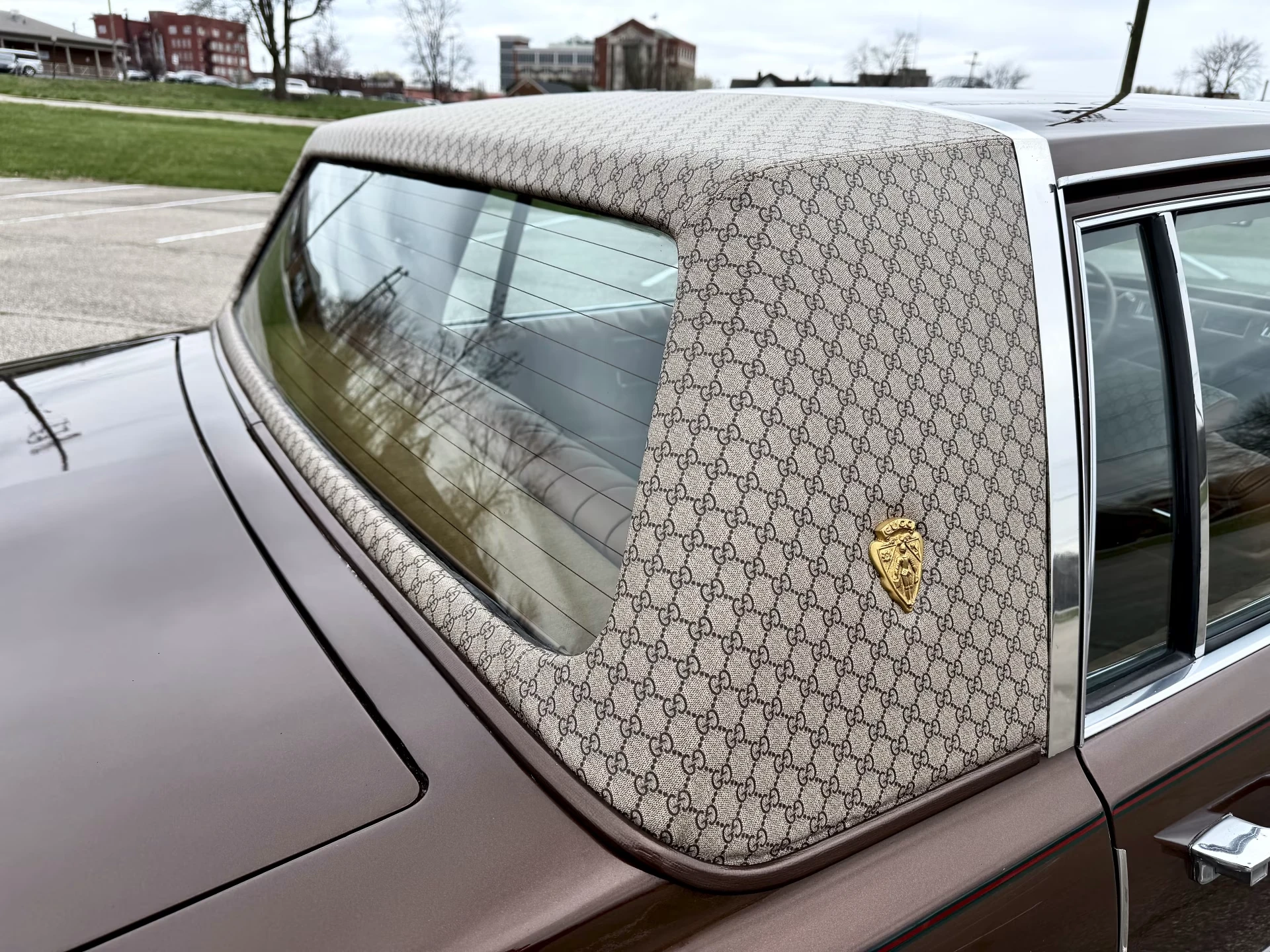
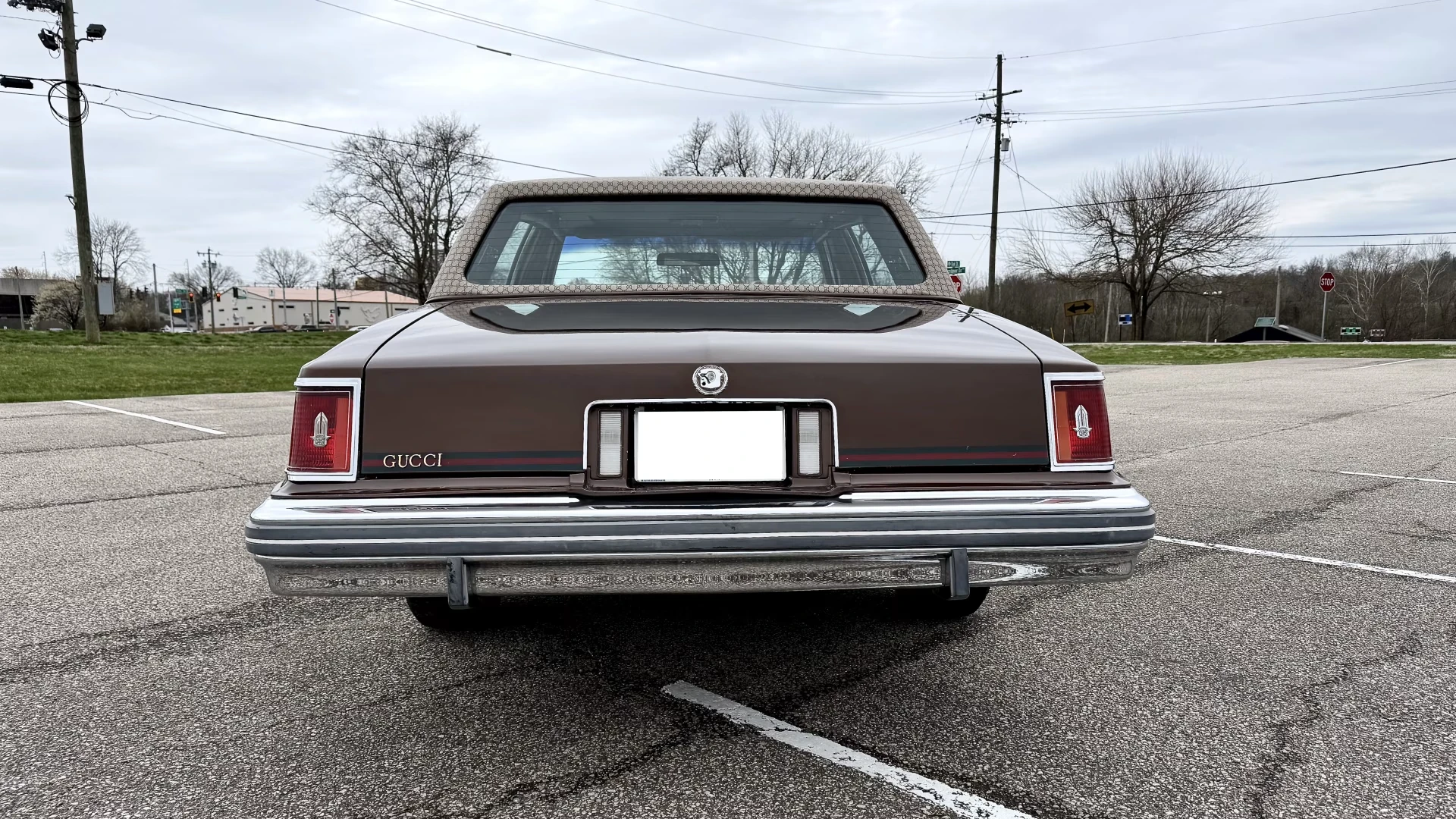
Each got a special landau-style fabric roof, imprinted with Gucci interlocked “GG” emblems and set off with a stainless steel band.
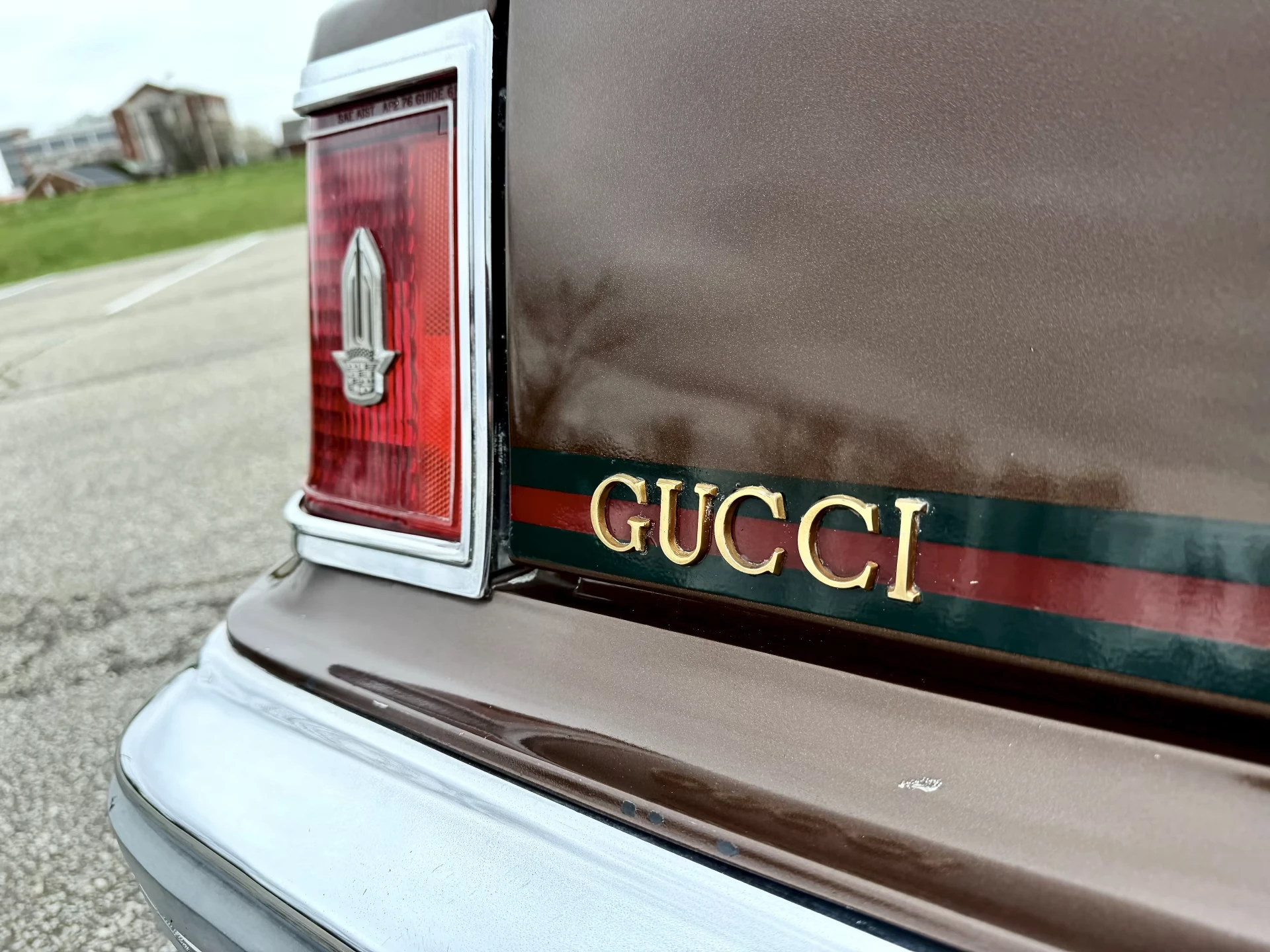
There was another Gucci badge on the decklid, along with the signature Gucci green and red accent stripe just above the rear bumper.
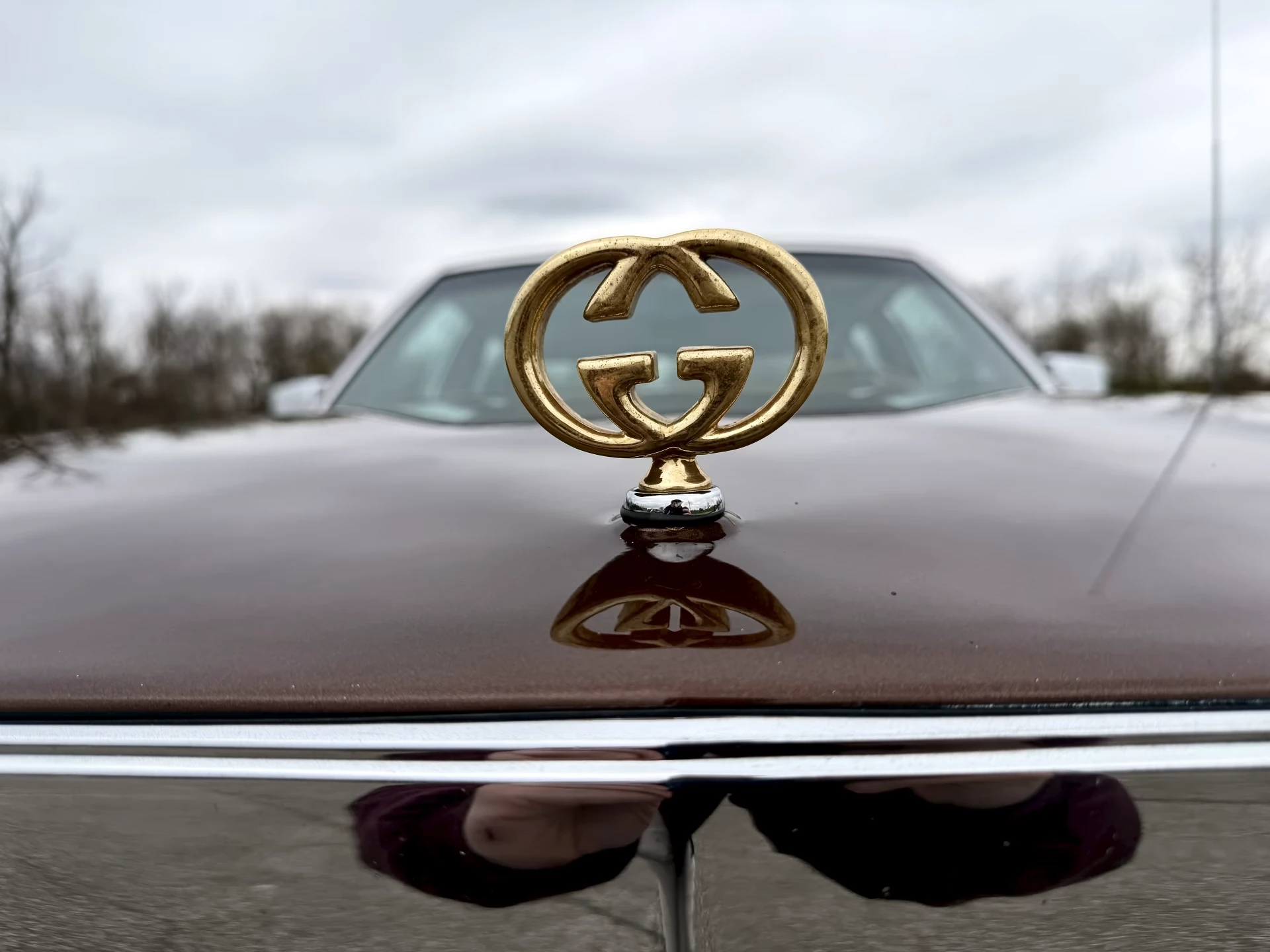
Buying one of these Sevilles gave you what the Miami News sarcastically dubbed “a carload of registered trademarks,” including the 24-karat gold-plated interlocked “GG” emblems that formed the hood ornament. Paul Goldberger snidely said this “looks something like a bottle opener but is more likely a buckle left over from an overrun of Gucci loafers.”
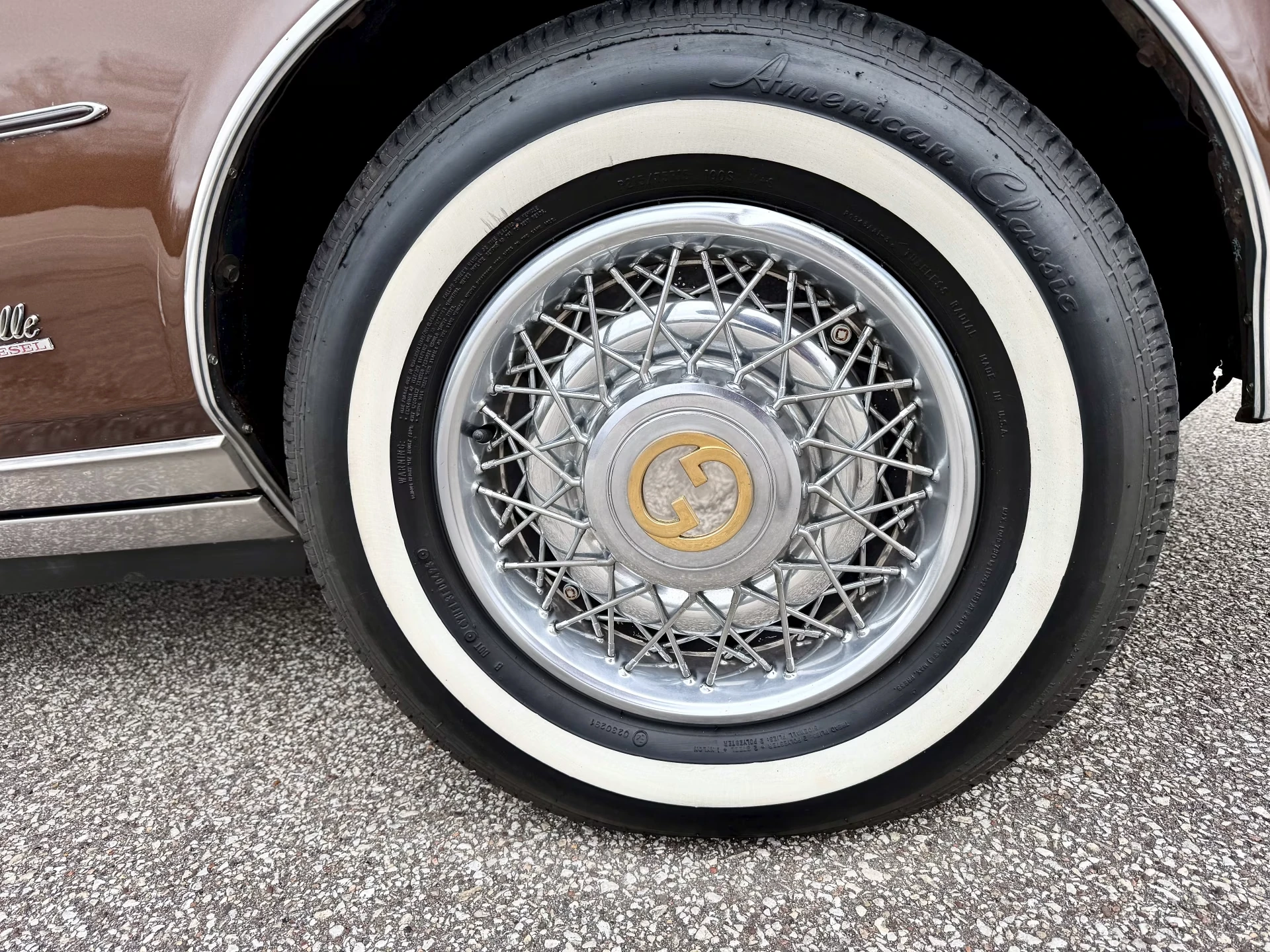
The emblem also adorned the wheel cover caps.
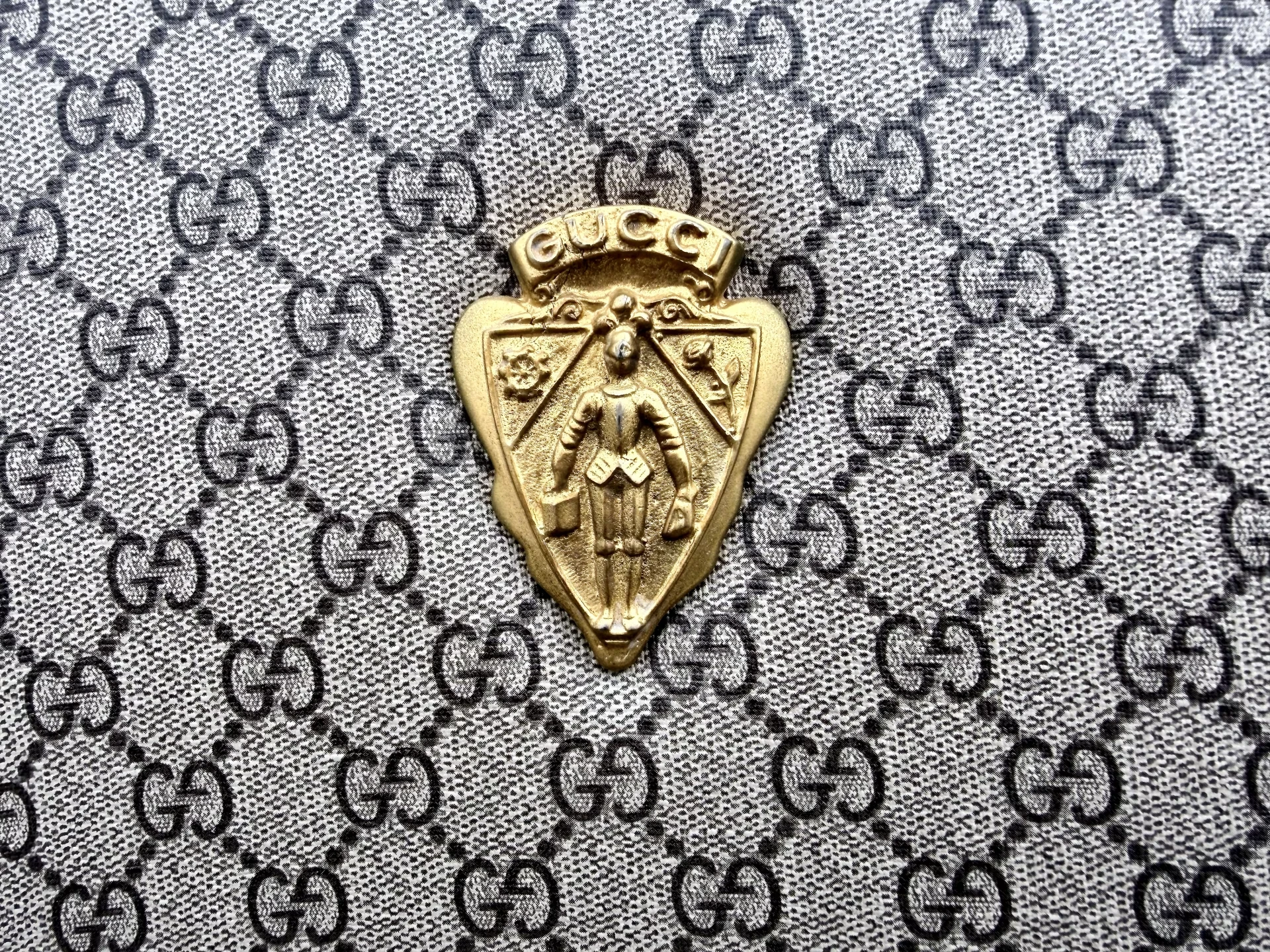
There was a gold-plated Gucci family crest emblem on each sail panel …
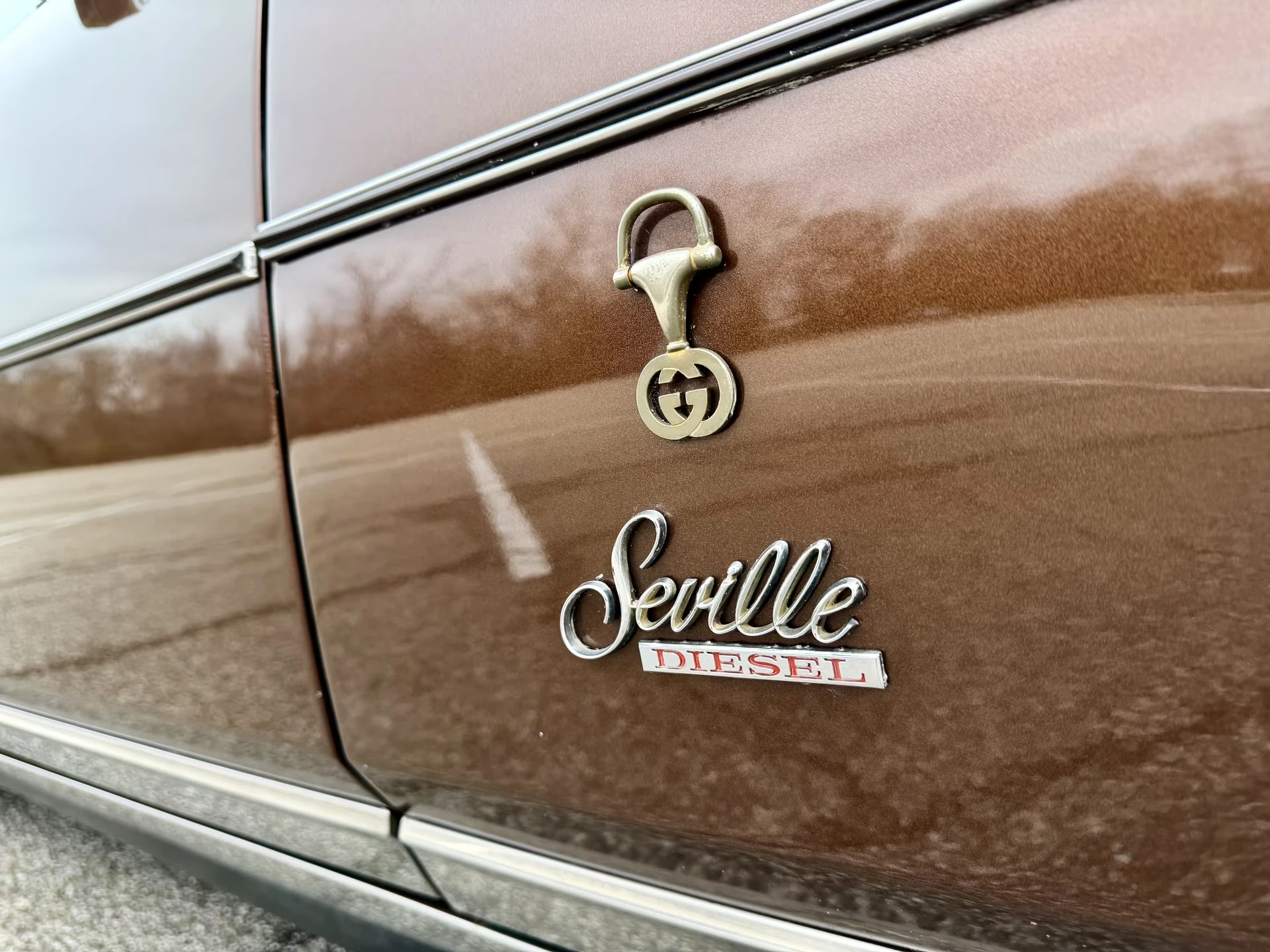
… and a Gucci horsebit ornament on each fender. Yes, this car has the LF9 Oldsmobile diesel engine, which was a $287 option on the 1979 Seville. Not all the Gucci Edition cars had the diesel, but 1979 was the first full year for that option, which was installed in 10,731 Sevilles this year, about 20 percent of production.
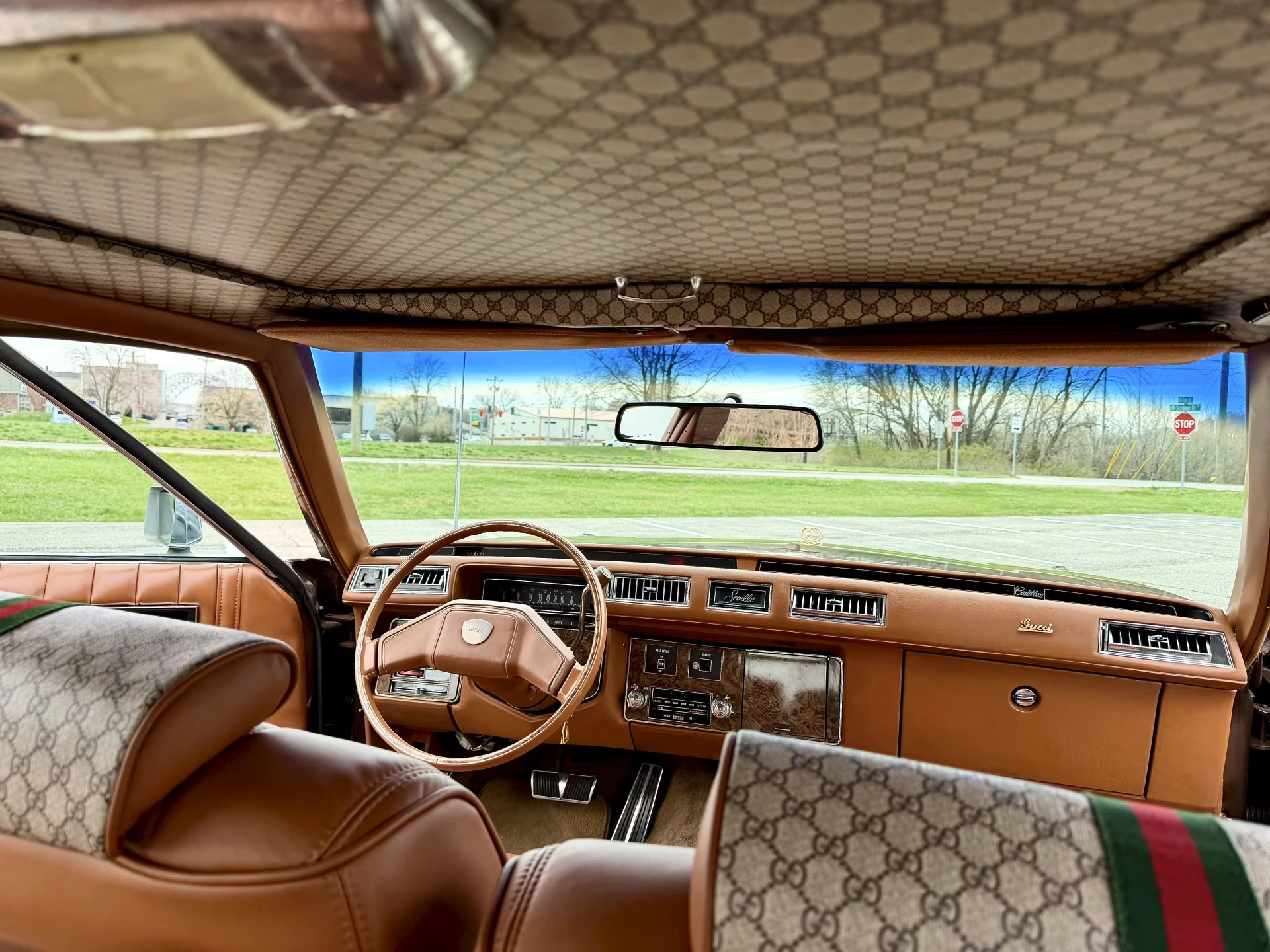
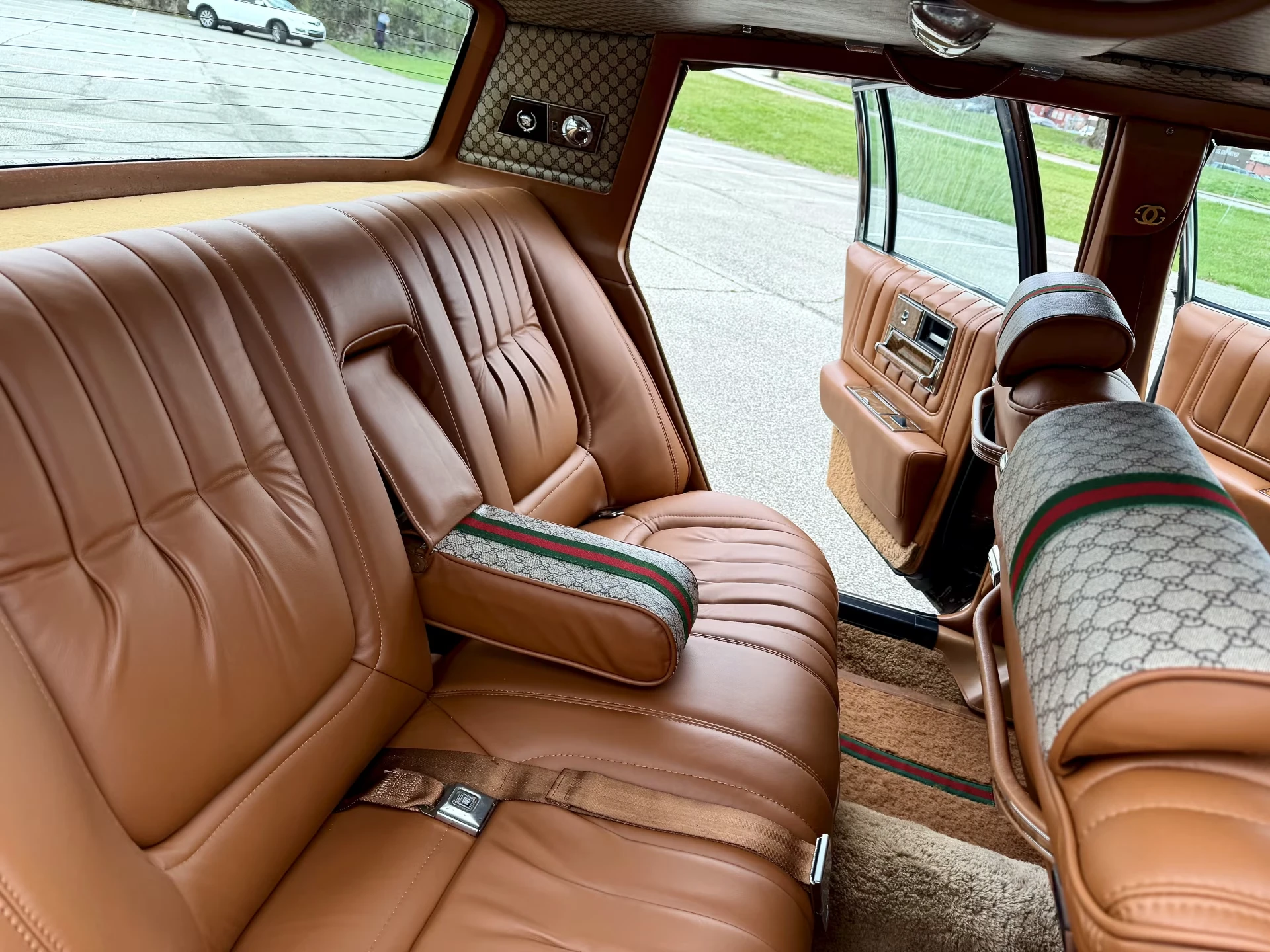
Inside, the Gucci double-G logo was applied liberally to the headliner …
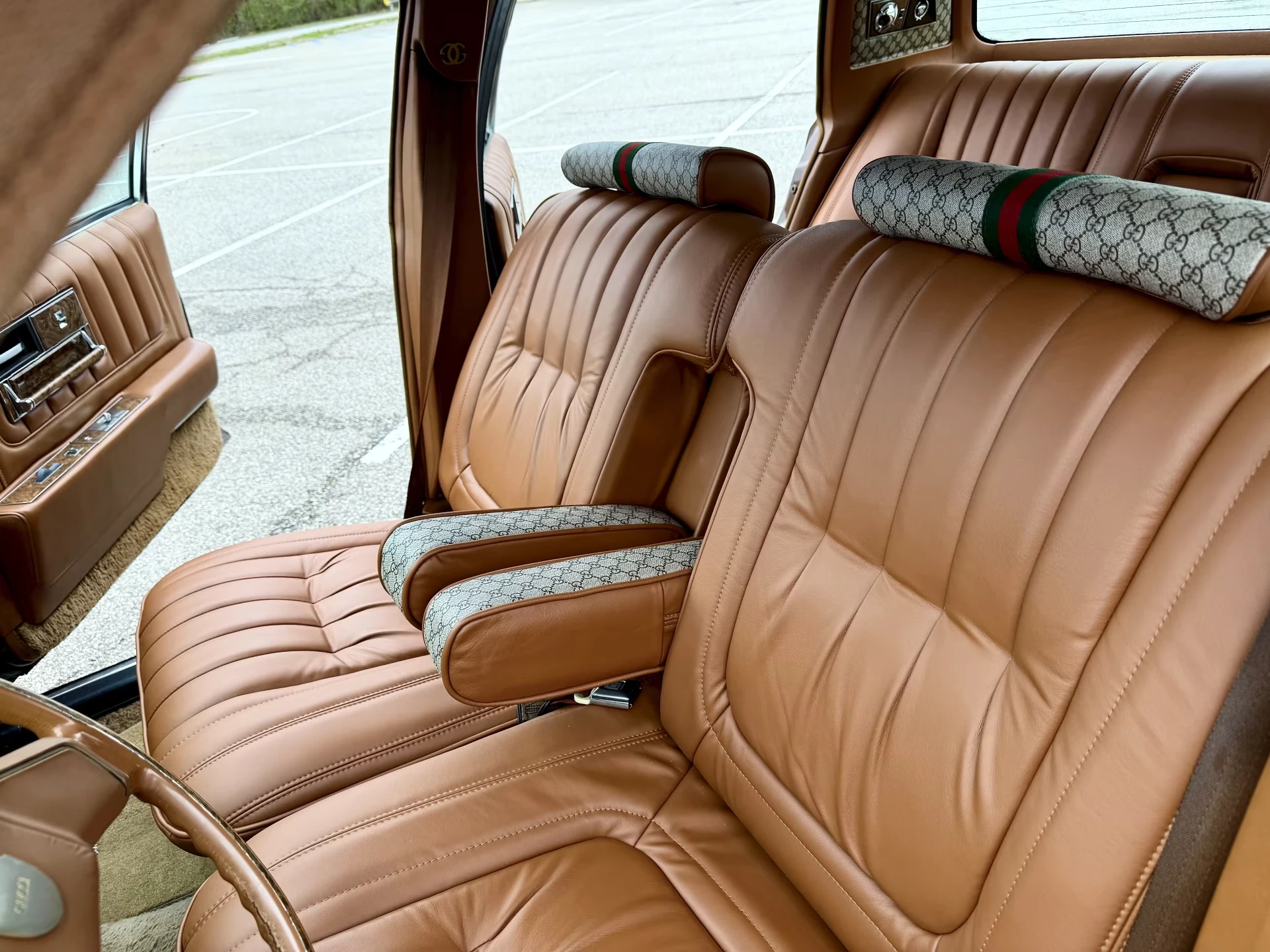
… as well as the seat armrests and the front seat headrests, which also had Gucci green and red accent stripes.
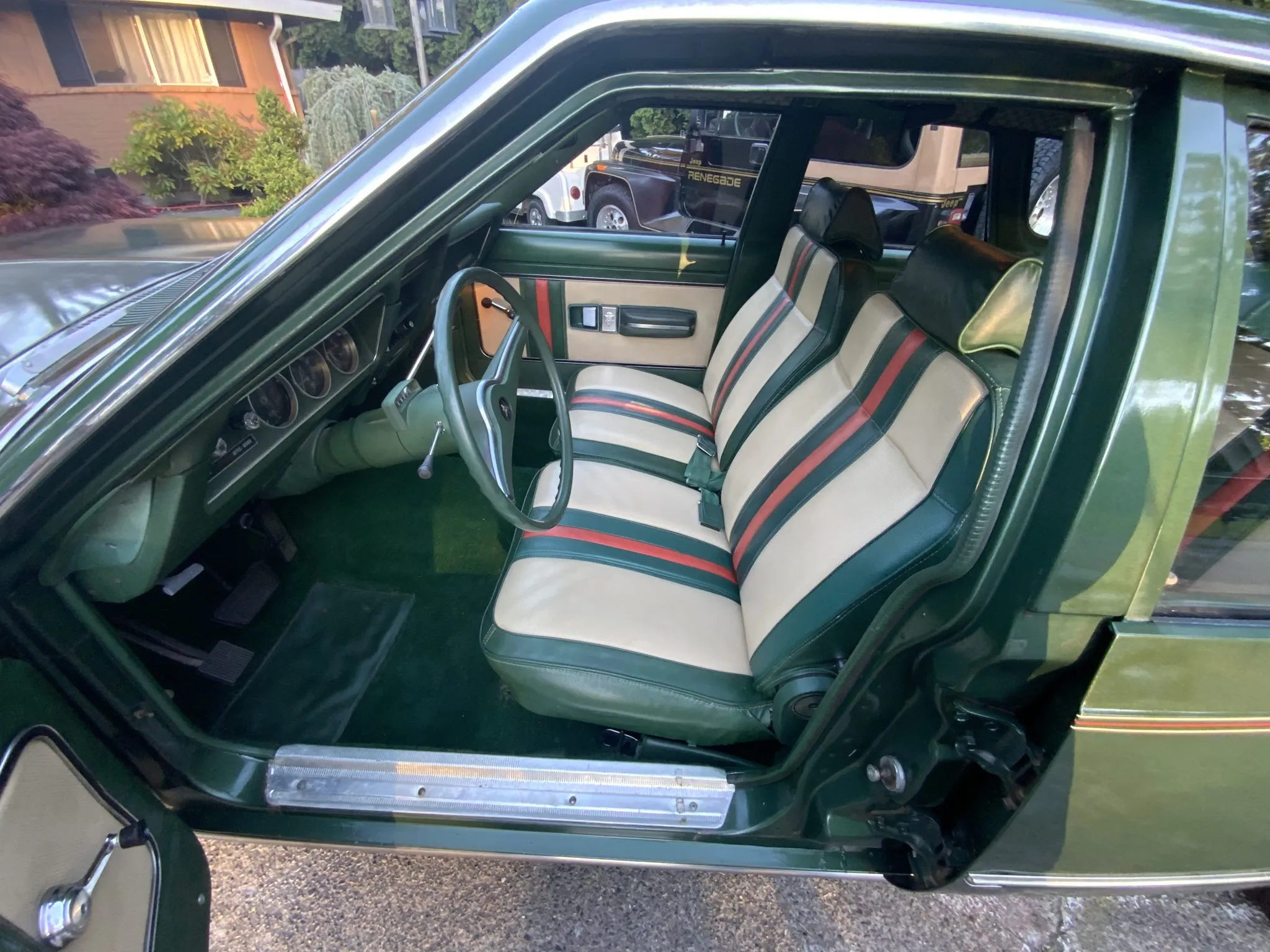
The seat treatment was less elaborate than the striped Gucci interior AMC had offered for the 1972 Sportabout, but that had been developed for factory production rather than as a postproduction conversion.
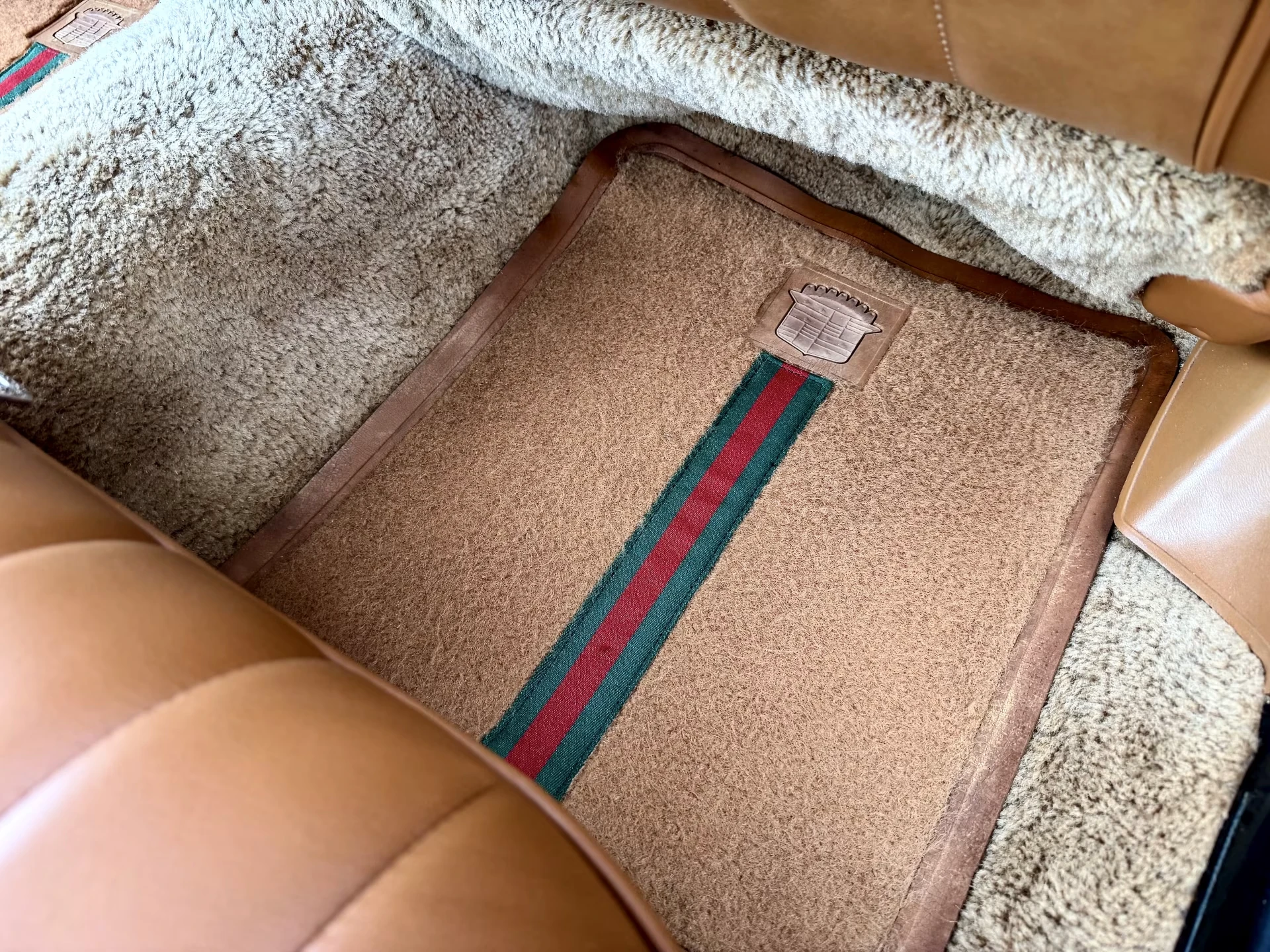
However, the Gucci Seville boasted special Gucci floor mats with the green and red accent stripe.
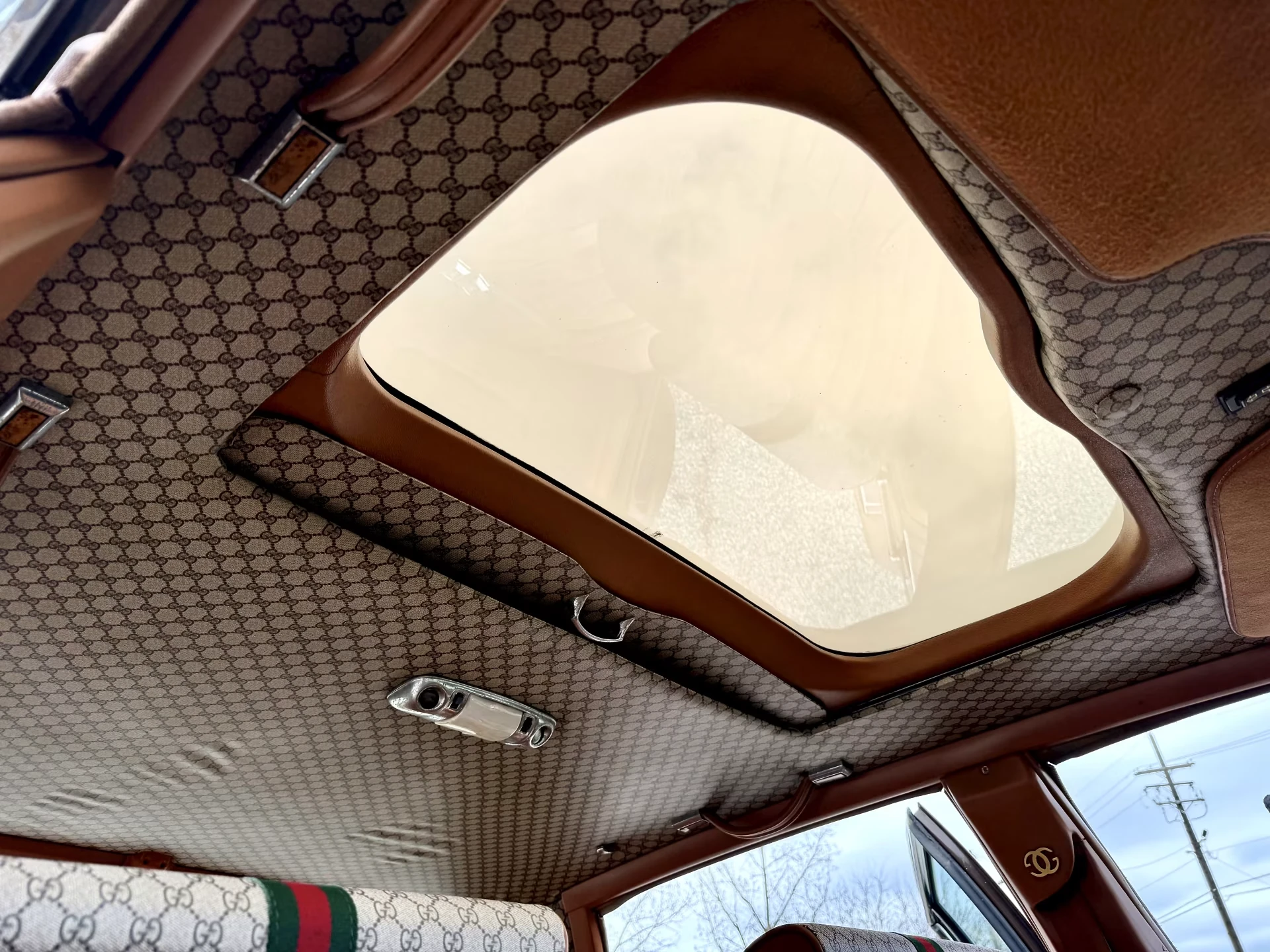
This particular Seville has the optional Astroroof, a power glass moon roof. The Astroroof was a very expensive option (I think it would have been $1,163 with this roof style), and not very common; it was also prone to water intrusion. Cadillac also offered a steel sunroof, which was a bit cheaper and significantly more popular.
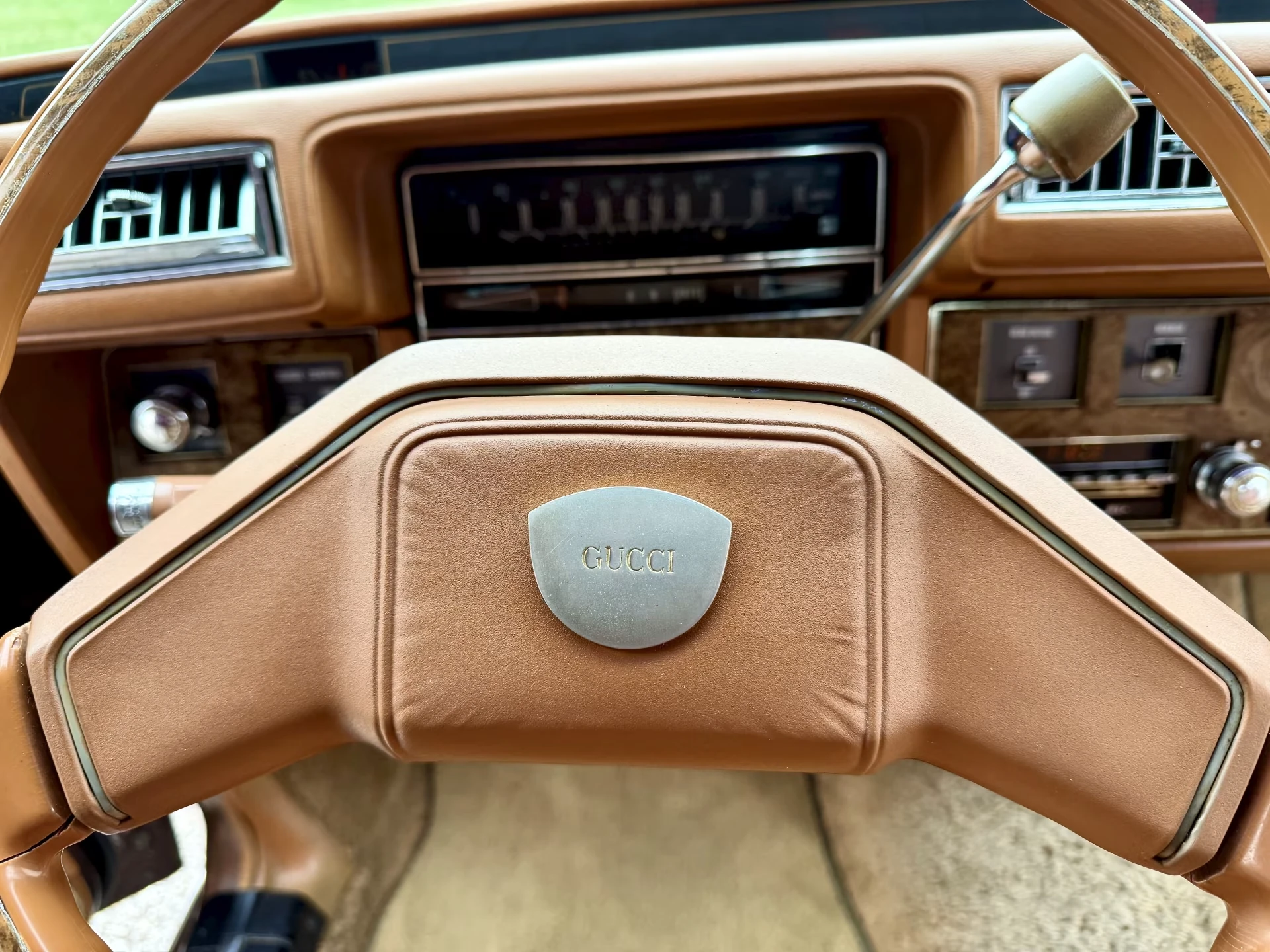
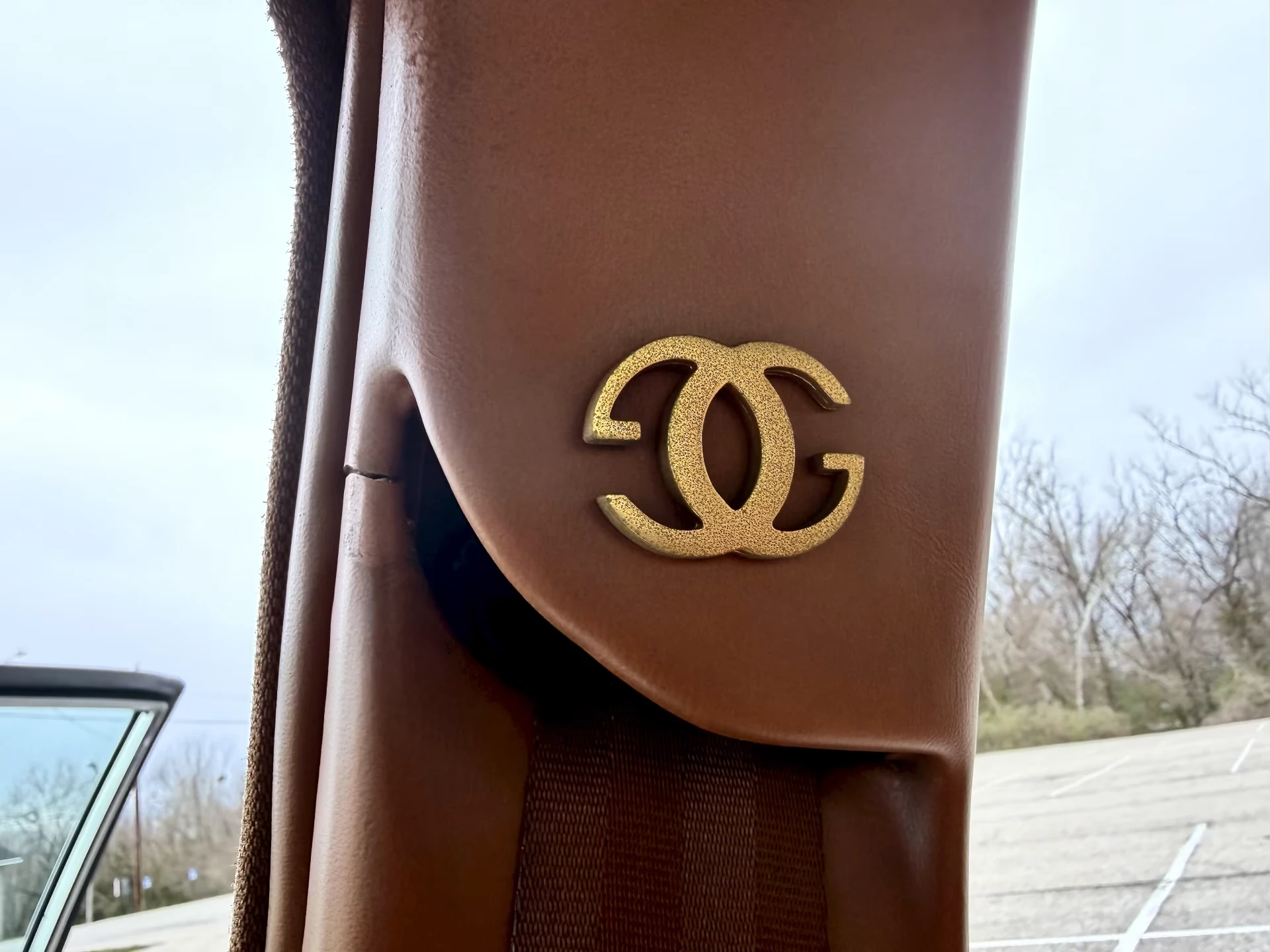
If the headrests and headliner weren’t enough, there were plenty of Gucci logos and emblems inside to remind you and your passengers what you were driving.
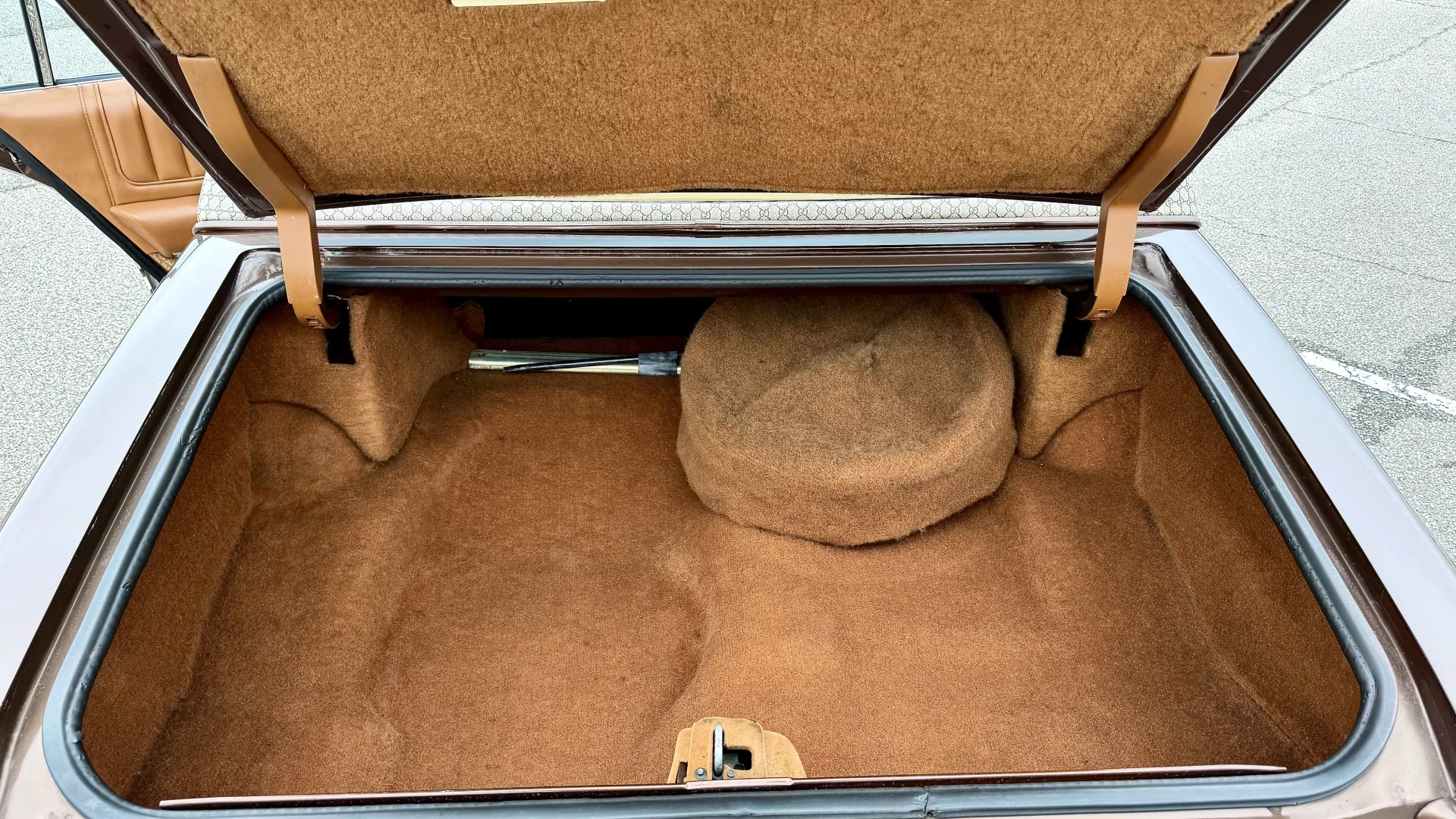
Each Gucci Seville came with a five-piece set of Gucci luggage, but it wasn’t mentioned in the Mecum listing for this car, so I’m guessing the set that originally came with this car is long gone.
According to Leibowitz, each Gucci conversion required approximately 30 man-hours to complete. Braman and Leibowitz anticipated significant demand, up to 2,000 cars, and they were prepared to hire up to about 30 employees to do the conversion work.
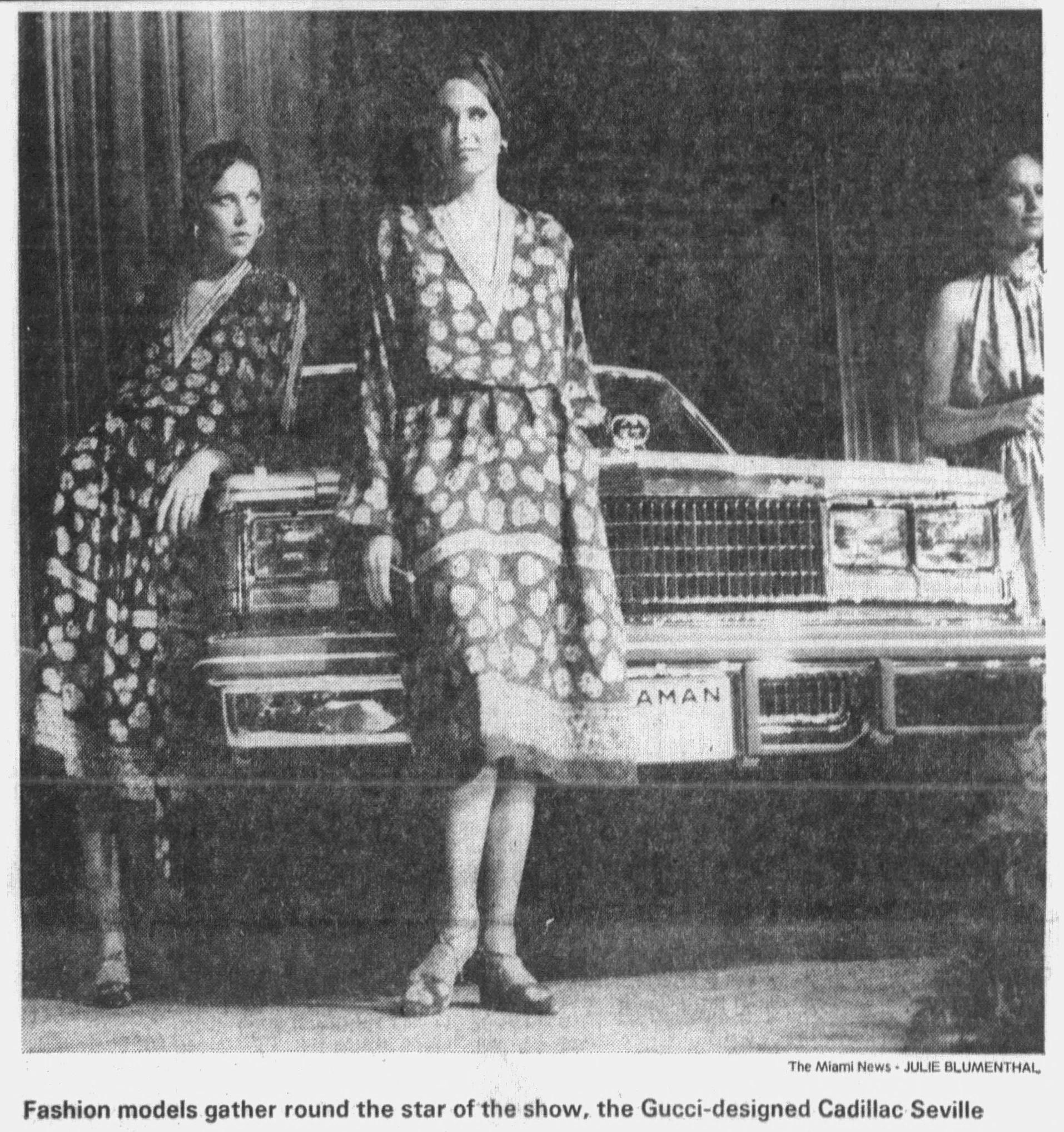
International Automotive Design built eight prototypes of the Gucci Seville. They were unveiled during a Gucci fashion show at the Fontainebleau hotel in Miami Beach on September 26, 1978, surrounded by fashion models. Aldo Gucci was on hand for the event, triggering some minor mob scenes. The Miami News reported:
Once the designer was recognized he was mobbed by Gucci groupies. The groupies, from outward appearance were well-dressed, well-bred women, but they pushed and shoved to get his autograph as hard as any teenager pursuing Donny Osmond. “That’s him,” blurted one woman, a mouthful of shrimp flying. Gucci mounted one of the turntables to pose beside his car. As he stepped down, he accidentally trod on a woman’s ankle, giving her her own Gucci bruise. Still the women crowded around him to get their pictures snapped with instant cameras and to get their brochures autographed by Gucci with his own Gucci-emblem ballpoint pen.
The cars were also shown at other Gucci events, including the introduction of his winter line in Beverly Hills, California. “Reception has been fantastic,” Bay Cadillac general sales manager Martin Lev told the St. Petersburg Times. The first car sold went to Florida House of Representatives member Helen Gordon Davis; star Sammy Davis Jr. bought another.
Even among the intended audience, not everyone was impressed. One attendee at a later Gucci event at the posh Safety Harbor Resort & Spa in Tampa Bay scoffed, “It’s just a little dress-up on a regular model and you have to pay for it.” Another guest, the wife of a New York fur tycoon, said, “I don’t like anything with emblems on it. … Seven percent goes to the designer off the top for the use of the name, and the products are made by an ordinary company.”
Braman originally announced the price of the Gucci Seville as $19,900 FOB Tampa, but by December 1978, contemporary press reports were citing a price of $22,900. I don’t know if the price hike reflected escalation in the price of the Seville (which could top $17,000 with a full load of options and was raised several times during the model year) or if Braman and Leibowitz realized they’d set the price too low to cover their margins.
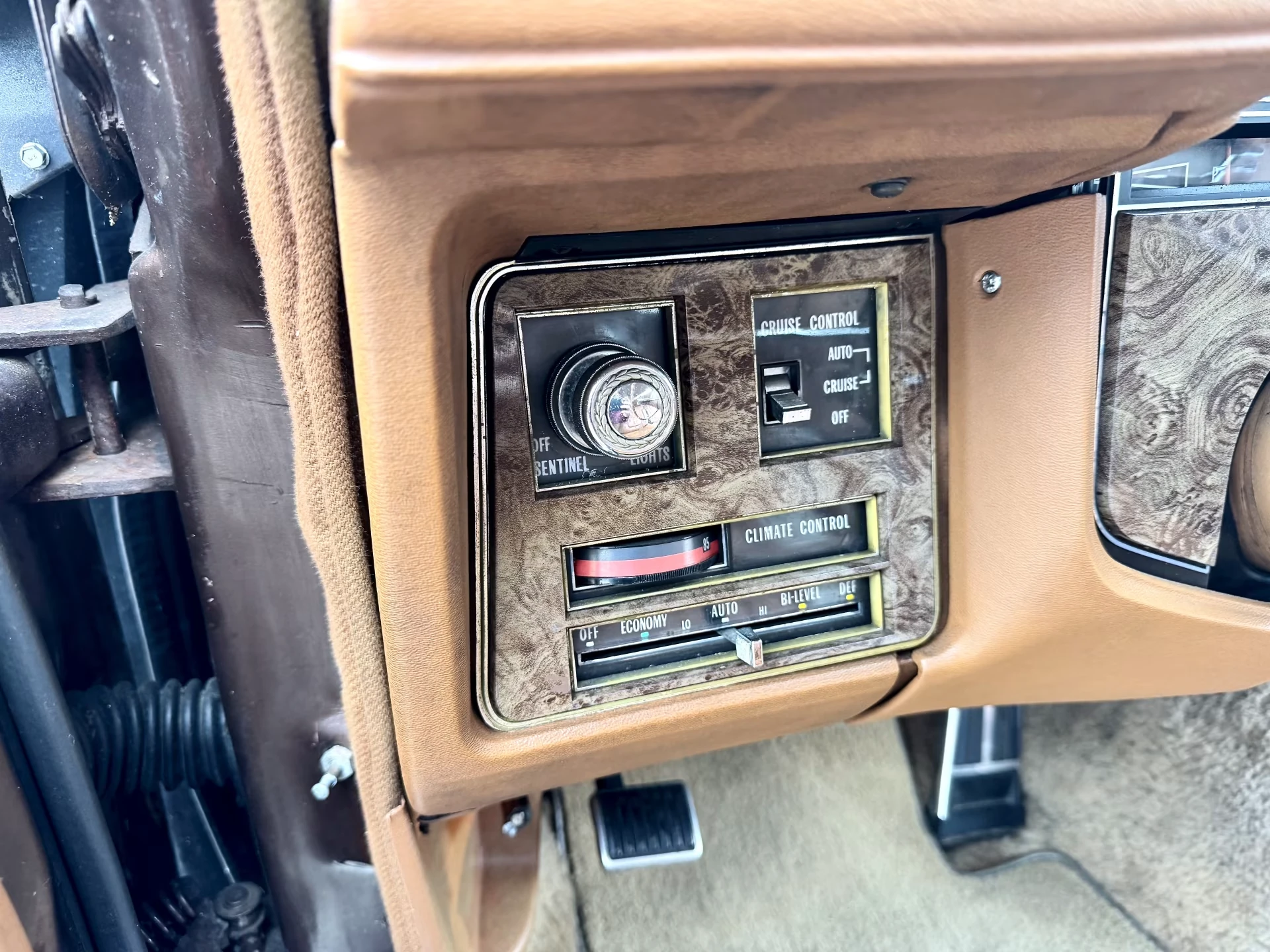
There was probably also some price variation depending on what options were specified on the base car. I assume most of the cars were heavily loaded, but this one is missing a number of available options, such as Guide-Matic auto-dimming headlights and the CB radio.
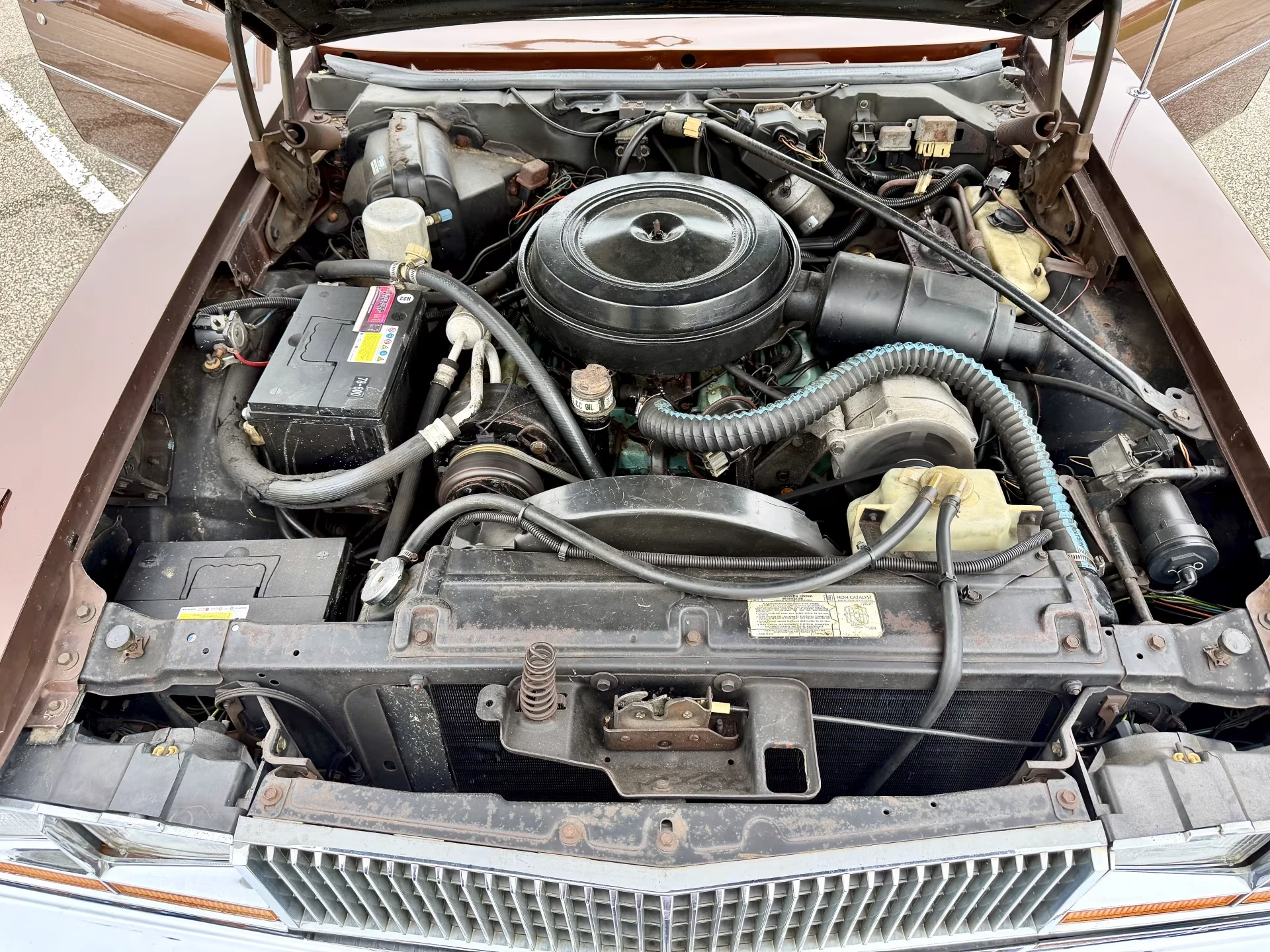
Another variable was the diesel engine. Today, the Oldsmobile LF9 5.7-liter diesel V-8 is notorious for its dreadful reliability record, which eventually led to an FTC-ordered settlement for buyers of early engines (discussed further in this post). However, at first, the diesel got a lot of positive attention and advertising for its claimed fuel economy. In the Seville, its original EPA ratings (not adjusted) were 21 mpg city, 29 mpg highway, which was dramatically better than the 14/19 mpg rating of the standard L49 gasoline V-8 (a fuel-injected version of the Olds 350). Did people with the money to buy a car like this actually need to care about fuel economy? Of course not, but it was another potential source of bragging rights, particularly since acquaintances might have a Mercedes-Benz 300SD turbodiesel, which rated 24/29 on the EPA cycle.
Leibowitz and Braman seem to have pushed the Gucci Seville as hard as they could. In January 1979, Braman and Gucci even went to Tokyo to promote Japanese sales of the car, offered for the equivalent of $30,000 USD each.
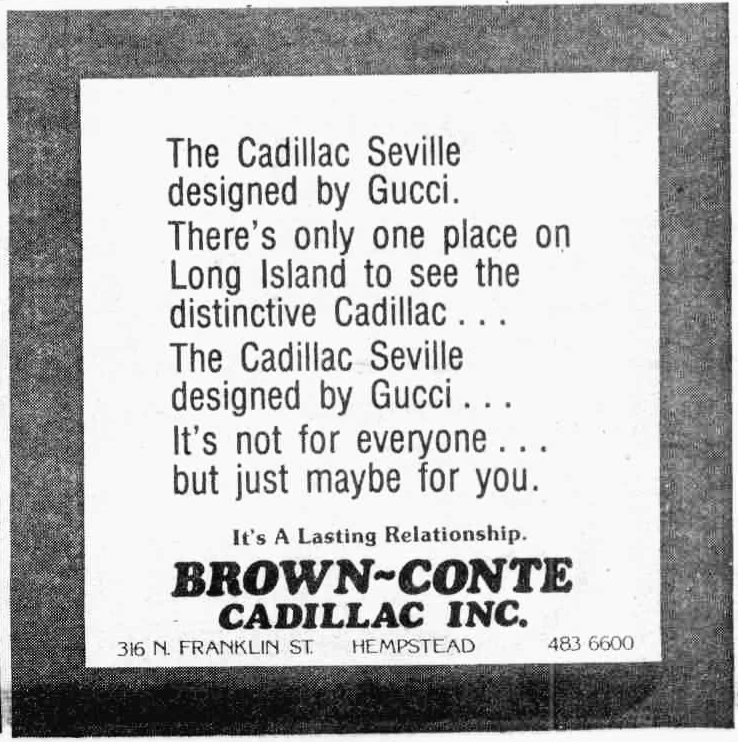
International Automotive Design does seem to have had sold some Gucci cars to dealers outside Florida. I found contemporary ads from Cadillac dealers in Knoxville, Tennessee; Long Island, New York; and Palm Springs, California, among others. The ads imply that many of those dealers had a single Gucci car, which they displayed in their showrooms as traffic-builders. Gucci was very popular at the time, so the cars attracted a lot of attention, even if customers ultimately bought something else.
Nonetheless, the Gucci Seville project wasn’t as successful as expected. The Mecum listing suggested that there were only about 25 of these cars in all, which sounds a little low, while a 2025 Bonhams listing for a white gas-engine car estimates production at “as few as 200,” which I suspect is a little high. Either figure would be a far cry from the 2,000-unit volume originally imagined. Ultimately, Braman and Leibowitz may just have bitten off more than they cared to chew. The Gucci conversion was a more elaborate effort than most dealer specials, but 20 or 30 people working in a converted warehouse didn’t have the economies of scale that made signature edition cars such moneymakers for Detroit. With a venture like this, it could also be very easy to underestimate the actual costs involved (particularly labor costs), something the Stutz revival found out at several points.
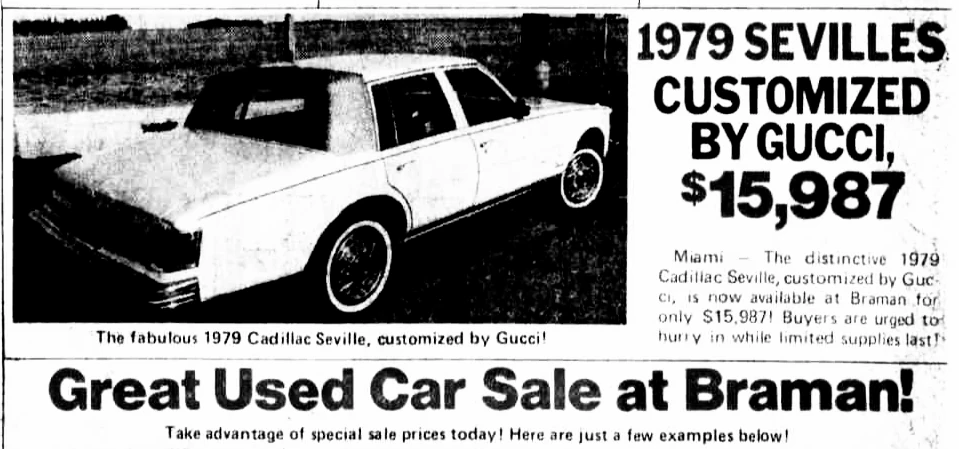
It probably didn’t help that the Seville was in its final year of this generation, or that by April 1979, a renewed oil crisis was having a chilling effect on previously extravagant luxury car sales. By July 14, Braman Cadillac was offering leftover Gucci conversions for a mere $15,987. Used examples popped up from time to time in Florida newspapers through the mid-1980s. Until 1984, asking prices were still typically $10,000 or more, not a bad rate of return for this kind of thing.
Norman Braman, who is 94 years old as of this writing, eventually became a billionaire; Forbes puts his 2026 net worth at $3.9 billion. He and Leibowitz sold Bay Cadillac in 1987, but they still owned many other car dealerships, and, from 1985 to 1986, they co-owned the Philadelphia Eagles football team. (Braman bought out Leibowitz’s share in 1986, and sold the team in 1994.) In 1987, Braman, Leibowitz, and Austin Rover founded Austin Rover Cars of North America (ARCONA), a joint venture to sell a U.S. version of the Honda Legend-based Rover 800 under the brand name Sterling. Austin Rover bought Braman out in 1988, renaming the company Sterling Motor Cars. It was not a success, so Sterling threw in the towel in August 1991, but Braman Enterprises is still in the auto business, with dealers for 14 automotive brands.
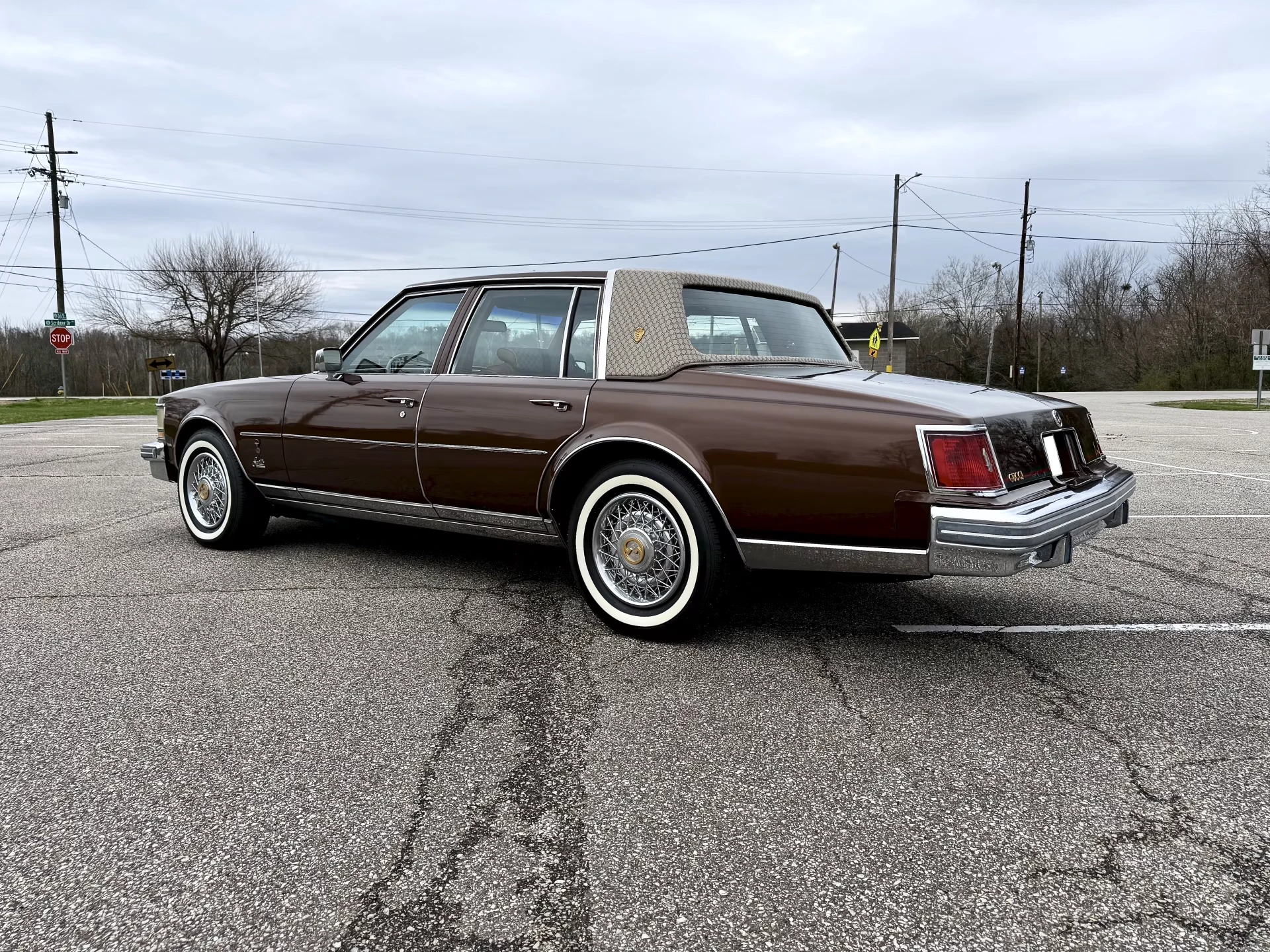
As for the aesthetics of the Gucci Seville, I’ll just quote Paul Goldberger, who said of it in the New York Times back in 1979:
It is all, obviously, rather silly, and one of the reasons is that it is all so unnecessary. A Seville is a relatively handsome car — it was a leader in the recent American fad of seeing who could look the most like the Mercedes-Benz, and that is not a bad piece of design to imitate. The “ordinary” Seville has a restrained, taut boxiness to it that is good looking and in no need whatsoever of all this cosmetic treatment.
Nevertheless, some people still can’t get enough of this sort of thing. The Seville pictured in this post sold for $39,600 at Mecum Indy in May 2026, an extravagant price for an extravagant designer car most people have probably never heard of.
Related Reading
Curbside Classic: 1976-1979 Cadillac Seville – GM’s Deadly Sin #11 – The Sin of Underachieving (by Paul N)
Vintage AMS Review: 1976 Cadillac Seville – “A Typical American — But One Of The Best” (by me)
1979 Cadillac Seville: Extremely Popular, But Teetering On The Brink Of The Abyss (by me)
1972 AMC Hornet Gucci Sportabout – The First Fashion Designer-Mobile (by Edward Niedermeyer)























Badges? We ain’t got no badges? We don’t need to stinking badges?
Treasure Of Sierra Madre
https://www.youtube.com/shorts/SOZE3WnsAYs
That Post Road Brown is a beautiful color. I wish browns would return. The Western Brown on my ’15 Ram 1500 is still a stunning color, especially when clean and in the sunlight.
“Nevertheless, some people still can’t get enough of this sort of thing.” Agreed, people still can’t get enough of it! Fiat also offered a Gucci edition 500 about ten years ago. https://www.fiatusa.com/assets/pdf/brochures/fiat_500_by_gucci.pdf
What a beautiful, luxury car. But like it says in the article, someone with this kind of money: why would you worry about fuel economy? Not to mention the noise it made. I don’t get it.
I had a 79 Eldorado with the Diesel 350. My Eldorado had the replacement motor, which had all the problems the early motors had fixed. it ran perfectly with no maintenance other than oil changes for several hundred thousand miles. They weren’t that noisy, in fact, the Cadillac Diesel was quieter inside and outside the car than the 1980 Mercedes 300CD we also had. The Diesel took a different driving approach, it went the fastest with the least throttle necessary for the situation, for instance, if going up a hill at a certain speed where half throttle was sufficient, flooring it would make it go slower, not faster. You had to increase the throttle in small amounts to get the best acceleration. I suspect many owners who complained about them never really learned how to drive a diesel. The Cadillac Diesel was another technology like the 8-6-4 that was released about a year before it was perfected, and the early bad press doomed it, even though the early problems were later solved. I also had an 81 Eldorado that I kept until a few years ago – it had the ECU reflash that fixed all the drivability problems, again, I suspect most of the complainers never bothered to have that done. It was a wonderful driving car, the best year of the Eldorado in my opinion. I wish Cadillac would make another Eldorado, and that Cadillac would remember Cadillac seats are supposed to be comfortable. My 2023 XT6 seats are like a rock compared to the 81 Eldorado.
That nameless Miami News writer is even funnier than the car.
The Miami News item did have a byline: The reporter was Joe Swickard. I don’t know if that was the same Joe Swickard who later became an investigative reporter for the Detroit Free Press, but it’s possible.
Seville. Bad Taste Edition.
at least it’s a diesel, so it already had minimal value
What a contrast with the elegant and clean style of another Italian designer car featured today, the Volvo Bertone Coupe.
Another car about which I knew nothing. I can’t imagine driving around in something so gaudy. It appears that most buyers in the era felt the same.
This was peak diesel craze but for the life of me, I can’t understand why anyone would fork over $2500+ for a 120 hp diesel that could barely get out of its way. This in what was already an expensive car. A diesel 300SD is an even better example.