
Photos from the CC Cohort by Hyperpack.
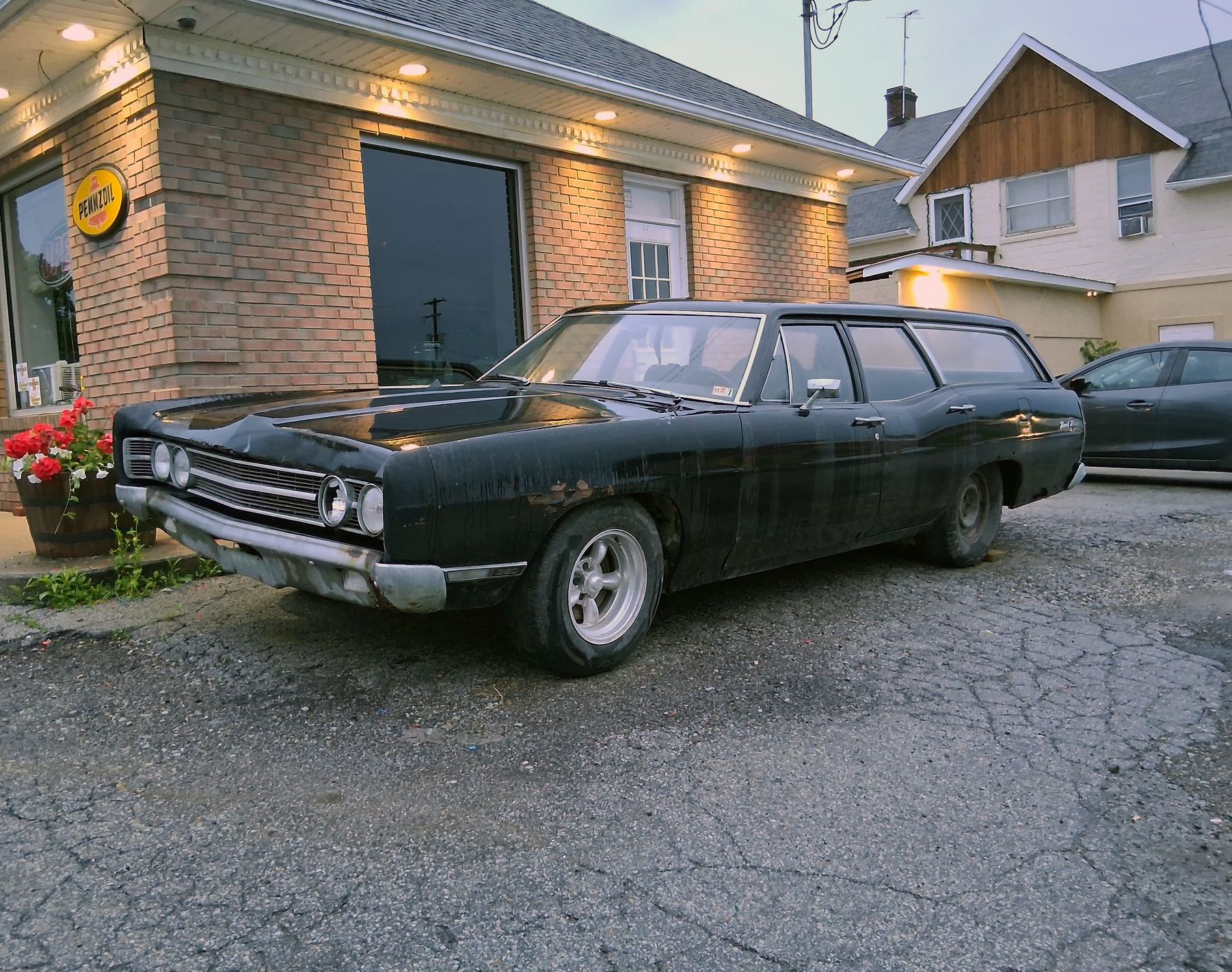
Where have all the Ford Ranch Wagons gone? It’s not the sort of question most enthusiasts spend much time pondering, but that inevitably comes to mind whenever one of these survivors appears, like this rough-looking 1969 example. And really, how could they have survived? Back then, Ranch Wagons were simply family transportation, the very opposite of cool. Worse yet, a life spent in fleet service. In basic Ranch trim, they say “value-seeking” and “down-to-earth,” the opposite of the exciting muscle cars and plush Broughams that captured enthusiasts’ imaginations and earned devoted followings.
So, work and family haulers that ended up discarded without fanfare. And perhaps that’s where its appeal lies now—its complete lack of hipness is, to my eye, a refreshing kind of different.

Except for the aftermarket alloy wheels on the front, this Ranch Wagon looks as no-frills as a full-size wagon from the self-proclaimed “Wagonmaster” could be back then. From what I can see, the biggest factory option is the engine: Rather than the base 240CID six or 302CID V8, this wagon apparently has the two-barrel 390CID V8, with 265HP. (The four-barrel 315HP version wasn’t offered in the full-size wagons anymore.)

So, no-frills, but deliberately chosen with upgraded hauling power.

Unlike Detroit’s usual name-dancing-debasement, Ford mostly retained a hierarchy with their wagon names since they first showed up in the early 1950s. Be it compact, intermediate, or full-size, Ranch Wagons were the entry-level, Country Sedans (Yes, “Sedan”) applied to mid-trims, and the Squires with their distinctive faux-wood were the top trim.

In 1969, Ford was starting to merge the wagon lines with the trim series of the full-size sedan, which ran, in rising order, Custom, Custom 500, Galaxie 500, and LTD. The base Ranch Wagon was trimmed like a Custom sedan, but Ford still just called it “Ranch Wagon” in 1969. Second up from the bottom was the “Custom 500 Ranch Wagon.” The Country Sedan was still just called “Country Sedan,” although it was trimmed like a Galaxie 500, but the top-of-the-line Country Squire was now called “LTD Country Squire.”
Got all that?

Like all of Ford’s 1969 full-sizers, the wagons were riding on a new 121″ wheelbase platform with wider tread, and carried on with the soft, rounded lines the 1968 showed up with, with a longer-lower-wider look, and lots of distinguishing trim to tell apart the multiple model lines. Naturally, the base Ranch Wagon line was the plainest looking of them all.

All the 1969 full-size wagons except the Country Squire still technically had the 240CID six as the standard engine, but almost nobody actually ordered it, and Ford made the 302CID V8 standard for 1970. Most buyers also ordered Cruise-O-Matic, but automatic didn’t become standard on the wagons until 1972.

The posh Country Squire was still the star of Ford’s wagon show, appealing to more upscale middle-class buyers, although it still wasn’t the kind of thing cool teens would dream about. The Ranch Wagon, which is barely mentioned in the 1969 wagon brochure, was for fans of value (and fleets). A basic six-cylinder Ranch Wagon started at only $3,074, only $16 more than the midsize Torino Squire wagon.

But regardless of which Ford wagon you chose, Ford’s 3-Way Magic Doorgate came standard. A Ford “Better Idea” that truly was that.

Back to today’s Ranch Wagon. With its mismatched wheels, I guess this was someone’s halfway-done project? The black, which was a factory choice, looks out of place for a family hauler, so perhaps it was a fleet vehicle? Either that, or a respray meant to go “Mad Max” or “Hipster” and now just looks funereal?

It’s been said before, but here it goes again; the age of the low-long-wide seems like a curious and accidental one in our age of tall, efficient two-box CUVs/SUVs. On the positive, old wagons can look awfully charming. Or somewhat clunky. On this Ranch Wagon, I don’t think that I find the sixties-style rear fender hips all that satisfying against the low cargo area roof.

Talking about that cargo area, looks like nowadays the wagon is doing more work as storage than as transport. More Barn-like than Ranch-like, if you ask me.

Also on this wagon, an example of the two personalities of Ford styling from the period; a homely industrial face on the Ranch…

… and a fancy die-cast grille, hidden headlights, and LTD crests on the LTD Country Squire. The Country Squire’s mix of neoclassic, modernist, and traditional faux-woodie styles seems a little strange, but buyers liked it: Ford sold 129,235 LTD Country Squire wagons in 1969, against 47,850 Country Sedans, 27,995 Custom 500 Ranch Wagons, and only 17,489 base Ranch Wagons.

So less common back then, less popular, and far more humdrum. All the stuff that now almost makes this Ranch Wagon an ideal anti-hip statement, which itself is a weird kind of cool.
A special thanks to Aaron Severson for additional help getting this post together.
Related CC reading:
Curbside Classic: 1968 Ford Ranch Wagon – Did Anybody Care?























Ying & Yang…had both sides of the ’69-’70 wagons. Inherited the ’70 Ranch Wagon from Mom & Dad, 351W & FMX, no A/C, cream with brown interior. When it was cold out, you’d roll down the drive in reverse, but to go in drive, would take 12 long seconds til drive would kick in. It’s life was short with me, as it was my first car, a fender Bender with a Nova II sidelined her. Dad found a front clip & bumper that restored her, but the LF frame horn was bent. Drove for another few months til Mom said it was too dangerous and was parted out. About 2 yrs later, a 69 LTD wagon from Florida popped up, 429, power everything, hide away headlamps, the works. Cut my auto nut teeth keeping the LTD running. The 429 was amemic & swapped in a 400 for a while. Added a tilt wheel with rim blow. Rebuilt & upgraded the C-6 trans. Rebuilt the 429 with twice pipes, a mild cam, ram an Offy Dual Plane 360 intake. Ran it to Houston for Cougar parts, to California for a job search after college, pulled anhydrous tanks & grain wagons for the farm, pulled a homebuilt car trailer for more adventures. Bought several parts cars for it, one was just for the fragile dash that always seemed to crack & break. Was a good ride for many yrs. Did see a rare 240 in line 6 & 3 on the tree manual in a junkyard in one of my parts quests. Looked odd with all that unoccupied room under the hood. Lots of great memories….
Cool. That black paint job gives it a mean, menacing look. Ditch the wheels and put some dog dishes on them and I`ll buy it.
I must say the 1969 LTD Country Squire with the hidden headlamps is quite appealing. It’s true, though: most of the wagons have disappeared. I remember reading a Hemmings article about a couple who owned a 1977 Pinto Squire and they were constantly one of the most popular cars at a car show primarily because it had been ages since anyone had seen a ’60s or ’70s wagon at all, much less a Pinto.
The 1970 Country Squire is appealing as well. https://www.oldcarbrochures.org/United%20States/Ford/1970_Ford/1970-Ford-Wagons-Brochure/index.html
However I’m more reserved about the 1971-72 models with the “Bunkie Beak” front end.
https://www.oldcarbrochures.org/United%20States/Ford/1971_Ford/1971-Ford-Wagons-Brochure/slides/1971_Ford_Wagons-04-05.html
I had 79 LTD country squire, top of the line with power driver seat, and limited slip. A company truck.
I owned a later and slightly smaller base Ford wagon, a 1972 Torino with a 400/automatic. Aside from the powertrain, I don’t think it had any options. The guy I bought it from got it as a hand-me-down from his father, who had purchased it because it was the cheapest thing that would haul his whole family and their camping trailer.
If fully loaded with passengers and cargo, how that beast could be effective powered by a six-cylinder is hard to imagine.
In the summer of 1971 when I was 7 my father got a new job, and we moved from the burbs to an old farmhouse. Dad had bought a used full sized Ford wagon either before or shortly after, and I’ve been try to figure out what year it was.
These days any newish used car will be three years old as most of them are leases, but that wasn’t true then. It looked very much like this Ranch Wagon, but I recall it being a Galaxy 500. It was white with a black vinyl top and a red vinyl interior (if you can imagine!). It seems likely it was a ‘69.
My family had one of these. It was the Custom 500 version in light blue with a 302 V8, 3 speed automatic, and an AM radio. That was it, no A/C, no power steering, no power brakes, nor any other options. My mother had been driving a 1964 Fairlane based Ranch Wagon. That was the only brand new car my parents had ever bought and she loved it. But by 1972 the Ohio road salt had taken it’s toll. Dad decided she needed a newer car and bought the 1969 wagon without asking her or letting her see it. He drove it home from work one evening and presented it to her. The first thing my mother said was “It’s too big.” My father’s reply was “You’ll get used to it.” Yes, I know how that sounds.
The next morning Dad left for work at the family business in the 64. As usual, Mom waited until I got on the school bus and then got in the 69 to go to the office. While backing it out of the garage, she caught the very thin chrome strip affixed to the right front fender on the door frame and tore it off.
When I got off the bus that afternoon I saw Uncle Fred’s 1962 Comet sitting in the garage. That was not unusual in itself. Uncle Fred worked at the family business as well and would let my mom drive his car if hers was being serviced or otherwise unavailable. He lived close to the shop and would either walk home or take one of the company trucks. I asked my mother where the “new” station wagon was. She replied very tersely “I am not driving that car.” That evening Dad arrived home in the 1969 wagon. You could have cut the tension in the air with a knife. Upon arrival at the office that morning my mother had told my father about the garage door incident and that she was not going to drive the “new” wagon and that was that. She wanted the 1964 back but Dad refused. They didn’t speak the rest of the day. My parents rarely argued but that evening they sure did. Dad said “What am I supposed to do with this car?” Mom said “Sell it, give it away, I don’t care but I’m not driving it.”
The next day when I got home from school there was a nice looking 1971 Pontiac Lemans coupe sitting in the garage. Uncle Fred had taken Mom to a used car dealer friend of his and she had picked that car out. Dad arrived home angry and they didn’t talk to each other much for about a week.
Up to that point Dad usually drove the “shop” truck back and forth to work. He decided to keep the 1969 Ranch Wagon and drive it himself. Of course, as big as it was, he could haul lots of stuff in it and would pick up and deliver tools and materials to jobsites. He also took it on long trips to pick up stuff for the business. I remember a trip to central Missouri one summer. Uncle Fred and Aunt Kate drove it to Maine and back once to pick up something Dad had bought.
For some unknown reason Dad started calling that car “The Road Wagon.” I never really understood why but I think it had something to do with a large horse drawn cargo wagon his grandfather had when he was living with them while growing up.
I started driving (on the road) in the summer of 1976. Dad bought a 1966 Ford F100 for me to drive to school and then to work afterwards. That winter we had a lot of snow and the F100 was about helpless without a load in the back. Dad told me to drive The Road Wagon instead of my pickup. It was so heavy that it was nearly invincible in the snow. By that time the rear wheel wells had rusted away and if you spun the tires it would throw snow and rocks up into the cargo compartment.
As time passed The Road Wagon rusted out more and more. The window in the tailgate would not roll down anymore so it would not open flat. It would still swing open as a door but the post was rusted out and the door would sag and need lifted up to close. Finally, you could no longer get it to latch so a rubber tarp strap was hooked around the handle and attached to the base of the whip antenna that had been installed for our company radio system. Of course, this enabled exhaust fumes to enter so Dad would always drive with a window partially open. The driver’s door also rusted out and was difficult to latch as well. About that time someone who owed Dad money “paid” him with an even cheaper 1969 Ford Custom Ranch Wagon. It had the 240 inline six and a three on the tree. The engine went into one of our company trucks and the white driver’s door went on The Road Wagon.
Then the automatic transmission in The Road Wagon started to fail. When you stopped at a light it apparently would remain in third gear. When you went to accelerate the entire car would shake and shudder. You would have to manually pull the shifter down into low and then upshift once you got moving. The engine was also using a lot of oil by that point. By 1980 it was rusted out so bad that even my father decided it was not safe to drive. The Road Wagon was parked in the “boneyard” where all the worn out company cars and trucks went to be stripped for parts to keep the other junk on the road.
There really wasn’t much of value left on The Road Wagon so after about a year it was decided to send it to the scrap yard. Back then you had to take the tires and fuel tank off of a vehicle before the scrap yard would take it. After removing these, I decided to shoot the windows out of it with a shotgun while my amused father watched. Then Dad said “Let’s set it on fire!”. So the hood was opened and the engine compartment and interior thoroughly doused with diesel fuel. A wadded up diesel soaked rag was lighted and thrown into the car. Soon it was fully engulfed. Suddenly my father ran to his front end loader equipped farm tractor. He started it up and proceeded to spear the blazing Road Wagon in the side and flip it onto it’s top. I almost pissed my pants laughing.
The next day the charred remains were dragged onto a trailer and I hauled it to the scrap yard. Thus ended the saga of The Road Wagon.
What struck me about this wasn’t so much the hip line/low roof combo (though we saw that on XA-XC Falcon wagons), but the amount of front overhang. Ford really piled on the length up front in the late sixties. I guess it was to ‘balance’ that long rear end, but it sure wouldn’t have helped manuevrability in confined quarters, like turning in a yard.
Look at a ’61-64, and there seems to be so much less front overhang; ’65-66 seemed to grow some, but again it looked in proportion.
Or is it an optical illusion: maybe it’s the relative paucity of trim on this Ranch Wagon that makes it seem so long in the front overhang department.
To some extent, yeah. The 1969 Ranch Wagon and Country Sedan were 7.1 inches than the 1964. Two inches of that went into the wheelbase, yielding a cargo length (back of front seat to inside of closed tailgate only 2.4 inches longer than in 1964. So, that suggests roughly 4 inches added to the nose — 6 inches on the LTD Country Squire, whose prow stuck out farther.
Thanks for the figures, Aaron. These days it’s hard to imagine that much sheetmetal bring added just for style- without the space being packed full of electronic gimcracks and doohickeys.
Nothing says cheap more than the front end of a 1969 Ford non-LTD.
It’s just so plain, more so than the 1968 or 1970 grilles. At least with Chevys and Plymouths, the front ends were basically the same from low end Biscayne and Fury I to Caprice and VIP, though the Plymouth did boast a slightly nicer grille.
The Ford just screams, “I should have bought an LTD!”
Interesting trivia note – the plain grill on the lower level 69 Fords was a plated decanting. I remember seeing older ones with pitting from exposure to the elements.
This black one shows off my biggest visual problem with these: the bright metal trim is around the large rear side window but is absent around the upper doors. The Country Sedan and Squire puts bright trim everywhere around the greenhouse so it looks right.
You’d think they would have jumped at the chance to save money, and just used plain rubber. Actually, plain rubber would have minimized the high hip/low roof look too.
My memories of the big Ford wagons of the late 1960s and early 1970s was that there were a lot of base Ranch Wagons and a lot of Country Squires but not many Ranch Wagon 500s or Country Sedans. A lot of the Ranch Wagons I remember did have the 390 as people wanted them to haul their trailers. As someone else mentioned the chrome plating around only the rear side window on the Ranch Wagons (and the Canadian Meteor Rideau 500s) looked out of place. They would have looked better without it.
Thats a rare find. Many a 1960’s or 70’s wagon ended up in the demolition derby. I think they were preferred over sedans or coupes because the rear ends were a bit more robust.
Another survivor, looking at the hood makes me wonder how much longer it’ll be saved .
Not a bad looking car IMO, I too remember these as crew, plumber and handyman vehicles .
Sadly the day of the long roof is gone, likely never to return =8-( .
-Nate