
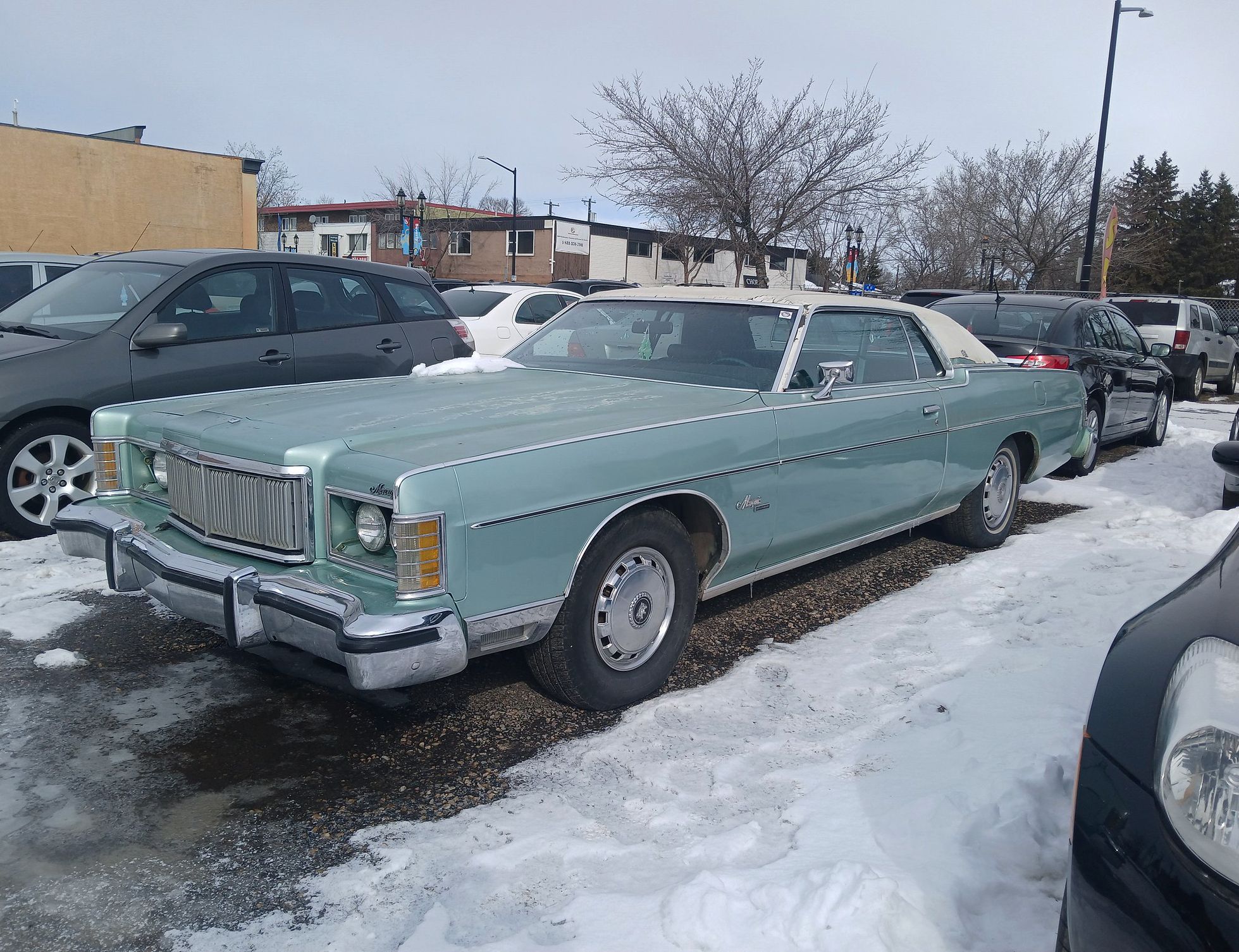
We just can’t let a week pass at CC without featuring a full-size 2-door American car. Especially, if it still seems in “curbside classic” running condition, and also, if it comes from the most full-size era of them all. And this week’s recent find to fit all that criteria is this 1976-1977 Mercury Marquis uploaded to the Cohort by canadiancatgreen. A survivor from Ford’s most ostentatious era, and as its Brougham title indicates, carrying the touches that Dearborn products became known for during those days.

Wish I could be more specific year-wise, but perhaps a Mercury fan will narrow it down for us? (Mr. Shafer?) After all, there isn’t much to tell these 1975-1978 Marquis apart, though I think the front fender and C pillar emblems indicate it’s a Brougham model. Officially, that is. After all, what wasn’t Brougham-y in those days?

Here’s an image from the 1976 brochure, with its eyelids properly closed to give it the full Dearborn/Mark III look from those days. Just a small reminder, since today’s find’s flaps seem to be in the perpetually open position that hidden headlights tend to end up in over the years.
Let’s check one more time our opening image and take one more look at this 2-door hardtop in full-size glory, the likes of which we’ll never see again, new from the factory. And if we changed the color to seventies brown, this survivor could be the car to star in a remake of Uncle Buck.
Related CC reading:
Cohort Classic: 1974 Mercury Marquis Brougham – The Costume Makes The Character
Curbside Classic/Jason’s Family Chronicles: 1976 Mercury Marquis
Cohort Pic(k) Of The Day: 1975-1977 Mercury Grand Marquis – Der Grosser Mercury
CC Outtake: 1975 Mercury Marquis Brougham – Uncle Buck Goes To The Opera























My parents had the 1974 Sedan Marquis, which I drove during high school. For the type of car it was, it was great. And mostly trouble-free, too. They were both fans of Luxo Barges. However, my mother went on to get a Cadillac Seville in 76.
When I was in high school, a buddy of mine had one of these. It was a huge car with a not so huge interior. The rear in particular was pretty cramped for a car of this size.
Said car was equipped with a 460 that drank gas at like 8 MPG. During our evening cruises, we’d all pool our quarters to afford some more gas.
The grille on these was uncomfortably close to the front grille of the 75-76 Continental and Town Car, resulting of course in the switch to the gigantic shnoz added for ’77-’79
The Marquis name is on the front fender which means t’s either a ’75 or ’76.
My parents had the ‘73 LTD 2-Door Hardtop, which as you all know by now became my first car.
It’s interesting that while Ford only did the hardtop in this generation (‘73 thru ‘78) for two of those years, 1973 & 1974, Mercury stayed with the hardtop for the whole generation for its 2-door cars.
Ford, you were not fooling anyone with that “Pillared Hardtop” BS from ‘75 thru ‘78.
This is not my car, but it’s real close to it…
The featured car is not a true ‘hardtop’ either, despite the pillarless design. Unlike the 1973, the rear windows on the 1975 & later Marquis two doors were fixed in place. I would label them a ‘coupe’ instead.
I would call it a 1975 or 1976 model. As you said, their is little difference in the 1975-1978 models. They actually used the same images in the ’75 and ’76 brochures. But for ’77 and ’78 they eliminated the fender nameplate, which is the only difference I see.
We got the wheelcovers down under on the P6 Ford LTD with a different emblem in the center.
Say, our Prime Ministers once rode on those hubcaps!
One of them (Mal Fraser) actually road tested one of these for a local car magazine, rating it against the Mercedes 450SEL it was to replace – and wasn’t too enthused, despite it being his government’s initiative to replace the too-expensive Benz of his predecessor with the top locally-made offering!
Well, there’s one way to cope with climate change – create a dry area the size of small village under your car for others.
Somehow, the lowness of this functionally-absurd machine makes it look really not too bad at all, helped by the light colour, and, perhaps, by the lack of whitewalls, rear spats and the headlights being open, all of which combine to simplify the bladey lines.
I am late here, but am going to guess 1977. Ford did a thorough revamp of its color offerings to freshen things up in 1977-78, and this looks like the Light Jade of those years. Just a guess, though.
I once knew a guy who had a solid red one, with no vinyl roof and the fender skirts. It was the best looking one of these 2 doors I ever saw.
But every time I looked at these wheelcovers, I saw the near-identical ones from the 70-71 Thunderbird.