

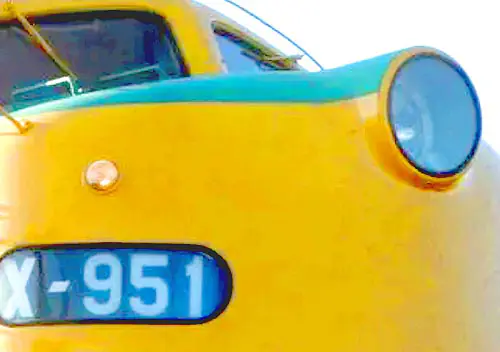
These shots by Jon O’Grady posted at the Cohort are terrific: the two long-running COE (Cab Over Engine) tilt cab trucks from Ford and Chevy, side by side and in the same livery. The near-immortal Ford C-series is the more common of the two, having been built for a whopping 33 years, from 1957 through 1990. We’ve paid tribute to it here, as well as several other posts. The Chevy tilt cab was obviously a response to the Ford, arriving three years later, in 1960. And although it was reasonably popular, it never achieved the overwhelming success of the Ford. Why exactly, I can’t say, as Chevy trucks were very dominant up to this time. The Chevy tilt cab lasted through the 1970s.

COE trucks had been a staple for decades, offering more payload space for a given wheelbase. But White redefined that genre in 1949 with its new 3000 series tilt cab COE, which placed the cab much further forward for even better space utilization. And the tilting cab gave unparalleled access to the engine and other mechanical components. The White 3000 was hugely popular, and used in a wide range of applications from local delivery to over-the-road transport with a sleeper cab attached. Its influence cannot be overstated. International followed suit, and then Ford plunged in, with its boxy C series in 1957.

Like the White 3000, the Ford found itself adapted to a very wide range of applications, but was perhaps most dominant in urban settings for curbside garbage hauling, utility service, and other fleet applications, along with beverage delivery and so many other roles where its tighter turning radius was advantageous.

Chevrolet had the time to improve on the C-Series, at least in its styling. In typical GM style, it was more sophisticated than the Tonka-truck boxy Ford. And that applied to its independent front suspension too, which was the big new thing on 1960 Chevy and GMC trucks. That turned out to be a costly mistake, as higher maintenance costs and other issues. By 1963, solid axles were back, but that detour may well have cost Chevrolet (and GMC) a substantial chunk of their market share, and likely contributed to the tilt-cab’s weak start that it never quite overcame.

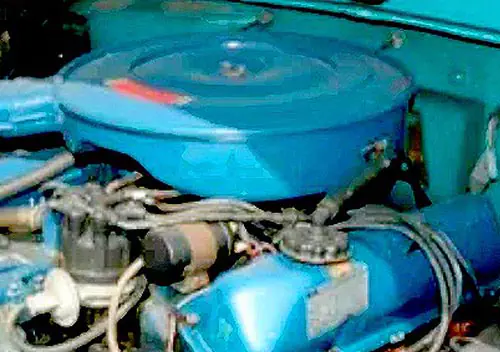
Like the Ford, the Chevy came with a wide range of engines, starting with the 250 and 292 sixes and small block V8s for the lower end. The big block V8s (348, 366, 427) were next, as well as the HD GMC V6s, in 401 and 478 CID versions. Diesels came with either the more expensive 4-53 or 6-32 DD two-strokes, or the unfortunate Toro-Flow 4 cycle diesels, related to the GMC gas V6 engines. There might have been others too. A zoom in on the Chevy shows a 427 badge on its side; in truck tune it was rated at 260 hp. As a kid, it was kind of a big deal to see one of these with the 427 badge, given the status that engine had in the late ’60s. And it sounded mighty good at full chat.
The Ford also came with a variety of six and V8 gas engines, as well as Cat, DD, Cummins and other diesels. Given its 33 year lifespan, the engines covered numerous generations of engine families. Here’s a comment about C Series engine left at a previous post by Bob B.:
Some of the early ones had ‘truck’ versions Ford of Lincoln and Ford Y-blocks before the common ‘FT’ (truck version of the FE) V-8’s. Super Duty V-8’s were offered in the heavy 800 and 900 models, and various Ford 6’s in the 500-600 versions. As for diesels, a few used the British Dagenham 6 cylinder in the 60’s but the Caterpillar small V-8’s (1100 and later 3208) were the most common I saw. I never saw a Cummins V-6 or V-8 in one, but I believe they were yet another option. A few had Detroit 6V-53’s. Starting in the late 70’s, the FT’s were replaced by the Lima 370 and 429, the Super Duty V-8’s were dropped, and the Detroit 8.2L added. 1986 was the last year the C was built with a gasoline engine (my company bought one of the last ones) and from that point on it was 3208 Cat or 8.2L Detroit only. The end came in 1990 when neither of those engines could meet emissions regulations. Due to the design of the cab floor, the truck could not accommodate any of the then-new Cummins or Caterpillar turbocharged aftercooled in-line 6 diesels.

Both of these cabs were also offered in raised versions; a true tall over-the-road Ford, and a slightly raised Chevy/GMC, as they also had their own big COE trucks for that role. Here’s your chance to own a matching set. They’re sporting BC plates, but no exact location was given.
Note: a rerun of an older post.












what a great catch of 2 lovely old trucks
You don’t see many of these dinosaurs around any more.
The company name on the doors is Tembec, once a large forestry company here in the great white north. I’d suspect these are somewhere in the East Kootenays, as they once owned several of the mills in the area. They were bought out 7 or 8 years ago now, shortly before I left the region.
I think another one of the primary reasons Ford did better with these trucks was after sales support. Ford seemed to make more of an effort to understand truck and fleet customers than Chevrolet, or even GMC did. At least in these parts anyway.
Things like that mattered to truck buyers and fleet managers.
Both were tough trucks, and both were designed in the days before ergonomics were a thing. Driving one of these all day was work! A guy I knew had a ’63 ish Chevy that had been a fire truck and it had a 409 in it. i installed a propane conversion on it for him and he planned to make a ramp truck to haul his race car with. Don’t know if he ever finished it but it would have been a unique rig for sure.
The latest materials I’ve seen on the GM tilt-cabs are from ’82.
We had both Ford and GMC cabovers like this in the fleet of our family business over the years. Hard to say which was better. The complicated Ford shifter mechanism went out the front of the cab and then back to the transmission. As it wore it was nearly impossible to shift and was a real PITA to work on. The GMC shift linkage went out the back, straight to the transmission. But the GMC cabs rusted like mad in the Ohio road salt. Around the windshield especially. All of ours had the windshields held in by silicone caulk and you would get a shower when you drove in the rain. I much preferred the “conventional” cab medium duty trucks we had.
The ubiquitous C model Ford, the model T of the trucking industry, the biggest piece of crap to ever hit the market IMHO. Uncomfortable is an understatement, if you are tall like me, you sat hunched over the steering wheel or slouched down in the seat. Two different shifters were used over the years, the second as bad as the first, it wasn’t long before the shifter would hit the dash in the forward positions and the seat when pulled back. Hydraulic clutch that was easy to push but you never knew where it would take hold. Hydraulic brakes that, because of the master cylinder design, were best bled from the frame mounted booster in either direction. And that tilt cab that allowed easy access, when it aged took 3 man and a boy to get up. That’s my rant for the day, I could go on but I’m sure you get the picture.
That’s about how I remember them! When the Ford shift linkage wore sometimes your hand would hit the dash looking for 1st. or reverse, depending on the transmission. GM stopped building their version at the end of 1980, but a few years later began importing medium duty diesel Isuzu cabovers. The Isuzu’s were excellent trucks, aside from being a little short on power and some early versions having rather complicated air-over-hydraulic brakes.
One of the Fords we had was a 1965 C750 with a aerial lift bucket, originally from Cleveland Electric Illuminating Co. The hydraulic brakes were totally unreliable. More than once I drove that POS into the ditch to keep from hitting stopped traffic. We changed the master cylinder, hydrovac, lines, wheel cylinders, and every other component but every time you stepped on the brake you didn’t know if it would work or go to the floor. We finally re-mounted the lift onto an International and scrapped the Ford. The other Fords and GMCs had air brakes.
And now the 4th-generation Ford Econoline (in cutaway form) has surpassed the C-Series’ entire production run, dating all the way back to 1992. The Chevrolet Express/GMC Savana doesn’t lag far behind (1996). Many updates to both vans over the years, but still on the same basic bodies. Where has the time gone?
Hah, CC Effect as I saw a C Series just a few days ago. Not driving, and possibly stationary for a while, but a pretty rare sighting of a once ubiquitous shape.
Dodge also tried to compete with the Ford tilt-cab with the L700 but it wasn’t successeful as the ones from Chevrolet/GMC.
https://www.curbsideclassic.com/blog/cohort-sighting-dodge-l700-tilt-cab-the-big-boy-a100/
Funny how much smaller the Jimmy looks – I guess they’re both the same size, really. GM styling, again…
Very reminiscent of out TK, which oddly didn’t tilt. It had weird flaps behind the doors and only head-bangers need apply.
Our Ford D-series did tilt but appeared later and was thus very modern.
Key thing was the splayed frames, with the engines set back & down under the seats for easy cross-cab access. Or three seats, as hand-balling stuff was more common back then.
I think the weirdest shift probably belongs to the Citroën Belphégor, truck; it was a very long, horizontal lever that ran through a hole in the back of the cab and vertically into the conventional gearbox! It was one of the old-school engine right up front & no tilt facility.
IIRC, it was Saurer down in Switzerland that were the first to copy the White cab. They made it for decades.
We can’t leave out IH. The Emeryvilles, Transtars, Loadstars, and Cargostars, all had huge following. While Jims assessment of the C series may be based on the mechanical end, the C series was without question, the most popular truck in a host of situations. For a driver, not much got around better. For a mechanic, working on cabovers, they earned their pay. Tilt cab trucks were just a necessary evil of city rigs. Conventional didn’t do well, and anyone that drove a cabover, learned quick how to tilt the cab, and the ensuing bent shift lever upon letting the cab down. Cabovers were the staple of our trucking, until deregulation and elimination of overall length laws, the cabover fell out of favor. I think I read, where Freightliner made it’s last OTR cabover the Argosy, in 2020, once king of their business. I drove a couple of cabovers, hated every one, but drove what the boss told me to drive. I knew drivers that would quit their jobs if told to drive one, others loved them. Today most smaller trucks are setback axle conventional, but in Europe, the cabover is still very much alive, as shown.
….’but in Europe, the cabover is still very much alive, as shown’…
Better described as: ‘outside North America, cabovers are the norm’.
In the early 70’s, I worked for a small, 2 store equipment rental outfit. We had about 6 of each of the Ford’s and GMC versions. Some stake beds, some box trucks. The Ford’s had 330 V8s, the GMC’s had the 401 V6’s. The GMC’s seemed a bit easier to drive, lighter steering and a very quiet, smooth V6. The days of manual chokes!
The styling of both had inspired Soviet KAZ-606 truck, prototypes of which resembled this Ford but production model had lower headlights integrated to its grill.
Interesting how both of these appear to have identical glass, despite the differing body contours below the beltline. I see the Ford’s cab construction was subcontracted to Budd, albeit designed by Ford and tooled up at their own expense, so I wonder if GM also subcontracted theirs to Budd, who economized on the bid by using the same glass they already had for the Ford.
No, the GMC/Chevy cab was not built by Budd, and the windshields are not interchangeable. The GM windshield has a sharp point at the outside lower corner whereas the Ford has a rounded corner. I suspect other dimensions are different too.
It would be neat to have a Mack N Series to complete the set. These used the Ford cab and CC has a full writeup
https://www.curbsideclassic.com/blog/vintage-trucks/vintage-truck-of-the-day-mack-n-61-thermodyne-diesel-it-only-looks-like-a-ford-c-series/