

It might seem like I’ve turned into Moparmodeller. I assure you that’s not the case. It’s just that I’ve worked my way through years and year-groups, colours, and various other ways to group models – and still I’m asked for more!
I’ve done a few of these kinds of posts focusing on individual cars or bodies over the years. There was my Edsel story back in 2023, and the ’56 Ford one (Jan ’26). The Skyline saga aired from February ’24. I’ve covered Camaros (Aug ’25), and some Mustangs (Feb ‘26). I did a two-parter on A-body Mopars just recently. I was asked for B-body Chargers, and replied with a story on ’68-‘69s (March ’26). I went on to write up later Chargers as well. But that leaves a lot of other B-bodies – primarily the Road Runners, GTXs, R/Ts, and Super Bees.
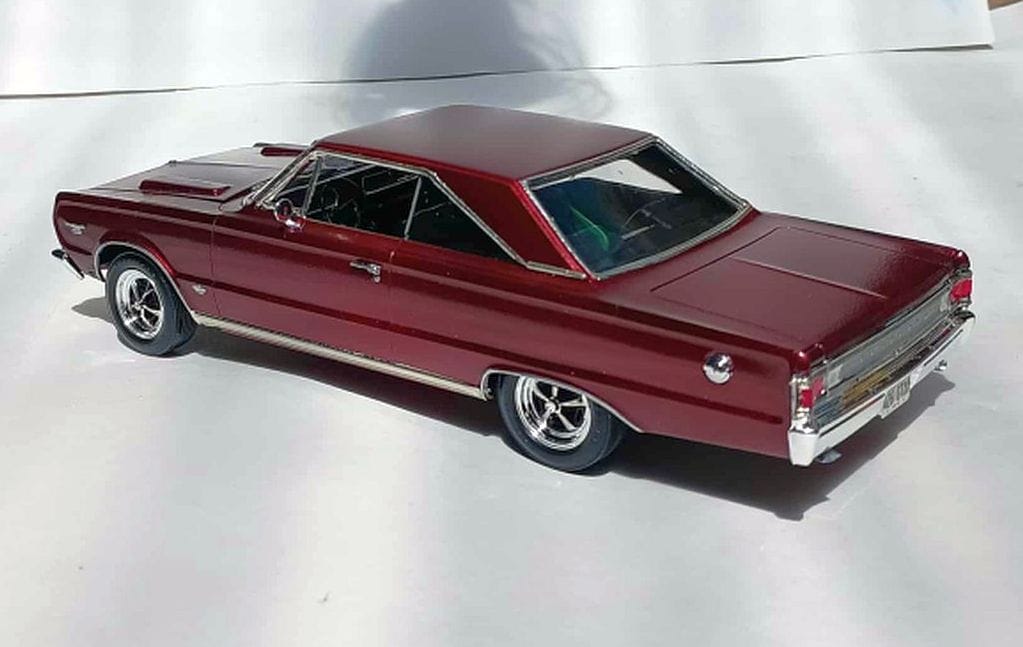
Not so strangely, I seem to have built a lot of these. I see a two-parter here, to tidy up the remaining Bs. As usual I’ll split it along Plymouth/Dodge lines. Plymouth today.
1967

These derived from the ’65-’66 cars, which in turn were a reskin of the ‘64s, which had (mercifully?) little in common with the infamous Exner ’62 design it started out as.
They had severely rectangular lines, almost a caricature in their stiffness of line. The roofline had already been seen on earlier Plymouth hardtops, initially with an odd-looking kink in the rear. Personally, I always found the upside-down taper of the C-pillar kind of visually unsettling. But it was distinctive without being freakish, not like some of the Exner-era designs.

This car does not seem to have been kitted back in the day; I guess it had to develop a reputation first. Revell released the Hemi GTX in 1994, making a Sox and Martin drag version available from 1999.

1968-9

All change! A new curvier body, with increasingly more graphic elements for the performance versions; black panels and stripes to add to the variety of scoops. 1969 brought a minor facelift of the new-for-‘68 design.
When new, Jo-Han produced the annual kits; these were excellent, but long out of production. Their 1969 Road Runner was a 3-in-1 kit with custom and NASCAR building options. Neither of my Jo-Han builds are stock. The red one uses the custom’s spoiler and has additional side stripes;

the mustard one has the wide steel NASCAR wheels and different graphics.

AMT produced a ’69 GTX convertible for 1990, adding a Pro-Street hardtop version for 1991, then a regular hardtop kit for 1993.
Then they added a ’68 Road Runner to their range in 1989; a Pro-Street version was added in 1992.
1970

A major change saw new front and rear panels, and the sides were smoothed off, losing the ‘eyebrows’. The front end was a rather tame precursor to the upcoming ’71 hardtop’s grille/bumper combo. Hardtops gained a flattish quarter-panel ‘scoop’.
Jo-Han again produced the annual kit in 1970. Monogram made one in 1982, with the 440 Six-pack engine. A street machine version was added in 1986 with the seemingly-obligatory twin four-barrels on a tunnel-ram manifold. This kit has been periodically updated.

The ’70 Road Runner likewise had been available from Jo-Han. Revell released a ’70 Road Runner in 2000; unlike the GTX, this had the Hemi. The 2022 revision gained the 440 Six-pack.

1971

A radical new body introduced fuselage styling already employed on the big Plymouths. Again, one of my favourite shapes. If you looked ahead to the photos, you might have guessed that.
In 1971 MPC had the promo and kit contract, and produced some lovely 3 in 1 kits. The 1971 came with an optional faux-Daytona nose and tail, while the 1972 could be built to resemble a popular Mopar show car based on the Road Runner. Some details of that version weren’t quite right, but it was quite a looker. MPC also did a dedicated NASCAR Road Runner, correctly sharing little with the annual kits.

Revell released a GTX in 1995. This was based on an earlier 1984 Monogram release of a Plymouth Satellite – I guess they wanted to avoid paying licensing fees for the GTX or Road Runner names, though it had the Road Runner’s hood and C-pillar stripes.

I didn’t like the black plastic it came in, so I painted mine yellow. Once the GTX came out, things got rather hectic on my bench! That shape just lends itself to so many colours, like…..

Holden Cyan Blue

Ford Tropicana Green

Ford Mulberry

Ford Red Pepper

Sorry, I don’t remember which orange this one is.
1973-4

The ’73 makeover played down the fuselage effect and emphasised more of a Brougham look, with a reshaped quarter window and a down-sweeping side crease. Granted they needed to incorporate the mandated 5mph bumper, but the grille was strangely-shaped, recessed between out-thrusting headlights. Not quite full-Exner, but an odd look just the same.

For this generation we have only MPC’s annual kits. I built the Baja racing version of the ’73 – an unusual building option.

The yellow ’74 was a mid-eighties reissue. Primarily intended as a modified street machine, I hand-painted black stripes – in those pre-internet days it wasn’t as easy to find information about what they looked like. Well, not down here.

The blue ’74 was a reissue from about ten years back. Although it had the Road Runner’s bulged/scooped hood, and the Rallye wheels, I added a half-vinyl roof and whitewall tyres for more of a prestige appearance.
We’d better check out the Dodge dealer next time!























I am fully with you on styling, the 1971 is beautiful and a in my eye a huge improvement compared to the previous generation( I also find the C pillar visually unsettling on those)
That Mulberry color looks really nice, but I believe it was never offered in the US? it would have been a nice competitor to the Plum Crazy of Chrysler
We had some beautiful car colours in the early seventies Gianluca. I think the US was slipping down into early Broughamhood while we enjoyed some of the brightest, wildest colours, pretty much throughout the seventies. Ford Australia had two metallic purples which would have nicely bracketed Plum Crazy: this and Wild Violet, as on this Dodge.
I spent a lot of my free time building and customizing model cars in the late 60’s into the 70’s, then stopped around the time I started driving my first car, a 56 Chevy Belair. A few years ago, at around 70 years old, I decided to get back into it, only to find I no longer had the patience to deal with intricate pieces of plastic that ultimately resulted in a plastic miniature. You have some really nice models there and I can appreciate them, but I’ve learned that it’s no longer for me.
excellent work ! they look real ! keep up your efforts….
Thanks Brock! I will as long as I can.
Rich, some guys find they can pick up where they left off in the hobby, but also a lot find as you have – whether it’s patience, eyesight, or something more sinister like arthritis or the shakes. For myself, I feel it may be a matter of my having kept the fingers nimble through the intervening years – but patience is another matter. I hear of young guys lacking the patience to finish a model too, so that’s not just a function of growing old.
I have far too many unfinished projects and I still keep starting more. Still, as I’ll live to at least 539 I’ve still got time…
539? I know that feeling, Bernard.
Once when my car was in the shop, they gave me a loaner 1974 Plymouth Satellite. I thought it would be great to finally get to drive one of these long coveted cars. What a letdown. The suspension was as hard as a rock, I felt every pebble and crack in the road with great announcement. The blind spot on the right side took a lot of getting used to, and now in recollection, I believe there was no right side mirror either. Acceleration was sluggish, and gas economy was non existent. I was glad to get my own wheels back quickly.
It’s horrible when an older car doesn’t live up to our expectations, and we have to take it off that pedestal in our minds. It makes you question the objectivity of all you may have read or heard about a particular car. Maybe that ’74 needed a good tuneup – but that wouldnt have fixed the other issues.
71/72 Sebring is sweet sweet sweet and these variations are a good opportunity to fine-tune my preferences. I prefer the twin hood indentations to the power bulge, and a single colour with no stripage. Still can’t decide between chrome or body colour front loop. Nice ones Peter.
Don, my preferences align with yours. With a body-colour loop it would look quite modern – if there were any such thing as a modern big coupe these days.
All I can say is “Simply delightful!!” The blue Satellite is my favorite (color as well!) and I’ve always & still pair OEM or mag wheels with whitewall tires for a different look! 🙂
Thanks. I think whitewalls seem so much less common these days that they are unexpected – and therefore quite eyecatching when we do spot them. That’s so long as they are era-appropriate in size.
Another awesome article…say I have query that’s kinda off topic, a friend of mine was around the other night and he mentioned the mansion that is opposite the block of apartments you grew up in on Mitford Street Elwood, my friend was saying in the early 1980’s the mansion was a rooming house, and not a very nice one from his description, I was wondering what it was like when you were living across the street, and was there still remnants of the tram line down Mitford Street to Broadway??
Thanks again for all the articles man.
Hi Newt. It must be interesting to have someone who knew your neighbourhood half a century ago.
Dad said he held me up on the front balcony so I could see the last tram to pass our place – but at the time my age was measured in months rather than years so I really don’t recall. I only have a very vague recollection of them ripping up the tram tracks. Growing up in the sixties, there was no visual reminder that there ever had been a tram system in Mitford Street – except for the occasional black on yellow “Hail Cars Here” sign at a former tram stop down the Broadway.
The mansion certainly was a boarding house in all the time I was there (as was the one on the corner). It seemed to be a home for older people with mental issues, and some of the residents were real characters. There was the old bearded guy with a very military bearing who once a month bought a five-pound bag of wheat and actually marched out onto the parade ground (front lawn) to feed the pigeons. I’d love to know what was going on in his mind! There was the old woman who always tried to bot cigarettes off anybody passing. They’re the two I recall. There were certainly other local characters, but I don’t know whether they were from the mansion, next door, or elsewhere.
MInd you, they could have pointed the finger back at me and said I was a bit of a character!
Glad you like the articles too, Newt.
These are all super-cool, Peter. I always seem to learn something new about the actual cars of which you have built the models. I hadn’t paid enough attention to the 1970 Plymouth intermediates to notice that they had lost the “eyebrows” on their side sculpting, as you had pointed out.
Also as you had mentioned, I also had an initially adverse reaction to the reverse taper of the C-pillars of the earlier generations, but I have come to appreciate them as a way to establish added visual interest and identity.
I like the rectilinear 1965 and ’66 models now probably more than I ever have.
Thanks Joseph. Like you, I appreciate the rectilinear style earlies more than I used to. In their day they seemed super-square when everyone slse was growing hips and curves. Taken out of their time context and looked at sixty-odd years later, they’re actually an attractive design.
I don’t set out to teach about the actual cars, that just kind of happens! Those ’68-9 Plymouth ‘eyebrows’ were almost invisible on certain colours, yet added some visual interest, some tension to the design. Taken away, I wouldn’t say the design looks flat or lifeless, but you’re aware it’s missing something.
I think the models he does are absolutely jaw dropping OMG
As a teenager, I too found the reverse taper C pillar ”unsettling” and was attracted to the fuselage styled cars first and foremost, but as an adult, began to appreciate the earlier cars more. That C pillar design shouldn’t work and it is polarizing, yet it does work somehow.
The ghost of it can be seen on the more shapely 68/70 cars as well.
But for me the sun rises and sets on the 68/69 cars.
I know I should love the 71s, and do, but sometimes from some angles, something is off and prefer the 73s, there I feel better now.
This is supposed to be about model cars, so I will pick the blue 73 as a favourite.
Jonco, it’s interesting the number of people who’ve said they also find that C-pillar unsettling. I had thought it was just me! And yes, you can see a nod to it in the ’68-70 roofline for sure.
Sometimes it’s a fine line whether I’m writing about models or the real thing. Sometimes the models are centre stage, other times they merely have a supporting role for a story about the real thing. And the comments, as usual, are all over the place!
Hope you the blue and yellow nova s I did
Yep! Sorry BIll, I’m in a way different time zone, and I was asleep.
Yellow one’s looking cool. How are you going to finish the blue one?
I’m curious if you recall what the blue color on the ’68 Roadrunner is? I have that one unfinished but painted with one of the Tamiya spray cans and it looks very similar. That one was coming along nicely until I got hung up trying to figure out how to make hood hinges that worked. If they are going to include all that detail on the air grabber setup you need to show it off right? 🙂 I suspect that your solution of just leaving it loose is much better.
Dan, you’re not going to like this, but I’m pretty sure that’s Duplicolor Holden Cyan Blue. Yeah, I know, paint from a dead brand from half a world away. That was pretty much my go-to blue before Tamiya expanded their range.
Now, Tamiya have an amazing range of similar but slightly different metallic or pearl or mica blues. There are three you could use that would look simiilar. I would have to sit down with the cans under a strong light so I could choose. It’s a dismal winter’s day here, but I would think TS50 Mica Blue would be very close.
Hood hinges that work? The Chinese Trumpeter kits had photoetched hinges with wire pivots that work like the real thing. A pain of a thing to assemble, as the wire they supply is so tough it’s almost uncuttable! There must be something similar available from the aftermarket, though I wouldn’t know where to look.
A very colourful episode this week! The gold with black vinyl roof is a great combination even if that body style isn’t my favourite. Thanks for another great selection,Peter.
Thank you Bernard. That’s one thing about sixties and seventies models – they will always be colourful if I have anything to do with it!
Hi Peter!
It’s great to see your work here once again! Every time I see one of your builds, I want to drag out another kit from my stash and start on yet another model! Hope you’re doing well sir and keep up the excellent work as you are able!
Bob Kremer
Ha! I wondered if you’d call in again, Bob. I’ve been writing here for three years. Originally it was fortnightly, but this year I’ve had the time to contribute a weekly piece.
I’m glad (amazed, humbled…) to be inspiring you. This year has been my most productive year for a long time; unfortunately that’s been in part because I lost my furry companion of 21 years. He needed a lot of my time as he neared the end. But so far this year I’ve finished about 30 stalled projects, most of which I wrote up here, as well as starting a few new builds – and even finishing some!
https://www.curbsideclassic.com/blog/miniatures-toys/six-months-dozens-of-models-one-busy-workbench/
Health will always be an issue, but I am thankful for what remains.