

A few months ago, I did a story on second-generation Chargers, in response to a request from Moparman. I mentioned at the time that what I really had a lot of was the third-generation cars. I’ve always liked these big, curvy, fuselage-shaped Chargers, with their distinctive Gremlin-like quarter windows. For a while, this I really felt was the future of car styling. For a short time it seemed like it might be – clean sides that tucked under at the bottom, a minimum of extraneous decoration, roof pillars brought out to the full width of the body, maybe even with the wheels pushed out to the body edges – to give an organic shape a more planted stance.
But, alas, along came the rise of full-formal Broughamhood, sending North America back to sixties squarishness coupled (sometimes uneasily) with neoclassical details. Or Broughamoid grilles with stacked rectangular headlights blacksmithed onto a shape never meant for them. Ugh. Aesthetic nausea as well as technical malaise. Add the mandated bouncy bumpers and early emissions era engine technology, and it’s a wonder anybody bought new cars at all. I wouldn’t have. Fortunately, the Brougham style didn’t play in my country; we went for a more European simplicity.

I can’t think why I like these ones so much. I think it must go back to a photo in a car magazine featuring the new American cars for 1971. This was something of an annual tradition in automotive publishing here, often along the lines of “What on earth are those Americans up to now?” It might give us an insight into what future Holdens might look like, and there were often technological developments of interest. For me, the attraction was the looks!
While I can’t remember the details on the car in the photo, I know it made an impression on me. I think it was the curves in the shape, allied with the definite fuselage body-to-roof integration, which made me think this was the next big thing in car styling. Just enough straight lines to give tension to what could have been a bloated shape.
For a short while, it was.

I was not blind to the car’s faults. No childlike adoration here. In my early teens I was turning Dad’s Falcon in the yard for him to go off to work – a four-point turn from the garage to the driveway if you got it right, a six-pointer if you had to go back an extra time and realign yourself. I had to miss the stairs, so rear three-quarter vision mattered a lot. Turning anything larger in there would have been an absolute nightmare!


I could see the C-pillar would be a huge impediment to rear vision. Shame; I really liked the look of that upswept quarter window. It would have been impossible to see the rear of the car for parking. That nose looked awfully long, too. A whole lot of practical issues – but then a coupe 5232mm/206” long by 1953mm/77” wide would be fairly impractical in my country anyway. And at around a ton and a half, with early emission-era economy and drivability – no, it wasn’t going to happen.

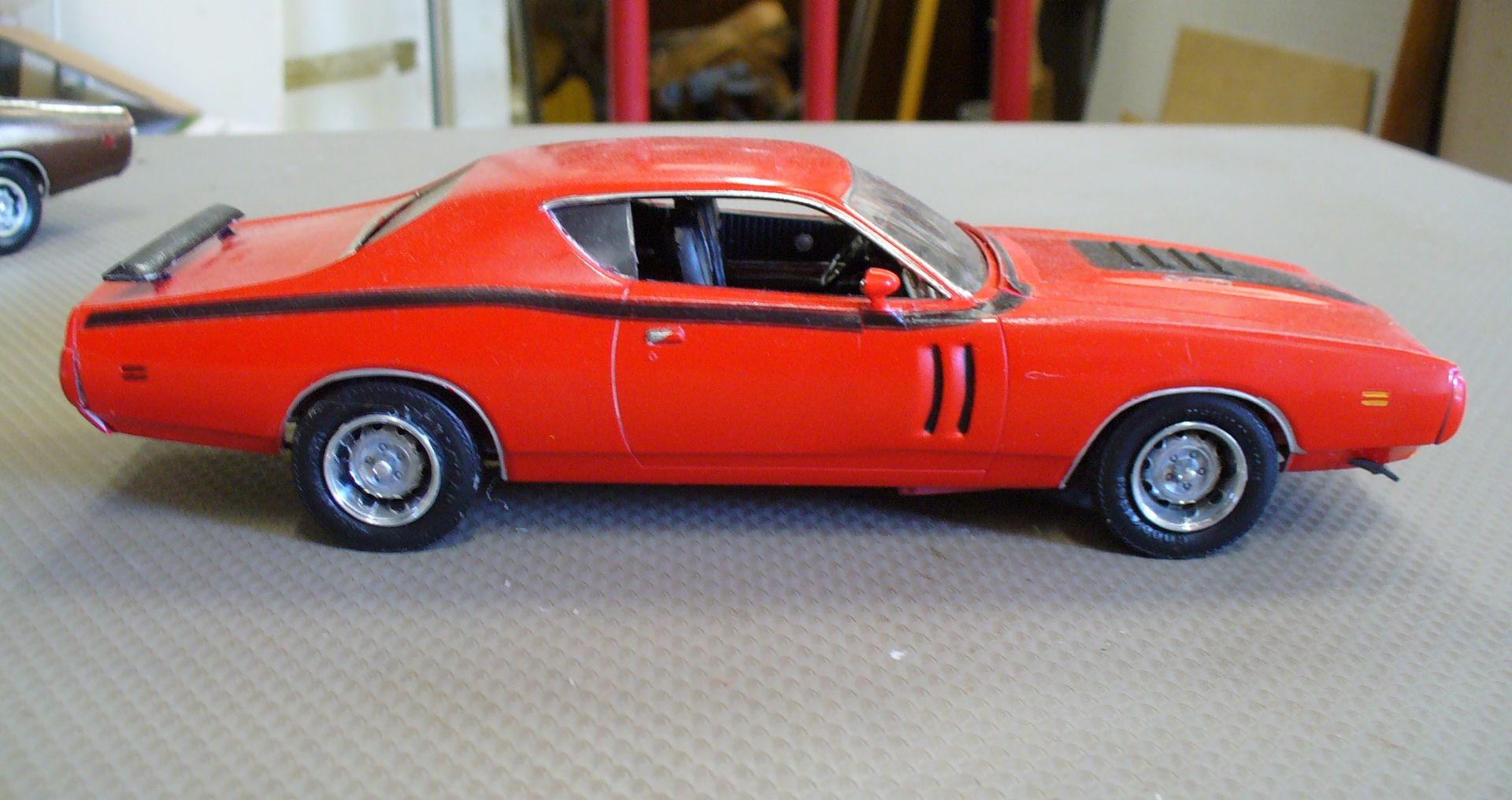
MPC ’71 Charger annual, moulded in Butterscotch.
For times like this, there are models. MPC made a kit of the Charger as part of their annual range for 1971. For the first year only, it was moulded in colour, either Butterscotch with an orange interior (mine) or the reverse, with accent paint along the body upper and lower edges.
They revised it each year through 1974, by which time it had gained an unusual custom station wagon version. There was also a drag version (Pro Stock seemed to be flavour of the month) as well. In 1974 form it made a reappearance in 1980 as something of a street machine, incorporating parts from several issues along with some rather garish graphics. We’ll look at the ‘74s later.

Then out of the blue, in 1999 AMT released a totally new model of the Charger. Much better detailed that the 28-year-old MPC kit, the AMT one represented an R/T with the 440 engine – and a bench seat interior. Now AMT has a history of finding strangely-optioned cars to base their models on. Hobbyists complained, they wanted the cool buckets-and-console – but it was an easy matter to swap the seat for buckets and a console from another kit. Or to cut down the centre portion of the seat to make it folded down for an armrest. A particularly skilful builder could make this movable between the two positions. Good luck getting your fingers inside to move it though!

I really appreciated the positive location points for the chassis within the ends of the body – like the Japanese companies do. Not so appreciated was the location of the rear axle on the rear leaf springs; it needed to be shifted back a few mm to centre the rear wheel in the wheel arch. I always kept forgetting to do that! And the decal R/T stripes were tricky to apply, being so thin they were prone to tangle.


Another version of the kit followed, a Hemi-powered Super Bee. Unfortunately, this came with oddly-styled alloy wheels which now look terribly dated, being a swirly-spoke design which was popular for, what, two years? I bought a few Super Bee kits, but didn’t use these wheels, swapping them out for something else, like the usual Mopar rally wheels.


Also, unfortunately for those wishing to build a stock Super Bee, the body shell is the same as the R/T – meaning the Super Bee model has the door ‘gills’ which were an R/T exclusive. Oh well, they’re not too hard to fill. The orange one was built before I realised this error. A bonus in the Super Bee version was optional heads from an experimental DOHC Hemi developed to clobber Ford’s SOHC427. A technical dead end, but cool to have in model form.
Currently AMT has the Charger R/T kit available with the Hemi originally in the Super Bee.
So much for history. Now for some more models.

Here’s a stock R/T in a decidedly non-stock metallic pink. (Testors’ Electric Pink)

And here’s that 440 Magnum. No 6-pack, alas.


Slightly modified, this Hemi Super Bee wears the R/Ts door gills, but a simple tail stripe.

And larger diameter wheels (somewhere there’s a Prius up on bricks).

I mentioned the ’74 kits before. Here is the 1974 annual kit built as the custom wagon version,


And here is the reissued street machine version from the eighties. I simplified the graphics and applied them over black for a more subtle appearance.

Interestingly, several online reviews I turned up tore strips off this kit for quality, but I don’t recall it being notably worse than other kits of the time. Guess the reviewers were young guys. Viewed as a holdover from fifty years ago, it’s not too bad. I wonder whether there’s enough interest for AMT to bring this back, or do a ’74 body for their excellent ’71 kit?
I’m outta here. See you next time!























Great models as usual Peter.
My pick of this lot: The Plum Crazy (or whatever purple metallic that is) Hemi RT/Bee Hybrid with the Prius wheels, although a larger diameter Dodge Polara reproduction rally wheel would look great on that car… you know, the one with all the holes. (Sorry, I don’t know what these were called in MOPAR parlance, but the Testor Pink version just above it above looks like it has the wheels I’m thinking of here.)
Thanks Rick. I get the idea. You’d like the purple one on Mopar Rallye wheels. (I think I used Ford Wild Violet on that). Normally I would be a traditionalist like that too – but after using them on almost all the others, I wanted a different look. That’s why I lowered it, too.
How about the blue one at the start? I didn’t mention it in the text, but it uses 15″ rallye wheels off a 1/24 scale Monogram model – which would probably equate to 16s in 1/25. Fun with scale!
Oh yeah, that one has those wheels too. Actually, until I scrolled down the the purple one, that blue one was my favorite. 😀
So , i enjoyed the article and all of your pictures not sure which is my favorite as they all in their own way are really nice . I am a big fan of all Chargers 1967-74 , but like you especially the 71-74 , and will show you why with several pictures to follow . Not sure if i can load them all in one email or have to do separate .
Basically the one model and original box it came in , then the actual real car i own that the model is based on .Not shown in pictures are several 1/24 scale die cast of Nascar Chargers from the same time period driven by Richard Petty and Dale Earnhardt . My actual 1973 Charger was a painted up Richard Petty street legal show car that I chose to restore back to factory specs other than swapping out the 340 motor to a 69 383 . The model has a 426 hemi with 2 4 barrel carbs.
Ok so heres second photo of actual box the model came in, as theres one photo per email
Sorry , heres photo
And now , the actual 1973 Dodge Charger I own that the model is based on
Neat. It must be great to be able to build a model of your car – and option it up with a Hemi! It’s a limitation of this site that we can only load one pic per comment.
I’m not sure I could pick a favourite out of these either.
A bit sad then Dodge didn’t gived the green light for a factory built Charger wagon. Btw, I spotted a picture of the box showing the custom kit of the Charger wagon released by MPC.
https://www.forbbodiesonly.com/moparforum/threads/1971-74-dodge-chrysler-plymouth-history.28175/
The box art on those old kits was amazing, Stéphane.
MPC’s art folk seemed to tap into exactly what would appeal to kids. Even after the cars themselves were less appealling, they illustrated kit features in such a way to draw you in. For example, I’d already built the MPC ’71 kit – but when I saw the box with that wagon version, with the woodie side decals, and the custom front end piece – I just had to have it!
I am trying to remember if I built a 73 or 74 kit – it’s been a long time. I always preferred that later car’s roofline over the 71-72. I love the color choices you made on all of these.
Thanks JPC. That was a while ago. I thought mine was a ’74 but according to the photo Stéphane found, my memory was a year out- because that was certainly the box!
One thing Mopar was never short of was great colours. Sticking with factory colours you can rarely go wrong. This generation Charger seems to be one of those cars that look good in just about anything, which is quite some achievement. I’m not too keen on the shade of orange I used – now – and now I have the proper green(s).
Peter: As the owner of a 1970 Charger 500, it took a while for me to warm up to this “fuselage” body style, but in time I did. Now, as far as your models are concerned: My favorites are the purple/Hemi car, the green R/T, the pink 440, and I’d love to see the blue R/T w/ the wheels & tires from the ’74 station wagon (which I find to be a bit awkward). I also prefer the chrome bumpers rather than body colored. As usual, your models are GREAT!! 🙂
Thanks. I was wondering what you would make of these, now that I know you have a ’70.
I’d agree the wagon is awkward, but as a 16 year old it appealed to me. Nowadays I’d want to blend the custom front end into the fenders, and possibly try to get closer to the box art colour.
It’s interesting that when the ’74 came back to the lineup around ’80, neither the wagon back nor the custom front were in the box. Stock-bodied street machine was the only choice.
As for putting the blue one on the ’74’s slot mags and whitewalls, that would take a bit of fiddling since I re-did the front end to fit the larger Monogram wheel backs. Might be easiest to imagine it! 🙂