

Text kindly submitted by Cal Sexmith. All images sourced from the web.
In previous stories, I’ve written about Dad’s cars and our family’s station wagon years. This time, we’re looking at the other cars that came and went in our family’s driveway, beginning in the mid-1960s, when some of our neighbours began buying second cars. Unlike many women of the era, my mother drove, having learned to do so at the age of nine while growing up on a farm. With two drivers in the family but only one car, Dad decided in late 1964 that it was time to find Mom a car of her own.
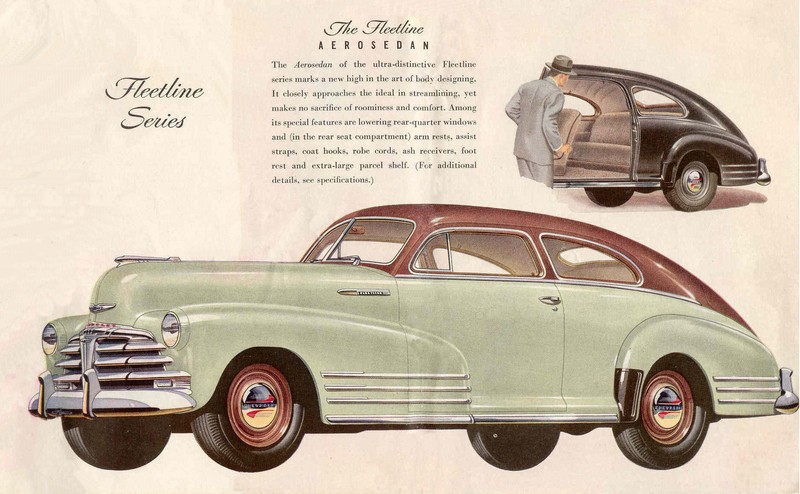
I don’t recall an extensive search, and I suspect the purchase was more a matter of opportunity than anything else. The daughter of one of our neighbours owned a two-tone green 1948 Chevrolet Fleetline two-door Aero-Sedan. She had recently married, and her new husband had a Corvair convertible. They decided they no longer needed the old Chevy, so her father asked Dad if he knew anyone who might be interested. We went over to inspect it, and Dad declared it to be in very good shape for its age, apart from some damage to both front fenders. One had been repaired and primed but not painted, while the other remained untouched.
The husband explained how the damage had happened. One day, his wife had hit a large tree beside their driveway, and the insurance company paid for the repair. They left the fender unpainted because they were considering repainting the entire car. But when she brought the Chevy home from the body shop, she was watching that tree so carefully that she hit the tree on the other side of the driveway! Despite this blemish, Dad handed over $100, and the Chevy became ours.
When we got it, the Chevy seemed archaic, with no turn signals, a starter pedal, hand throttle, hand choke and a rudimentary heater. Despite being Mom’s car, she rarely drove it, preferring our 1963 Fairlane. I remember her saying that what she really wanted was a Nash Rambler or Metropolitan. As a result, the Chevy became Dad’s commuter car.
We didn’t keep it long, perhaps a year and a half. In the fall of 1963, Dad switched from teaching high school physical education to working as a guidance counsellor. He began taking additional university courses to qualify fully for the position, and in the spring of 1966, the school board granted him a sabbatical for the 1966–67 school year. Under the terms of his sabbatical, Dad would receive two-thirds of his salary but had to return to the school board for at least two years after completing the program. One consequence was that the old Chevy had to go. Dad sold it to the father of one of his colleagues, who continued driving it around the small town where he lived for several more years.
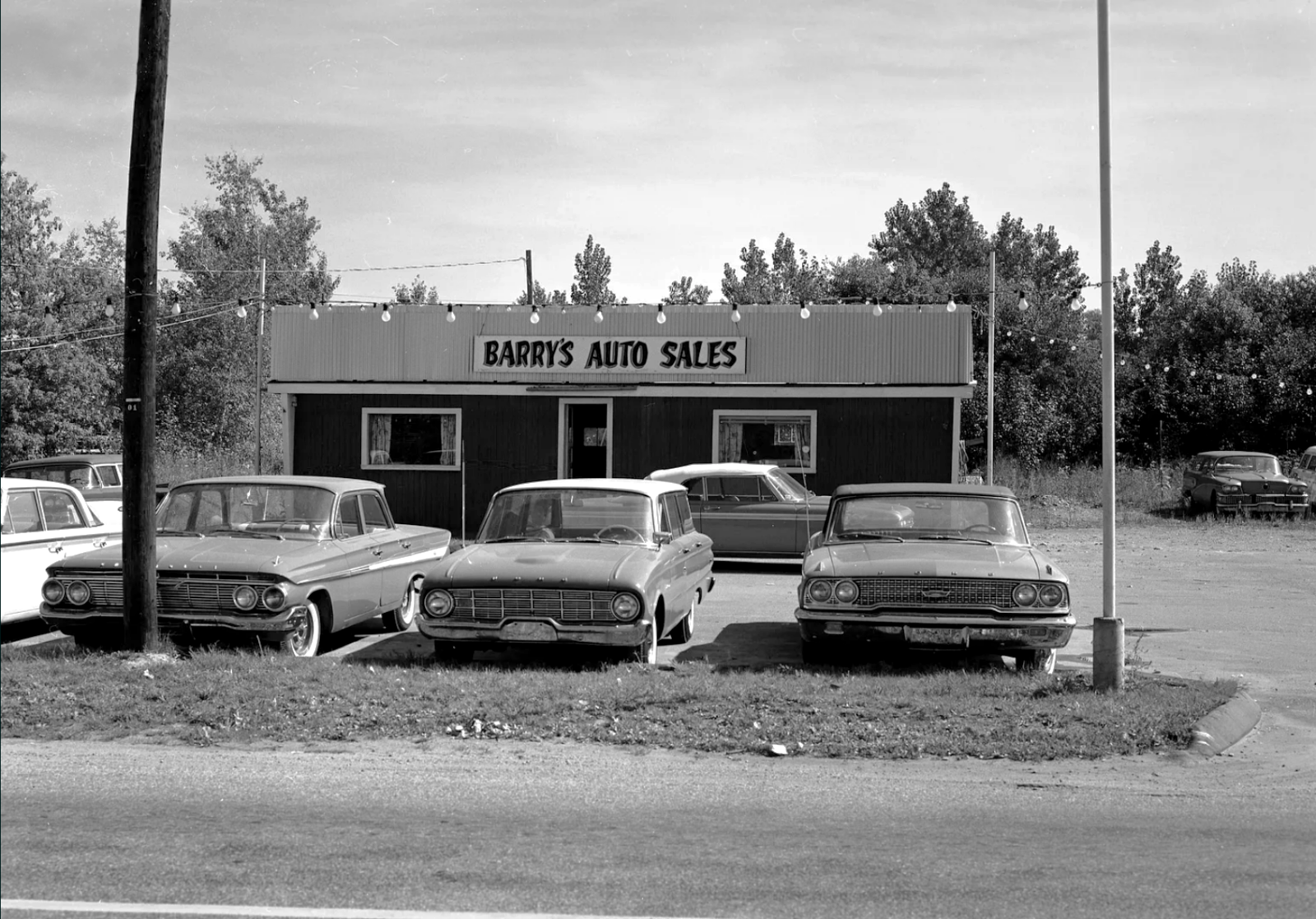
When we returned to Prince Albert in the summer of 1967, there were plenty of changes in our lives. Dad took on additional administrative duties at school, which came with a boost in pay. We had rented out our house while living in Edmonton, and my parents considered moving to a larger home when we returned. In the end, they decided to add on to the existing house, with renovations continuing into early 1968. The family grew, too, with the arrival of my sister in late 1968. With so much going on, the search for a replacement for the ’48 Chevy was put on the back burner.
Around this time, Dad and I began the tradition of cruising the “lemon orchards,” his name for used-car lots, to see what was available and whether we could find a replacement for the old Chevy. I remember trying out a variety of cars, mostly North American models from the mid-1950s. Among those that stick in my memory were a light blue 1954 Plymouth, a maroon 1954 Pontiac, a pink-and-grey 1955 Pontiac, a purple-and-white 1956 Monarch and a green 1957 Chevrolet. Mom still preferred something smaller and suggested a Volkswagen Beetle, so we found a blue late-1950s example to try out, along with a grey Vauxhall Victor of similar vintage.
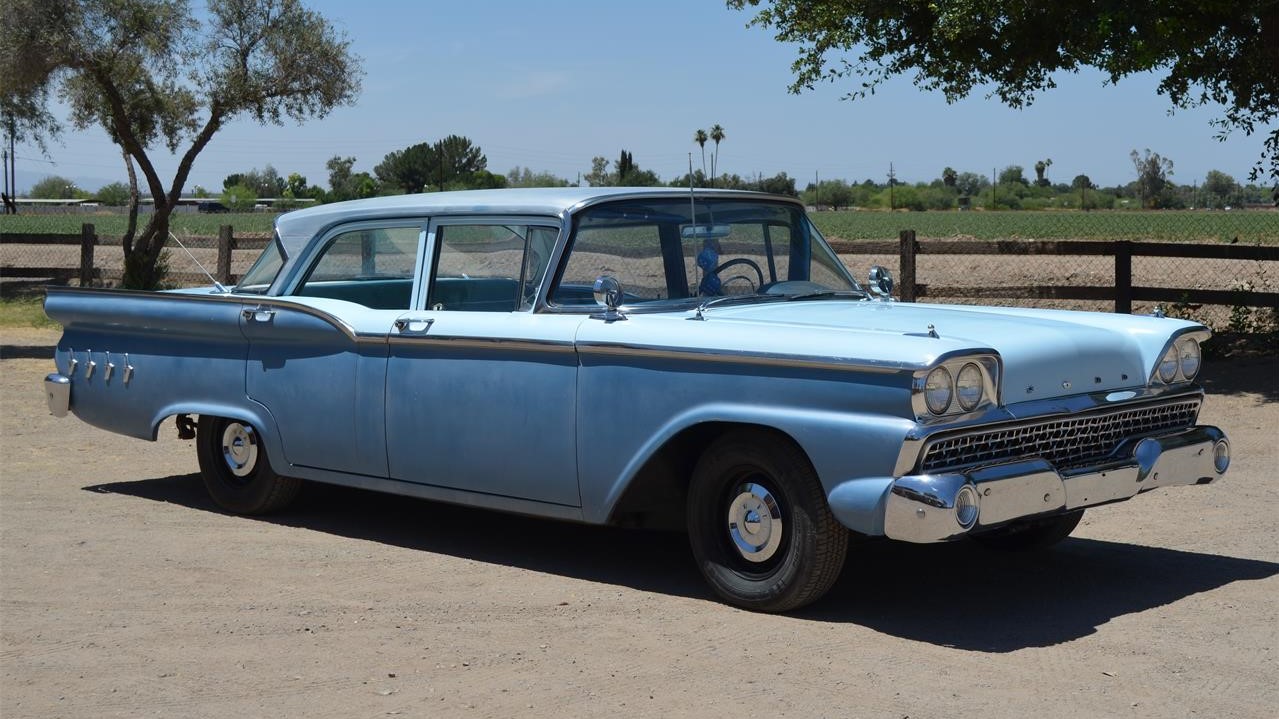
What happened next was quite different from what we had anticipated. My paternal grandfather retired for the second time in 1961 or 1962, following a serious health problem that he nearly didn’t survive. After recovering, he moved from the small town where he had been a school principal to an apartment not far from our house. His retirement didn’t last long, however, and he soon returned to teaching, taking evening classes at the local community college for adults working toward their high school diplomas. With Grandpa living nearby, we also had access to his car, a turquoise 1959 Ford Custom 300 sedan that he had bought second-hand shortly after retiring. Since he lived within walking distance of the school where he taught, he rarely needed the car and let Dad use it whenever we needed a second one. In 1969, at the age of 79, Grandpa retired for the third time and moved to a seniors’ complex. He continued spending his summers at his cottage and needed the Ford then, but from the fall of 1969 onward, the car spent its winters with us. When Grandpa passed away in 1971, Dad inherited it.
The old Ford, as we called it, was a basic car, powered by an inline-six engine and paired with a three-speed manual transmission. Its only significant option was power brakes. When I started high school in the fall of 1971, I rode to school with Dad. Every Monday morning, we stopped at a service station for $2 worth of gas and a quart of oil, which kept the Ford going for the week. I remember the station owner, a former student of Dad’s, asking him whether he was trying to wean the car onto a Volkswagen diet. This was also the first car I learned to drive with a manual transmission. On weekends, Dad took me out to the backroads to practise.
In 1972, after Grandpa had passed away and his estate was settled, Dad decided it was time to replace the Ford with something newer. He placed a classified ad offering it for $150, and within a few days it sold for $125 to a fellow who already owned another 1959 Ford. I suspect he was looking for parts.
The search for a replacement for the old Ford began a few weeks before it was sold and continued for a few weeks afterward. The first two candidates were at a local auto body shop whose owner was a well-known hot-rodder and customizer who also dabbled in interesting used cars. Both were black Ford Thunderbirds: a 1962 model priced at $900 and a 1964 listed at $1,100. Dad seriously considered the ’62 but decided he didn’t need two cars with 390-cubic-inch V8s. With me only a few months away from getting my driver’s license, I suspect he may also have had reservations about giving a teenage boy access to such a car.
Mom was still campaigning for something small, and Dad found a red 1969 two-door Vauxhall Viva at the Plymouth dealership for around $1,000. It had low mileage and looked good, but the Viva and its badge-engineered sibling, the Envoy Epic, had poor reputations. The Viva had been replaced by the Vauxhall Firenza in 1971, and the Firenza’s troubles culminated in a successful class-action lawsuit against GM. Given that history, Dad concluded there was probably a reason the Viva was priced below comparable Datsuns, Toyotas and Volkswagens. I don’t know what its previous owner bought instead, but I hope it was a Valiant or Duster rather than a Cricket.
The next car we looked at was a white-over-navy-blue 1966 Mercury Comet Capri hardtop with a 289 V8. It wasn’t a Thunderbird, but it had my full approval. I believe the asking price was $1,200, a little more than Dad wanted to spend.
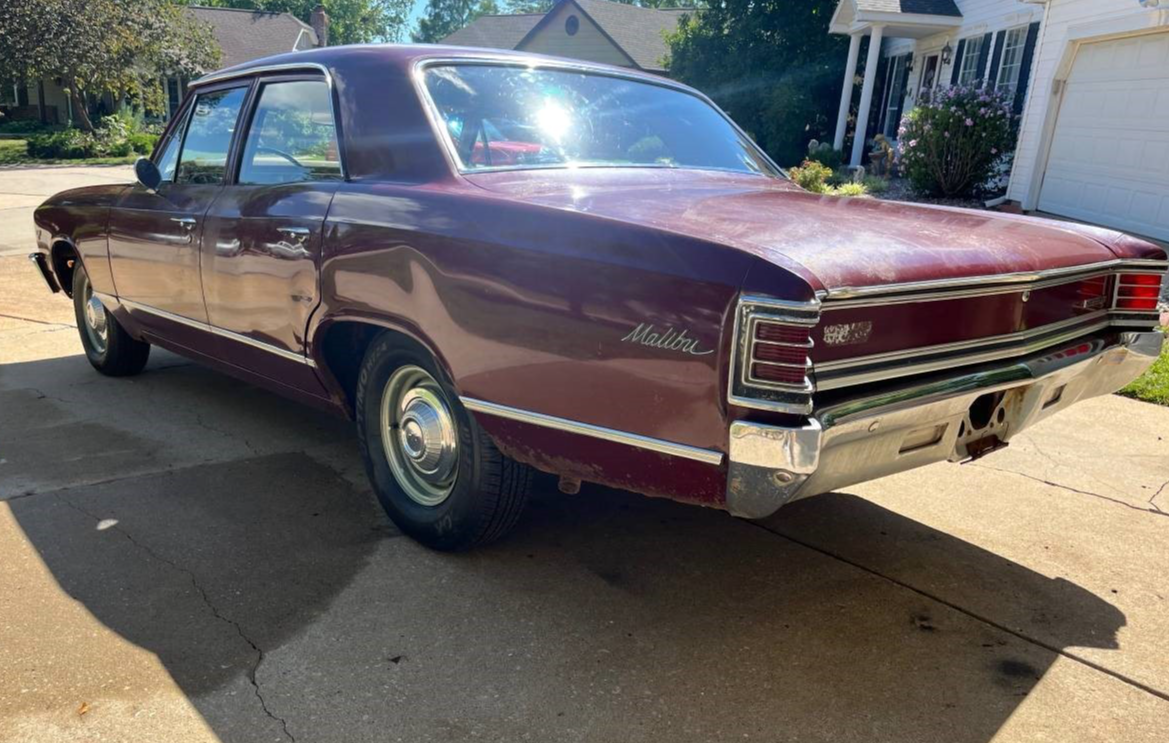
The final candidate was a turquoise 1967 Chevrolet Chevelle 300 four-door, equipped with the 230-cubic-inch six and a three-speed manual transmission. It was being offered for the bargain price of $700. The Chevelle was in good shape and reportedly had belonged to a local priest—presumably driven to church only on Sundays! Its low price was no doubt due to the almost complete absence of options beyond an AM radio. Nevertheless, Dad decided it would make a suitable second car, and that the six-cylinder engine would help keep me out of trouble.
As it turned out, we kept the Chevelle for only about five months. It was traded in the very same day I got my learner’s permit. In the fall of 1972, my parents bought a house on a rural property and decided we needed a truck, so the Chevelle was exchanged for a 1966 Dodge D-100. But that’s a story for another time.
I remember two notable incidents involving the Chevelle. As a stripper model, it came with very cheap black vinyl seats and rubber floor mats. On a hot day, the seats seemed to mould themselves around you. Fortunately, the front bench seat had one of those fuzzy blue seat covers that made things more tolerable. One day, Dad offered a fellow teacher, Mr. Price, a ride home. I was going along, too, and made a beeline for the front seat. Dad told me to let Mr. Price sit up front, but he insisted I could ride there since he was only going a few blocks with us. Once he climbed in, he understood why I’d been so eager to claim the front seat!
The other incident happened when we went to visit friends who were building a new house on a rural property. The access road was still under construction and extremely rough. On the way home, the Chevelle suddenly stalled. It restarted readily enough but died as soon as the clutch was let out, and the gearshift wasn’t behaving properly either. Our friends tried towing us with their truck, but the Chevelle’s rear wheels simply skidded rather than turning. This was before cell phones, and the property didn’t yet have a telephone connection, so our friends drove to a nearby farm to call for a tow truck. Once the car reached the garage, the mechanic quickly discovered the problem: we’d picked up a stick on the rough road, and it had wedged itself between the shift forks, leaving the transmission engaged in second and reverse simultaneously. It was a quick fix, but I came away having learned an interesting trick for disabling a car with a three-on-the-tree transmission!























Cal, thanks for starting my autumn Sunday morning off with a smile. My Dad was an Ohio state trooper, having graduated from the patrol school after serving in Korea. Mom didn’t drive until I was born (1961), but living on a farm with a baby, Mom had to learn. I recall Dad telling me that Mom, when learning to drive from Dad, parked the car straddling the parking space line in an old Hudson, which eventually gave out when Mom pushed the clutch in and when right through the floorboard. Dad then bought for Mom a ‘58 Dodge Coronet, black and white, that had been wrecked. It sported a ‘59 Dodge Coronet front clip. Big car for Mom, who weighed-in at 100 pounds. Next was a very nice used Ford Falcon four-door wagon in hearing-aide beige that served Mom and the family, including my new little brother, quite nicely. Fast forward to relocating to Arizona in 1969, Mom/second cars consisted of a ‘62 Buick Skylark coupe, a ‘64 Rambler Ambassador wagon, and a ‘66 Dodge Dart sedan. All used cars, all decent. The Dart was Mom’s favorite. She wouldn’t even start the car until we kids were buckled-up in the back seat, likely a nod to my Dad being a trooper.
Eric B. What a great narrative of living thru the 1960’s. A world away from today. In my family my mother always ended up being gifted my Fathers car and at the time he was able to buy a new car every 2 or 3 years. Her favorite was a 1965 Chevy Impala SS. Originally Aqua, it began to peel and my Father had the Dealership respray it in White. She loved that car and so did I. Aqua interior and some kind of big mystery dial on the dash board that must have indicated fuel economy.
I was born in 1963 and have lived in Ohio my entire life. I am keenly aware of the local impulse during the 60’s and 70’s and 80’s. Your family picked up stakes and moved to Arizona in 1969. I can’t imagine a more significant transformation. How did it work out ? Your tale is captivating and for someone who stayed put, I would be so interested in your summary of the 1970’s. I hope that everything worked out.
Great essay! Thanks for recounting your family’s experiences with previously enjoyed automobiles!
You are a fantastic Automotive Chroicler! When I see some of the prices,, you can’t buy a tire for what the 59′ Ford sold for!!
Thanks for a fun read. Your poor mom never did get the little car she wanted. Typical men of the times!
Well, FWIW my own dad, who emigrated from Europe as an adult in 1947, never learned to drive and my mom was always the driver in our household. She too had learned on a farm tractor, when she was in college in North Carolina. We only had four cars from the first in 1953, to 2010 when she had to stop driving, all four cylinder and all stick shift.
I can relate to the 48 Chevy fender dents I have a Aero Sedan, when you drive it all you see is the hood, the fenders are bulky and sticking out a lot further than you think, I recently scraped mine squeezing into the garage, I liken driving it to driving a V-6 Tacoma with a hood scoop all you see is the scoop.