

Newly moved to Swindon with a fully expensed company car, our Citroën Ami as a weekend Meccano® project and my wife Janice able to cycle to work most days, it was time to think about selling her Citroën Visa, before it broke again and before the rot set in once more. We loved camping – we couldn’t afford any other sort of holiday – so what we fancied was a Citroën Acadiane. Based on an extended Dyane it was longer in the rear than a 2CV Van and they were a popular camping conversion and bigger inside than our two man tent. People we knew gave us first refusal on theirs when they intended to sell and we were heartbroken to hear that their car had ended its life in a ditch, banana shaped to match its banana colour.
Shortly after we found ourselves at a 2CV Club camp in Yorkshire. We hadn’t really met Jim and Liz before but they said they had a van that they were minded to sell – so we followed them home to Bradford to find a red AK250 van – low roof, short body; that is to say the complete opposite of the Acadiane and the least best fit to what we wanted. So Janice bought it anyway.
The trick about this particular 2CV Van was that it was on an Ami Super chassis with a 1220 cc, 60bhp engine (quite a percentage uplift from the 18bhp it had ex-factory) and more or less exactly what I’d wanted to build out of my now deceased Citroën Dyane. The body featured six side windows instead of the normal two and was one of a short series built like that with right hand drive for the Belgian Post Office. Except this one was left hand drive. It was registered with a ‘Y’ plate meaning 1982 – its year of import to Britain. The Post Office specials were built in 1977, the Ami Super ran from ’72 to ’76, and the engine, goodness knows – because the guy who built this pocket monster chiseled off the engine number (probably to cheat on his insurance…) You could tell it wasn’t all quite right by the lump on the front of the bonnet to clear the engine – made from bean cans and filler – lots of filler. Jim told me a local 2CV specialist had taken it apart to see how not to build an Ami Super powered 2CV.
Spoiler Alert: we still call it Liz and Jim’s van, and they remain good friends to this day. They had it for 11 months. We’ve still got it, 41 years later and we still just call it ‘the Van’.
Our first trip was to the 1985 World 2CV Meeting but that was only 30 miles from home! We took it on the 2CV Club’s London to Brighton run – memorable for hitting an indicated 100mph on the M23 – but as months progressed it was clear all was not perfectly well. It broke down whilst acting as backup on the Ami Super’s maiden journey. It reached the point where it would start but how long it would run for was another matter. It seemed not to want to warm up, until it would overheat. Fuel would not pump from the tank, or it would flood the carb. The timing seemed impossible to get right and as soon as it was right it went off again. The lights worked when they felt like it and the gearbox made a noise like it was full of sand. I didn’t blame Liz and Jim, but I was getting to the end of my mechanical tether.

Our aim was to go to the 2CV World Meeting in 1987, which was to be in Portugal. So I gave up fiddling and shipped it off to a guy called Pete Sparrow who was starting out and is now big in 2CV Racing. When we got the van back, we set off on a wing and a prayer driving down through France, across the Pyrenees, through the Picos Mountains to the Portuguese coast. We enjoyed a great rally before heading home. Central Spain was hot, which is not ideal for air cooled Citroëns but the Van ran faultlessly. The only issue was a 28mpg (imp.) thirst and a 4 gallon tank, so we bit through a few fingernails hoping there would be a gas station when we needed one.
In ’89 I became a Partner in the consultancy I was now working for and we moved back to the east of England to establish a new branch office. The Van drove over but despite the success of the trip in ‘87, it was clear that more work was needed. The floors had been bodged, the bean cans and filler were parting company and the electrics were still not well. It leaked in the rain and the bulkhead had rust in it. We’d bought new old stock rear doors in Portugal so they were alright! Getting a new business established in a new town took my energies and, Spoiler Alert: in 1990 I had a new toy to play with so, partly dismantled, the Van went to live on a farm with a bunch of caravans. It stayed there until Janice’s ultimatum: fix it or scrap it. Don’t tell me, it was her car!

I’d rather fix it. I found a guy in Oxfordshire and we trailered it over there. He split shell from chassis and set to with a welding torch. The chassis was not as good as the Ami’s but better than most 2CV’s of indeterminate age. You can buy a new galvanised 2CV chassis from any number of suppliers: no one makes an Ami Super chassis so you have to fix up what you’ve got.

With new floors, new toeboard, rear inner arches and a new bonnet and wings carefully cut and stretched with the fluting on the bonnet tailored to match, we got the van back as a rolling chassis. It had never been so sound. The centre console no longer moved every time you changed gear, it didn’t leak and the floor was strong enough to take a bracing bar to which I could bolt harnesses for baby seats.

I built a new wiring loom – mainly 2CV but with differences for the four pot engine and its ‘conventional’ ignition – and a new dashboard using parts from a Citroën GS. We were back on the road.

Most importantly though, someone had given me a 1299cc engine of completely unknown provenance. That allowed me to swap out the 1220 into the Ami and enjoy a mighty 64bhp in the van. It gave a good excuse to sort the exhausts out too. Rather than trying to get the outputs from left and right banks of the flat four to match up with the factory correct silencer and exit the tail by a second silencer under the floor parallel with the suspension, it now has two completely separate and unconnected systems one for each pair of cylinders using just the under floor secondary silencer, one each side. Frenetic Subaru anyone? More like two swarms of angry wasps having a pitched battle at the bottom of a tin dustbin. Only louder. And angrier. Especially approaching 7000 rpm.

Despite being LHD and suited to European adventure, we tended to use the Ami for our foreign trips – at least until the kids had grown up and moved on, and that was when the van returned to the international scene. We’ve used it for adventures to Poland and Germany, to Czechia, Austria, Slovenia and Croatia and in ’25 returned to Slovenia via Germany, Switzerland and northern Italy. It never missed a beat in 2500 hot miles, much of it on the Autobahn and Autostrada where it will cruise at the 130 kph limit (81 mph) with plenty in reserve – with its original 425 cc twin it would have struggled to reach 50 mph. The torque of the ‘big engine’ (I know ‘big’ is a relative term…), hauls it up Alpine passes with comparative ease, aided by the fact it now has a 5 speed gearbox.

The old grindy 4 speed eventually gave up and there are many more 5 speed boxes kicking about than direct replacements. The trouble is, it’s 3 inches longer. So either you can move the engine forward (needing new engine mounts and stretching the bonnet and wings still further which is not exactly straight forward) or you can hammer a hole in the bulk head (which messes up the gear change and the handbrake) or as we did, you can raise the gearbox a couple of inches to clear the obstruction. That puts an excessive angle into the drive shafts, so the trick is to reduce the ride height so that they retain approximately the same relationship with the inner CV joints as they should have. That’s an easy fix, achieved by winding up the rods which connect the suspension arms to the interconnected horizontal spring under the floors. So now the Van is also a ‘low rider’ although not so low that it can’t cope with atrocious roads and the odd field.

Apart from being a rolling billboard of all the places we’ve been, the van remains the utility vehicle of the family, whether it’s transporting garden rubbish and lawn mowers, hauling logs, fetching the annual Christmas Tree or helping neighbours with house moves.
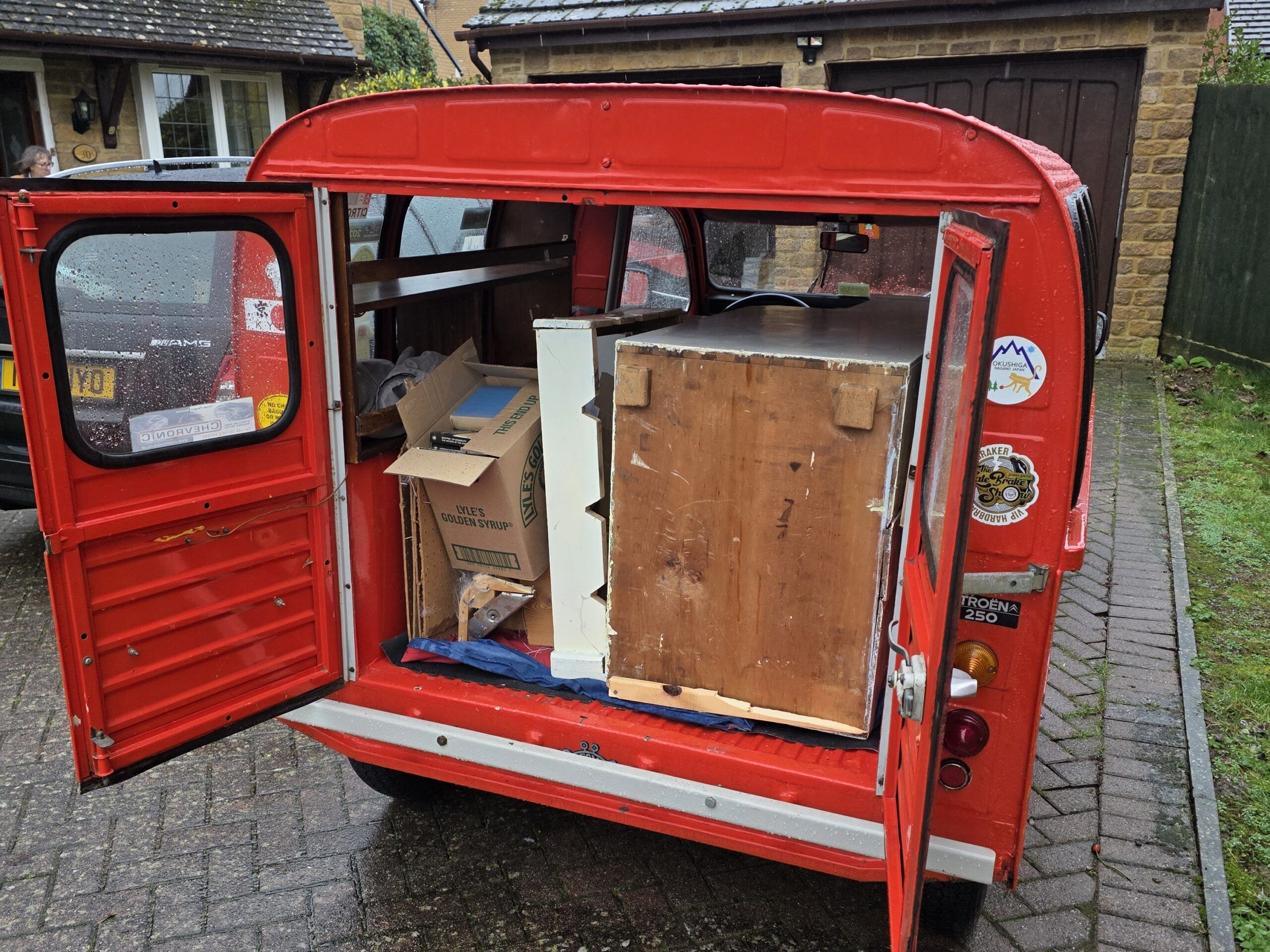
It’s amazing how much fits in 1.5 metres x 1.0 metres. The van isn’t going anywhere, it’s way too useful.
Related CC reading:
Curbside Classic: 1959 Citroen 2CV AZ – Four Seats Under An Umbrella, by T87
Curbside Classic: 1969 Citroen 2CV – The Most Original Car Ever, by PN
Curbside Classic: 1948-1990 Citroen 2CV – Ceci N’est Pas Une Voiture….C’est Un Art De Vivre*, by Roger Carr
Curbside Classic: 1980 Citroën 2CV 6 Spécial – Sumptuous Septuagenarian, by T87
Curbside Classic: Citroen 2CV Hoffman Cabriolet – The Ultimate Chick Magnet?, by PN
CC Twofer: 1982 Citroën 2CV 6 Charleston & 1976 Citroën 2CV AKS Fourgonnette – Fraternal Flat-Twins, by T87
CC Roadtrip Outtake: 1964 Citroën 2CV Fourgonnette – A French Clover In Ireland, by Jim Klein
Lane Motor Museum Basement Outtake: Citroen 2CV Sahara – 4×4, Thanks To Two Engines, by PN
The Ultimate Heresy: The Citroen 2CV “Brougham” Super, by PN
Citroen 2CV Citroneta – The Three Box 2CV, by PN
COAL: #1 Citroen 2CV – A Perfect Student’s Car, by Dion























I love both the van and the story!
Wow, a genuine hot rod 2CV. And a van at that. I love your dedication to this on-going project; the end result is terrific.
Thank you. Ongoing project is a good term. There’s always a few things that still need to be done. I really ought to sort the wiring loom out before it does something annoying like catching fire…
What a van and story. Despite a tricky start and haven taken a while to get this one sorted but it sounds like it is well worth it. The chassis and engine upgrades sound ideal to make it very usable.
Wonderful story, thank you ! If I had the experience and facility, this would inspire me to modestly restomod a VW Passat B3 wagon with a newer EA888 1.8T engine. Unmatched space efficiency in a traditional long roof. Oh, but wait, they dont’t have a ski pass through rear seat. Another modification would be necessary.
To this American, your “foreign car” story is so foreign to my life and experiences. But good for you…and bless your heart…
I must confess a real dislike for 2cylinder engines: it’s probably the off-sounding effluvia from Fiat 500 tailpipes and their nutty skipping-rope cylinder actions that put me off. (I would love to try a Panhard PL, or a BMW 700, however. They either of seem quite sophisticated on video, but I’m digressing). A flat four of about 1.2 litres seems exactly the right amount of engine for this elegant little Manx of a van. It looks cool, and can do real-world speeds, with all the comfort of that famous 2cv suspension set-up. There’s nothing not to like.
Well, nothing once the baked bean tins and ferrous frillys were removed, but that makes for a great tale.
What a sleeper! Must be a total riot to drive.
Nice looking van ~ I had no idea Citroen ever made a 4 cylinder air cooled engine, that’s sweet .
This is the very essence of Hot Rodding : you built it to suit your needs and managed to make it look sharp a the same time .
Kudos .
-Nate
2CV and Hot Rod are not terms you usually see together, although Car magazine did build a turbo 2CV around 1987. Making a four cylinder 2CV was a worthy project even if the end result was only an upgrade from slow to not so slow
For Nate, not only did Citroen make a flat four, it was used in the BFG and MF motorcycles motorcycle and the Trihawk three wheeler.
Absolutely loving this series, full confirmation that Citroen people are just generally a little bit nuts. Even by 2CV standards this one is a funny looking beast.