
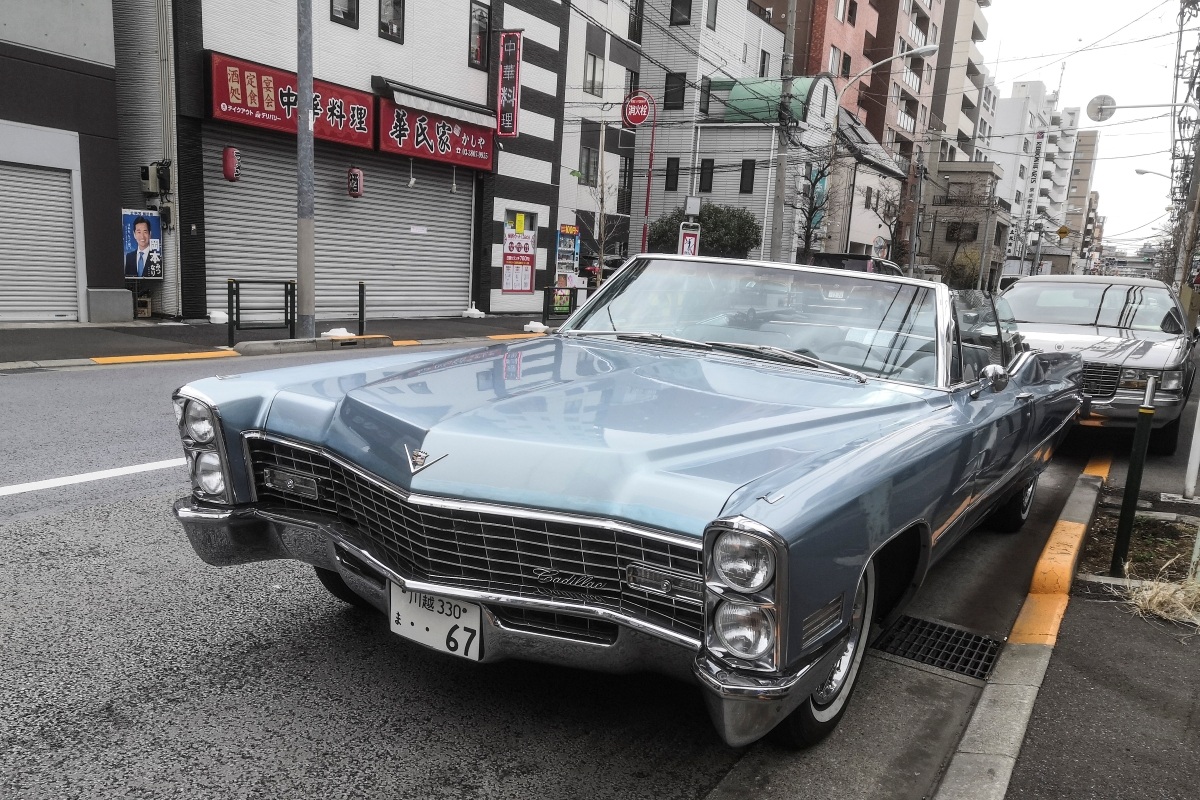
For the better part of the 20th Century, i.e. right until the Cimarron, Cadillacs were designed to impress. They were big, often bold, sometimes beautiful and always remarkable. Everyone has their favourites – I’d opt for the 1942 Series 62, perhaps tied with the all-new-for-’48 fastback. I like cars from that era, if my byline hadn’t made that clear. But I will admit that the mid-to-late ‘60s were another high point in GM styling, as exemplified by this De Ville.
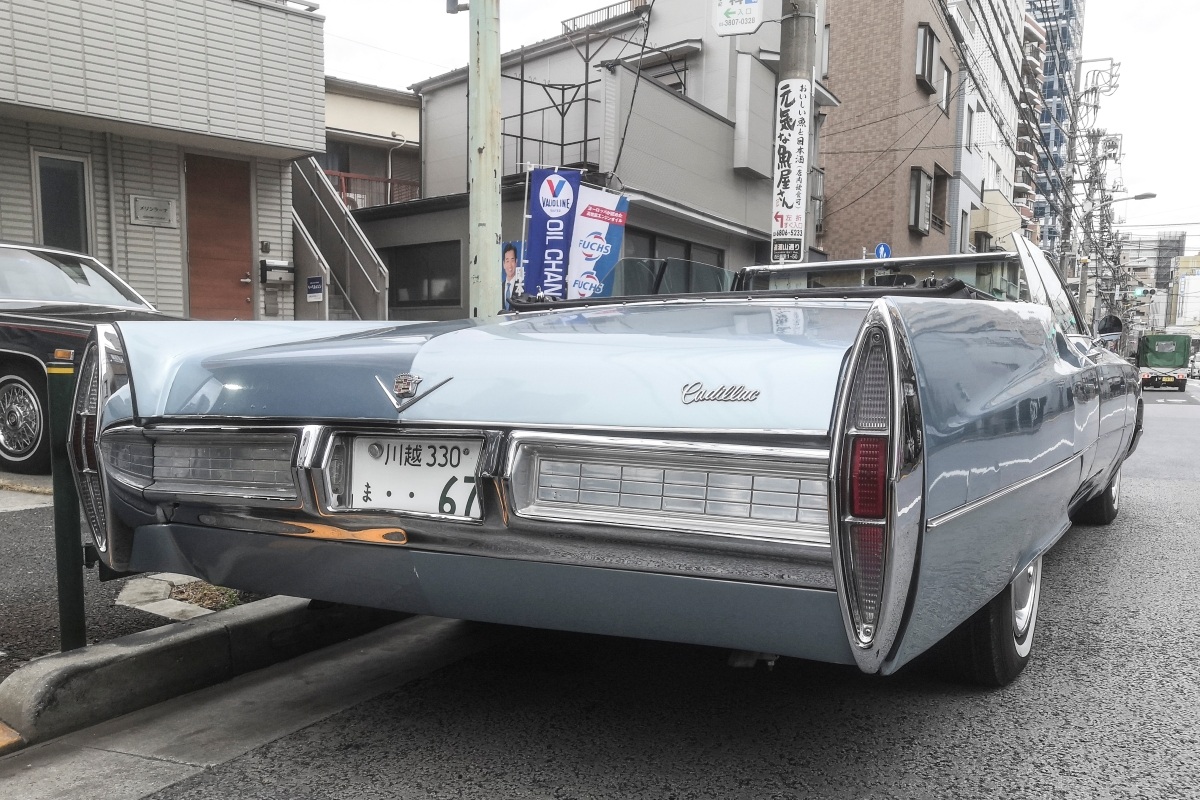
Of course, these Bill Mitchell/Stan Parker era cars look almost like the opposite of the 1930s-40s Streamline Moderne stuff that typically floats my boat (bathtub?), being as angular as possible and stretched in width and length to proportions that would have seemed hard to fathom a couple of decades prior. Size matters, no matter what anybody told you, but it doesn’t have to be a deal-breaker if handled skilfully. In the ‘60s, the champions of small-car styling were Italian. Big cars, on the other hand, were Detroit’s forte.
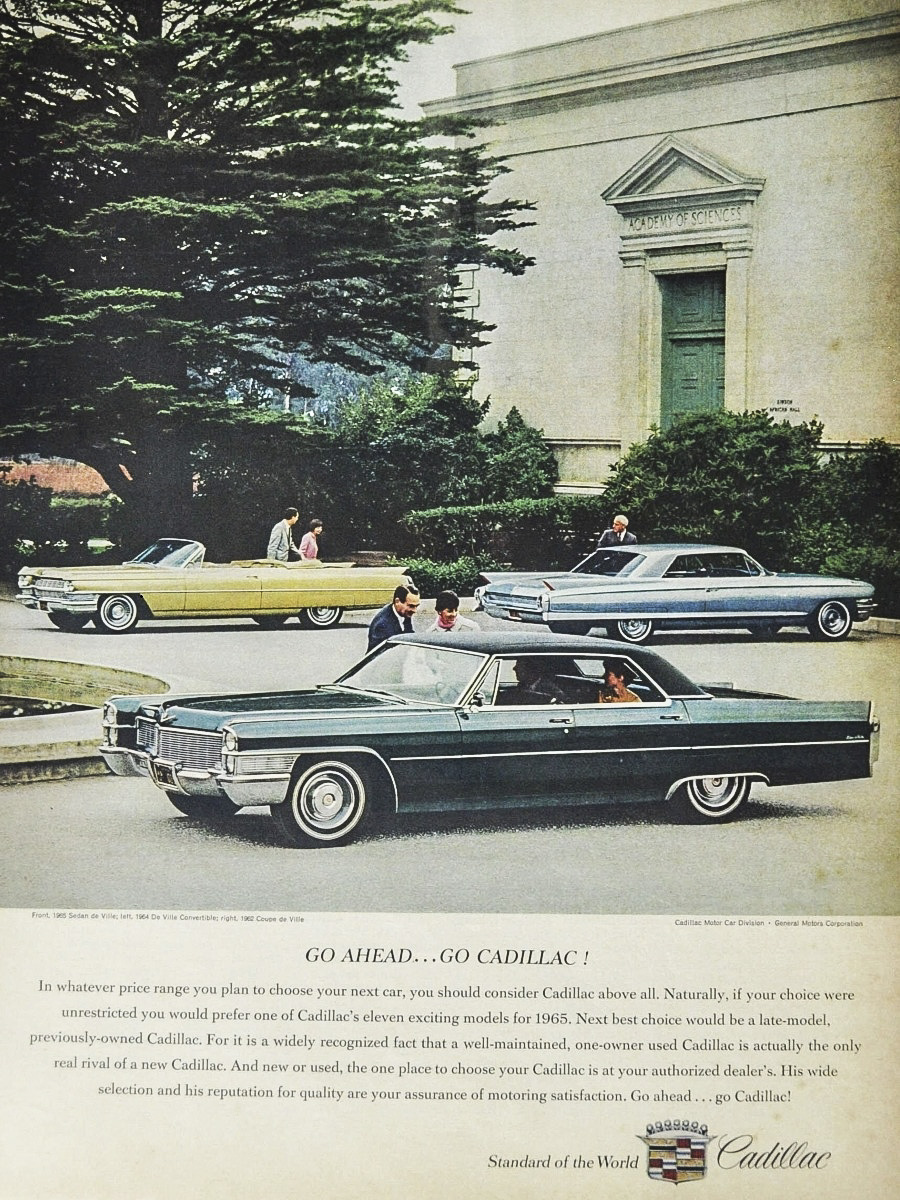
Cadillac styling went into a well deserved cooling-off period after the excesses of 1959. Every model year implemented gradual changes; they all pointed away from the goofy late ‘50s, but kept a modicum of continuity – the fins were still there, the horizontal quads remained in place within the grille, the general trend for longer/lower/wider carried on. Then came the clean-sheet ‘65s, when Cadillac simultaneously got a new chassis and shed the last vestiges of the Googie era. I mean, look at the 1965 advert above. Ostensibly, it was about Cadillac’s resale value, but surely its real aim was showing how much crisper the new design was.
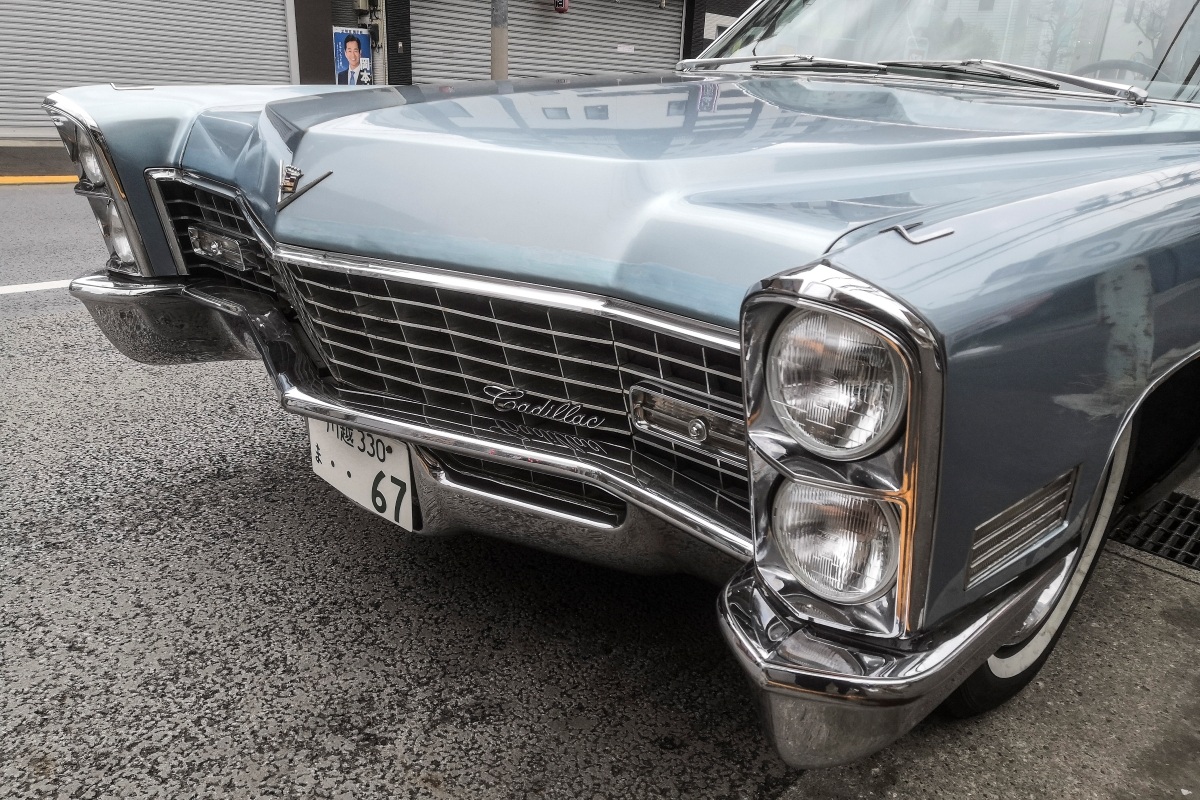
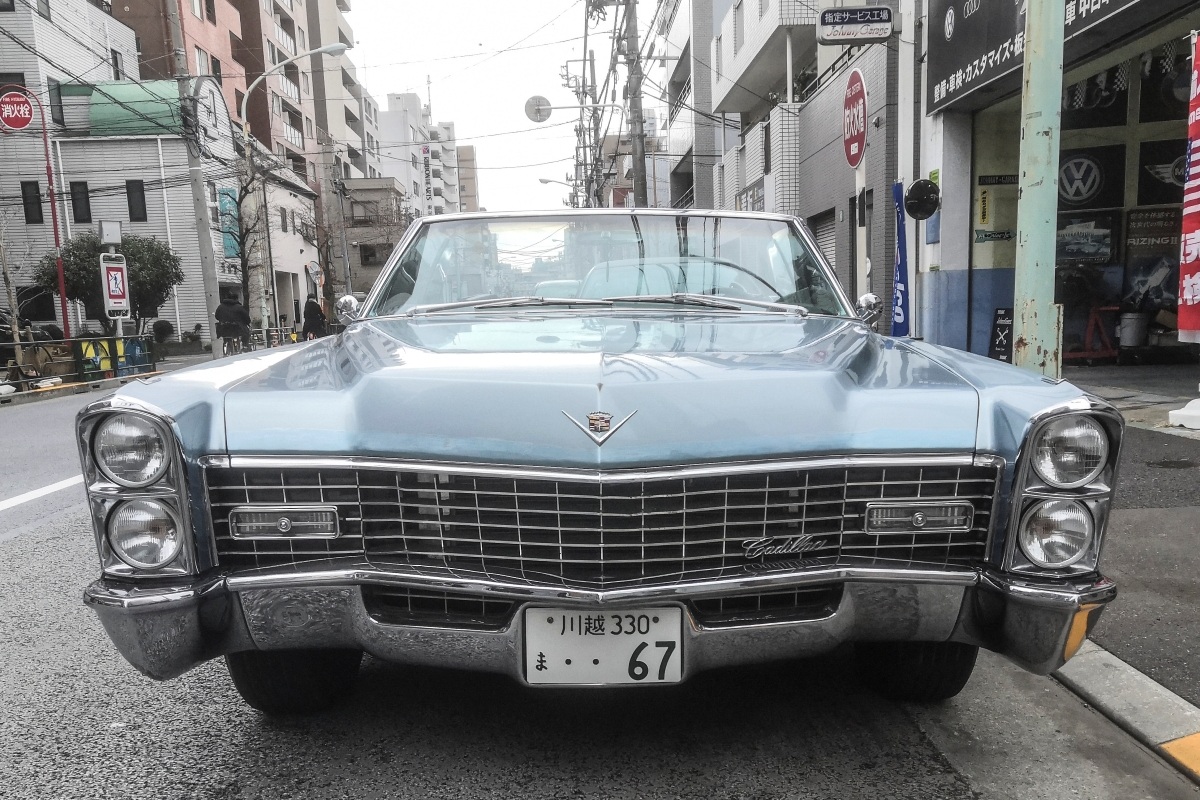
The most striking novelty was the headlamp arrangement, obviously. Pontiac had led the way at GM on these since 1963; the real pioneers had been Nash way back in ’57, but they had been too early (and too minuscule) to start the fad. It gelled a lot better with this kind of styling though, widening the grille even more and accentuating the front fenders in a very satisfactory way. Full-size Pontiacs kept them for a long while and they were also adopted by Mercury Comets, as well as larger Fords, AMCs and Plymouths by 1965. Cadillac’s take was one of the best, second only to the Buick Riviera. For ’67, Cadillac gave their headlights a pronounced forward-jutting angle, which made it look more aggressive in a very pleasing way.
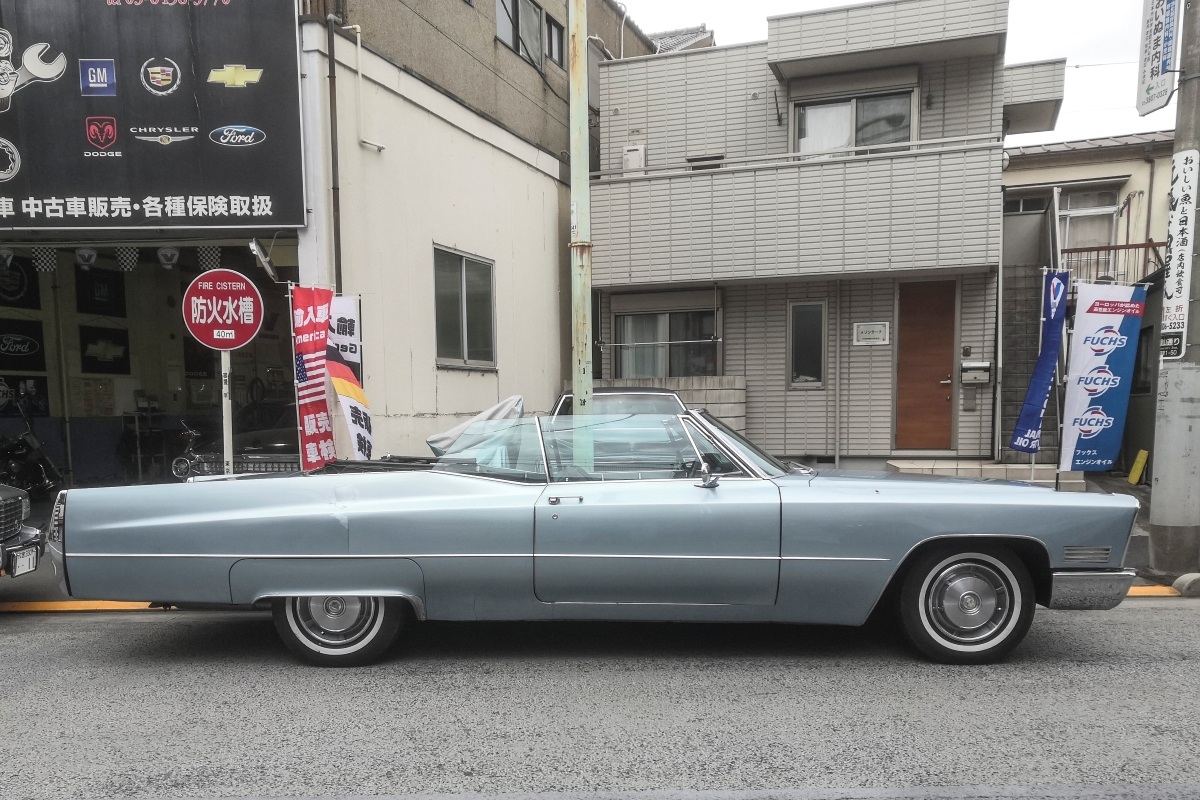
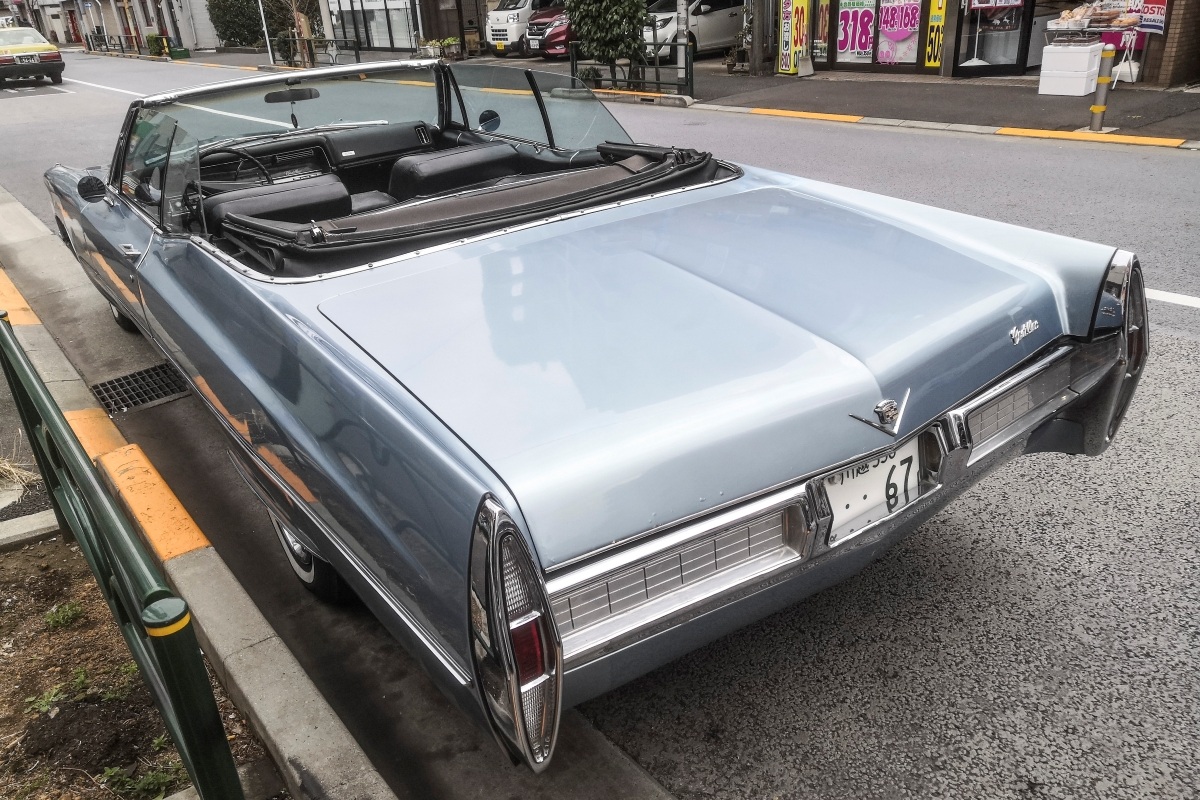
That probably didn’t help any with aerodynamics, but then that was not on many people’s radar in 1967. A brick is a brick is a brick. Well, except for that long and delicately arched beltline crease running down the rear half of the body. That line, absent from the 1965-66 Cadillacs, would remain as is until the full-fledged remodel of MY 1971.
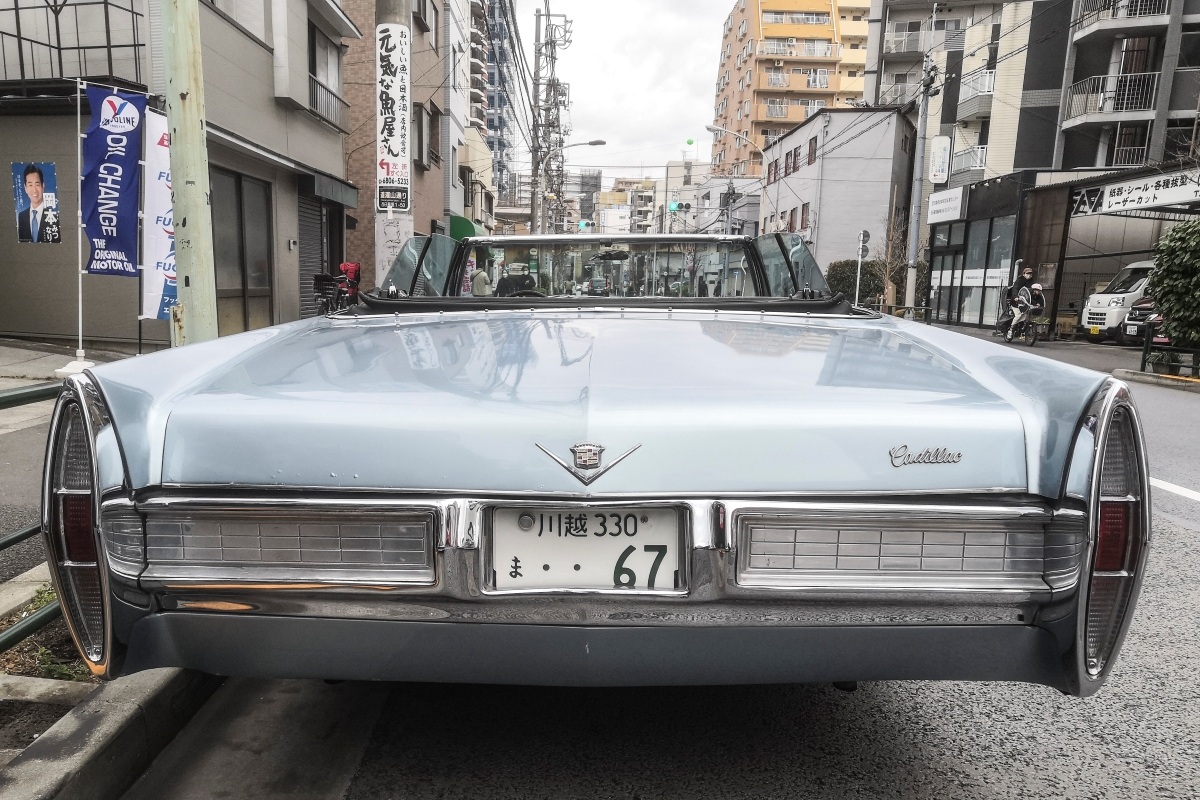
The glass-half-full type debate about late ‘60s Cadillacs’ rear end: did they do away with the fins and skegs of the earlier cars, or did they merely integrate them to the design more cohesively?
Of course, the real 1967 novelty for the division was the Eldorado coupe, now a completely separate type of Cadillac unto itself. Superb styling, groundbreaking drivetrain, huge hit. The only things it had in common with this De Ville was the division’s 429ci (7 litre) V8 and the hood emblem, really.
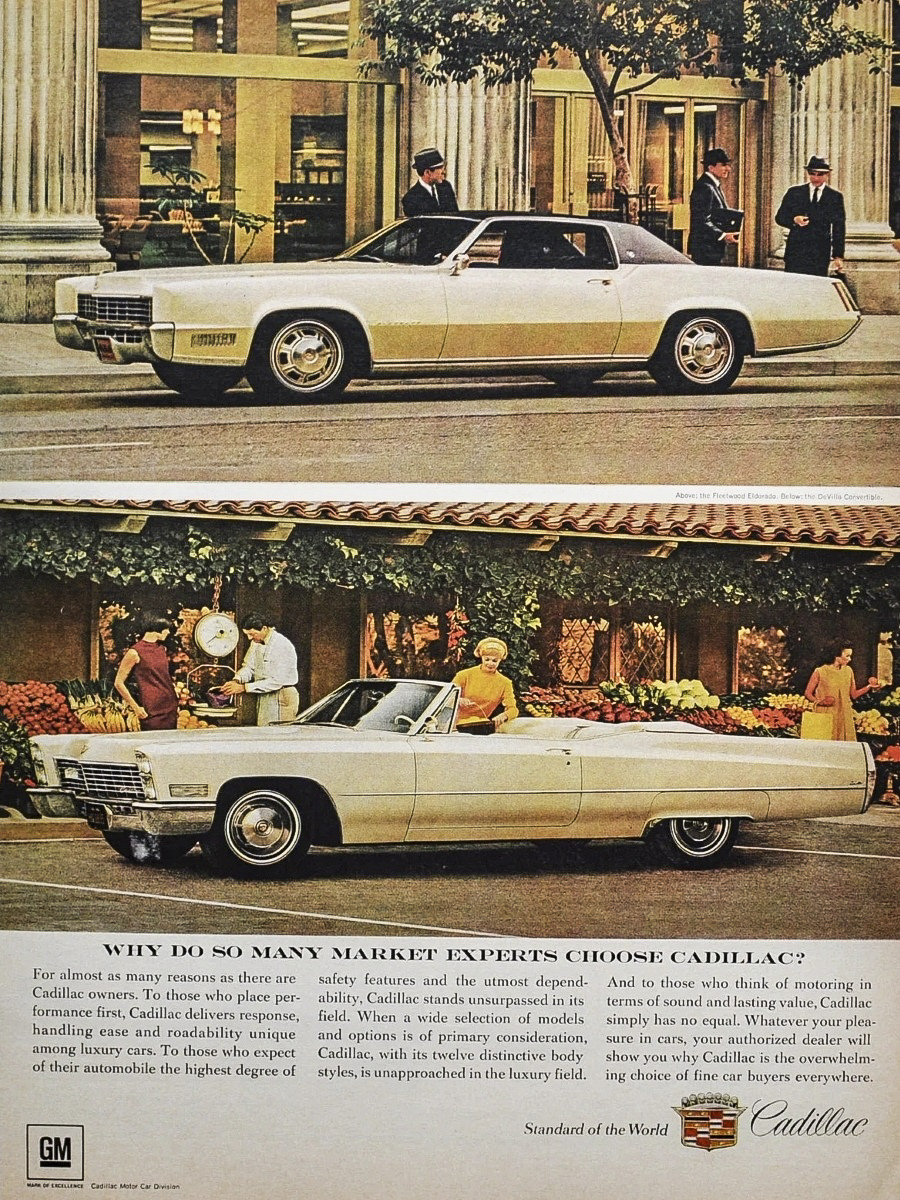
The general look of the front end’s centre section, with the coffin-nose hood and bulging eggcrate grille, were also quite similar (but not identical), giving the new Eldo some family resemblance with the RWD cars. What the new Eldorado did not provide was a convertible version, for the first time since 1953, making the De Ville Convertible Cadillac’s only drop-top for 1967. But it remained priced like a De Ville, i.e. well below the Eldorado or anything with a Fleetwood badge.
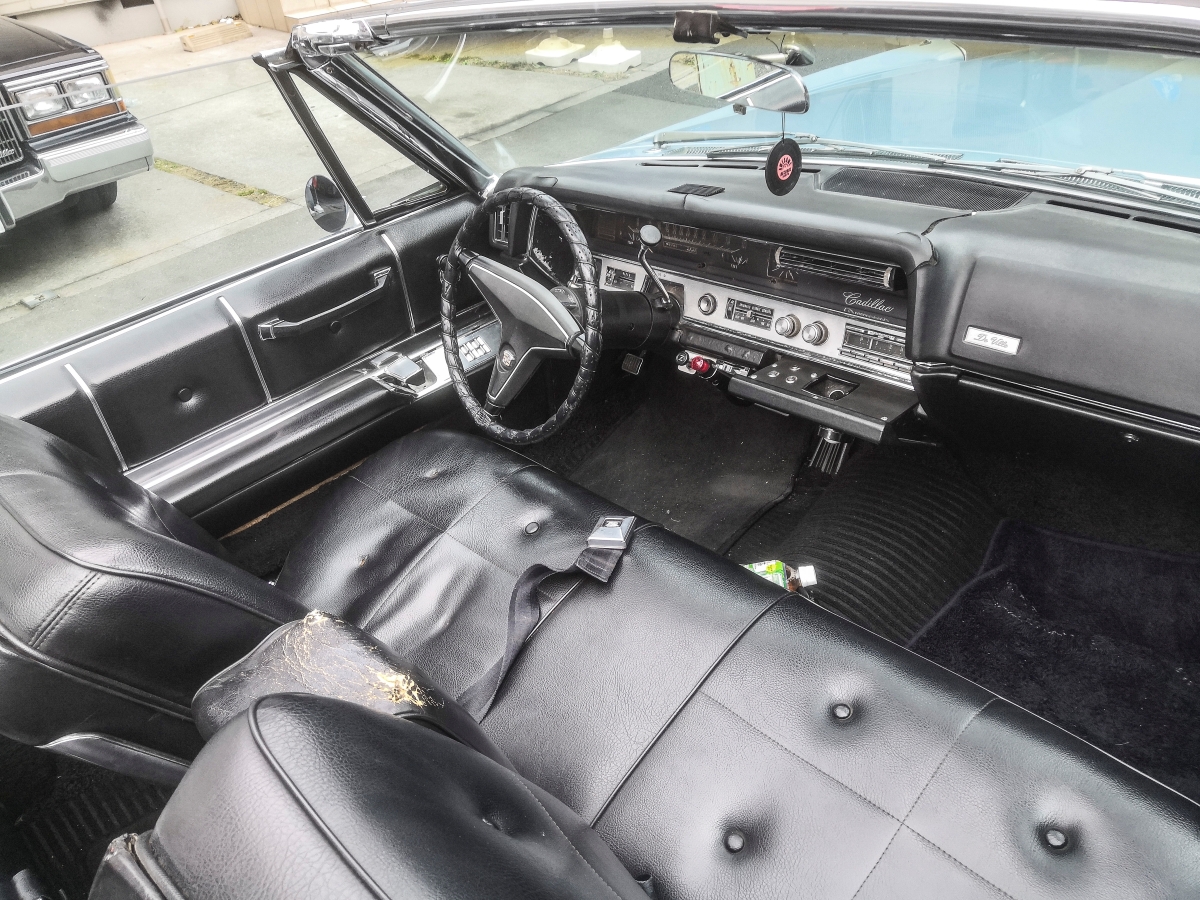
This did not help with sales, unfortunately: 21,450 Cadillac convertibles (19,200 De Villes plus 2250 Eldos) were made in 1966, versus 18,200 De Villes-only the next year. This is despite Cadillac’s overall production increasing slightly in 1967. The near-identical 1968s confirmed this trend, with 18,025 convertibles set against yet another record year for the division as a whole. Convertibles were on the decline, no matter who was making them or how cool they looked.
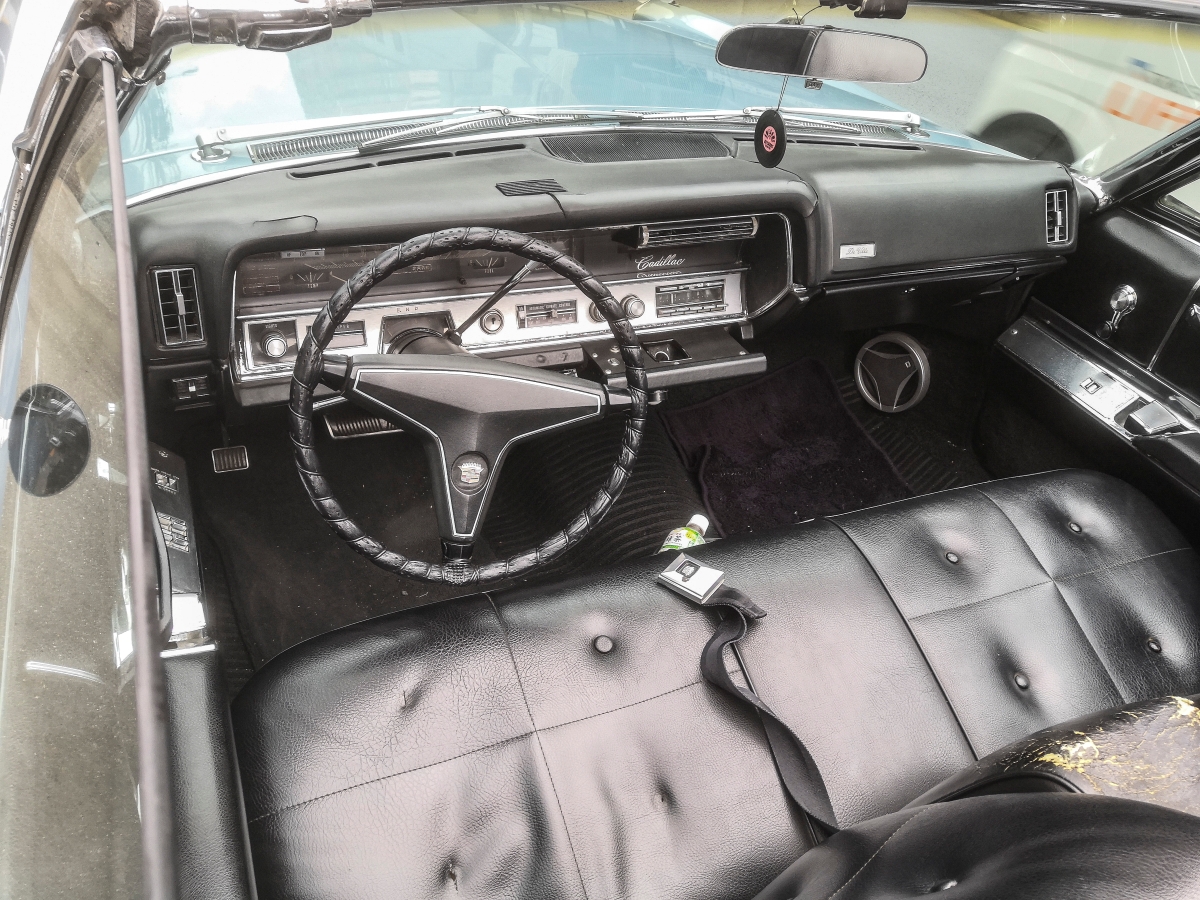
The dash was pretty thoroughly redesigned, again pointing away from the jet-age stuff and towards the padded multi-rectangular way of the future. Not the car’s best feature, in my opinion – the ’65-66 dash is far more interesting to look at. Is this one more user-friendly and/or safer in some way?
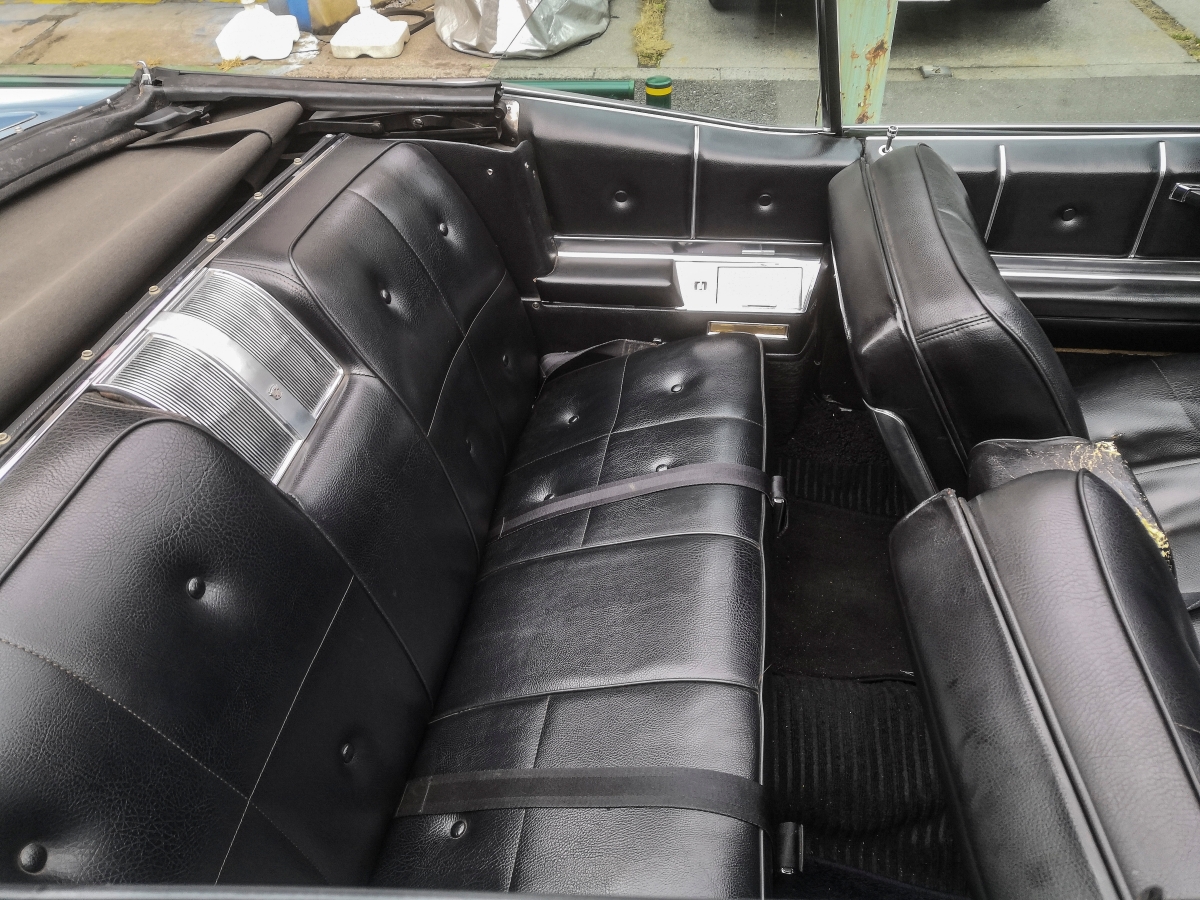
According to many sources, including quite a few on this website, 1967 was one of the last model years in which quality control and general fit and finish were up to snuff. All I can say is that compared to this 1973 Eldorado that I covered a couple years back, the interior here looks very well put together. It could be a question of restoration, but just the basic design of the soft top storage area and the cabin in general look far better in this instance. The lack of wood inserts helps a lot.
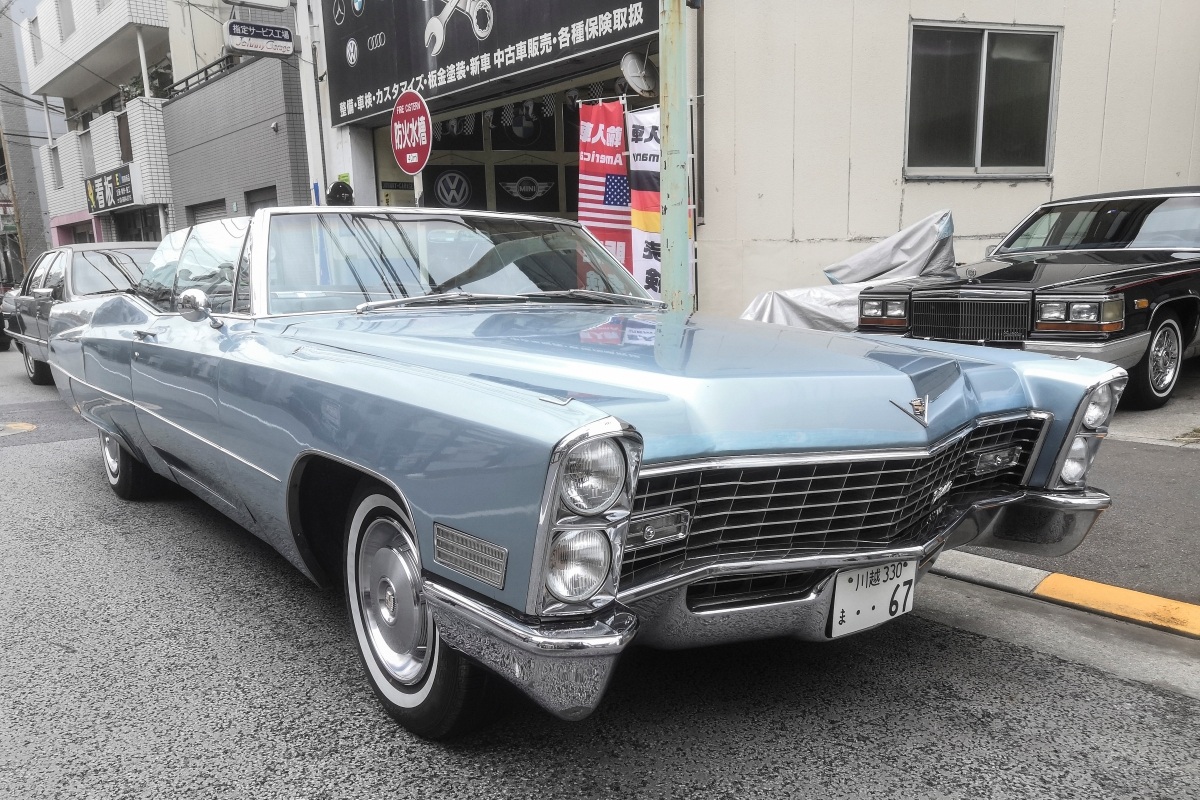
Having one of these in Japan is absolute madness, given how unsuited they are to local roads. In its domestic context however, a giant convertible like this would appeal, I’m sure. Eighteen thousand-plus Cadillac customers can’t all be wrong.
I think the case could be made that 1967 was the high-water mark for postwar Cadillacs. Actually, I would broaden it to the whole 1965-68 generation, chiefly due to the fact that the ’67-68 dash was kind of a let-down, which offsets the more dynamic external styling. But then add the 1967 Eldorado to the mix, and that particular year becomes the vintage of choice again.
Related posts:
1967 Cadillac Fleetwood Sixty Special And Brougham: Cadillac Builds The Ultimate Passenger’s Car, by Aaron Severson
Curbside Classic: 1967 Cadillac Sedan DeVille – Be Careful What You Wish For, by Joseph Dennis
Alleyside Classic: 1967 Cadillac DeVille Convertible – In 1:1 Scale, by PN
In Motion Capsule: 1967 Cadillac DeVille Convertible – Très Chic, by Joseph Dennis
In-Motion Classic: 1967 Cadillac Coupe DeVille Convertible – Rolling Americana, by Joseph Dennis























I have liked the 67 (and 68) Cadillac since I was a kid. Cadillac really nailed the design on these, in my estimation, with just the right combination of clean and brash. The front end is particularly good, and is my favorite feature of the car. I wonder if it is just coincidence that the 1967 Ford Galaxie came as close as any other car to directly copying the front of the 67 Cadillac. As I think about it, the 67 Mercury did a pretty good impression of this car from the rear.
1967 was the year that significant interior safety standards applied to US cars so interiors were dumbed down in the name of safety (and probably also cutting of costs) that year all across the industry. I think I agree with you that I like the 67-68 best on the outside and the 65-66 on the inside.
This is not true.
The National Traffic and Motor Vehicle Safety Act of 1966 was not enacted until September 9, 1966, when most 1967 models had already begun production, and the initial set of standards under the law were not finalized until January 31, 1967. The only part that took effect during the 1967 model year was FMVSS 209, the standards for seat belt assemblies, which took effect on March 1. (Standard 209 has requirements for seat belts and seat belt anchorages; it was essentially continuing an existing federal standard established by the Commerce Department under an earlier law.)
Your correction is strictly true, though the manufacturers knew that Federal standards/requirements were coming and generally what they would be, so things like padded dashes and energy absorbing steering column systems were incorporated into most 1967 vehicles in advance of the strict requirements. For example, the steering wheel design in this 1967 Cadillac was almost certainly done in anticipation of the looming standards.
As did Ford’s goofy mushroom in the center of their steering wheels, as JP says some preemptive safety stuff was done in anticipation.
’67/68s have been some of my favorite exterior designs since a neighbor got a new ’68 in dark charcoal gray with black vinyl roof and black leather that year, though the dash was a bit of a letdown, it was still superior to what followed in ’69 onward. The ’61-64 IPs are my favorite, super quality materials, still rather glitzy, but not very safe for sure!
The automakers were familiar with the GSA requirements (which were implemented for 1966 on cars purchased by the federal government for its own use), and probably correctly surmised that they would be the starting point for the federal standards, yes. However, they didn’t know for sure what the federal standards were going to be, or even if the safety law was going to pass (which Detroit devoutly wished it wouldn’t) until it was far too late to do anything differently with the 1967 models.
Dad owned a ‘67 Fleetwood for about 2 years in the early 70’s. He ended up trading it in because it always seemed to need expensive repairs. But that’s when the design caught my eye.
In my opinion, 1967 was THE high point for GM styling. There’s not a single GM make that doesn’t have at least one model that’s beautiful.
“According to many sources, including quite a few on this website, 1967 was one of the last model years in which quality control and general fit and finish were up to snuff.”
Add me to “many sources.”. Our 1963 and 1966 were exemplary. Our 1971 gave the impression of being a “Big Chevy” in materials and workmanshio.
I’ve always loved the ’67 Eldorado for its styling. So timeless. BTW, let’s not forget the ’57 Lincolns also had dual stacked headlights like Nash. Laws which did not allow dual headlights that were in effect in a handful of states disappeared in 1958.
Cadillac magic was potent indeed into the late ’60s. They were pleasing from every angle, but the telling detail were the taillights. Through clever use of multipurpose bulbs, clear lenses and cleverly deployed shrouds, the whole unit would glow red, yet the bottom part would show white when the backup lights went on. One needs to see the light disassembled to understand the alchemy. But in 1969, the taillights were prosaic and unimaginative, a collateral development to the un-stacking of the headlights. The Standard of the world began to shrink in stature, a process that continues to this day.
Nice find. Seem like that is either a Cadillac nut’s home or business? I see at least 3 Caddy’s in your pics.
For me, I’ve always liked the 1975 to 1993’s due to my age and what I grew up with. However, lately the 1965 and 1966 Sedan Deville’s have grabbed my attention and I especially love the 1966 with a slightly cleaner front end look. But it’s the long straight lines that just get me. I would love to find a nice example that could be driven often (not a trailer queen).
It always surprised me what I saw on the roads in Japan. I lived in a small city name Tokuyama, in Yamanashi prefecture. On hot summer evenings, we’d go to a yatai (cart restaurant?) for noodles and beer. Often a Yakuza (gangster) would come to practice his English. He was driven around in a Lincoln Town Car. It was impossible to park it, so the chauffeur drove and the block the entire time Mr Yakuza was with us. It was a sight to see because gasoline as quite expensive at the time.
A sorry example here of one of Cadillac’s best exterior designs. I’d agree that ’67 was a high point, and a bit cleaner than the still lovely ’68.
No Cadillac says “out of my way or I will crush you like a bug” more eloquently than a 1967 model. I’ve been tempted by that perfect front end for a long time, but my tempt has always been tempered by the post-64 (or maybe even post-63) rear end design, which has just never worked for me, although it certainly worked wonders for sales.
I’ve spent way too much time pondering the merits of the 1967 vs. 1968 Cadillac interiors. Both years are among my favorite exterior styling for Cadillacs, but the 1967 interior is just simply nicer all around. In defense of the 1968, the 1969 Cadillac handed its beer to a Lincoln, and slurred to the 1968 Cadillac: “I’ll show you a deteriorating interiorating.”
This old beater could be beautiful .
-Nate