
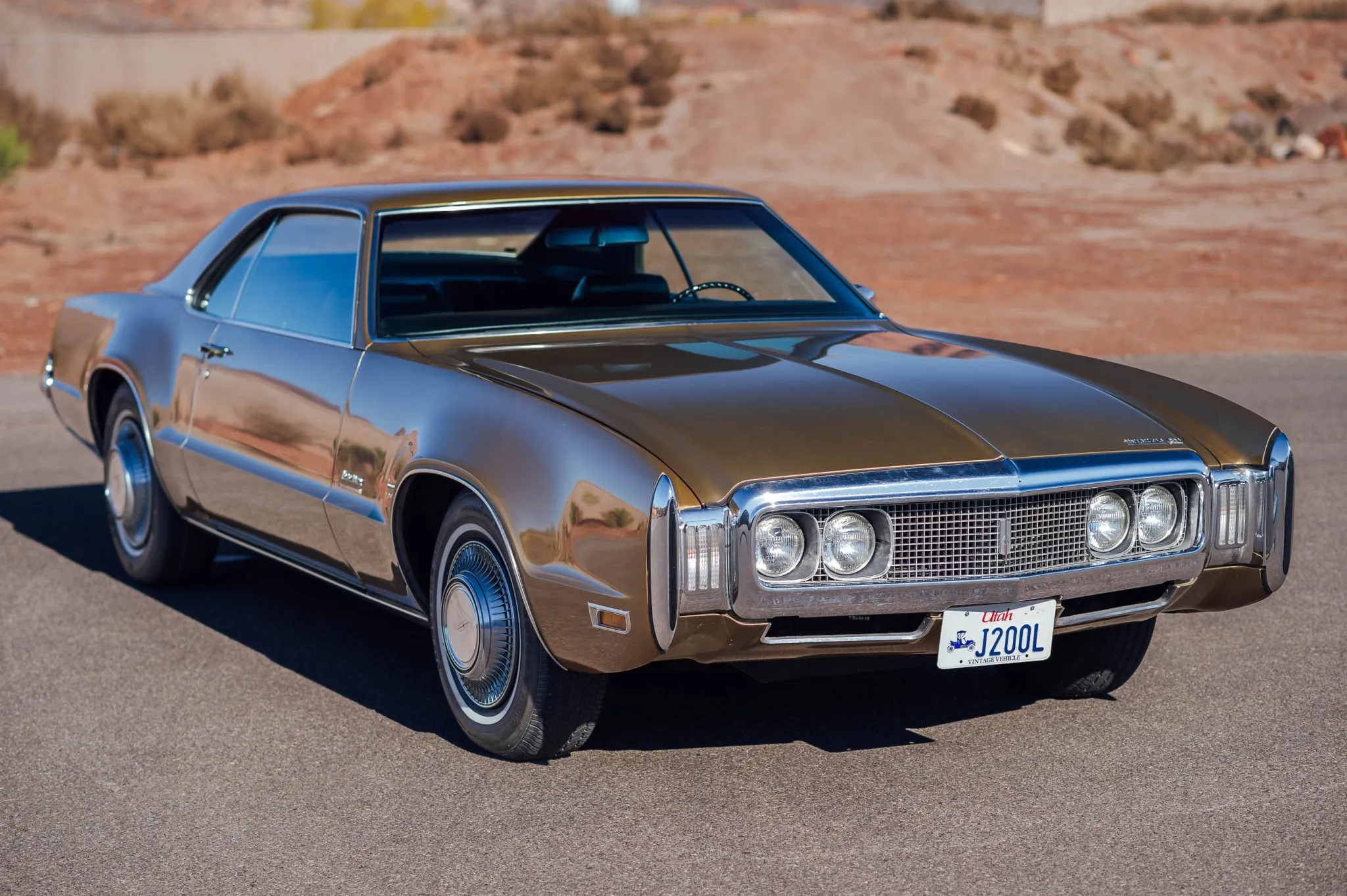
The original Oldsmobile Toronado was a landmark design that Oldsmobile stylists spent the next four years undermining. By 1970, the final year of the first generation, the wine had definitely turned to vinegar, but this Burnished Gold Toronado still has one ace up its sleeve: the 400 hp W34 GT engine. Is that enough to make up for its compromised styling?
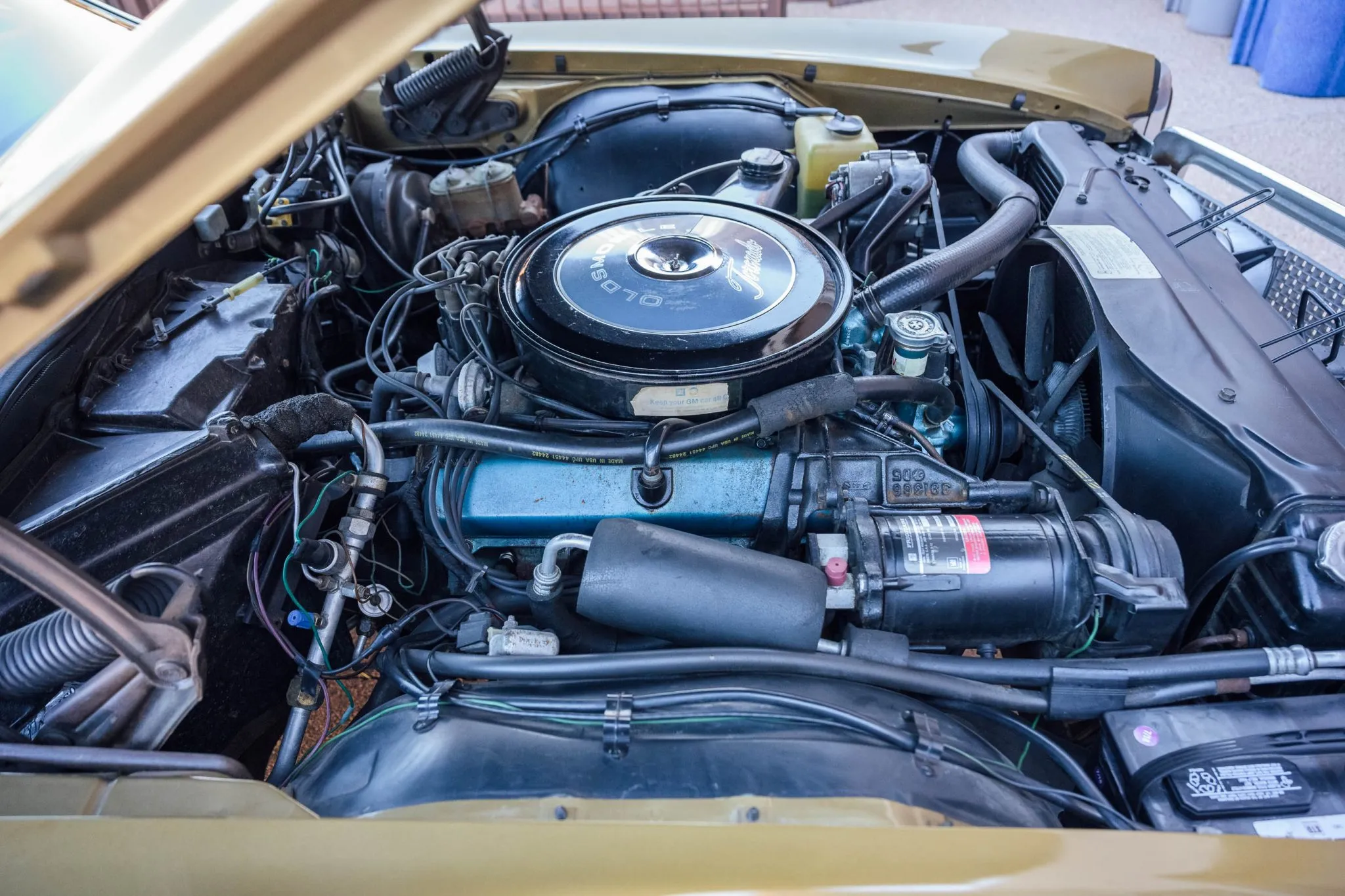
Whatever else you might think of it, it’s hard to completely dislike any car with 400 horsepower. That was a gross rating, of course (GM wouldn’t start consistently quoting net outputs until 1972), and the vagaries of GM corporate politics meant that there were undoubtedly engines of this time with lower advertised ratings, but more real power. However, it just has a nice ring to it: four hundred horsepower, plus an even 500 lb-ft of torque (also gross). What’s not to love?
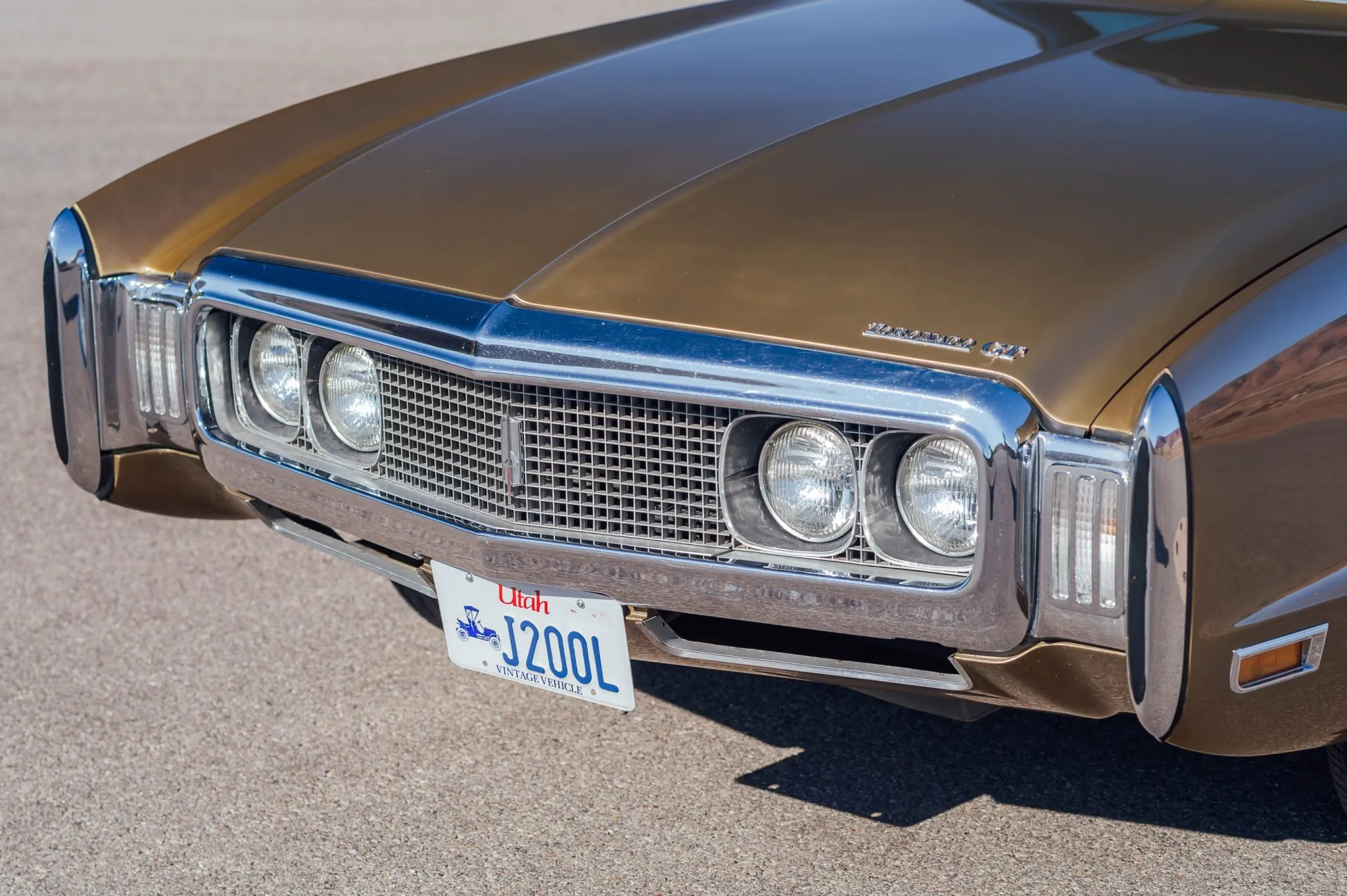
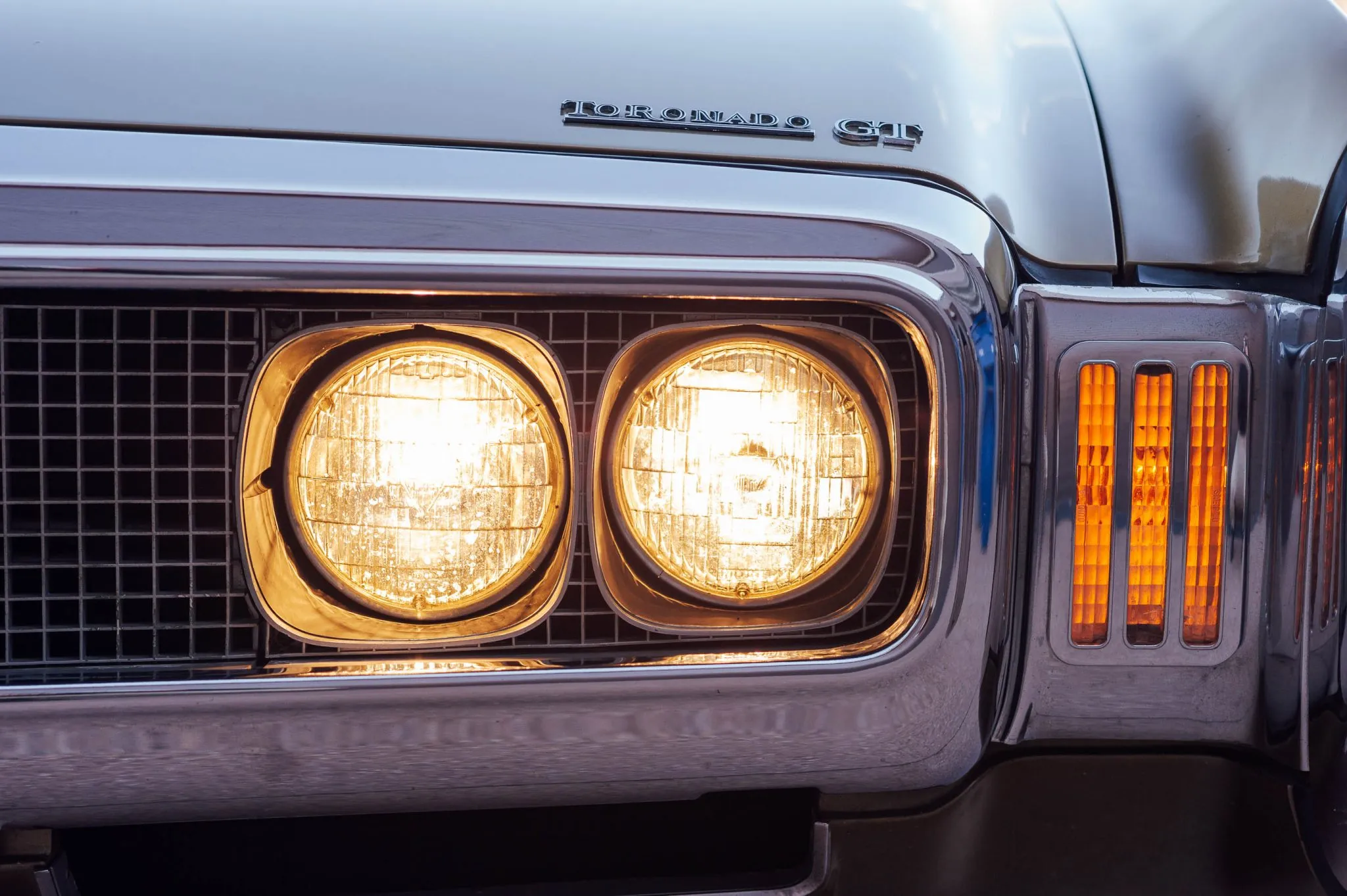
Well, how about this face, for starters? The chrome nose the Toronado had worn in 1968 and 1969 hadn’t been its finest hour aesthetically — it just looked so heavy, and it probably was — but this was worse. The hidden headlights GM used in the ’60s had often been a pain to live with, but they were an important aesthetic feature, so when they were deleted, the front ends of these cars really needed a design rethink they didn’t get. It smacks of commercial or military vehicles where a component that doesn’t work right is just removed or wired open or shut.
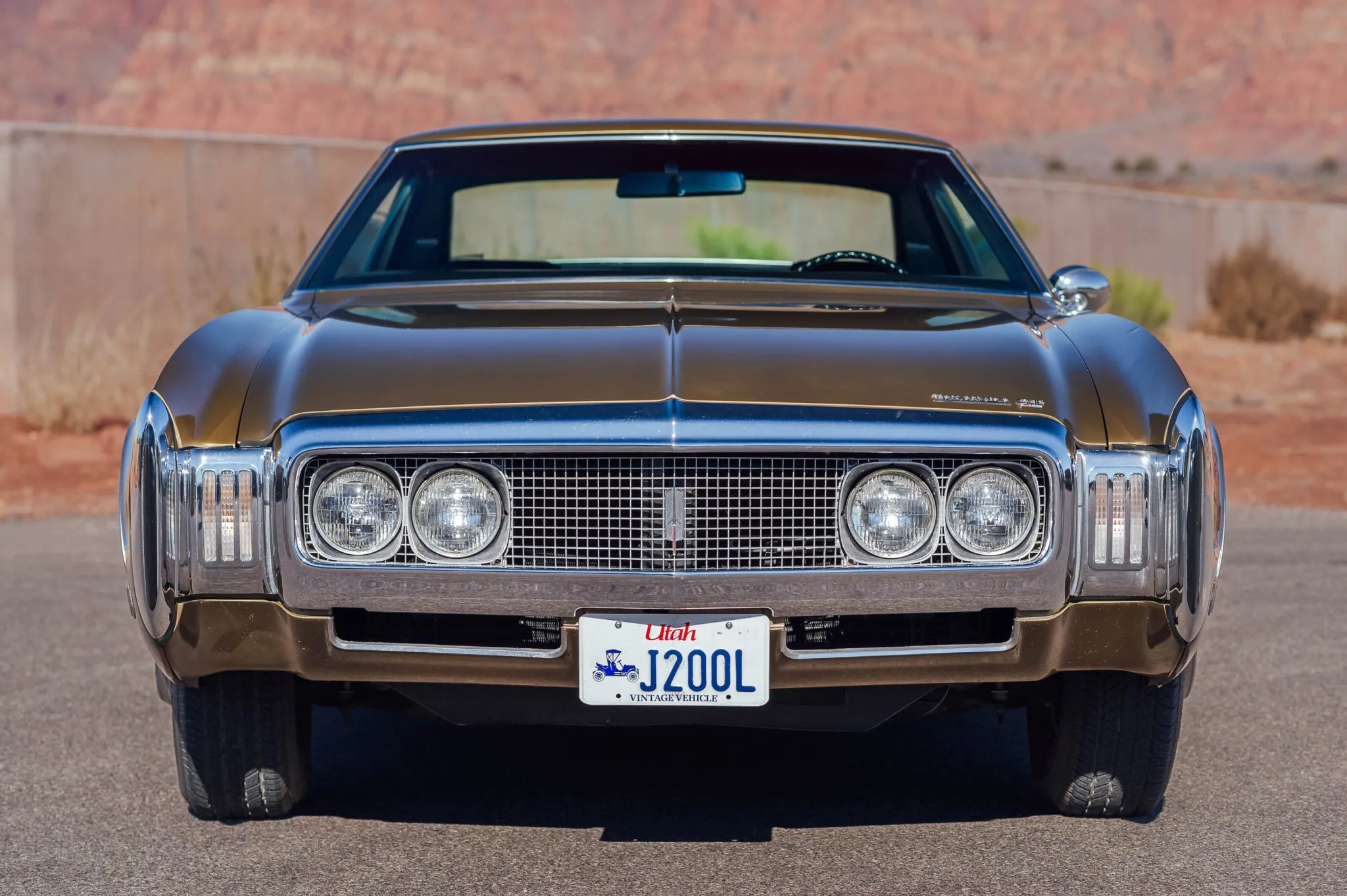
The 1970 Toronado was a one-year-only facelift of a body shell that had been around since 1966, so it probably wasn’t a big tooling priority for Oldsmobile, but these were expensive cars people bought primarily for style and panache. What’s the point of serving a tossed-off, half-hearted design in a fashion-conscious segment?
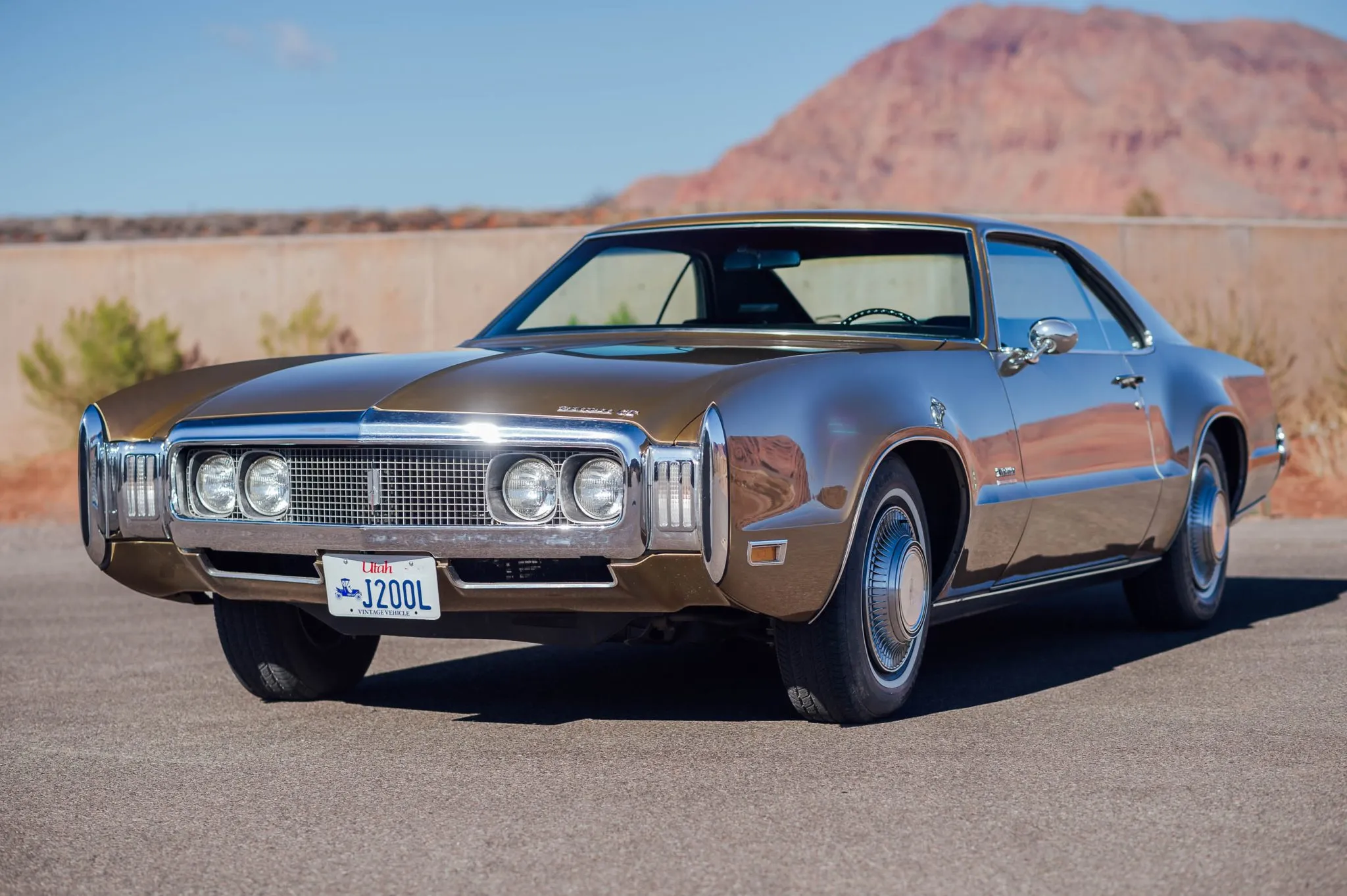
It got worse. Note the way the fenders flare around the wheelhouses? For 1970, Oldsmobile had rather awkwardly eliminated one of the signature features of the Toronado: its bold round wheel openings.
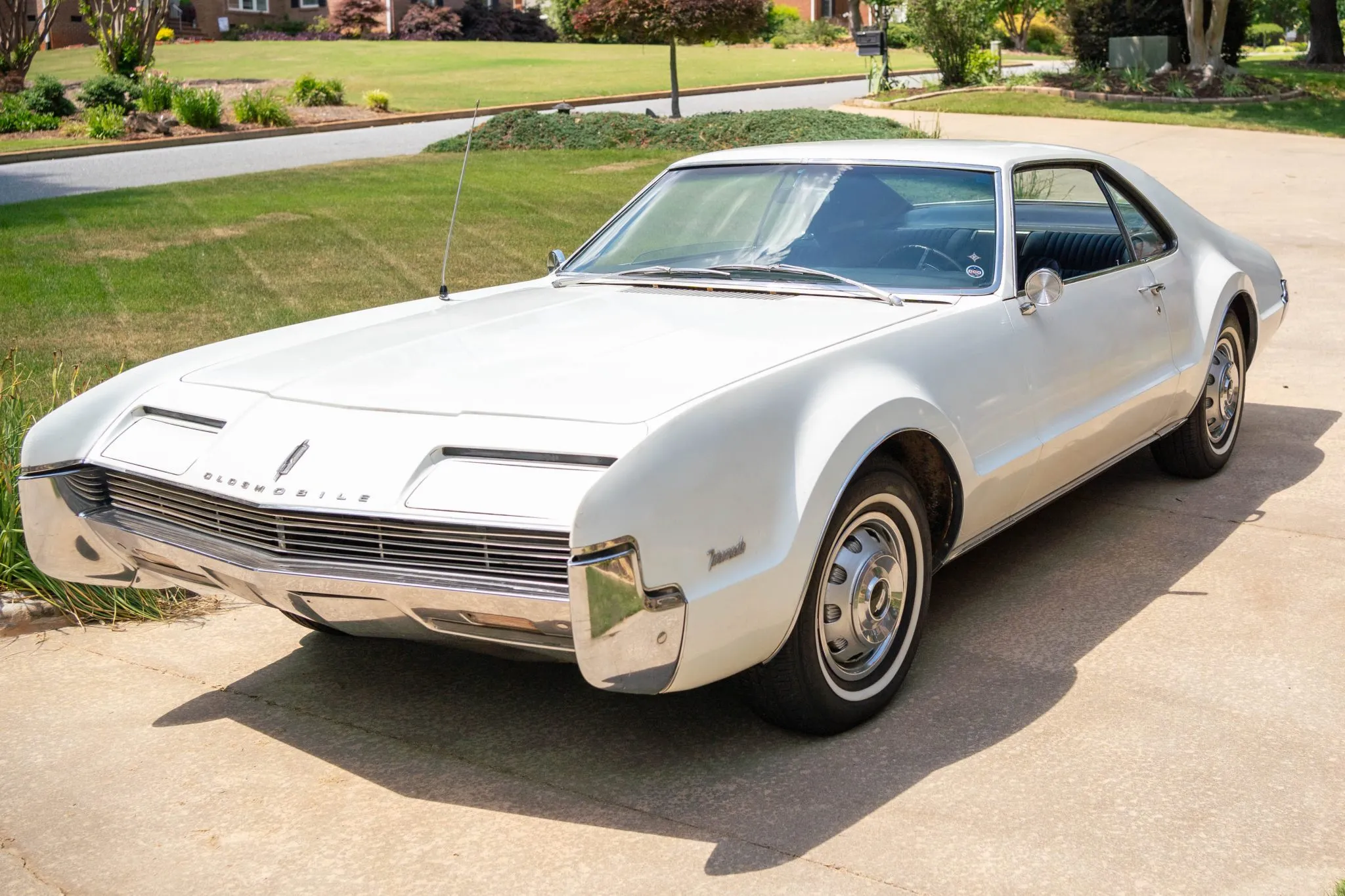
Flash back to 1966 and the initial Toronado. From this angle, you can clearly see the way the wheelhouses stood clear of the fenders, with the chamfered edges of the wheel arches merging with the horizontal body-side crease. It was a neoclassical throwback to the era before most cars became basically slab-sided, and it would have been distinctive even if it hadn’t been accompanied by the original bladed front fenders.
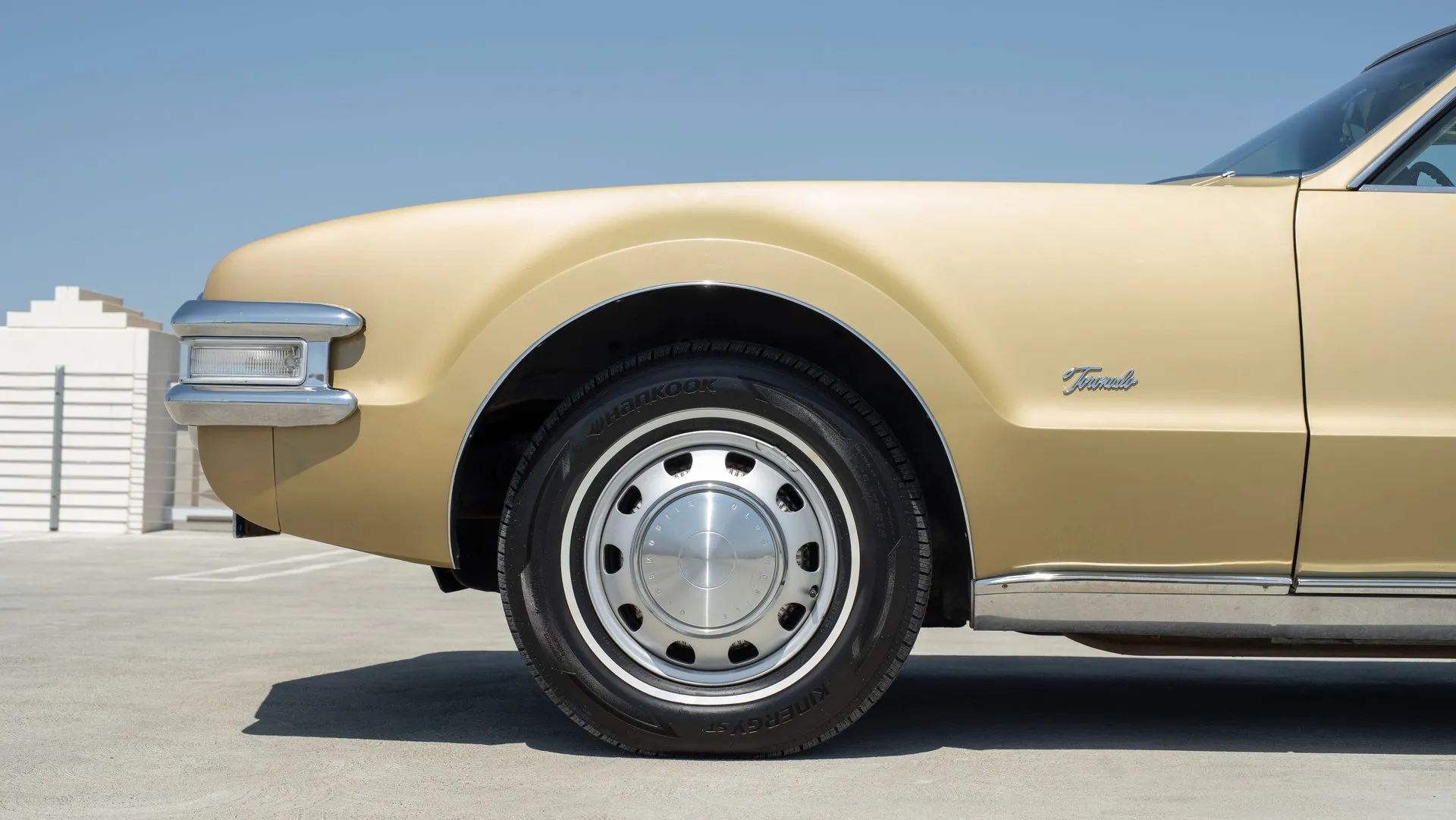
Oldsmobile had maintained that theme through 1969, even as other elements of the design changed. It was one of the main things that made a Toronado look like a Toronado rather than a Buick Riviera (which shared much of its inner body structure).
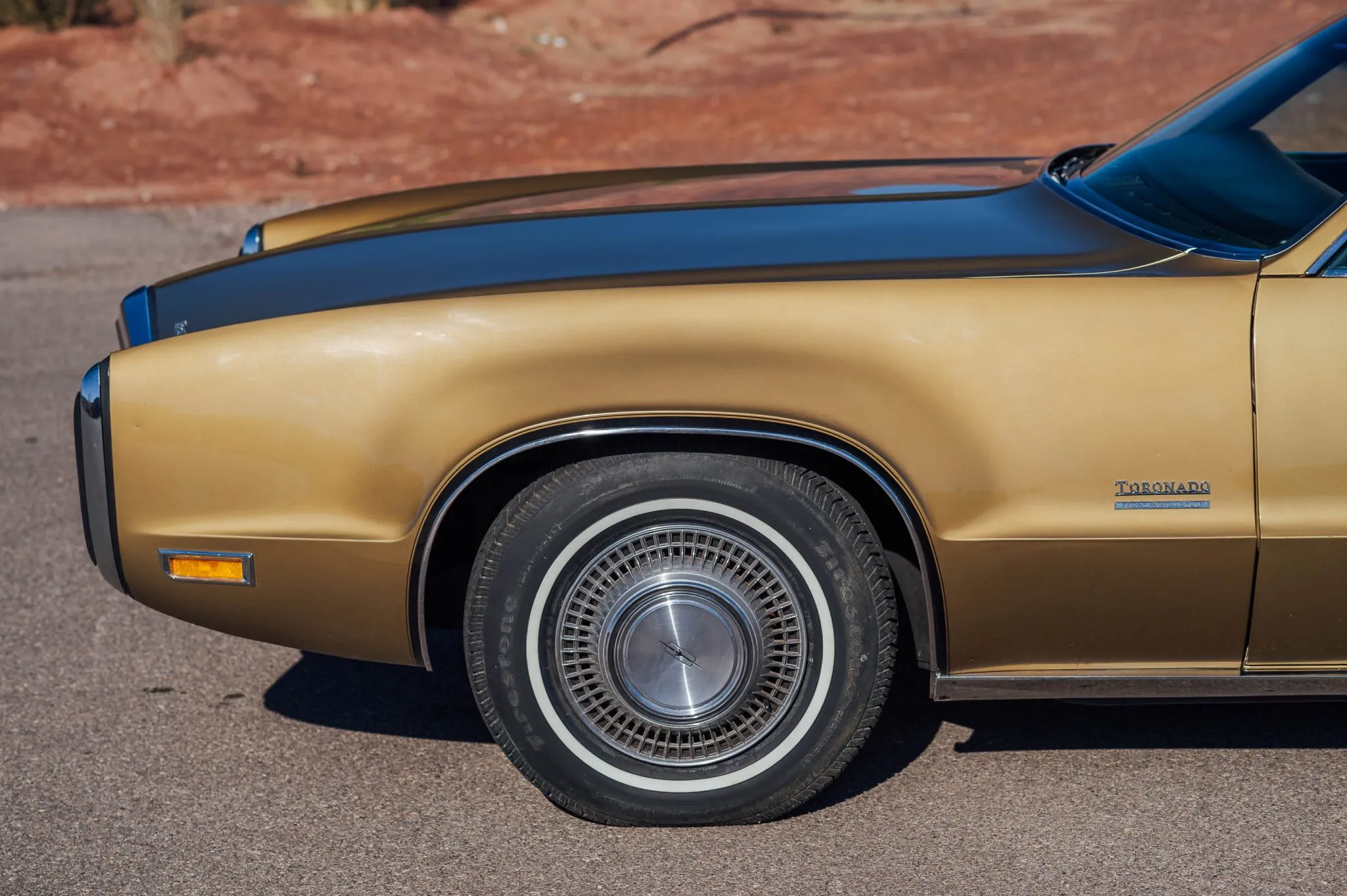
For 1970, Olds kept the horizontal crease, but squared off the wheel openings, smoothed out the pronounced wheelhouse flares, and minimized the chamfered edges of the wheel arches (there was still a little, but it was now disguised by the chrome wheel arch moldings). I think this represented the limits of what Oldsmobile and Fisher Body could do with the existing tooling — they could reshape the outer sheet metal, but the inner structure shapes couldn’t be cheaply altered — but it made the Toronado look like it had gotten some ill-considered custom body work, done on the cheap.
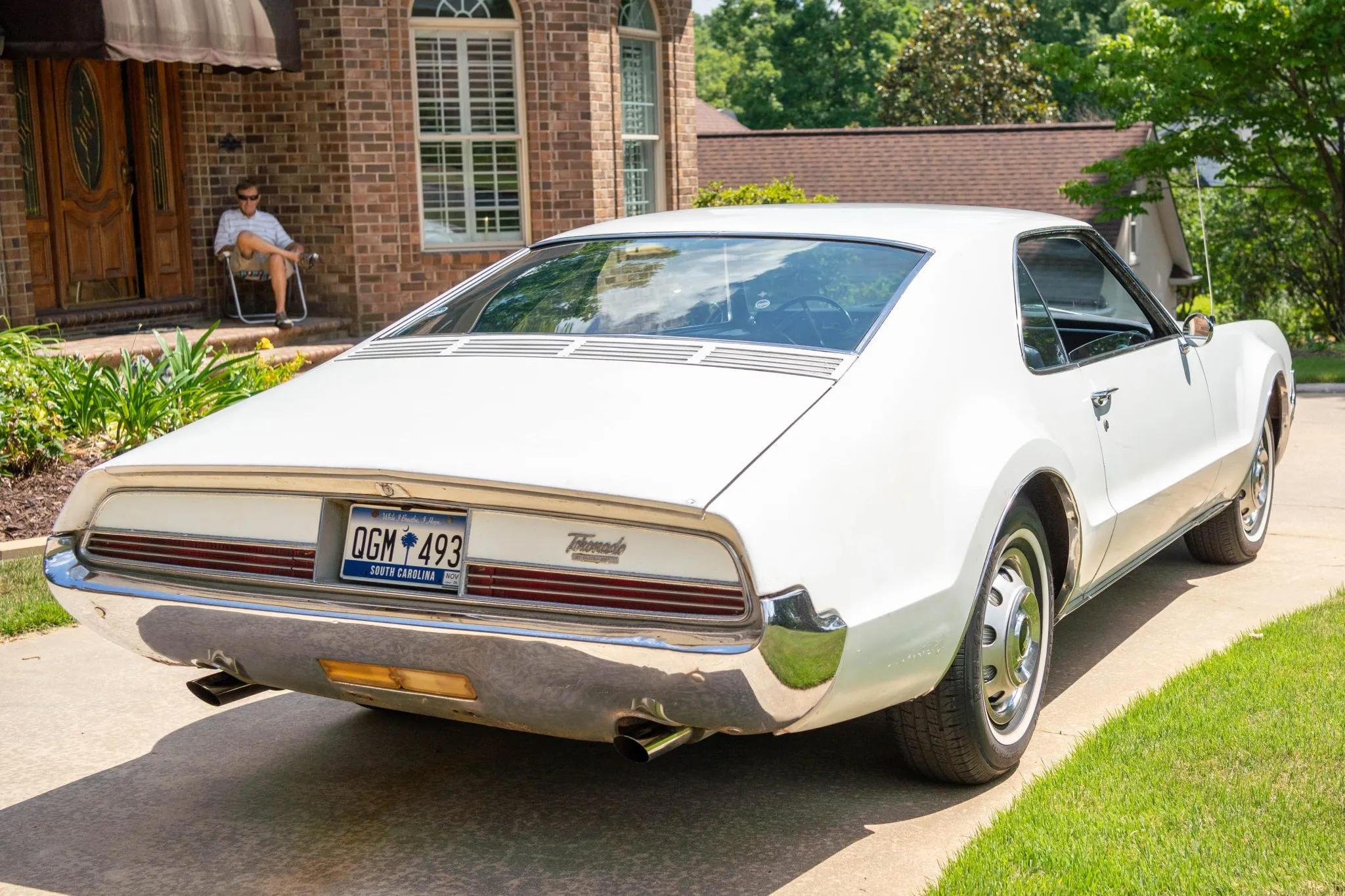
The 1966 Toronado had been unequivocally a fastback: The sail panels blended into the rear fenders, sloping downward to the tail cutout.
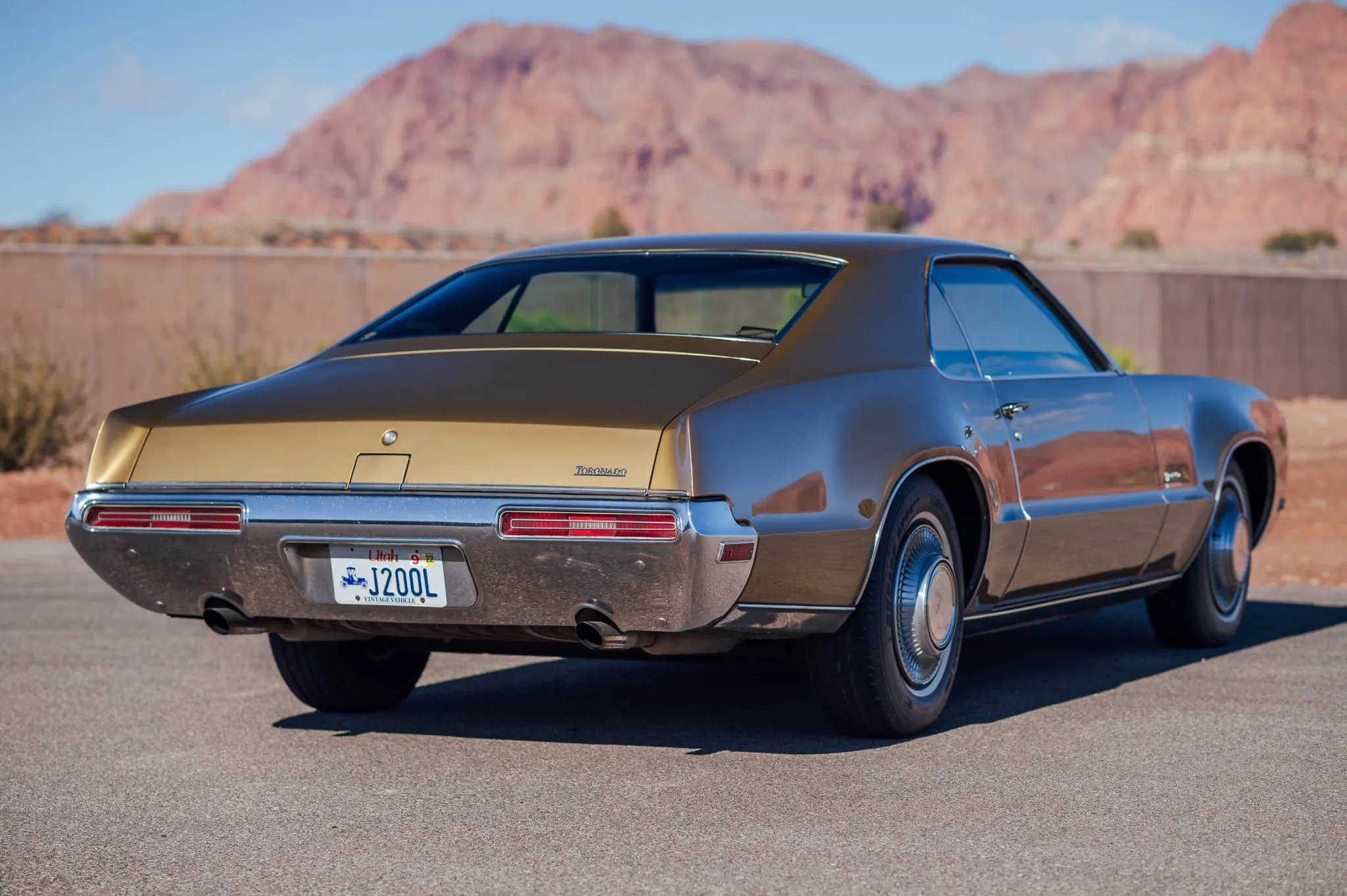
The 1970 car had a distinct separation between the sail panel and the fender, which had a sharp, bladed, fin-like edge. Combined with a new crease through the decklid, it contrived to make the fastback Toronado look like a notchback coupe.
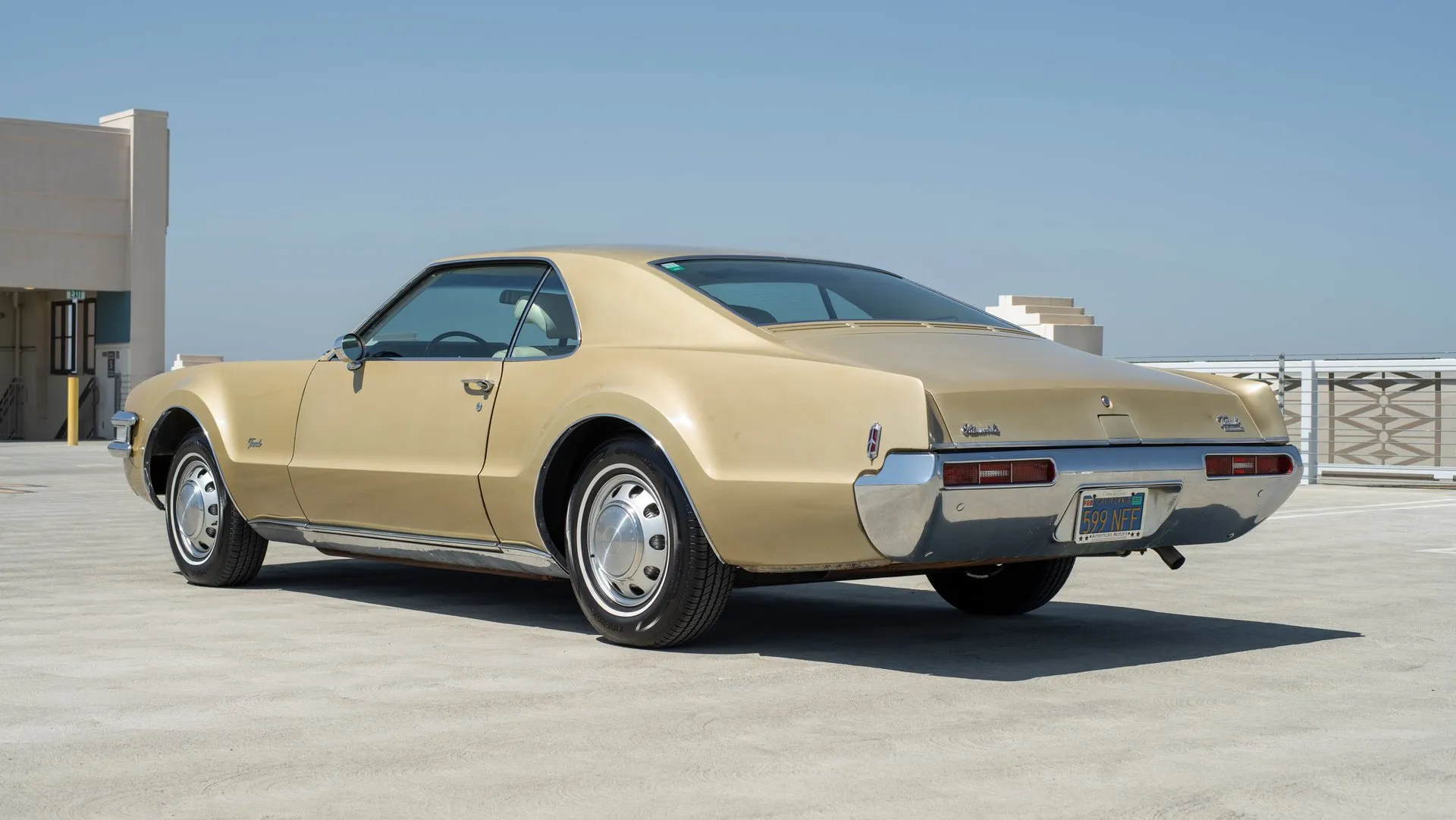
Oldsmobile had actually reshaped the rear fenders and decklid for 1969. However, the 1969 Toronado had retained the original wheel arch chamfering and body-side crease, which created a more visually intelligible relationship between the new fender shape and the shapes of the body side. Whether it was an acceptable compromise was arguable, but it felt like it had been competently executed, which helped.
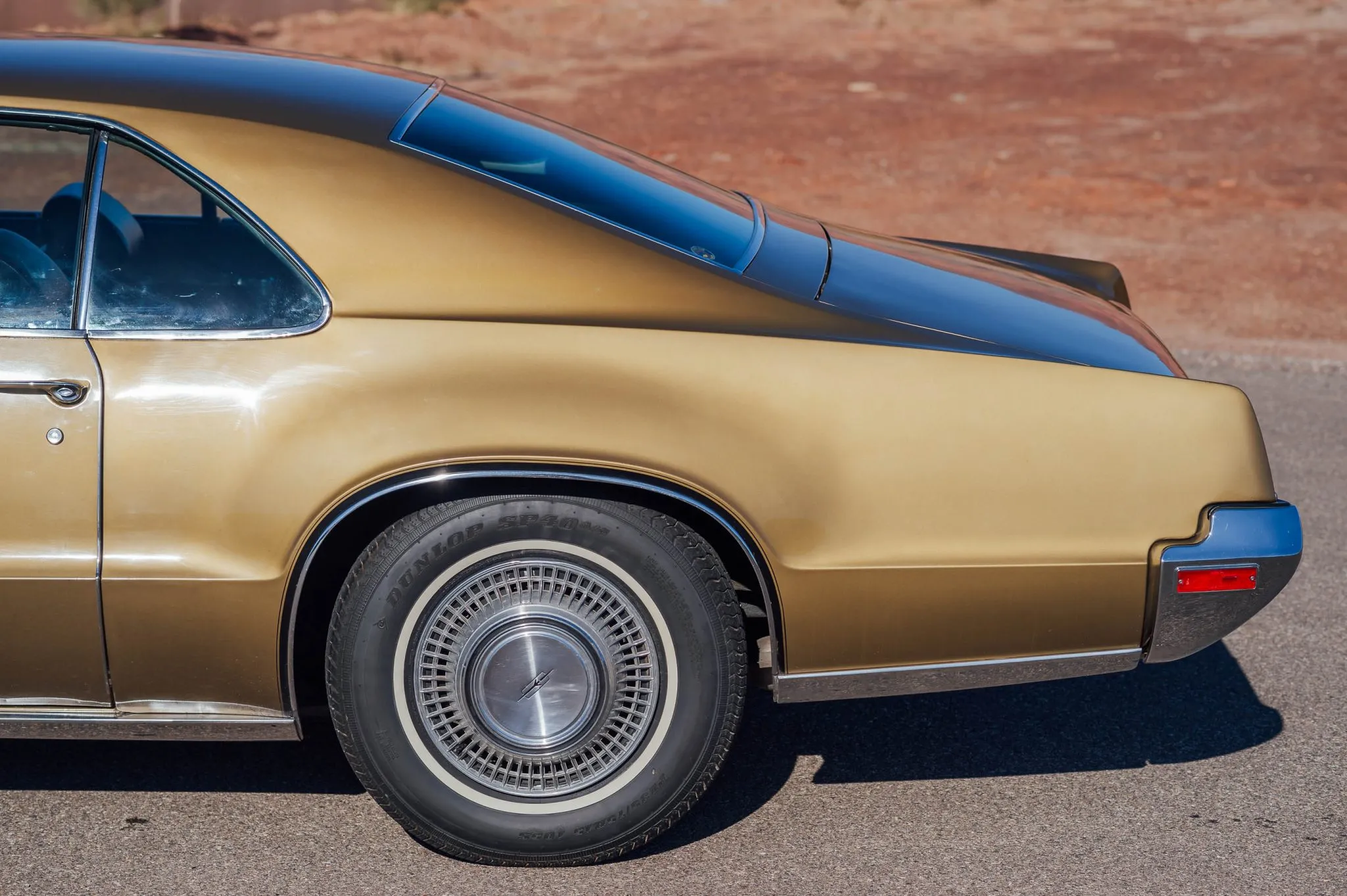
With the 1970 model’s clumsily altered wheelhouses, that relationship was gone, leaving an awkward mix of angles and curves that didn’t go together.
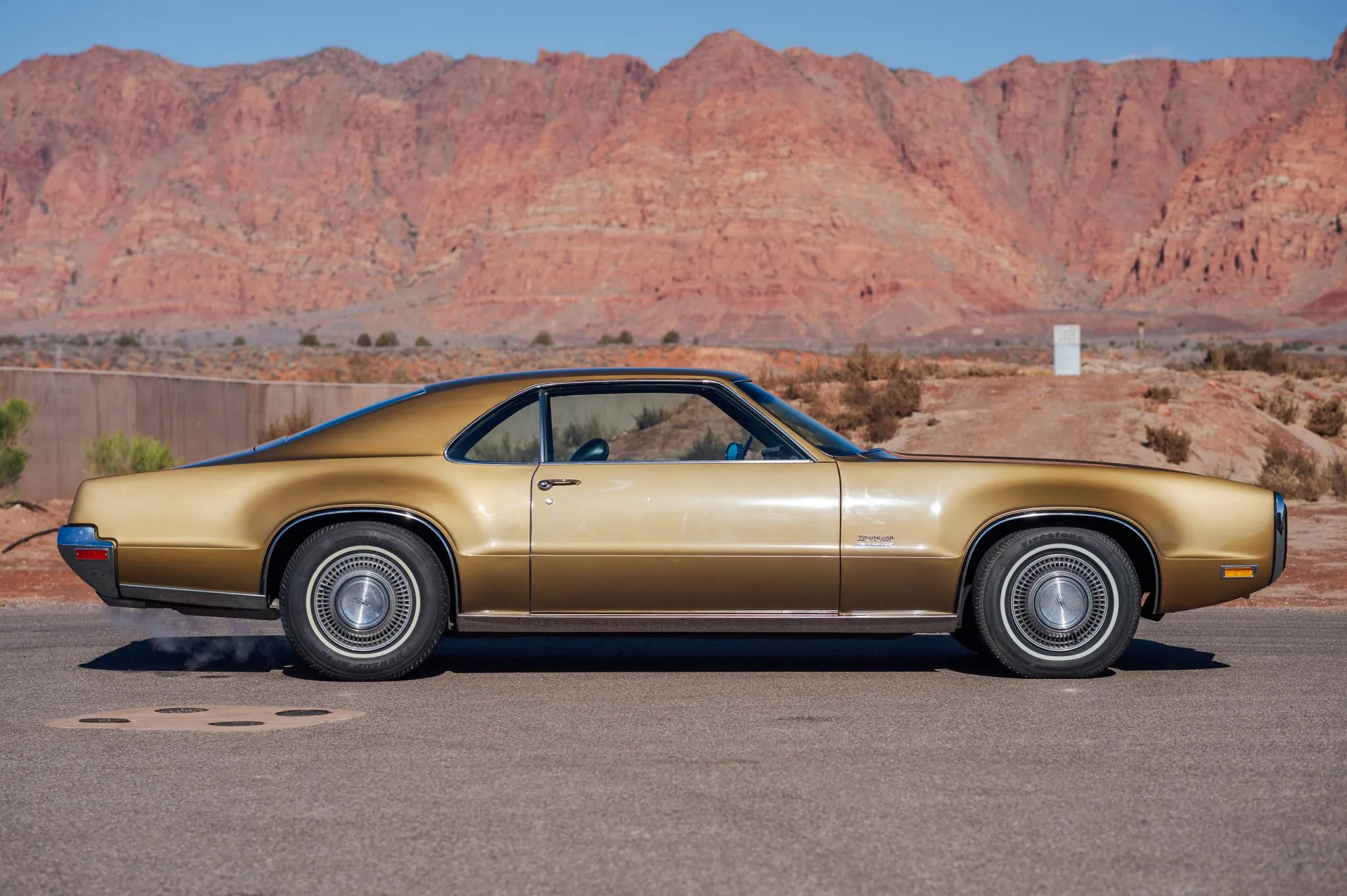
In profile, the shape was basically fine if you squinted a little, but metallic colors accentuated the poor integration of the wheel arches. From some angles, it could be also mistaken for a 1969 Riviera, which hadn’t been a problem for the Toronado previously.
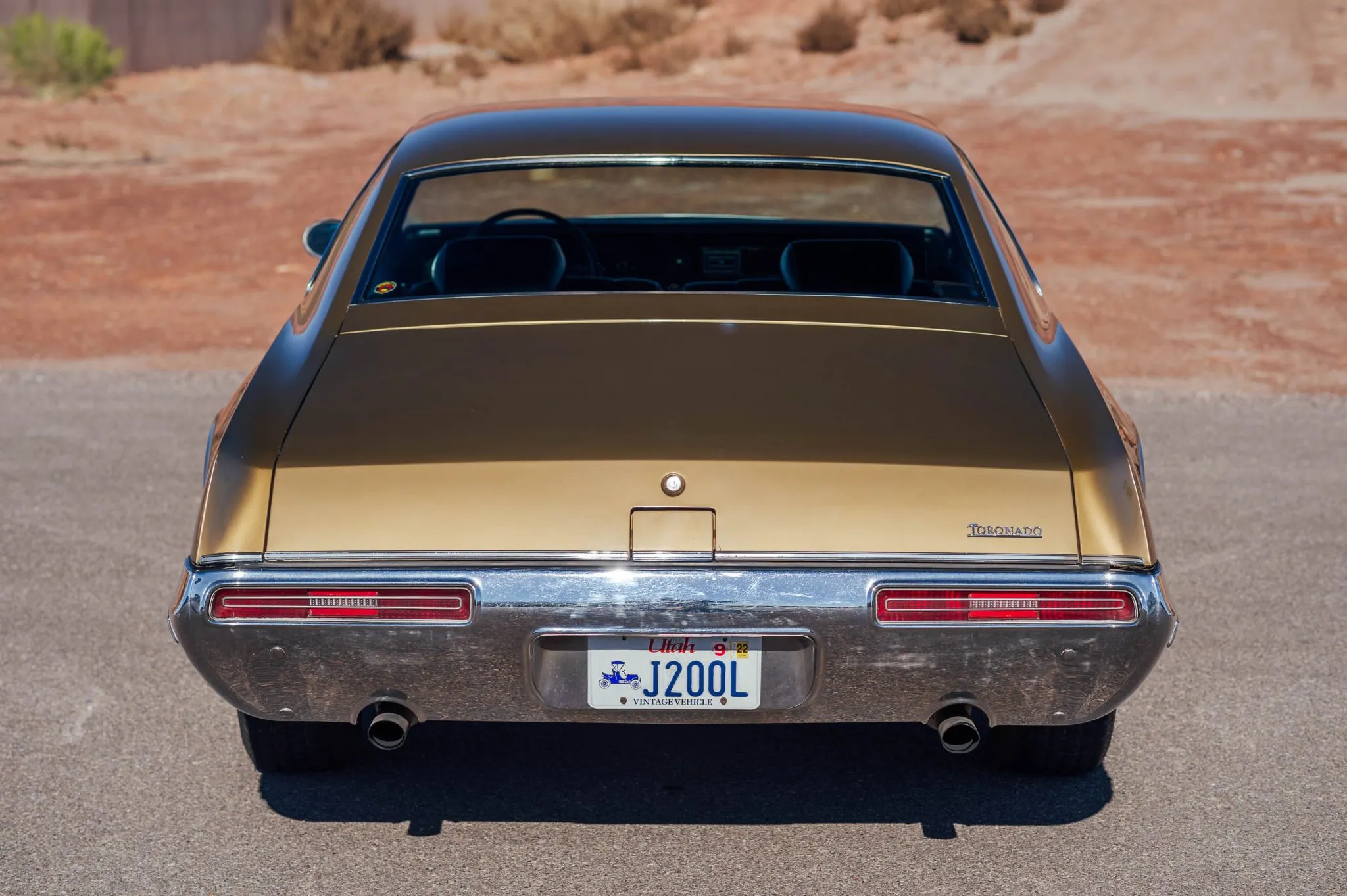
From most angles, if you examined it closely, it was apparent that Oldsmobile had contrived to make the Toronado look more different than it actually was, with very mixed results.
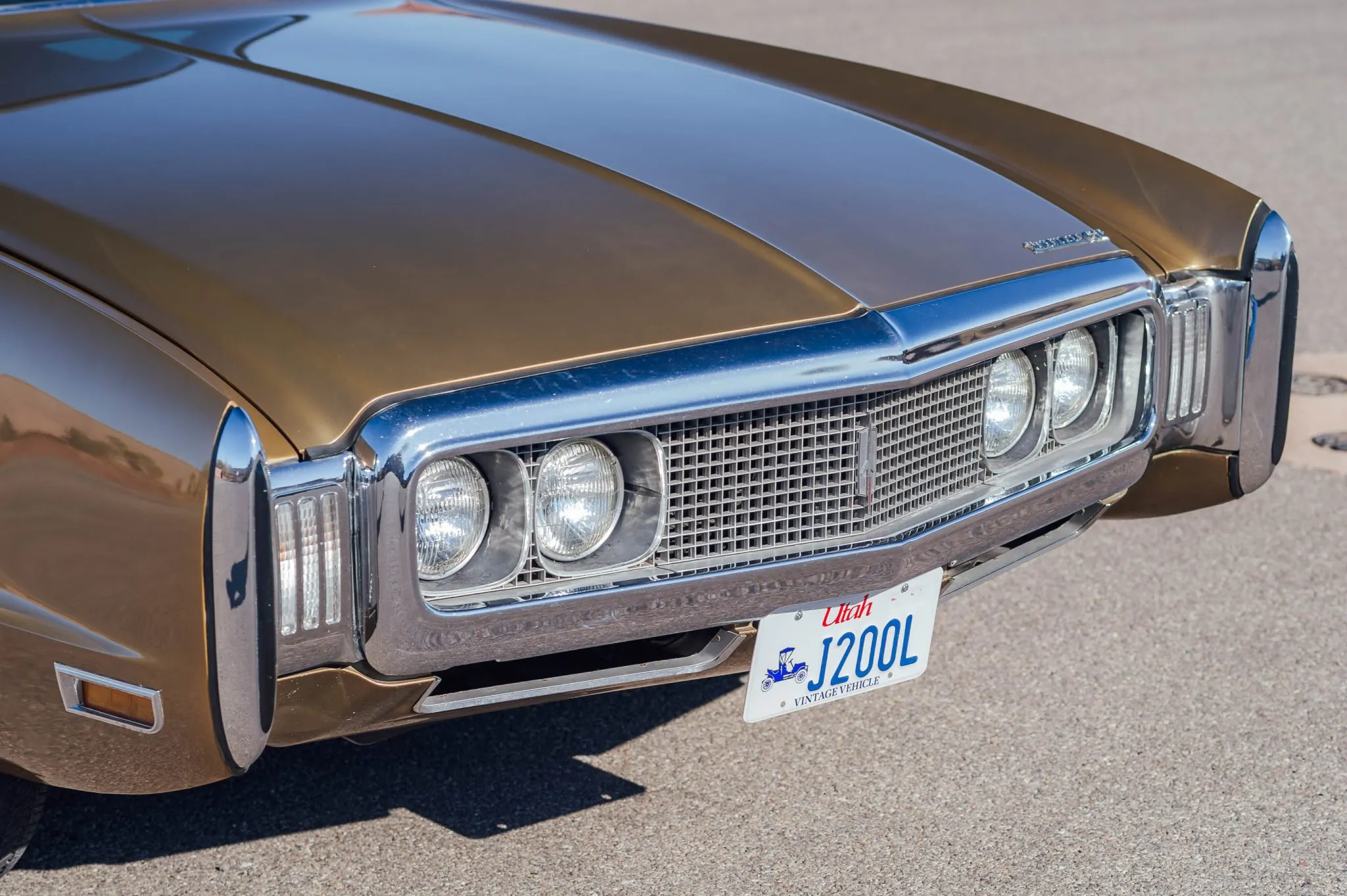
I just can’t get over the nose, which reminds me (not in a good way) of the helmet fins of the Jack Kirby comics character Galactus.
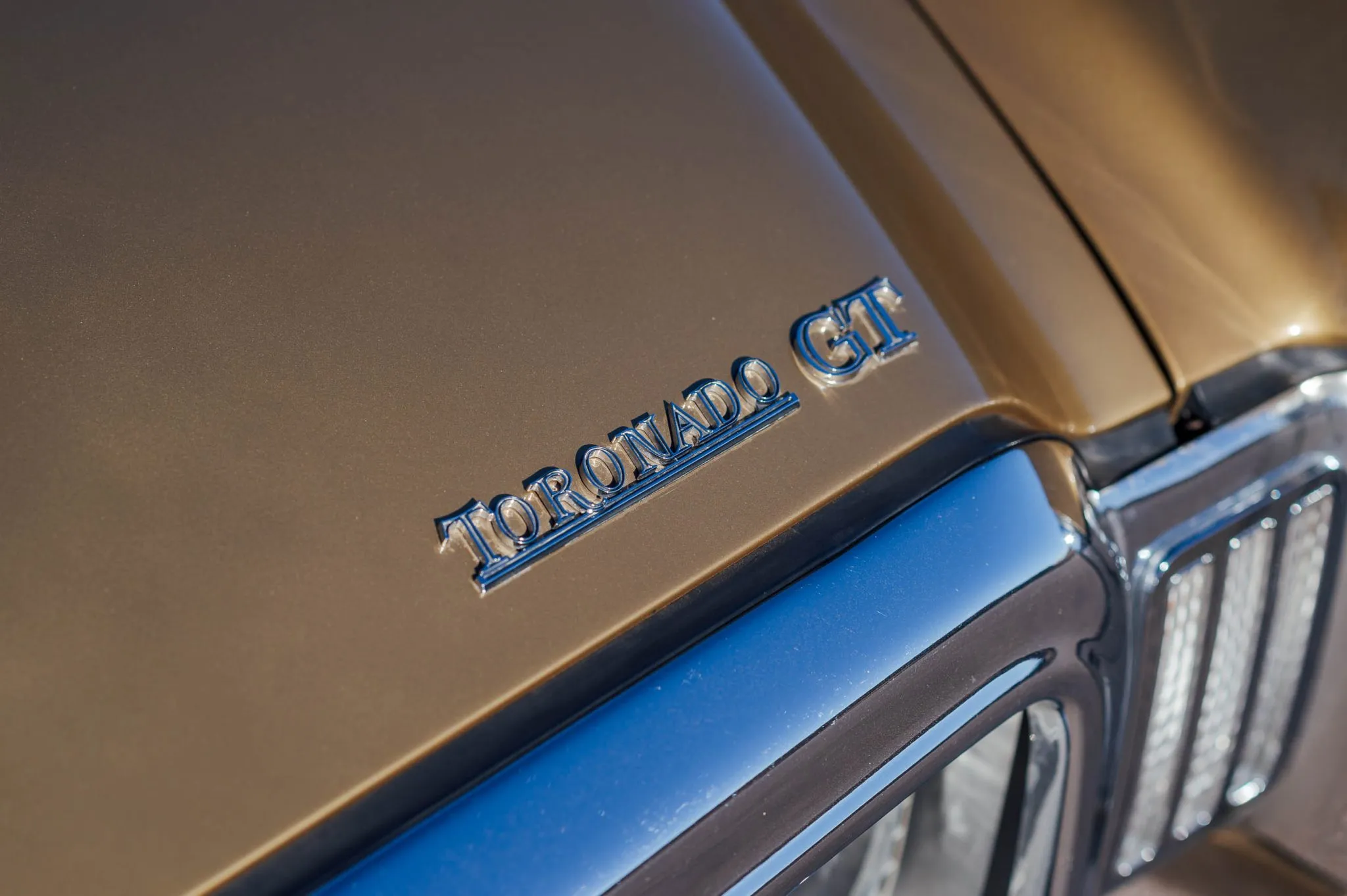
Just above that unfortunate snout, on the leading edge of the hood, was a badge that offered some mitigation for this car’s numerous aesthetic missteps: “TORONADO GT.” The GT was not a separate model, but a surprisingly cheap $47.39 option that included this emblem, the more powerful W34 engine, and dual exhausts. According to the dealer information, it was also supposed to include “special body-side paint stripes,” but neither this car nor most of the other GTs I found online seemed to have them — most Toronado survivors of this vintage have been repainted, and the stripes were probably not reapplied afterward.
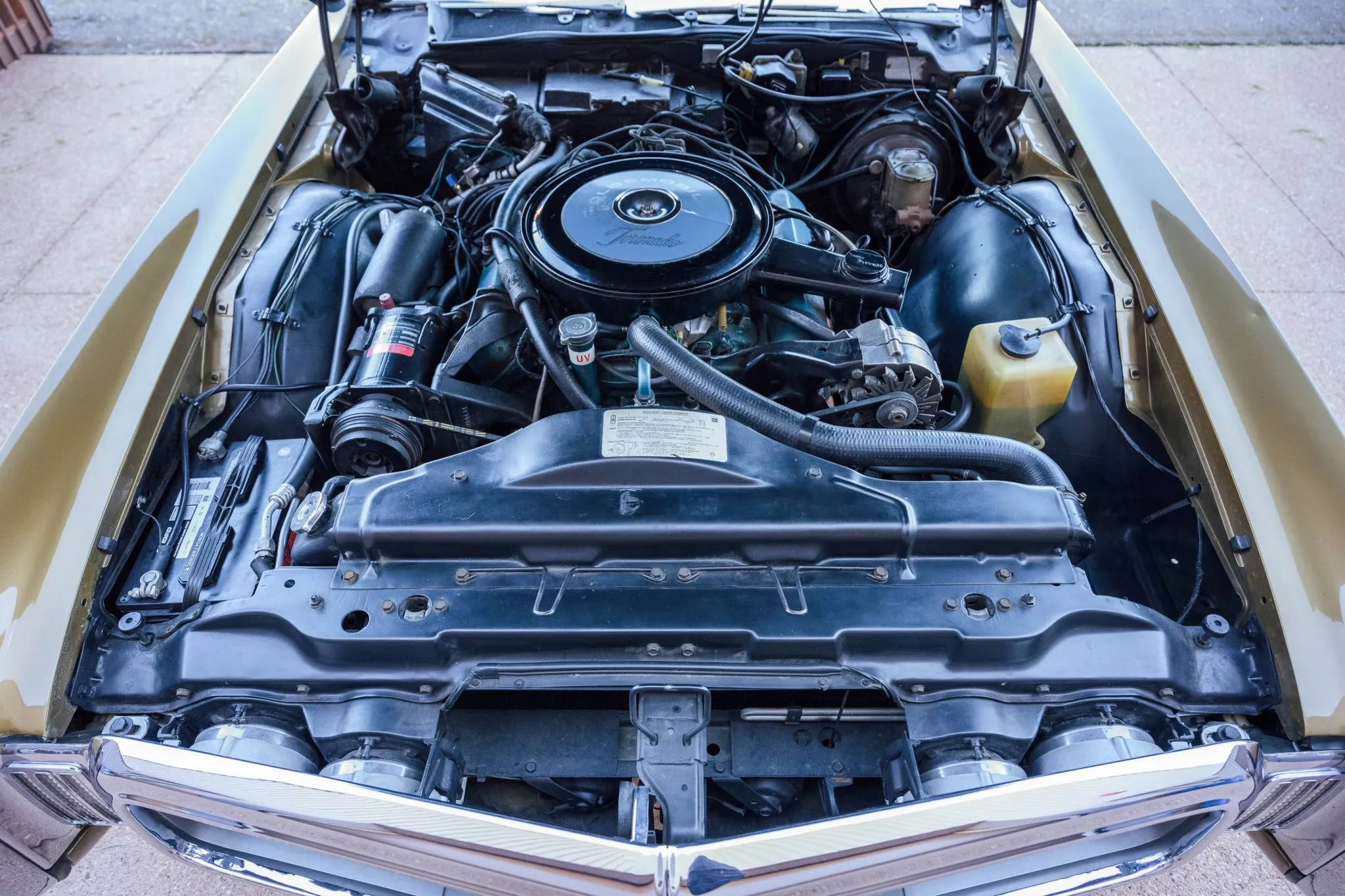
The 400 hp W34 engine had been optional since 1968. It was originally accompanied by a Force-Air cold-air intake system, but the 1970 version included only the special cam and dual exhausts. The Car and Driver test of the 1968 W34 car had gotten 0 to 60 mph in 7.7 seconds, the quarter mile in 15.7 seconds at 89.8 mph, and 0 to 100 mph in 21.0 seconds. A 1970 Toronado wasn’t meaningfully heavier, and while the loss of the Force-Air system might have cost it a smidgen of quarter-mile trap speed, the Toronado GT was still very brisk so long as you didn’t get lured into any foolish stoplight contests with the street racer set.
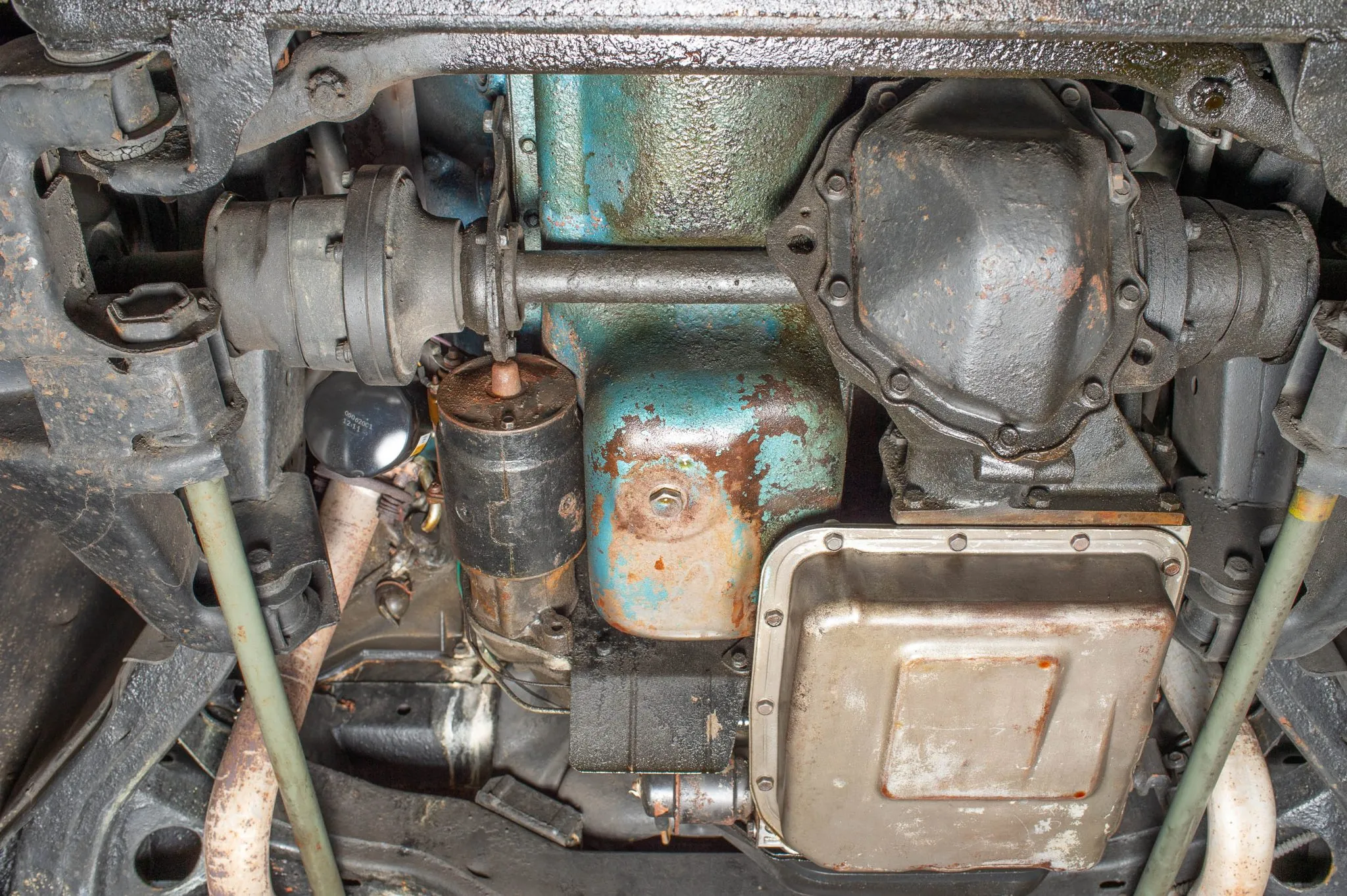
Unlike the Riviera Gran Sport option, the W34 Toronado GT option didn’t include a performance axle ratio or a limited-slip differential (which the Toronado didn’t offer), although its TH425 transmission had “performance” controls for firmer shifts and probably higher upshift points. The axle ratio was the same 3.07 to 1 as supplied with the standard engine.
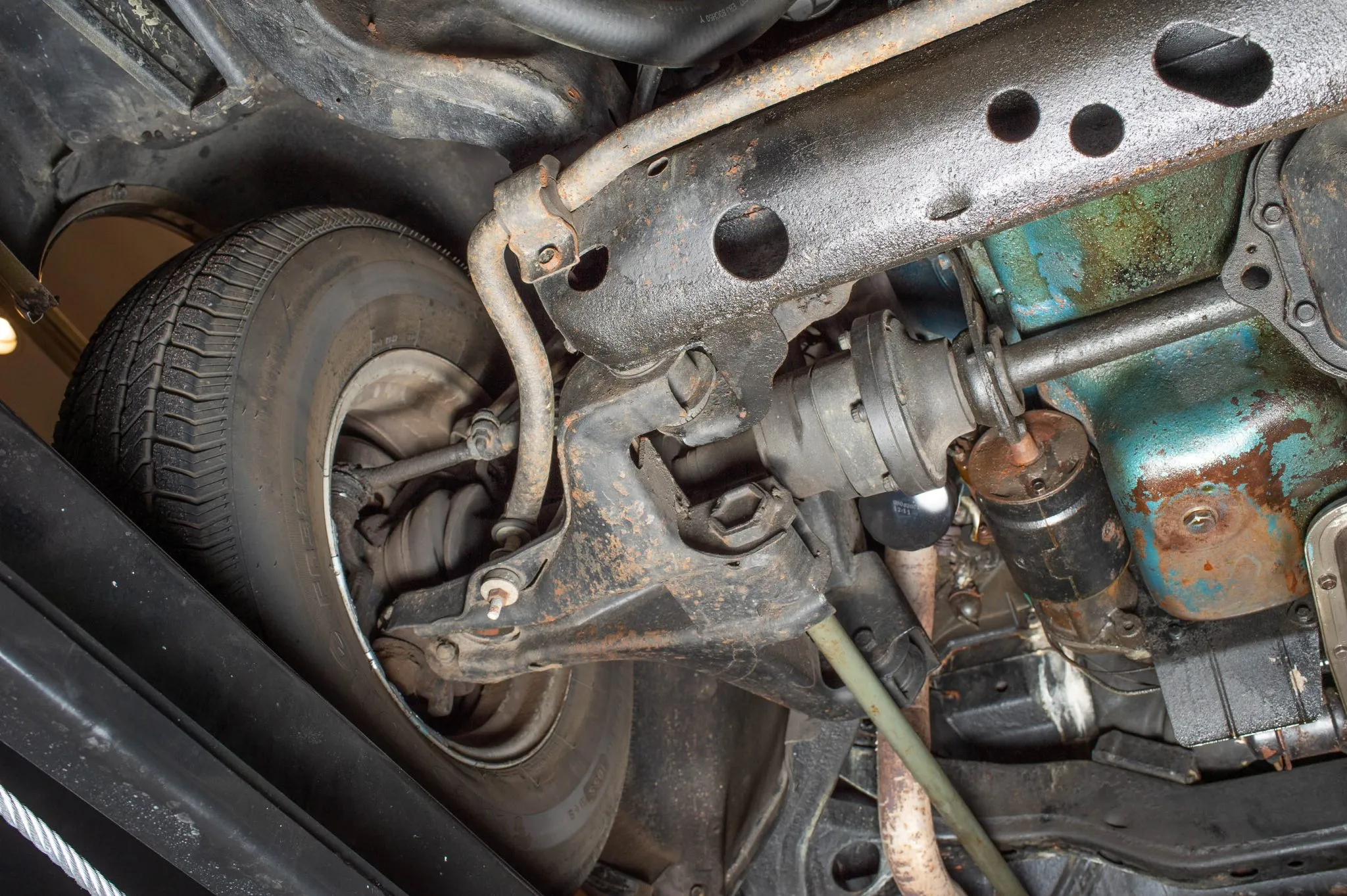
Oldsmobile also didn’t include or mandate a firmer suspension with the GT, although there was an F41 heavy-duty suspension on the Toronado options list for a modest $21.06. I don’t know how many people ordered it — probably not many — but it was a worthwhile addition, giving the Toronado more composure without any painful sacrifice of ride quality. Interestingly, it could be combined with Superlift adjustable rear shocks, which Olds made available for towing.
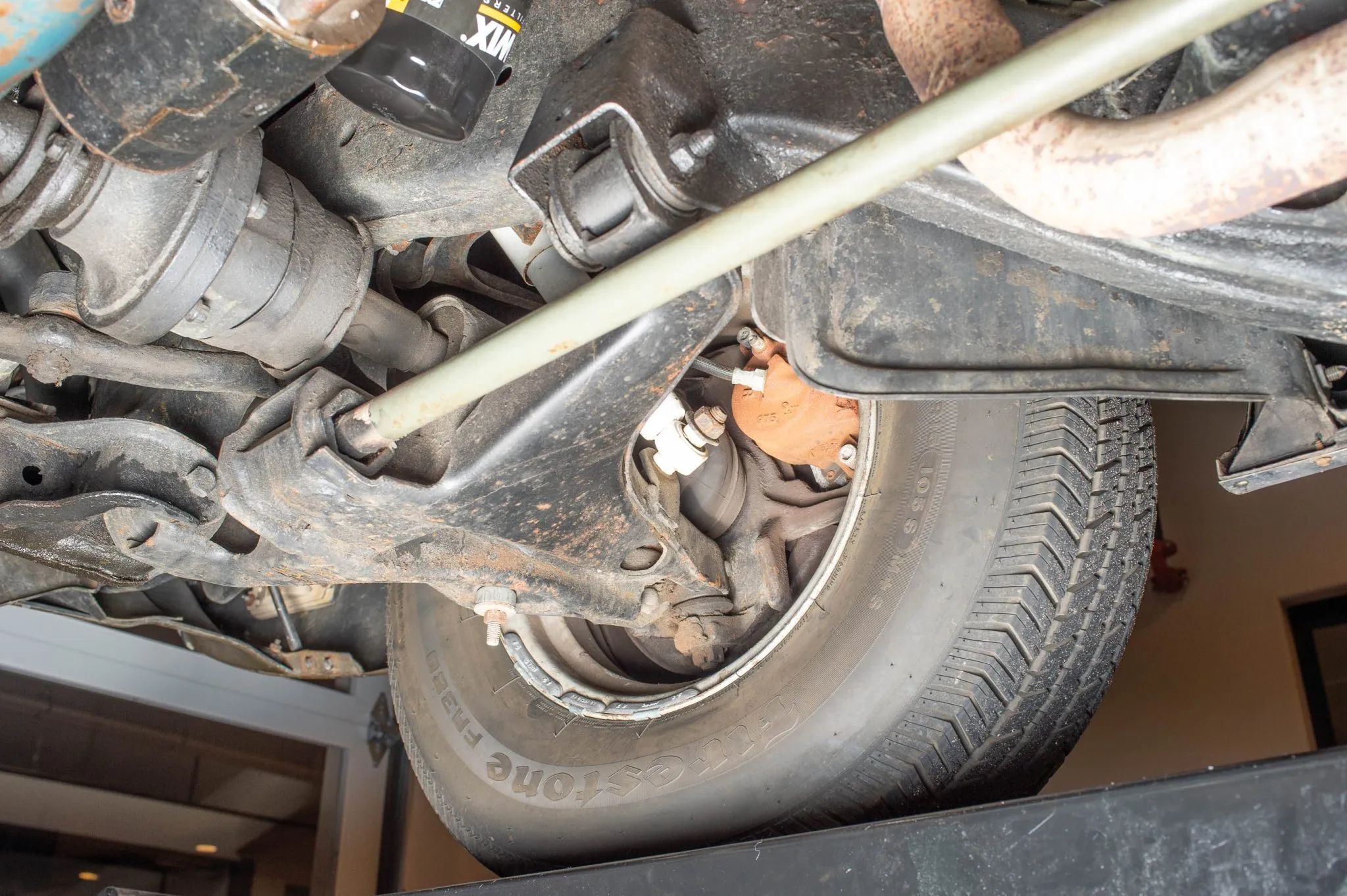
Essentially every critic on either side of the Atlantic who drove the early Toronado had remarked on the painful inadequacy of its standard drum brakes, which were simply not up to the job of stopping such a fast, heavy car with so much weight on the nose. Front discs, which helped some, had become available for 1967; they were finally standard for 1970, which was long overdue. Even with discs, directional stability could become a problem as the brakes got hot. In February 1970, JL9 True-Track rear anti-lock brakes became optional on the Toronado, although I don’t think they were ever common, and I see no indication that this car (whose cowl trim plate indicates a February build date) is so equipped.
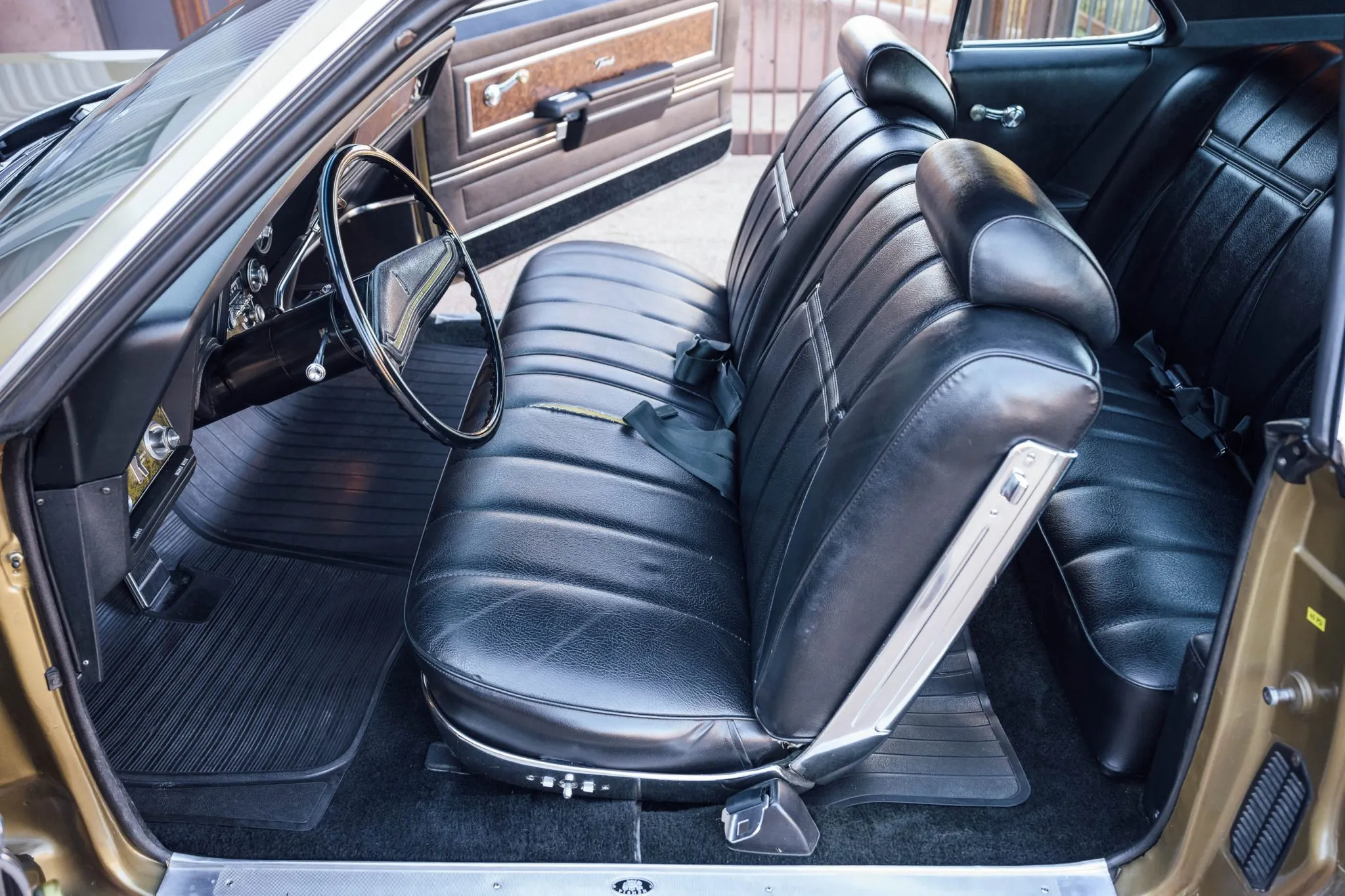
This Toronado is a base-trim model, not the somewhat fancier Custom (which was theoretically an option package through December 1969 and became a model in January 1970). The base trim was actually considerably rarer than the Toronado GT option — 5,341 cars were built with the W34 engine in 1970, about 20 percent of production, but only 2,351 cars had standard trim.
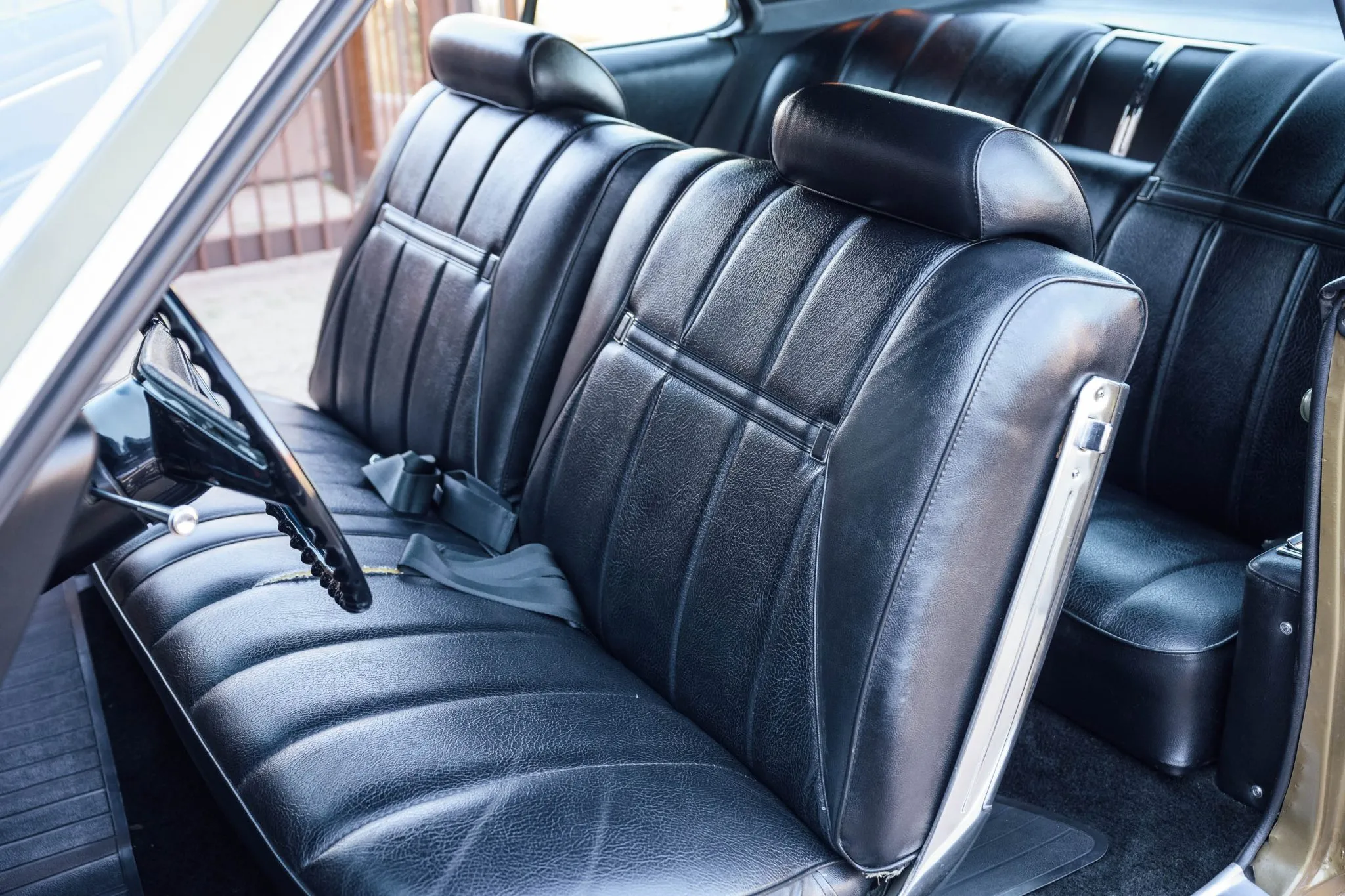
You could get Strato Bucket seats as a no-cost option with either the standard or Custom Toronado (although a center console was $50.55 extra), but few buyers ordered them, since a bench seat with no console afforded more opportunity to show off the flat floor that was the main party trick of Toronado front-wheel drive. Only 1,811 Toronados had buckets for 1970.
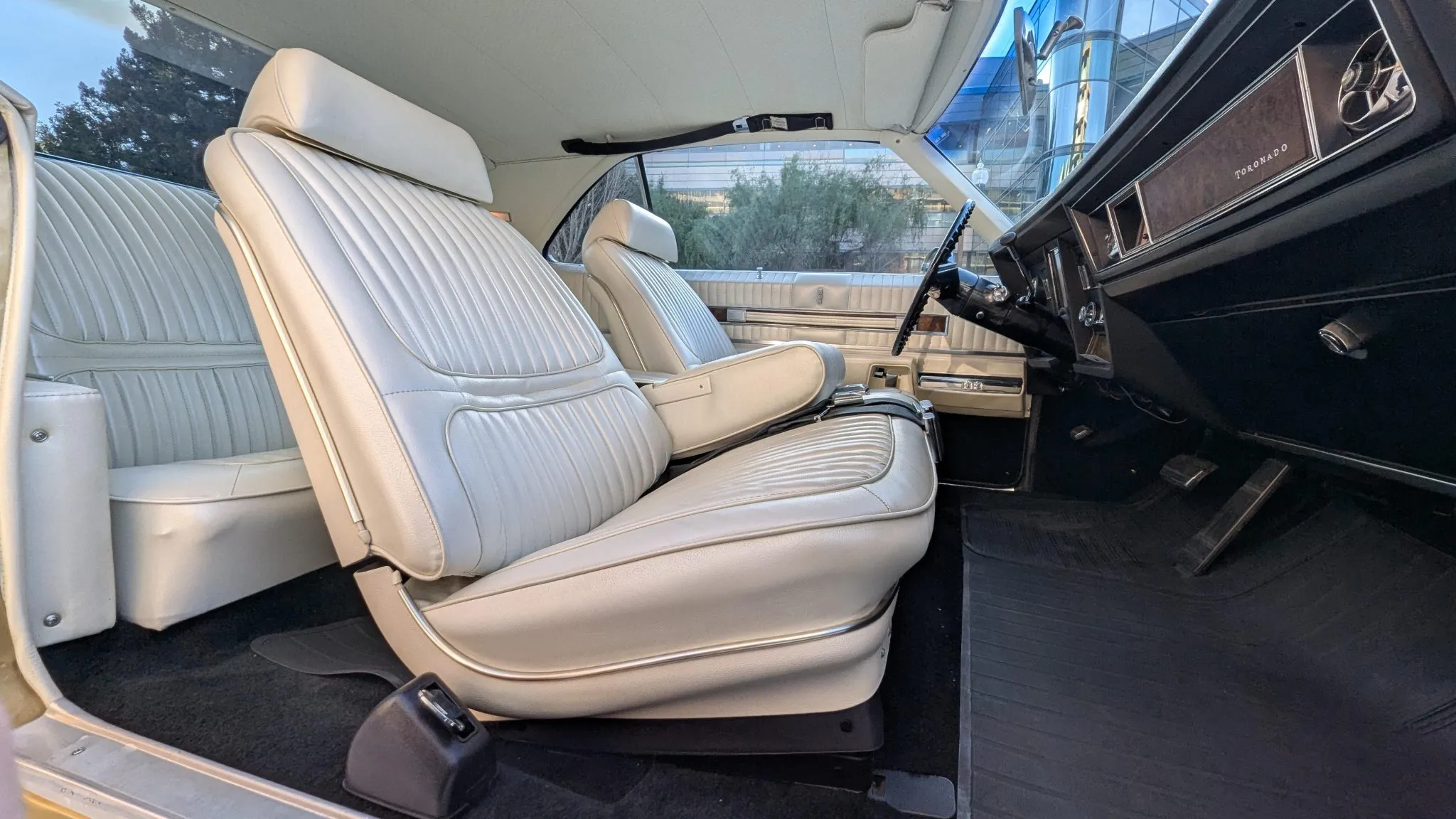
The more popular Toronado Custom, which cost an extra $193, was distinguished by its vertical pleat stitching style and different door trims with pull straps, but its most important feature was its Strato Bench front seat, with separate seat backs and a folding armrest. The Strato Bench had been the most popular Toronado seating option since the beginning.
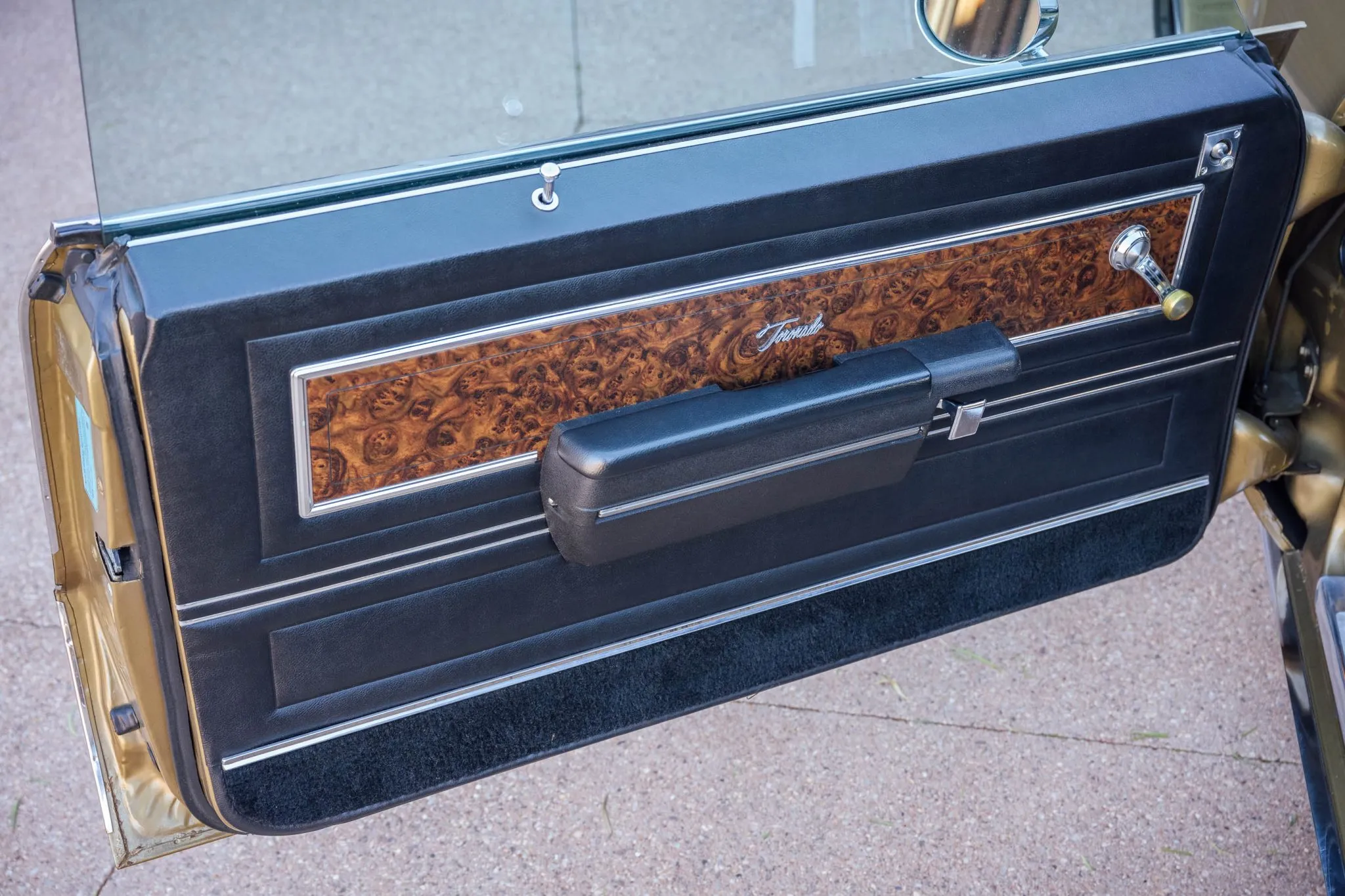
Curiously, this base Toronado was ordered with a six-way power seat ($100.05), but not power windows ($110.59). That was unusual: The Toronado usually had both. (For 1970, 91.6 percent of Toronado production had power windows and 85.3 percent had power seats.) More than 90 percent of Toronado buyers also bought the vinyl roof, another feature this car lacks.
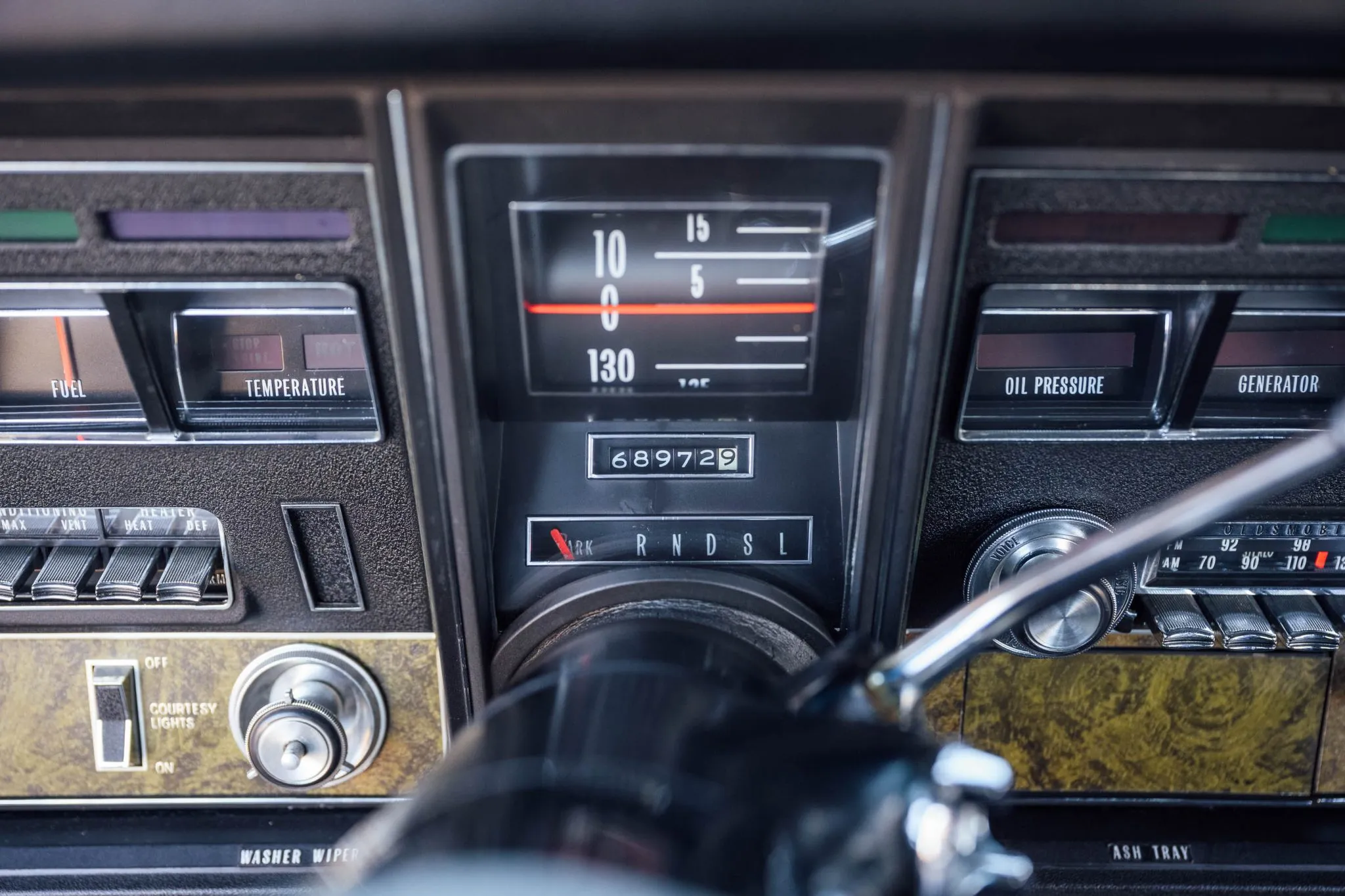
One other point in the Toronado’s favor was that Oldsmobile had retained its unique instrument panel with rolling-drum speedometer, although the secondary gauges had been replaced with warning lights back in 1968, a cost-cutting move.
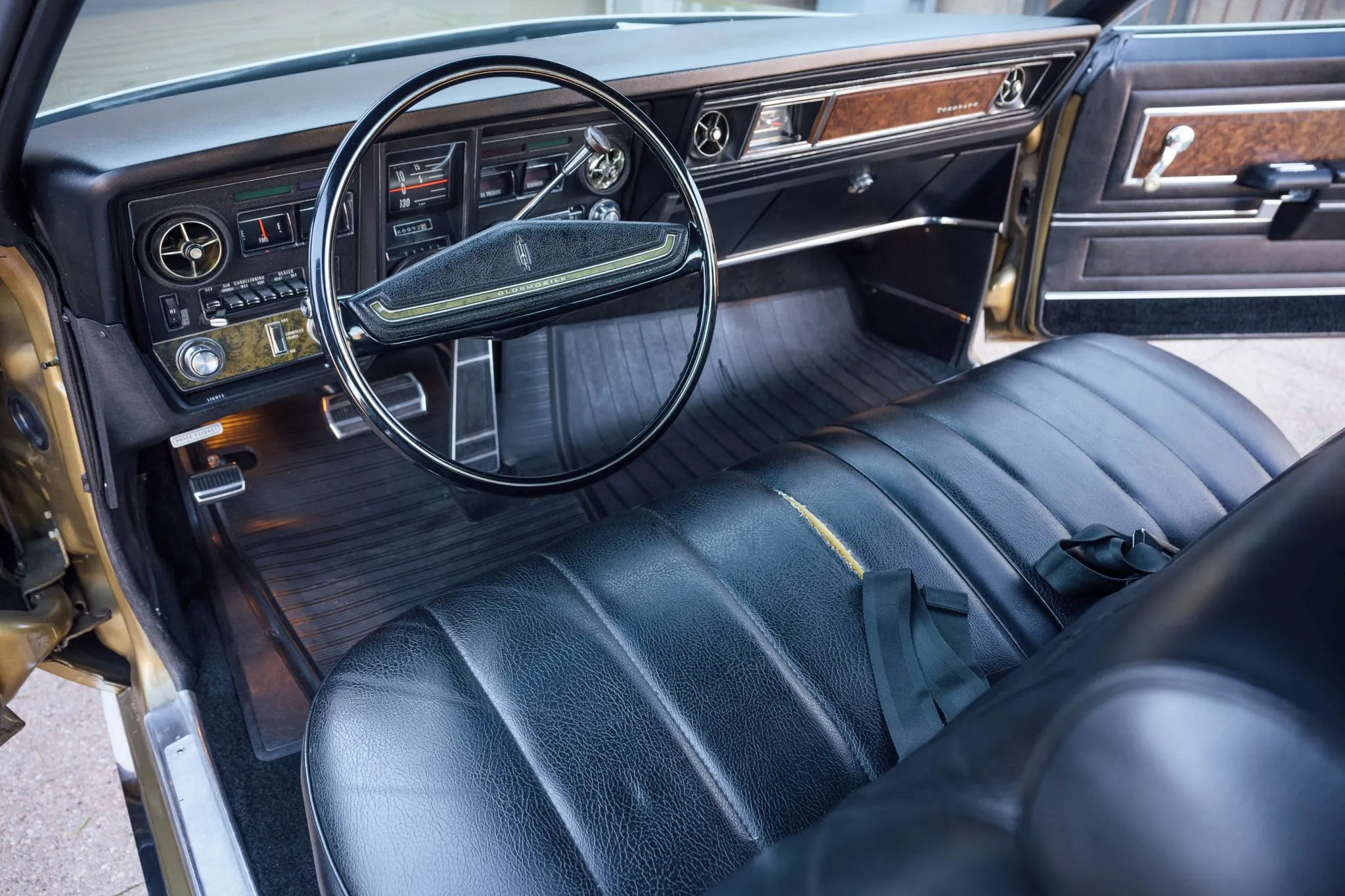
There was no longer a unique steering wheel, which was too bad, but the Toronado had a bit more interior character than the 1970 Riviera, which now just looked like an Electra 225 hardtop inside. This was an area where I think GM designers kept missing the boat in the personal luxury field: Judging by the success of the Thunderbird, buyers in this segment wanted enough interior distinction to remind them that they were driving something special.
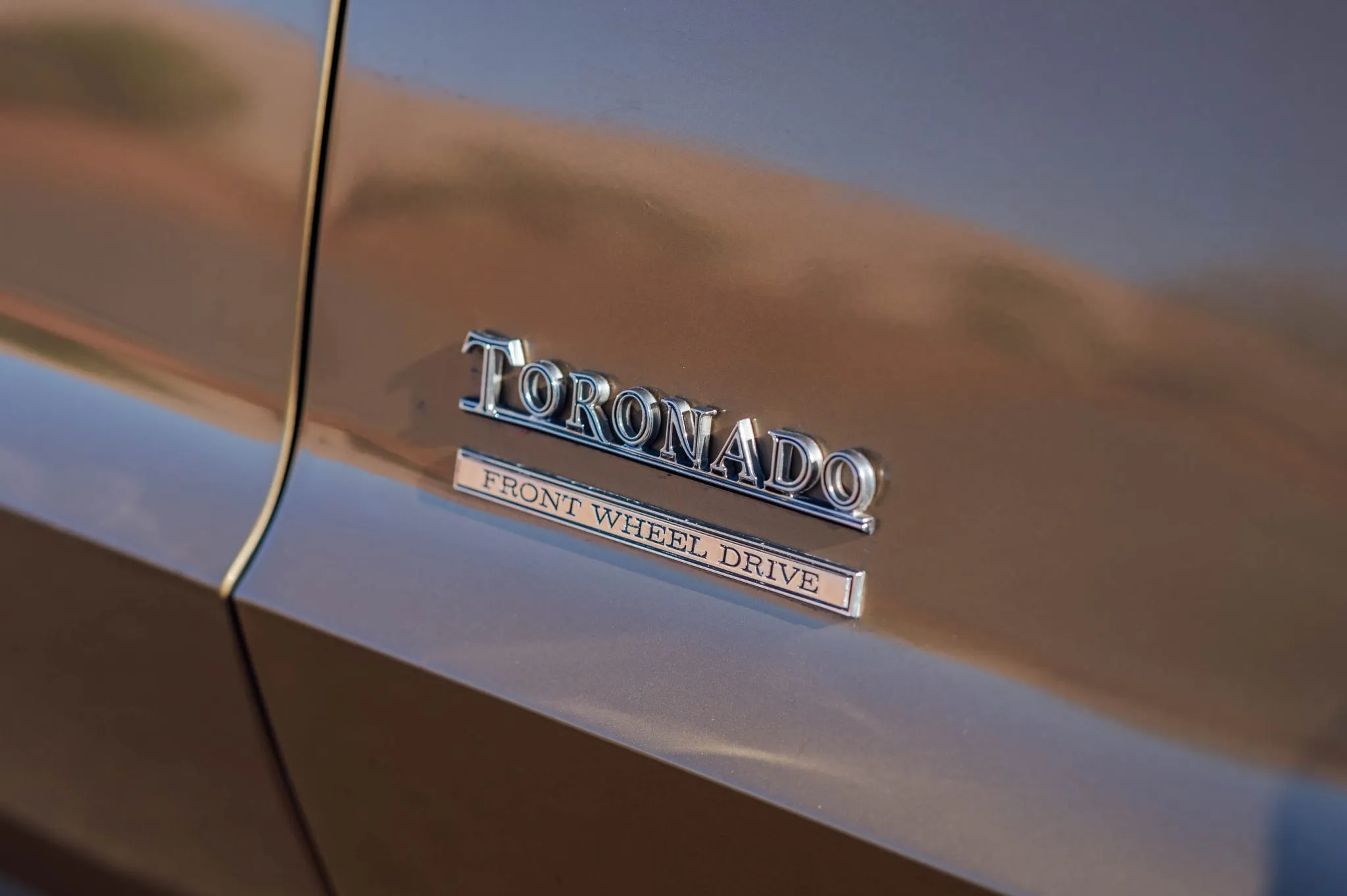
Oldsmobile and Cadillac had instead spent a bunch of money giving the Toronado and its Eldorado sibling front-wheel drive, which was in many respects just as much of a gimmick as the Thunderbird’s sequential taillights. Putting 400 horsepower through the front wheels as placidly as the Toronado GT did was an impressive engineering achievement, but it was also a wholly gratuitous one.
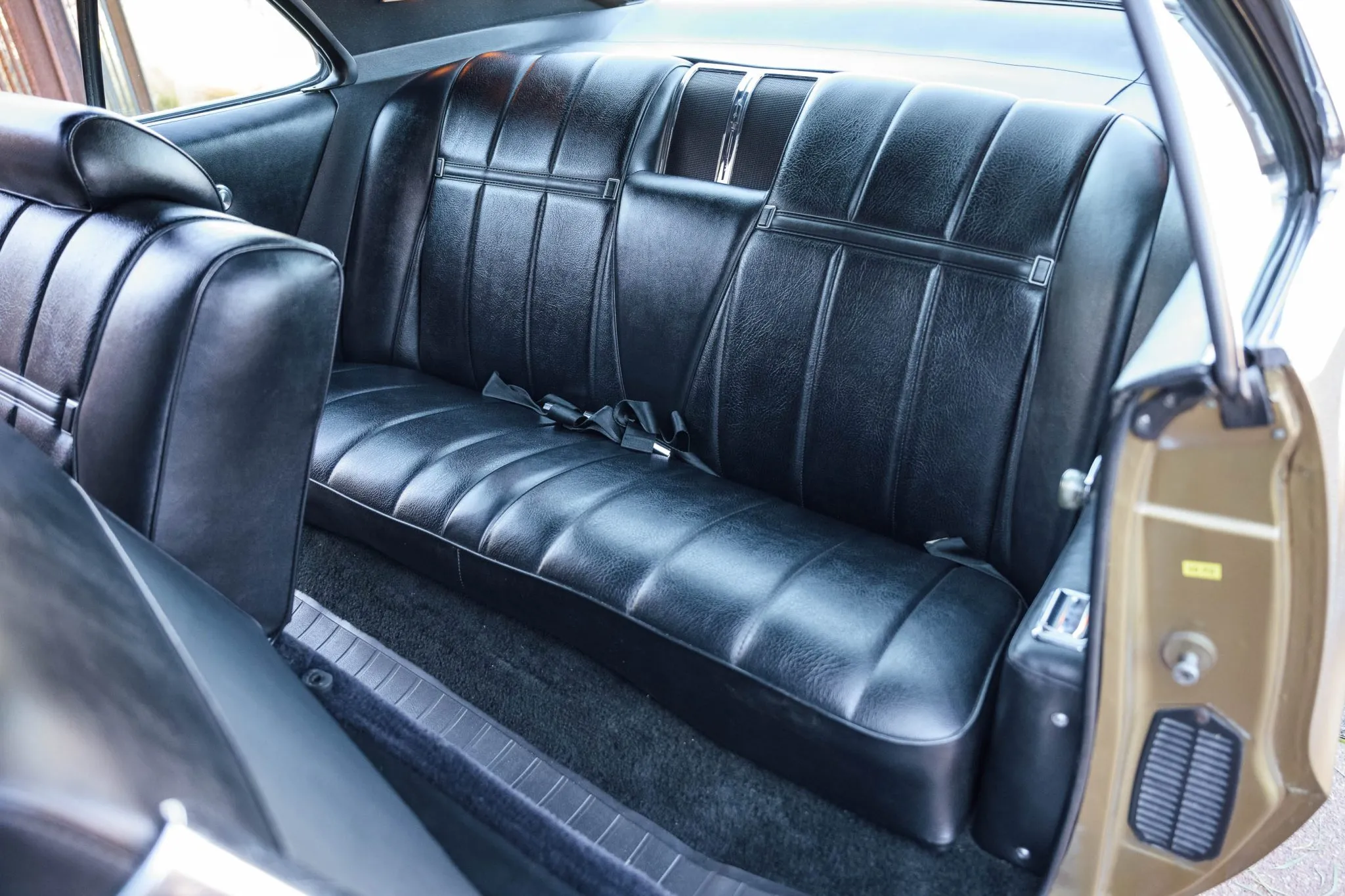
It wasn’t like it paid off in interior space in the back seat …
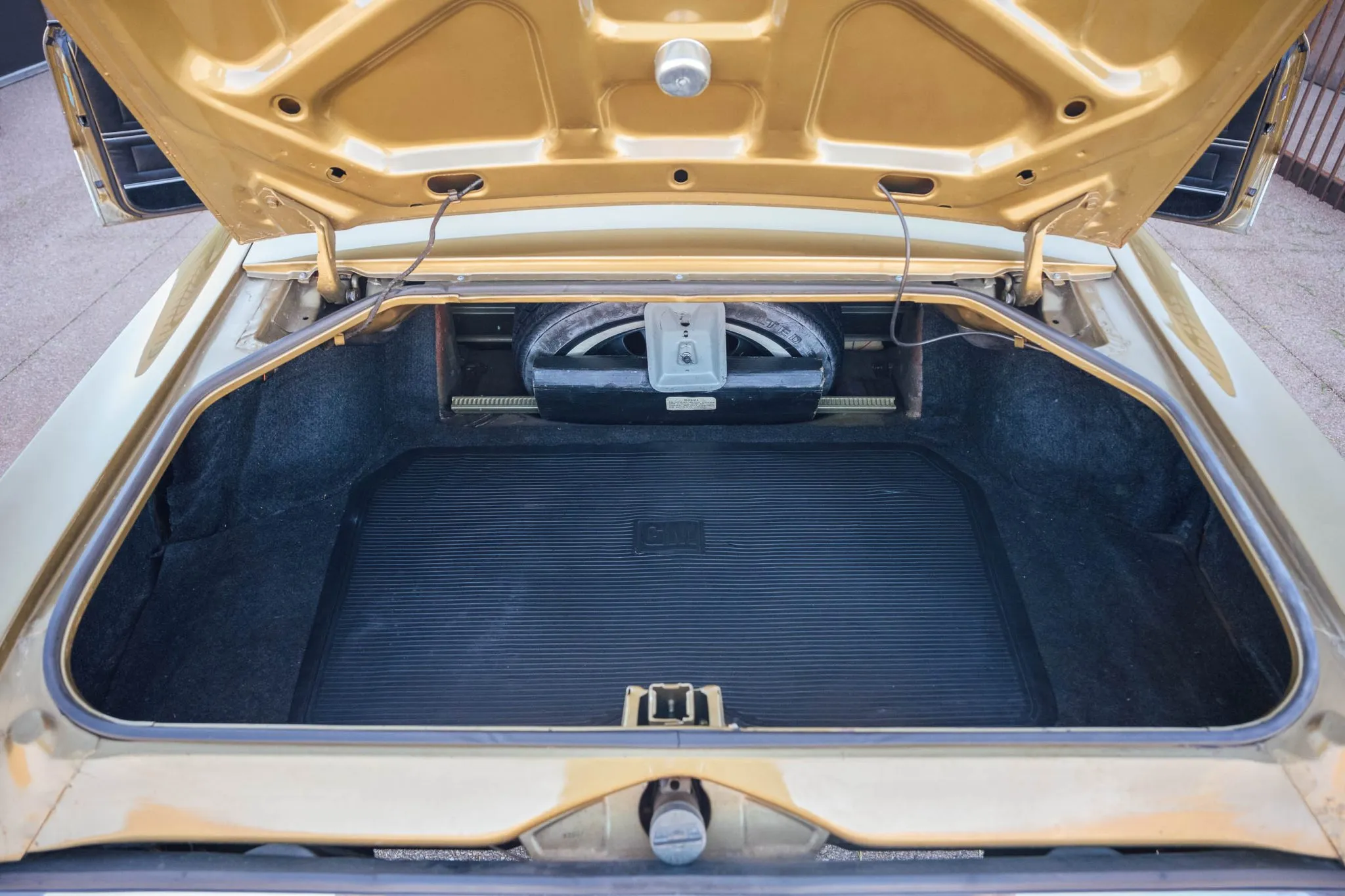
… or in the trunk, although the trunk was adequate for the ways most people were likely to use a car like this.
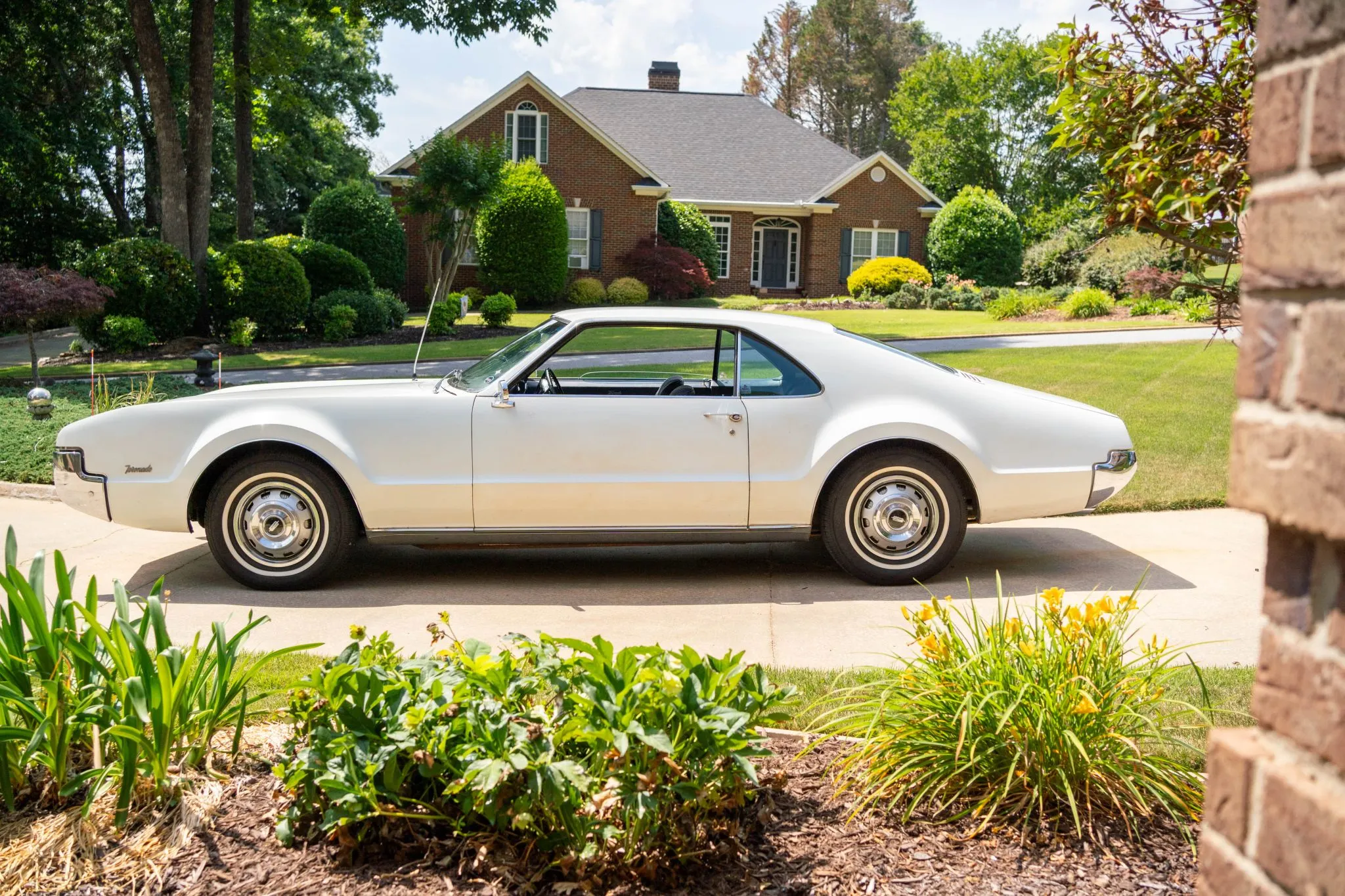
I’ve said before that I think the original Toronado was too much of a styling exercise for its own good. It was certainly striking, but it was aimed at critics and classic car buffs rather than its ostensible market — the automotive equivalent of one of those big award-bait dramas Hollywood likes to put out around Christmastime. I’ve always found the 1966 Toronado more impressive than pretty, and it’s not as good-looking as the contemporary Riviera, which was far more conventional in approach. The trajectory of Toronado sales suggests that contemporary buyers felt similarly.
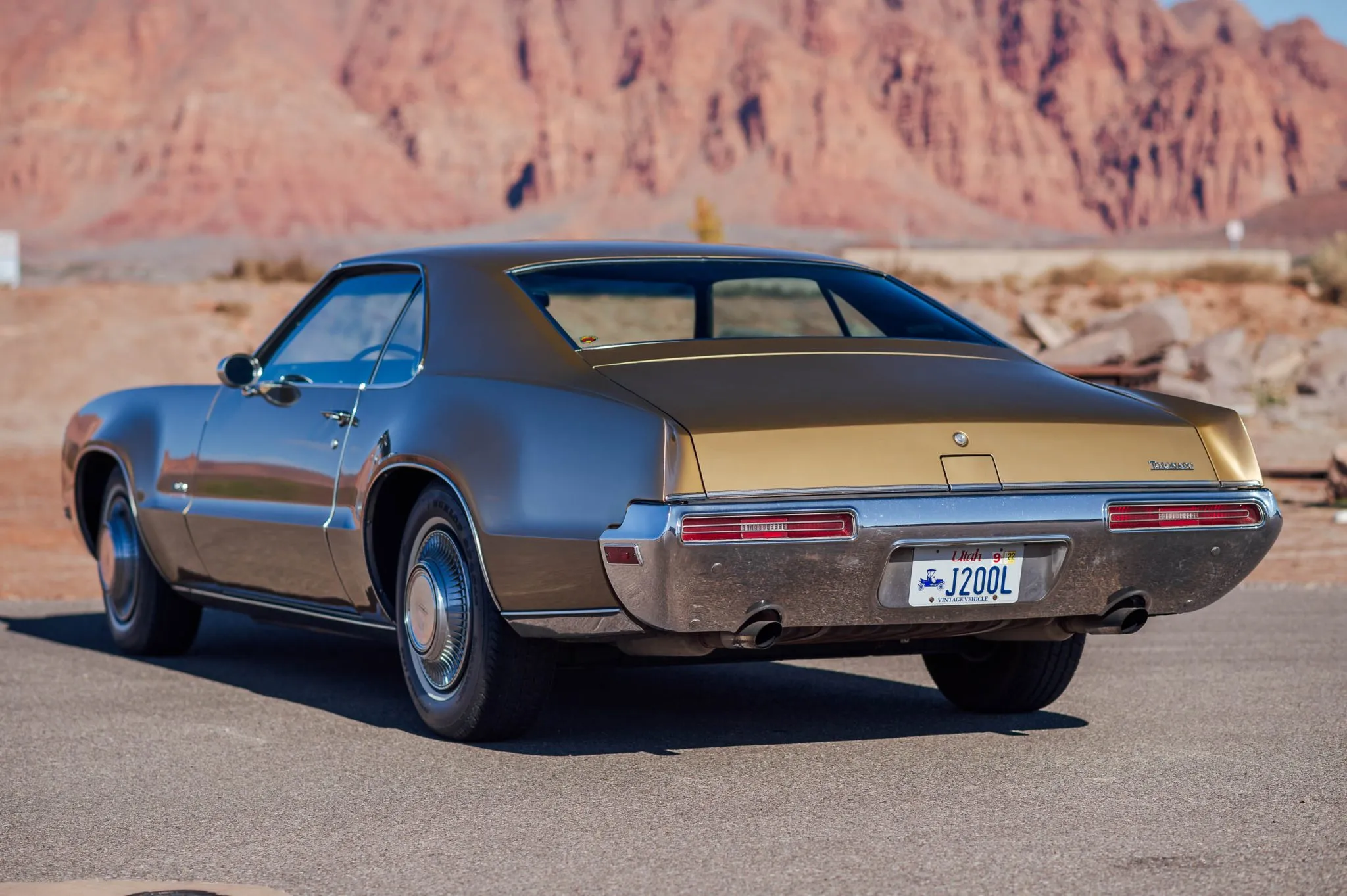
This 1970 Toronado no longer even had the courage of its somewhat eccentric convictions to keep it warm at night. From the rear three-quarter, I keep thinking it looks like a redress of the previous year’s Riviera, which wouldn’t have been the worst thing were it not for the fright-mask nose.
Oldsmobile built 25,433 of these cars for 1970 (plus 42 chassis for coachbuilders), which was firmly average for the first-generation Toronado. So, obviously some people bought them, but why? Did they like the looks? Or, like me, did they simply squint their eyes, grit their teeth, and mutter, “Four hundred horsepower“?
Related Reading
Vintage Review: 1968 Oldsmobile Toronado – April 1968 Car and Driver Road Test (by GN)
1969 Oldsmobile Toronado – A Powder Blue Paint Job Highlights The Toronado’s Identity Crisis (by me)
Cohort Classic; 1970 Oldsmobile Toronado – How To Adulterate A Design Classic In Five Easy Steps (by Paul N)























Not my cup of tea. I don’t like the front. I don’t like the speedometer and I’m not a fan of front wheel drive. But I can see that people like it for the 400HP. I keep going with my 55HP Mercedes Diesel.
The front end is an improvement over the previous years, even if it does look like a TIE fighter (AI image)
As I read this my JoHan model of the ’70 is gazing over my right shoulder. It’s about the same colour as the example in the first colour.
One of the few car models that I haven’t rebuilt as my skill improved.
Personally I think the nose job for ’70 is more elegant than the misstep of ’69 which was too heavy and disconnected from the body shape even if it did retain the wheelhouses of the original. In any event, I would prefer a Toronado of any year in that generation to the equivalent Riviera – on aesthetic grounds: the ’66 illustrated is just delicious.
I think the guys who designed the 1970 Toronado front end might have been inspired from the front end of the customized Toronado roadster used in the first season of tv series Mannix.
https://www.curbsideclassic.com/features/curbside-tv-the-cars-of-mannix/
Good call on Mannix’ car being an inspiration. It’s worth noting that when the show was better sorted out in later seasons, they managed to get Chrysler as a sponsor and from a mildly customized 1968 Dart convertible, Mannix drove E-body convertibles from then on.
As to the aesthetics of the Toro, to borrow from Charles Dickens with regards to 1970 PLCs, it was the best of times, it was the worst of times. On one hand, you had the Mark III, downsized Grand Prix, Monte Carlo, and still attractive Eldorado.
But on the other, you had the Bunkie-beak Thunderbird, Toronado, and Riviera.
The R.E. Olds Museum has a really nice gold GT, and I was able to take this comparison shot between the fender arches of it and their gold 1966 Toronado.
Especially with the wheelcovers instead of the styled steel wheels, the ’70 screams “generic Oldsmobile” styling cues. It could be a Delmont, Delta, whatever 88. Despite it’s faults, I’ve always liked the original ’66, but this is just an ugly mess.
+1
When I see a car from this era oddly optioned (such as this six-way power seat without power windows) I always wonder if the driver’s anatomy necessitated more flexibility with seating position or they were specifically disgruntled with power windows based on the often-patchy reliability of this feature in the 60s and 70s. Save for the front end and the oh-so-close-together headlights, I think the design of this car is very nicely balanced.
This year is just ugly. The ’66 was a work of art. And I love those speedometers. But wouldn’t that just be a barrel of monkeys to drop the oil pan on!
First time I’d ever heard of on not liking the 1970 styling. I think it’s magnificent. Way better than the 68-9
With the original Toronado being one of my favorite designs of the 1960’s, I can only quote Marlon Brando: “Look how they massacred my boy”.
This article articulates extremely well everything I find wrong with the 1970 redesign, although I could pass over the fender arches; once the front and rear designs had been twisted so much from the original, I do not even think the unique arches and creases would work.
I also think that a Toronado, or really any big PLC, just looks bad with a bench or even buckets without console: were you really going to bunch up 6 people in this car?
By the way, great photo Aaron65, really highlights the differences!
I think the original Toronado was too much of a styling exercise for its own good.
Agreed. As well as too much of an engineering exercise for its own good.
Olds would have left the original alone if it sold, but they had to do something. The Toronado isn’t alone in this predicament. First year new cars often overshoot the acceptance of their intended market.
As the first generation Toronado struggled, Olds used the annual changeover to fix what it believed was the styling problems. Yet these fixes didn’t work. What we see here is an attempt to remove as many unique Toronado traits as possible and we’re left with generic Olds. Sad.
Olds’ expectations got burned by the first generation. It was more careful in the future.
Great article and pics 🎉🎉🎉 really fun to read. Thanks!!!
The transition of the 1969-70 Toronado from the well-defined wheel arch creases to the smooth bulges remind me, quite a bit, of the 1972-73 Plymouth Satellite Sebring coupe which did almost the exact same thing, and I wonder if the Toronado was the inspiration. The timing certainly would have been about right for the Plymouth design team to have seen the Toronado and thought, “hey, we can do that, too!”.
Chrysler did loop bumpers better, were the torsion bars adjustable like a Chrysler to tune the ride and handling? I reckon those cars would be wild in the wet, with only 459 NM of torque my daily activates the traction control if you get on it in the wet, the mates Toyota Aurion just smokes the tyres, but at least this thing should stop GM discovered disc brakes.
There is a LOT of weight on the Toronado’s front wheels! I believe the torsion bars were adjustable for ride height, but at the rear end unlike Chrysler’s that adjusted at the control arm.
GM might have dabbled a bit with the loop bumper fad, but not like Chrysler who jumped in, feet first. I think it was only the Mopar A-body that never got them.
Fascinating that Ford never gave loop bumpers a try, although the Mustang certainly had the elastomeric front bumper covering option, beginning with the 1971 cars, then on all Mustang II cars. They certainly went with the Pontiac stacked headlight look for a few years in the mid-sixties.
I never warmed up to the ’70 Toronado. My grandparents bought a new Delta 88 in ’70, and it looks like the Toronado inherited the 88’s wheel arches, as that seemed to be an Olds styling theme for the period. The 88 was a better looking car that year, particularly the convertible and 2 door ‘Holiday’ hardtop coupe.
A high school friend’s father had this exact model. We were greatly amused as he smoked the front tires leaving the school parking lot. Lost his privileges when the front tires were bald at 5000 miles.
Besides the sketchy reliability of 1960s hidden headlights, I’ve wondered if their disappearance on GM cars might have been an edict that only the Corvette could have hidden headlights. It sounds like something GM management would do. I can’t think of a GM car past 1969 that had them, although they looked so good on the 1969 Caprice that they should have been standard. It would have been a good way to both stand out compared to an Impala and match the Ford LTD.
Nah, I’ve seen no support at all for that. (Note that the Opel GT retained concealed headlights through the end in 1973.) If anything, it was probably prompted by FMVSS 112, which required that concealed headlamps incorporate a means of putting the lights into the open position without any tools and keeping them open if the mechanism failed. As of January 1, 1970, the lights also had to be able to open or close within 3 seconds at any ambient temperature between 20 and 120 degrees Fahrenheit.
Though I prefer the 66/67 iteration I had 2 ’69s that I loved. The smoothed out sides and revised ’70 front doesn’t bother me, it’s still a highly unique American automobile. It was the ’71 that ruined it as far as I’m concerned.
I actually don’t mind the 70 too much, largely because I think the 68-69 is worse because so much of the 66 design remained to be a sad reminder of what was desecrated, and the 71 just threw away all semblance of unique identity and merely became a budget Eldorado knockoff.
The 70 Toronado reminds me of a fuselage Chrysler product more than anything which you can take as a compliment or an insult to it depending.
An employee of my family’s business bought a new 1970 Toronado GT. It was dark green with a darker green vinyl roof and interior. I always thought it was a good looking car and the performance was amazing! At 60 MPH you could punch it and still squeal the tires. His wife used it as her daily driver and they towed their 25 ft Airstream travel trailer with it. Eventually he traded it on a new 1977 Toronado. The choked down 403 was sickly compared to the earlier car and the squared off body looked strange. It was orange to boot! What a disappointment it was.
A masterful dissection of Olds’ studio’s faux-pas, Aaron. You highlighted a few changes I hadn’t noticed; now I’m wondering how I missed them! It looks quite different from its predecessors, I’ll grant them that.
Maybe it’s not so bad if you think of it as though it was a stand-alone design? The front end is infinitely nicer than the ’68-9, though nowhere near the elegant simplicity of the original.
Like the ’70 best for this first generation Toro though it should have kept the lights hidden while complying with the new regs. The air vents could have been more squared to go with the new theme, and there should have been an option for bucket seats with center console sans floor shifter, and instead with an 8-Track player and room for a dozen cassettes, and a cup holder to hold Red Barn coffee or shake.
Hidden HL work-up.
Oh, man, does that simply change ever do a 180° turnaround from bad to good. You just have to know that the Olds stylist looked at it, too, and wonder whose idea it was to go with the exposed headlights that just ruined it.
The 1970 Toronado could be ordered with bucket seats (which were a no-cost option) and with a console (which cost about 50 bucks), it just usually wasn’t.
As you say creating a front-wheel-drive Toronado was a completely gratuitous feat.
Moreover this left only few resources for designing a more sophisticated rear suspension,as is clearly evident from its primitive rigid axle with leaf springs. Budget also failed, not allowing for adequate brakes.The tribute to the Cord was more important than anything else.
I actually really like the 70. The nose is unique to one year, before the entire redesign to a poor man’s Eldorado. The 3-strip markers look a bit out of place, but not off-putting (as other Olds products had them as sidemarkers). I prefer the open headlights and remaining toward center like that. It makes the nose look more blunt, and gives the car a more aggressive look. Fitting for being a GT with that engine.
The 66/67 nose looked classy. But the 68/69 looked nauseating to me. It looked like an attempt at a gaudy luxury car. But either one looked just so wide. The 70 gives the illusion of being narrower than it is.
I knew there was something about the wheel area, but I couldn’t place it until you called out the wheel arch shape and the flare of the fenders. I like the 70 better that way too. Basically I prefer the whole car.
As someone who grew up with 80s cars, the dash looks archaic. But attempting to put myself in that time period, the rolling speedometer would have been very cool.
I got a good look at the one from the RE Olds museum, at the Oldsmobile Homecoming in June. I liked it so much I got several pictures.
Olds management didn’t have the courage of conviction to keep the 1966-’67 Toronado styling as unsullied as possible throughout the model run, immediately tried to water it down, until it was not much more than a generic amateurish iteration of the Delta, Delmont etc styling features for 1970. Frankly, they were tired of the Toronado, just like Buick management was of the Riviera, both suffered for it for 1970.
If a Snowth was a big Oldsmobile, it would be this car. That’s just one reason I like the 1970 restyle.
Mah-na-mah-NA!!
I liked the original Toronado with the pop up lights, this 1970 model has lost all of that, but 400 hp and FWD is “holy torque steer Batman” territory.
I’m most curious about the 42 chassis for coach builders since the GMC motorhome didn’t come out until 1972 and only used the power pack.
Jetway 707 probably used a good portion of those.
https://www.curbsideclassic.com/blog/cc-outtake/curbside-outtake-american-quality-coach-aqc-jetway-707-toronado-transit-bus/
As far as the other oddities I’ve seen, such as a cab/chassis type motorhome, flatbed truck, etc… I’m curious if those were diy jobs or actually done by coach builders.
The RE Olds museum car has a 3 spoke steering wheel, which I find to be better looking. 70 Toro GT W34.
Can’t seem to get the picture to load upright from my old phone.
My father had two Toronados for a while, a 1966 and a 1969. While one of them was at the dealer for something, I sat in a very lightly used (maybe 10,000 miles?) 1970 in Oxford Gray with a double white pinstripe, white bucket seats, and a console. In the words of Linda Vaughan, “Boy howdy!” That, to me, was the ultimate first-gen Toronado. (No, Dad did not see fit to trade for it.)
I understand why people have said that the original styling concept was diluted or degraded (and Aaron65’s shot of the two rear quarters is fascinating), but let’s not forget that 1966 and 1970 were very different times, in society at large and, I’m sure, in the GM styling studios as well. A 1966 Buick Wildcat is a lot different from a 1970 Wildcat, too.
Does “different” mean “better”? Of course not. But I suggest that a 1966 Toronado wouldn’t have made a good 1970 car.
I disagree that the engineering of the Toro’s fwd was gratuitous, not only was it virtually bulletproof from day one, quite an accomplishment for a chassis so different, but anyone who owned one in snow country sang its praises, as it was far better than rear drive in low traction circumstances, a fact noted by drivers in some of the early car buff mags at the time. The brakes in ours with big front discs were fine, and the flat floor was also unique and much appreciated when a taking trips in our ’69. The poor mpg, however, was not, but then it never claimed efficiency.
rwd not red, damn autocorrect.
Note that it sold for $41K. I follow the Gen 1 Toro market and that’s a very high price for one of these, normally one this nice would sell for more like $20-25k, it’s the BAT effect for sure here. Toros are generally unappreciated in the market compared to other similar year pure muscle cars.
Note that no fwd car with this kind of power had even been built before, imo it was an engineering masterpiece and totally unique in 1966. I’d have liked it better if built to a smaller scale as originally intended and with better brakes initially, but still admire it just as it was.