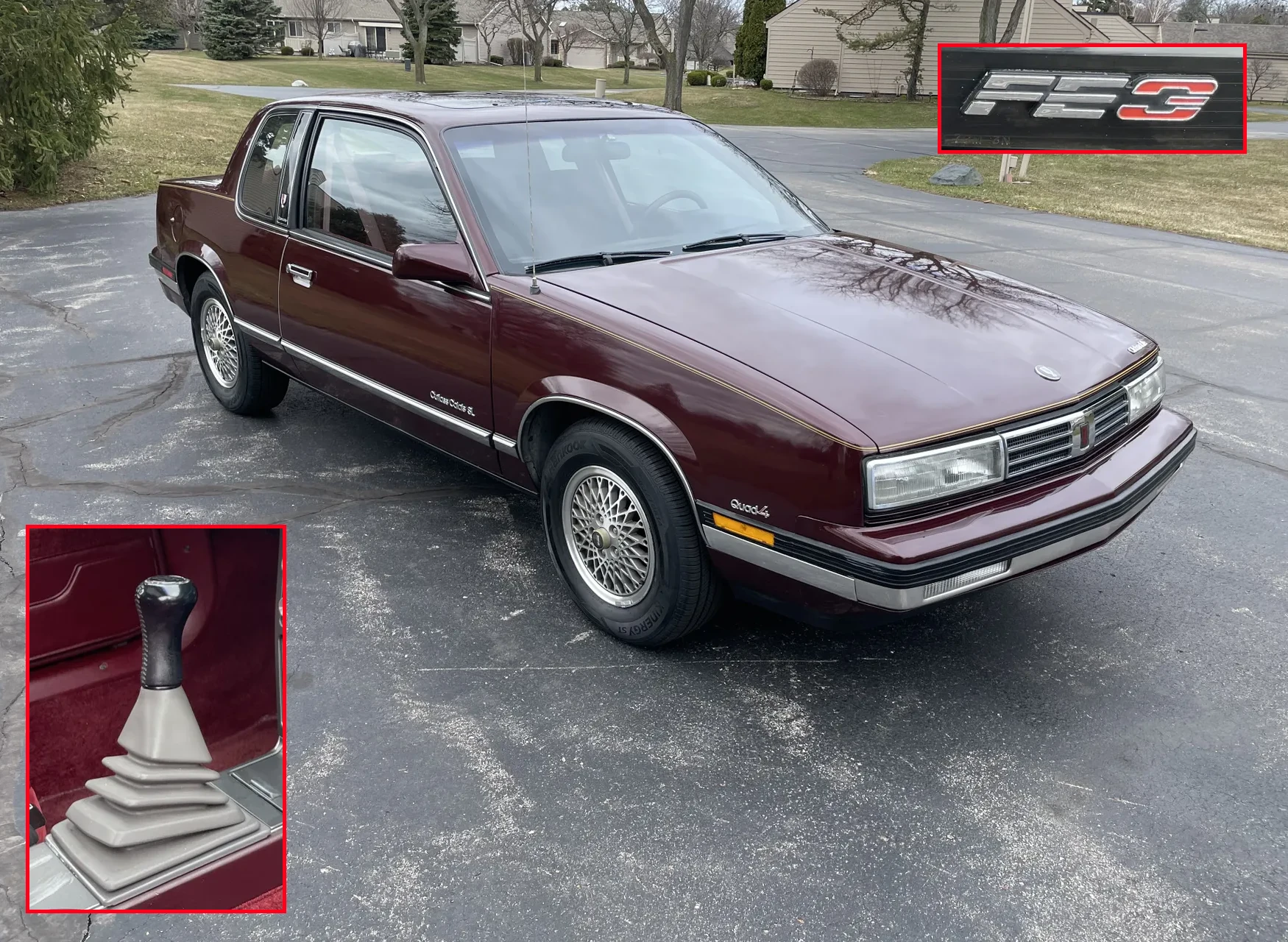
In 1988, Oldsmobile tried to breathe some life into the dowdy N-body Calais by offering it with the new DOHC Quad 4 engine. Car and Driver compared the combination to wearing “Reeboks with your three-piece suit,” and buyers didn’t exactly come running. This very original Calais SL has the Quad 4 engine, the rare 5-speed stick shift, and the FE3 sport suspension. Is it an underrated sleeper, or are the high-revving engines and velour interior like chalk and cheese?
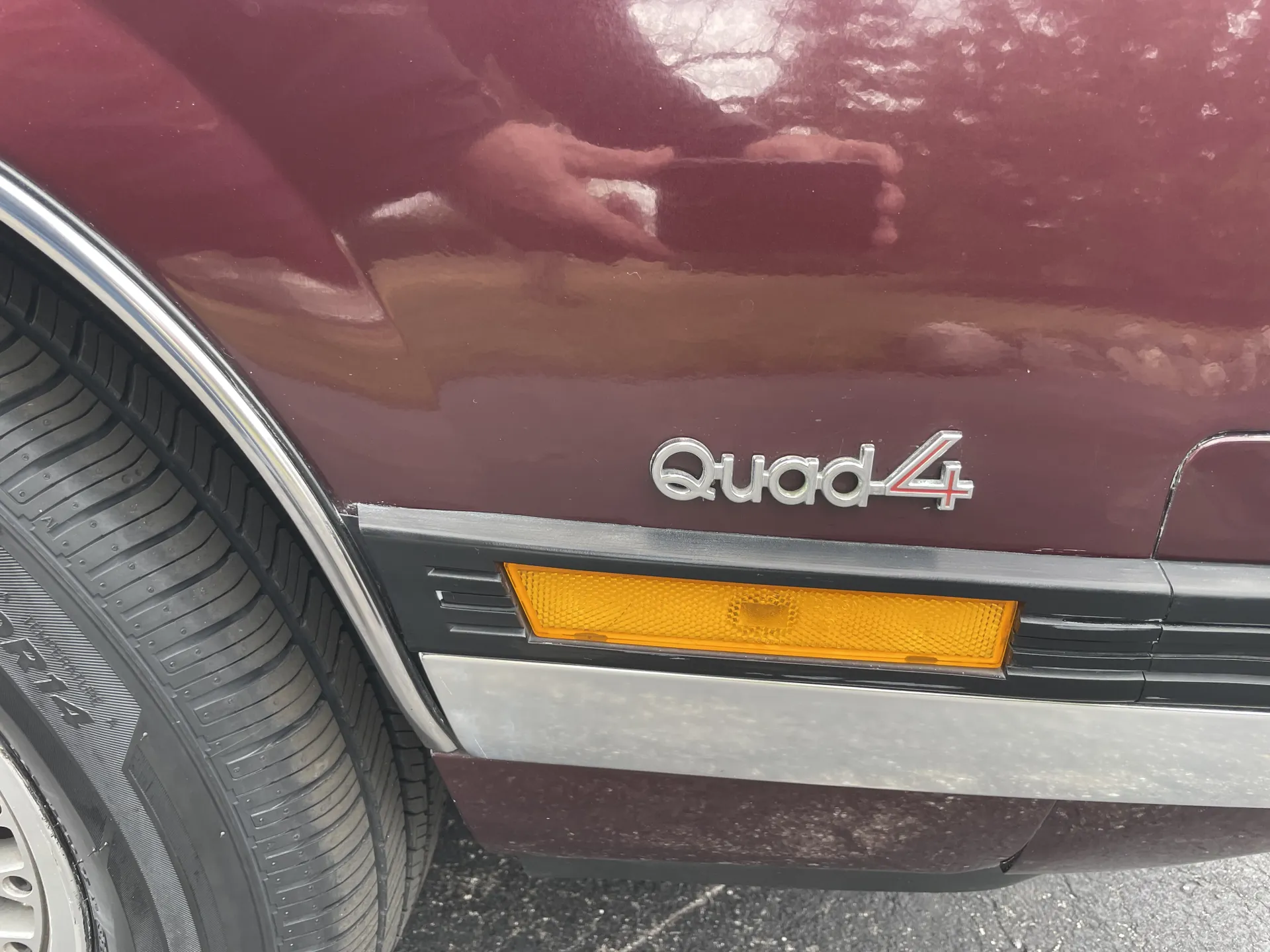
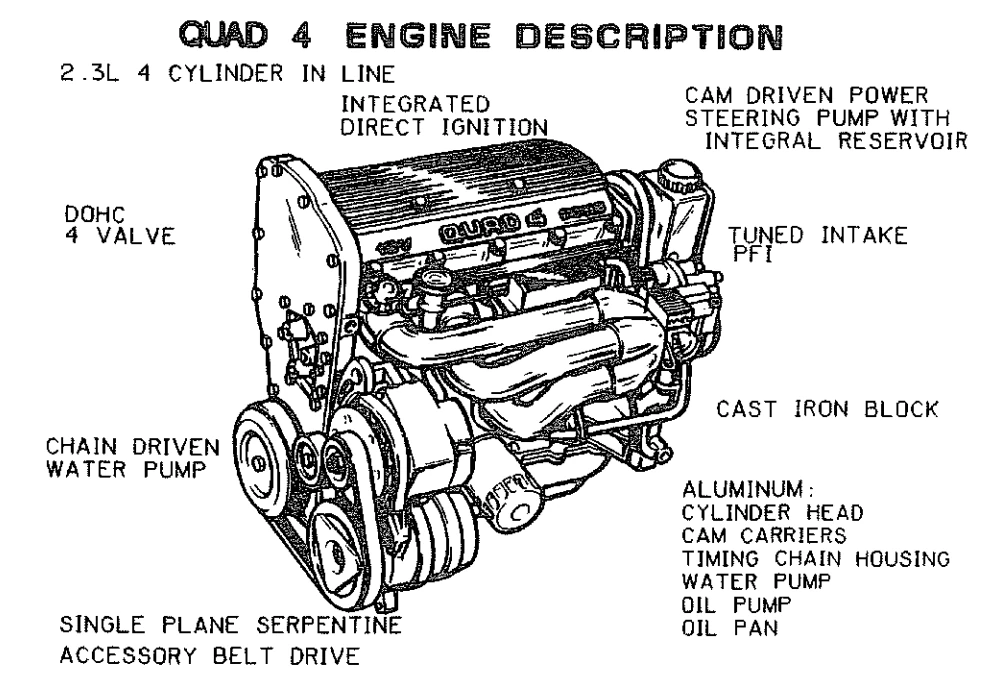
Talking about this Calais is really the story of an engine as much as the car around it: the much-vaunted, once-promising GM Quad 4, a clean-sheet inline four-cylinder engine with chain-driven dual overhead camshafts and four valves per cylinder — the first such engine GM had ever developed in-house. (The earlier 16-valve Cosworth Vega engine’s twin-cam head was designed by the British engine maker Cosworth.)
Development of the Quad 4 began in 1981, and there were running demonstration prototypes of the DOHC 16-valve cylinder head by early 1983. It got development approval in the autumn of 1984, and Buick-Oldsmobile-Cadillac Powertrain engineers even let Car and Driver sample a prototype in a 1986 Oldsmobile Calais. However, pilot production didn’t actually begin until February 1987, and the new engine didn’t become a regular production option until the 1988 model year.
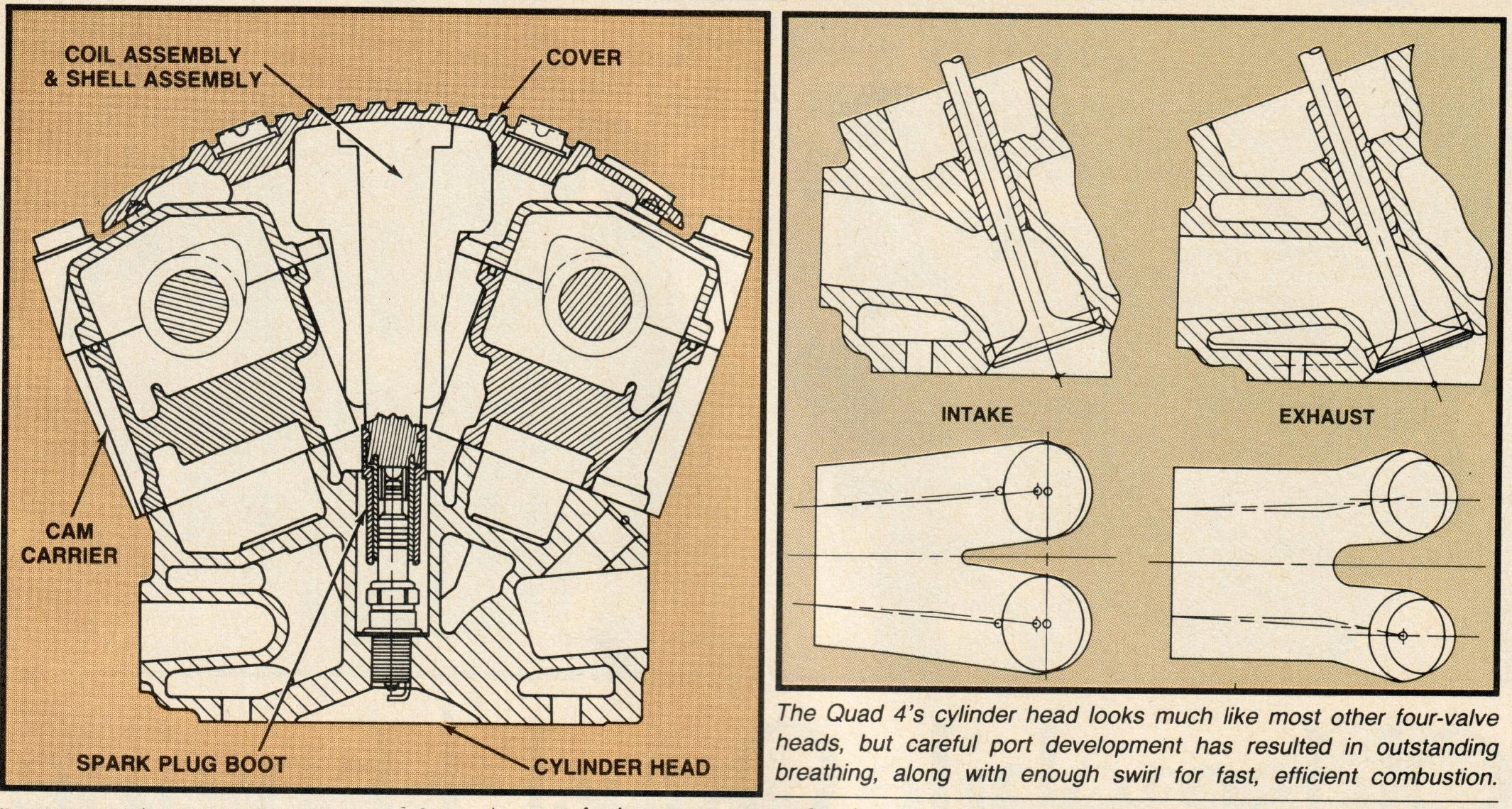
According to Oldsmobile chief engineer Ted Louckes and engine engineer Tom Leonard, actually getting the Quad 4 approved for production was a tremendous internal battle. They said the 16-valve head design had an unnamed but apparently powerful enemy in GM Engineering Staff who was convinced that it would be a failure like the Cosworth Vega, and forbade Engineering Staff personnel from supporting the project. The corporate Product Policy Group wasn’t enthusiastic because of the cost, and thought adding yet another four-cylinder engine seemed redundant. Leonard said they “took eight months out of our development program” to sell the engine to corporate management.
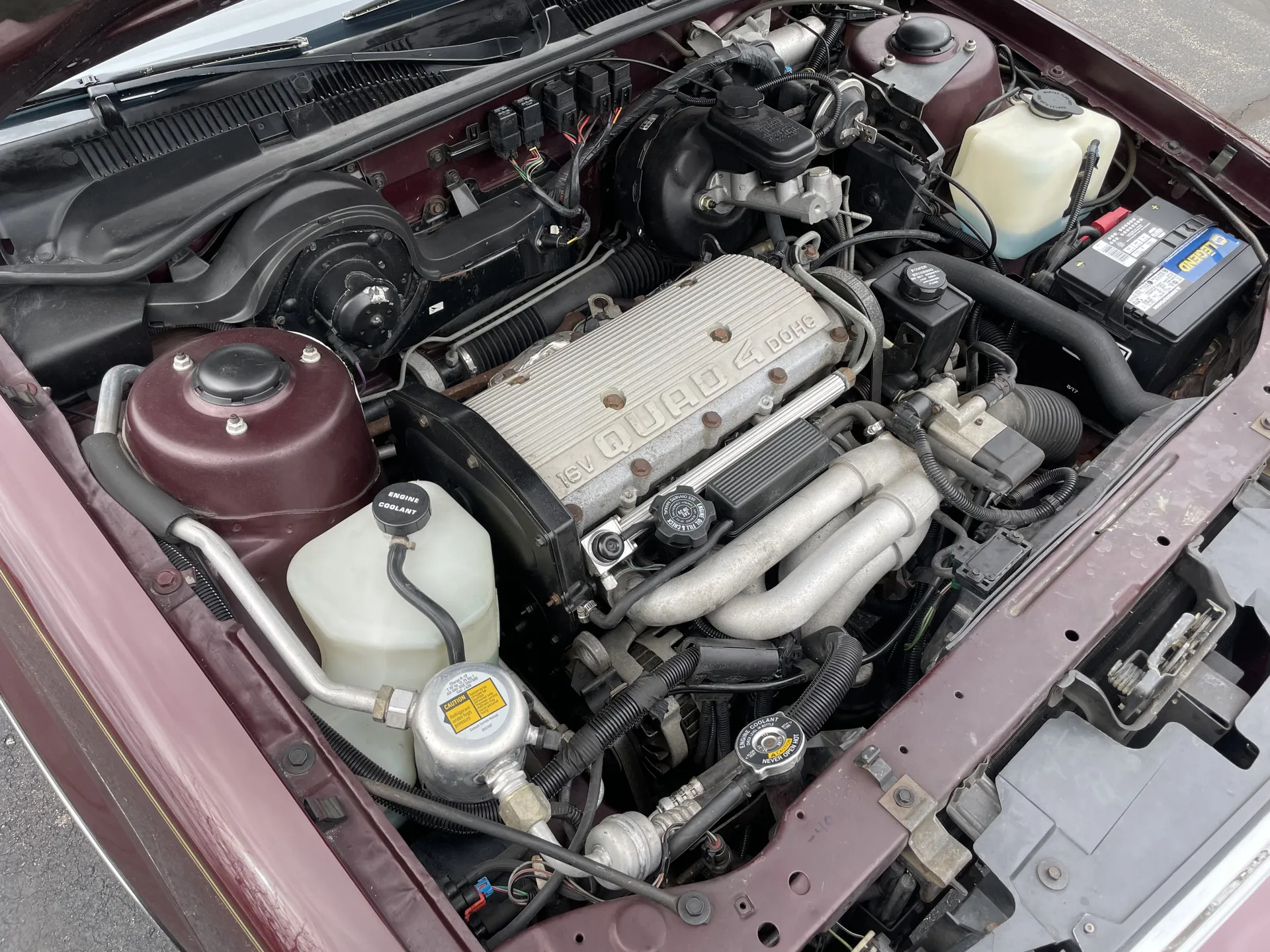
The Quad 4 engine — the name came from an internal contest — was not a groundbreaking design in a global sense, but it offered relatively light weight (about 300 lb “wet”), low internal friction, low reciprocating mass, and excellent volumetric efficiency. With computer-controlled port injection (metered based on manifold absolute pressure with feedback control) and coil-on-plug direct ignition, it had excellent specific fuel consumption and good emissions performance, allowing it to dispense with secondary air injection and exhaust gas recirculation.
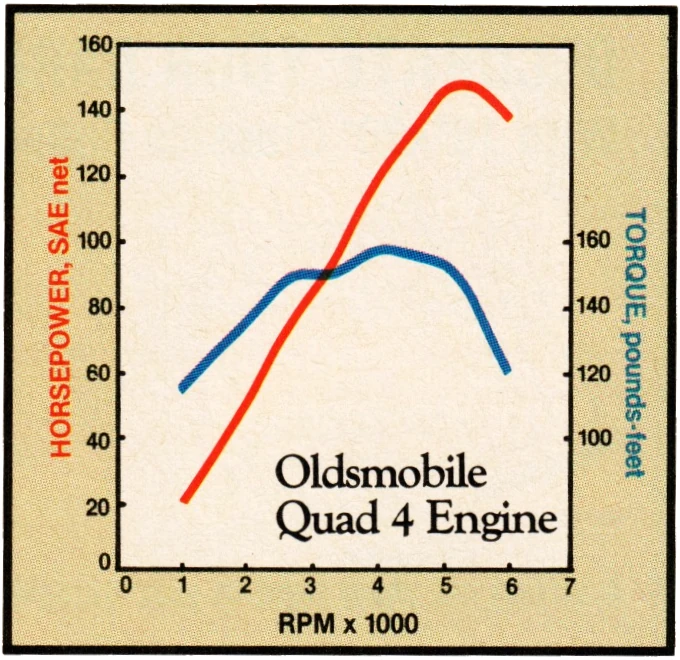
An initial net output of 150 hp and 160 lb-ft of torque from 2,260 cc (138 cid) was better than some bigger V-6s of the time. The output of the Quad 4 wasn’t quite on the level of the hottest race-bred contemporary German fours, but its performance needed no apologies. GM eventually got 190+ hp out of the Quad 4 in street-legal, emissions-compliant, normally aspirated form.
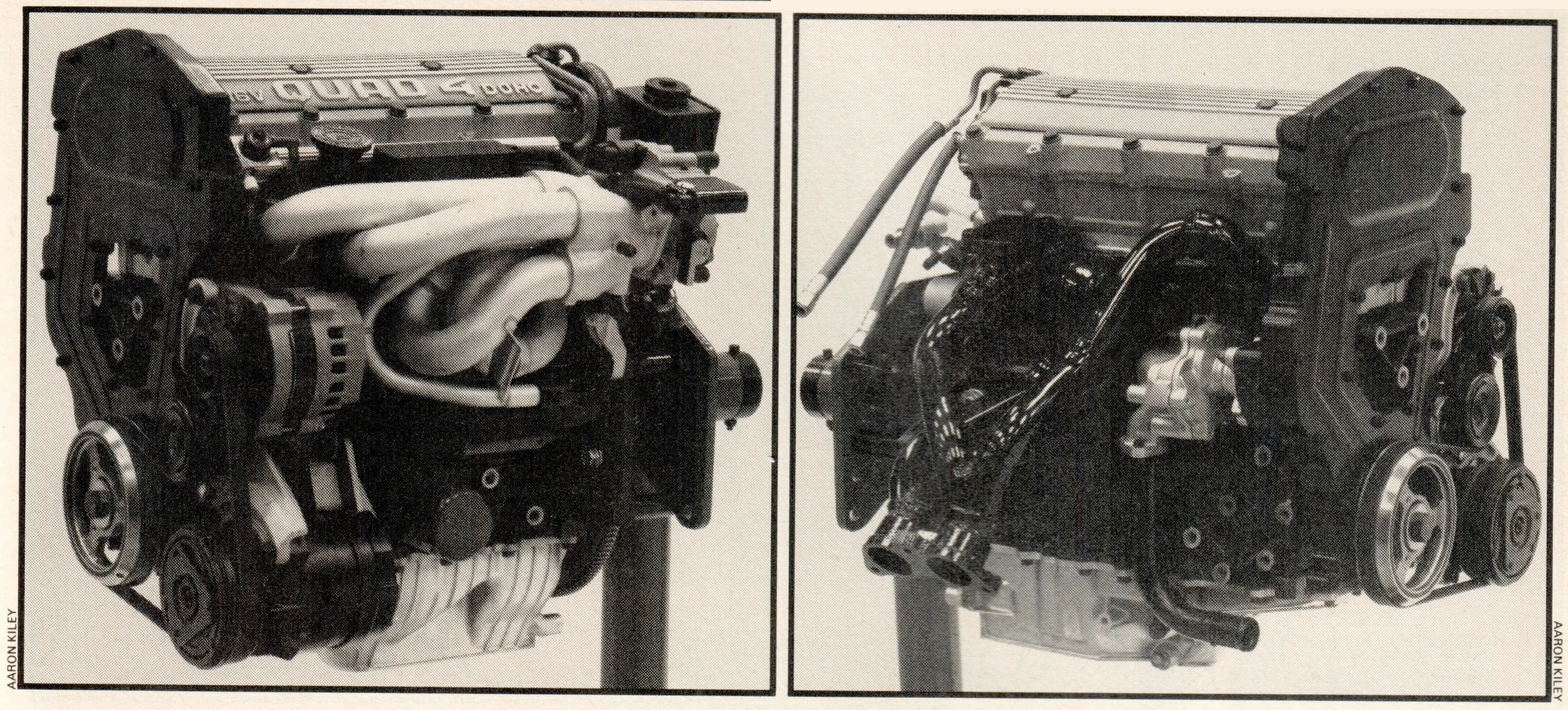
Where the Quad 4 fell down was refinement. Inline-fours have an unbalanced second-order force, a vertical shake caused by the movement of the connecting rods, which becomes increasingly noticeable as displacement grows beyond about 2 liters (122 cid). The Quad 4 was designed with provision for counter-rotating balance shafts to quell that shake, but didn’t get them until 1995, both for cost reasons and because balance shafts consume some engine power. In addition to the vertical shake, the Quad 4 got unpleasantly loud at higher RPM — not a great quality for an engine designed to be wrung out to a 6,800 rpm redline.
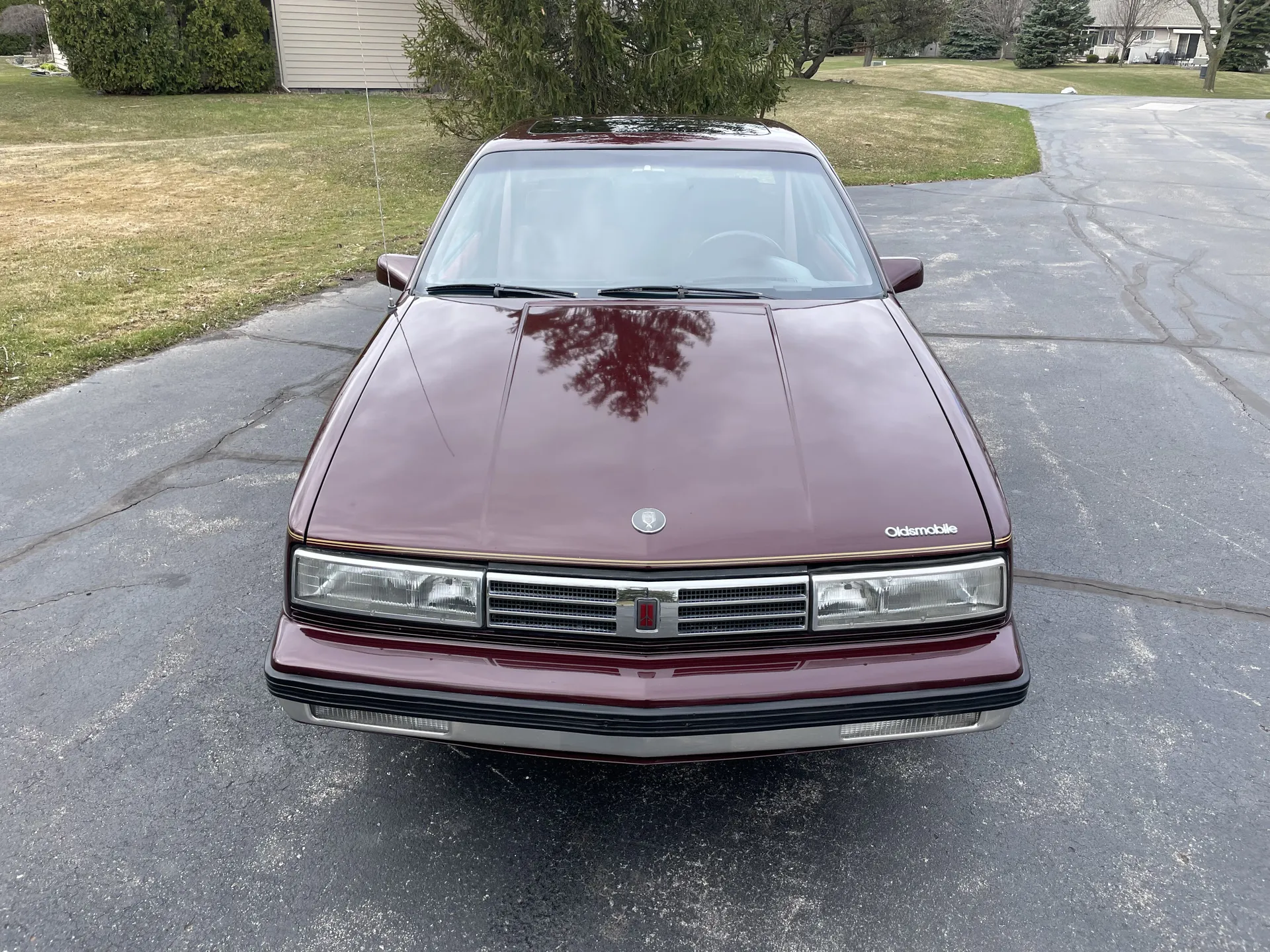
In a dedicated sporty car, that might not have been the end of the world, but the initial home for the new engine was the GM N-body compacts: the Oldsmobile Calais, Pontiac Grand Am, and Buick Skylark. (About 200 early engines were installed in late 1987 models for evaluation by, in the words of Richard C. Noble of Newhouse News service, “various dealers, fleet users, engineers, selected potential customers and automotive writers.” The Quad 4 wasn’t a regular production option until the 1988 model year.)
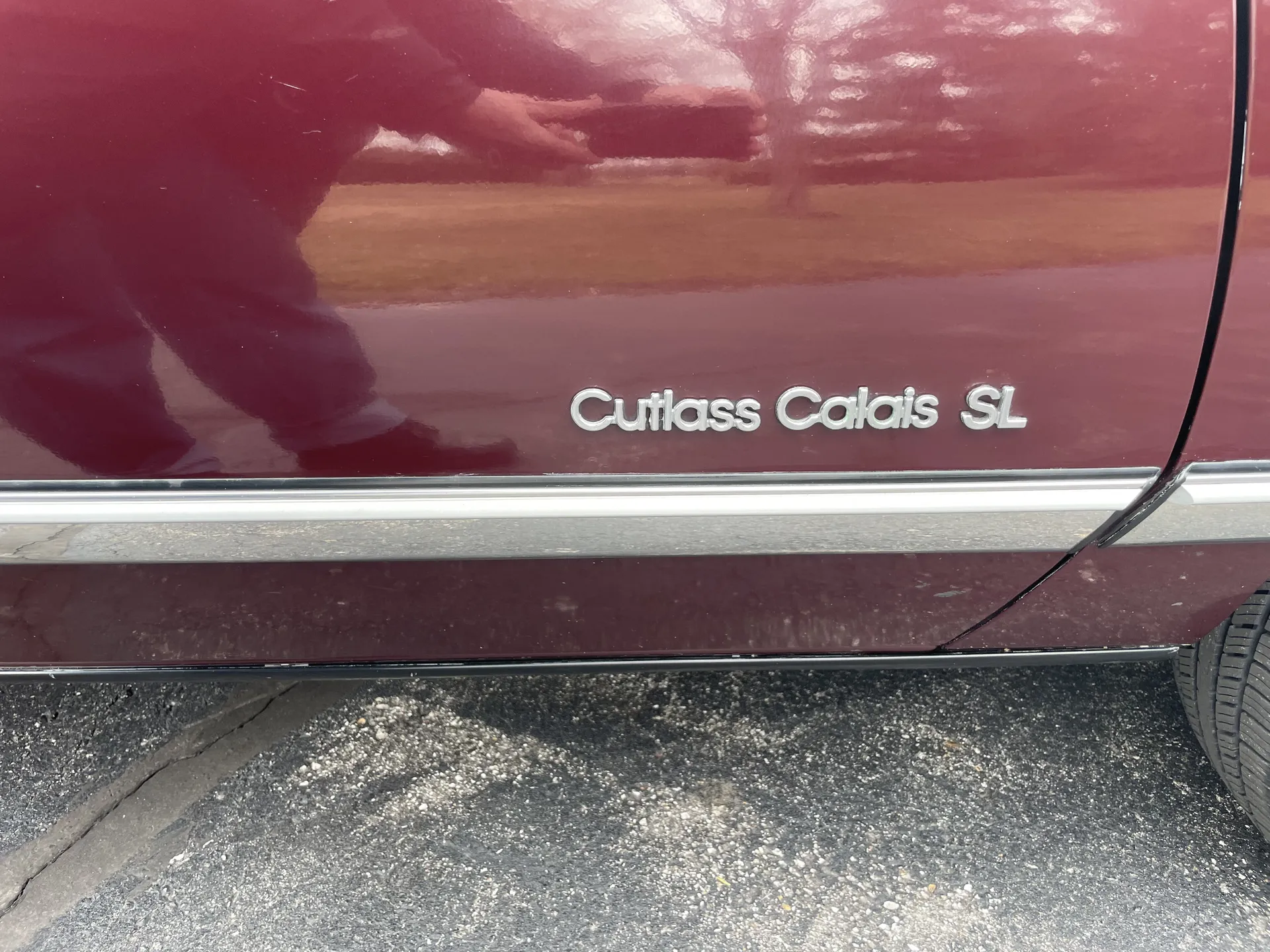
The N-body Oldsmobile Calais, which had bowed for 1985, was renamed “Cutlass Calais” for 1988. This meant that for a while this year, Olds had four quite different cars called “Cutlass,” two of them called “Cutlass Supreme.” Previously, the top Calais trim level had also been called “Supreme,” but some lone voice of reason in the Olds product planning department realized that calling the N-car the “Cutlass Calais Supreme” would be preposterously confusing, so for 1988, that trim series was renamed “SL.”
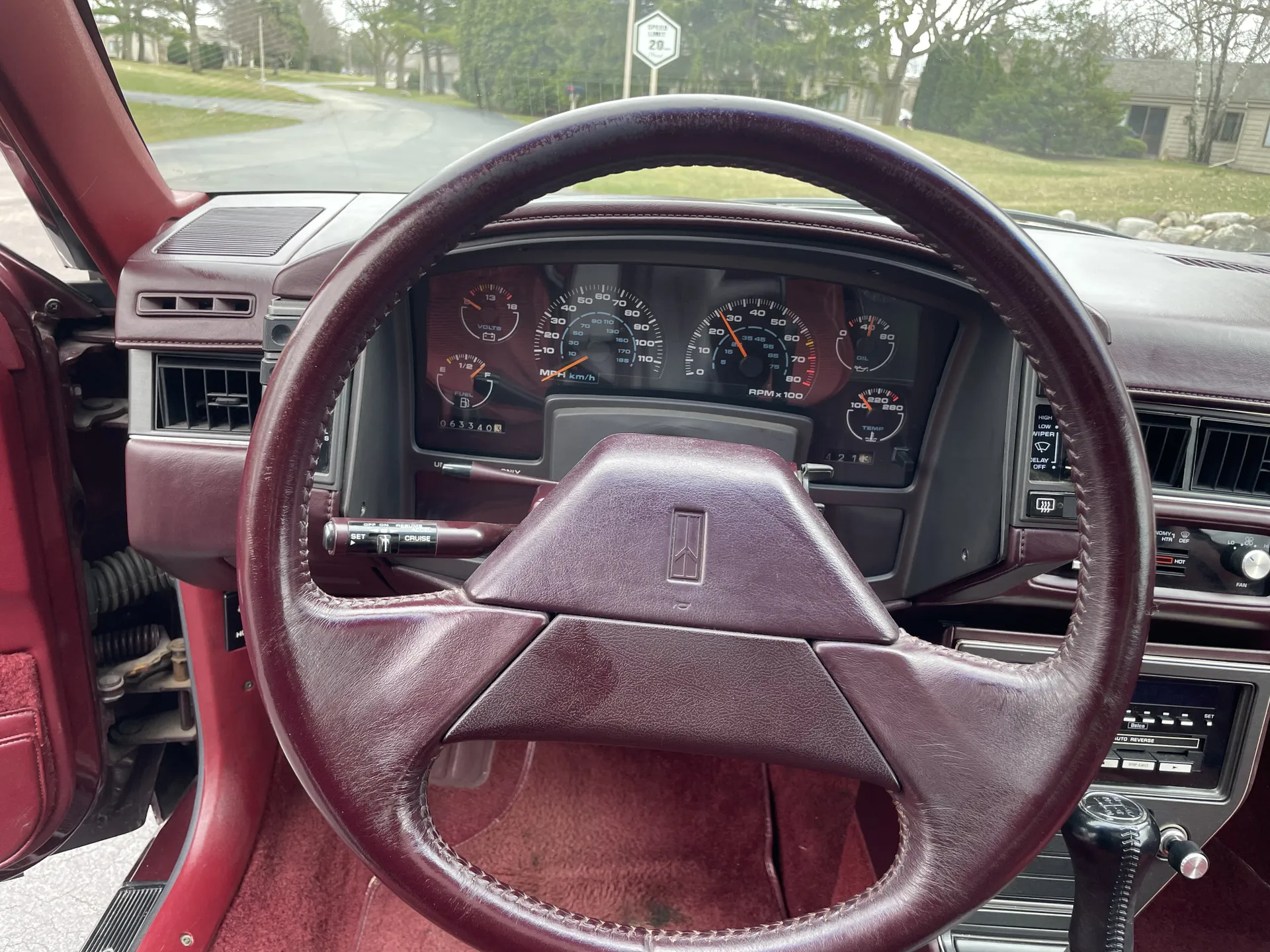
Previously, there had been a GT package for the base Calais, but to better spotlight the availability of the Quad 4 engine, Oldsmobile replaced the GT with a new top-of-the-line sporty International Series, available in two- or four-door form. It had the Quad 4 engine, sport suspension, aluminum wheels, Rallye Instrument Cluster, blackout exterior trim, aero rocker panels, and some extra equipment like intermittent wipers and a tilt steering column. (Although the brochure suggests that the Calais I-Series was only available with the Quad 4, the production totals only make sense if the V-6 could be substituted for the four with automatic transmission.)
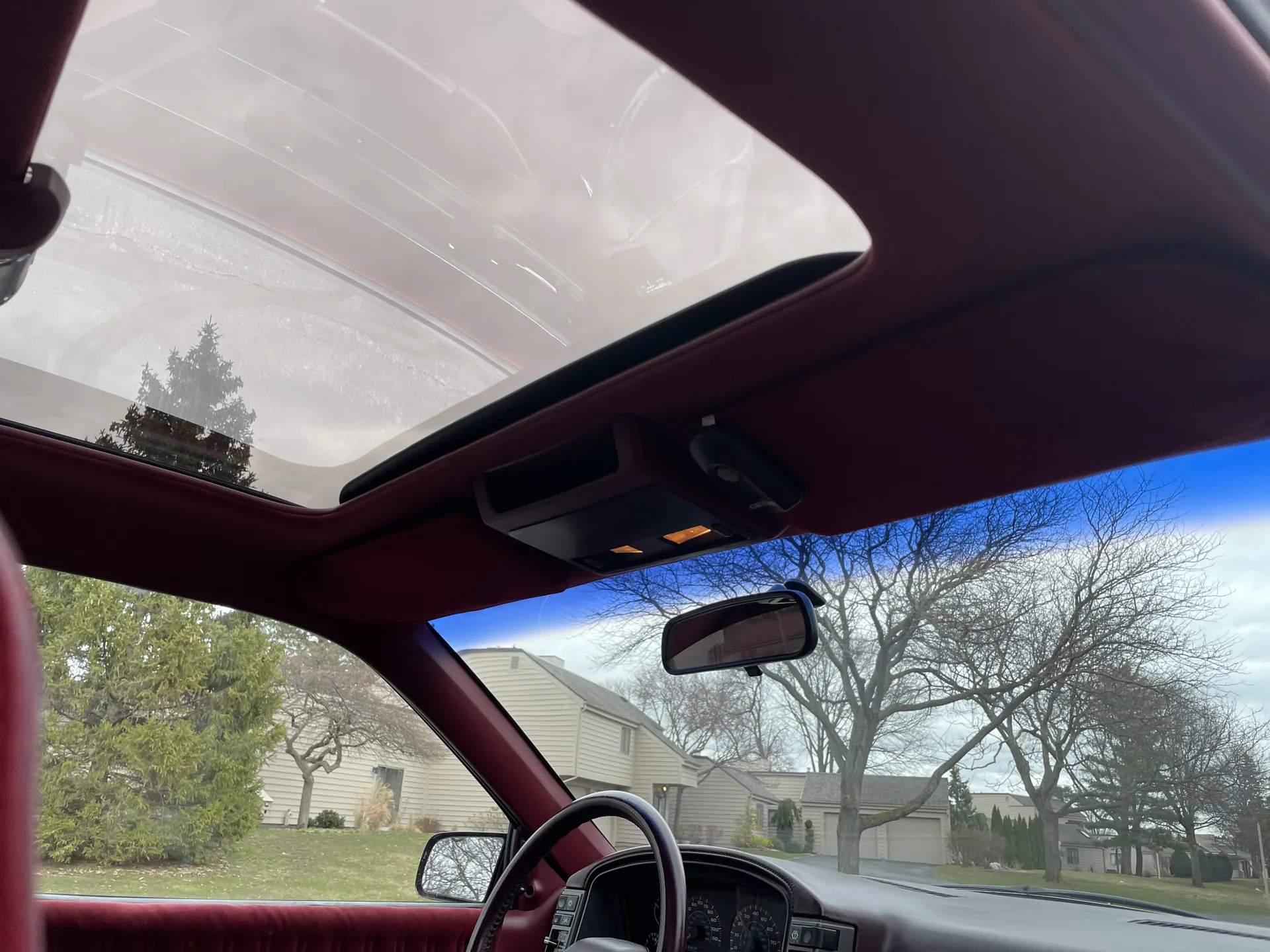
A Calais International Series listed for a hefty $2,500 more than a Calais SL, and nearly all of its pieces could be ordered separately, which is what the original buyer of this SL coupe seems to have done. They also added the glass sunroof for $350.
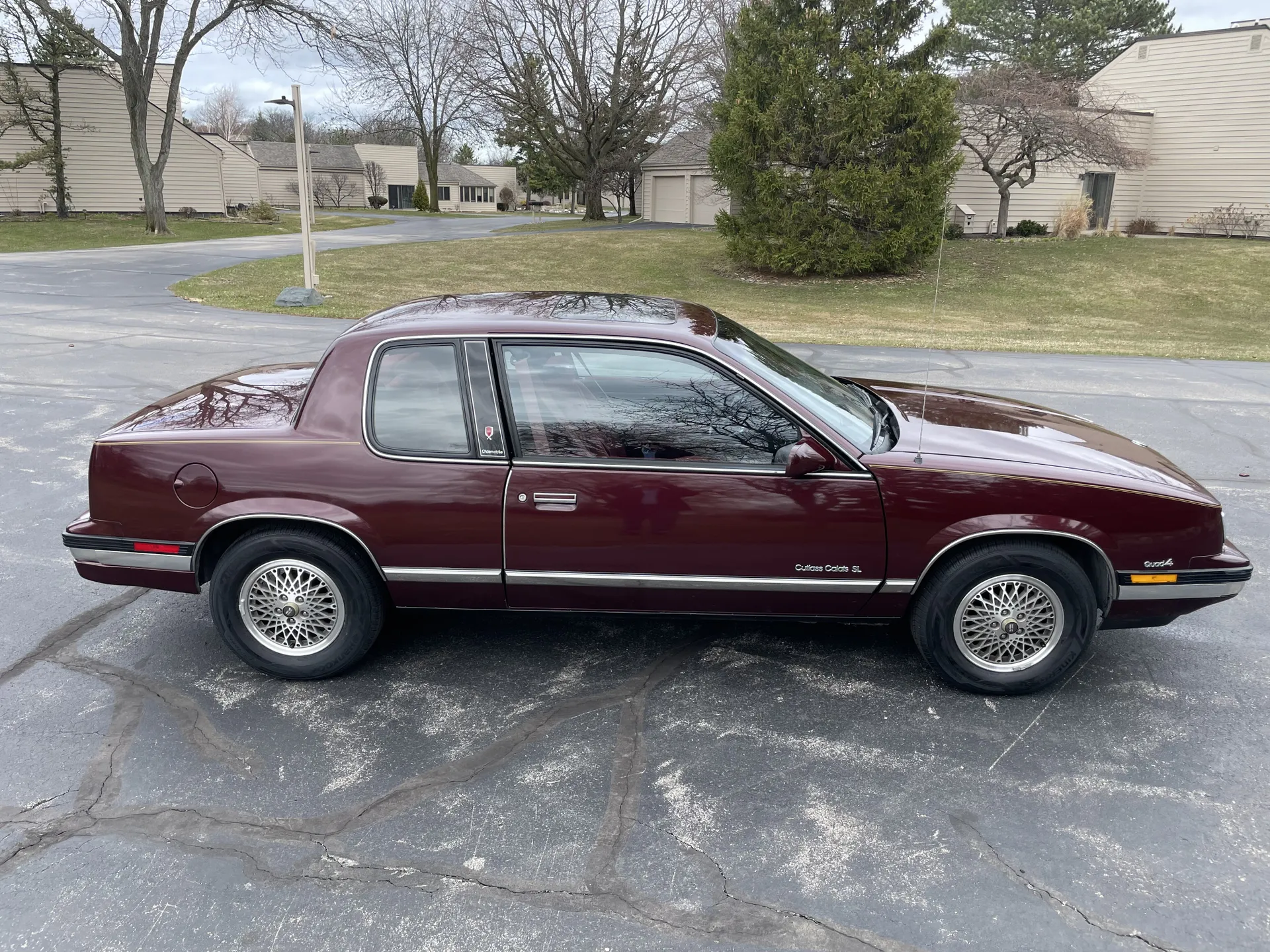
The car magazines had not been enthralled with the N-bodies even when they were introduced for 1985. Road & Track editor Tony Swan called the earlier Calais “the automotive equivalent of your second cousin who lives in Des Moines—or was it Omaha? Dubuque maybe? You were aware of the presence, but there wasn’t much urgency attached to it.” Car and Driver‘s Jean Lindamood thought Oldsmobile had not “gone far enough in its move to lower the average age of its customers,” and wondered if Oldsmobile would go under in 20 years “because all of its customers have died.”
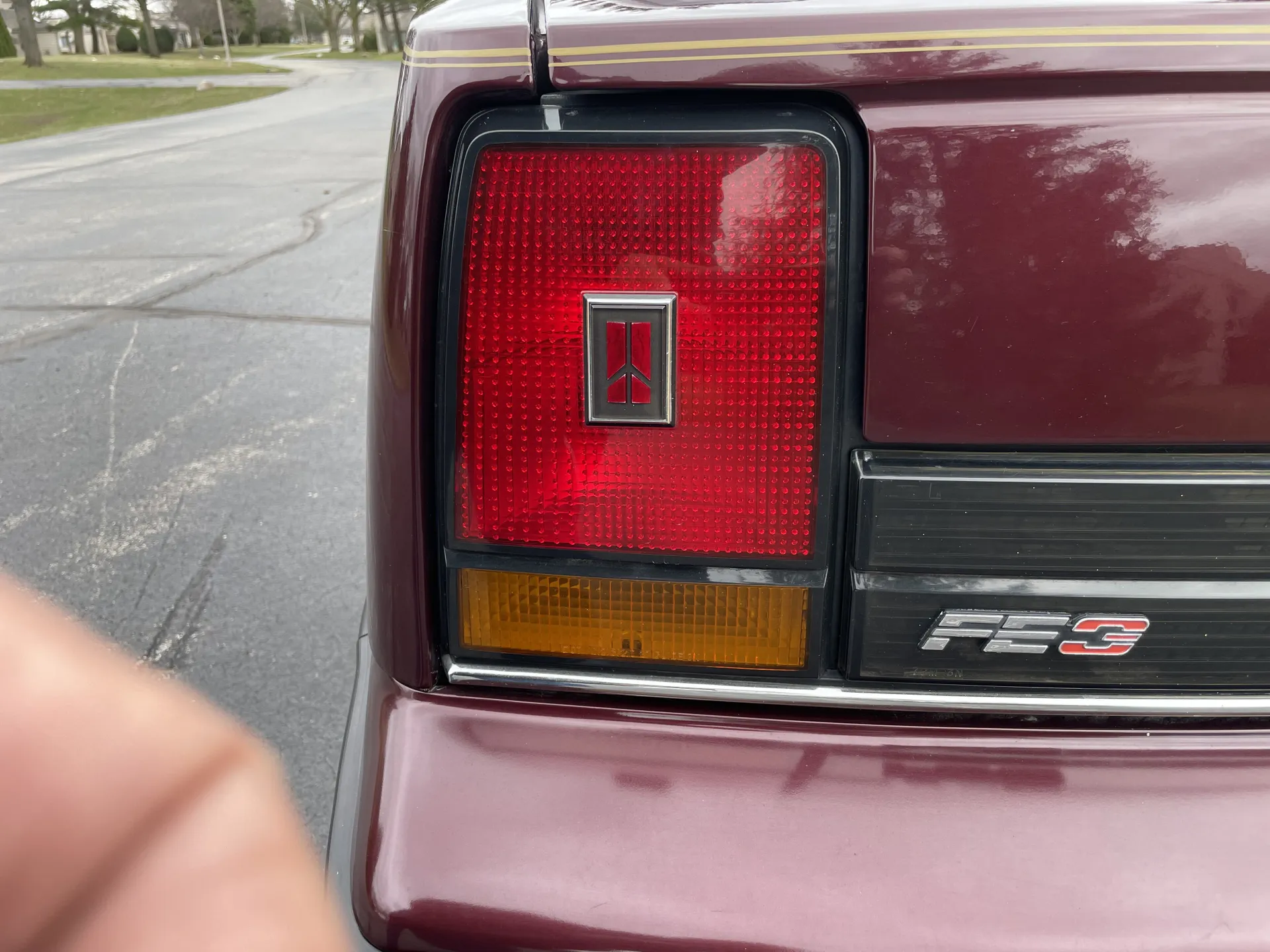
In the interim, the F41 handling package featured on most of the early press cars had been replaced with the FE3 Touring Car Ride & Handling Package, which included firmer gas shocks, stiffer springs, firmer bushings, a rear anti-roll bar, and a thicker front anti-roll bar.
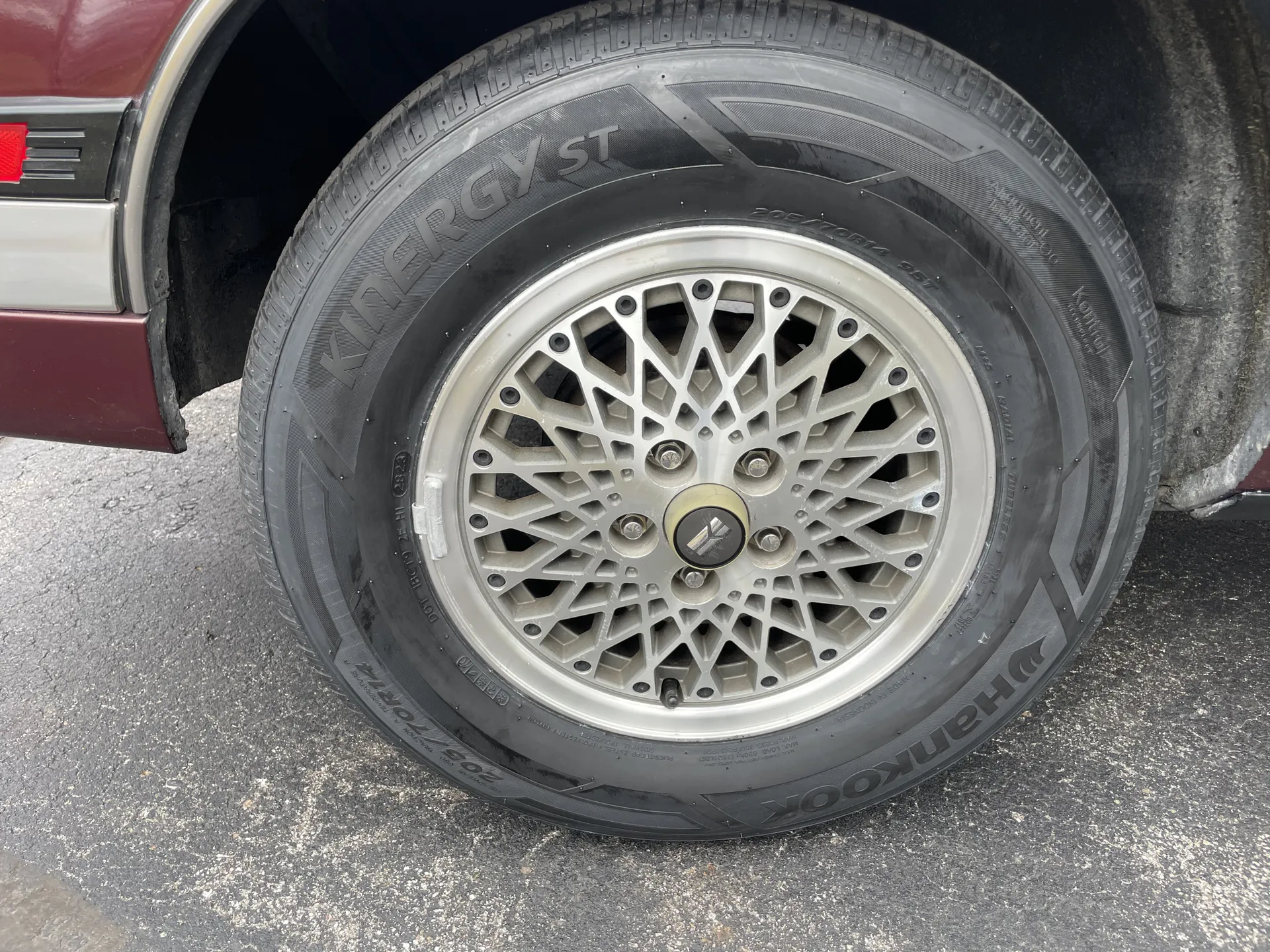
Perhaps more importantly, the original 13-inch wheels specified with the F41 package gave way to optional 14-inch wheels and 60-series Goodyear Eagle GT+4 tires, which provided a dramatic improvement in dry grip (from about 0.71 g to 0.82 g, in Car and Driver tests). Tony Swan of Road & Track found the FE3 Calais able to “negotiate a set of twisties with considerably more agility,” although torque steer could be a problem.
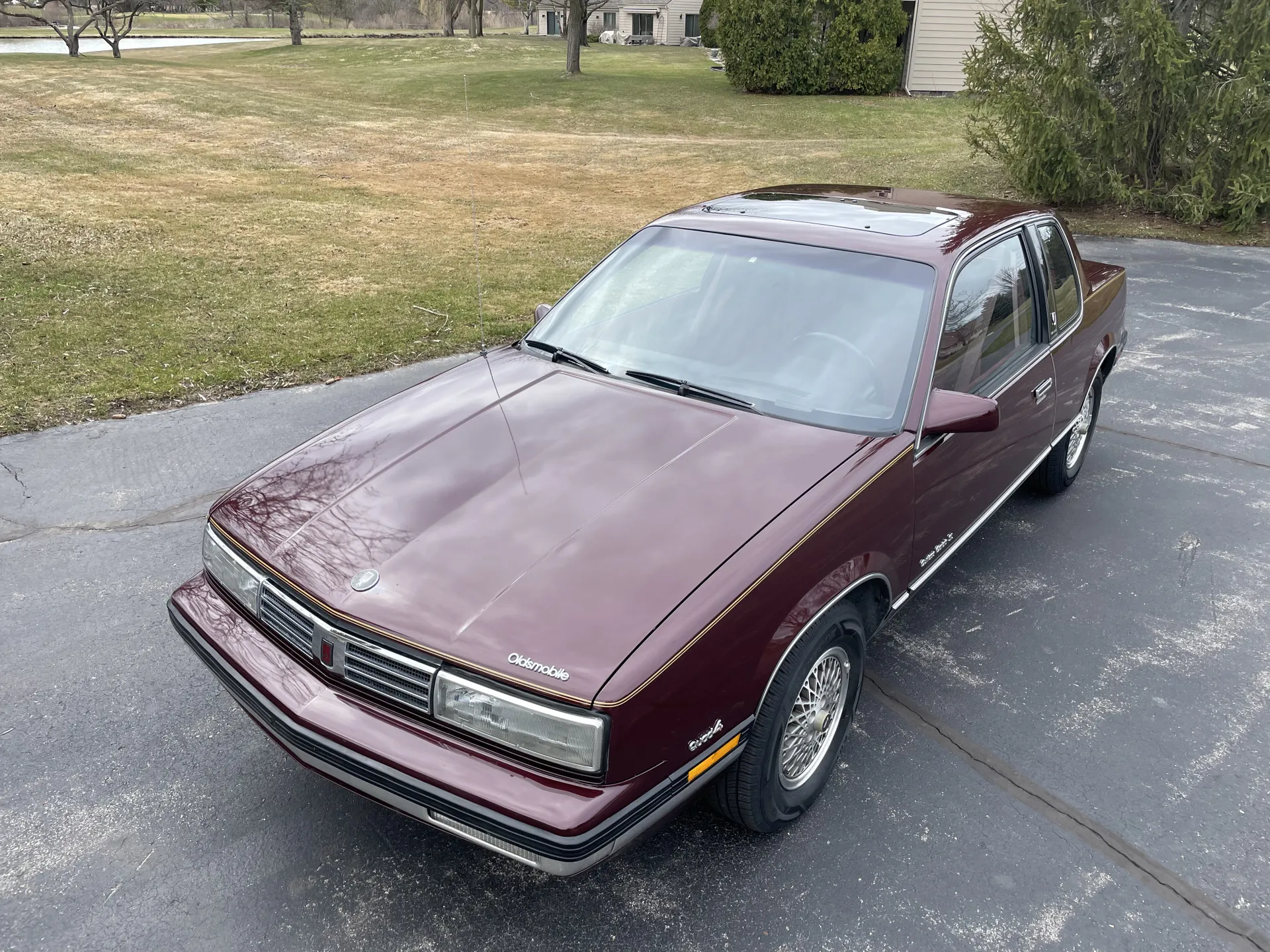
The arrival of the Quad 4 engine in the N-bodies was greeted with cautious enthusiasm. Actual performance was fine: With the 5-speed stick, Oldsmobile claimed a 0 to 60 mph time of 8.5 seconds, more than 2 seconds quicker than a Calais with the optional 3.0-liter V-6 and automatic. Most of the car magazines beat the factory time; Road & Track got 0 to 60 mph in 8.2 seconds, while Car and Driver managed 7.8 seconds, with the quarter mile in 16.1 seconds at 83 mph and an actual top speed of 116 mph. They even got 22 mpg — short of the EPA ratings (25/36 mpg originally, 22/33 mpg adjusted), but decent enough for a 2,800 lb car with this performance.
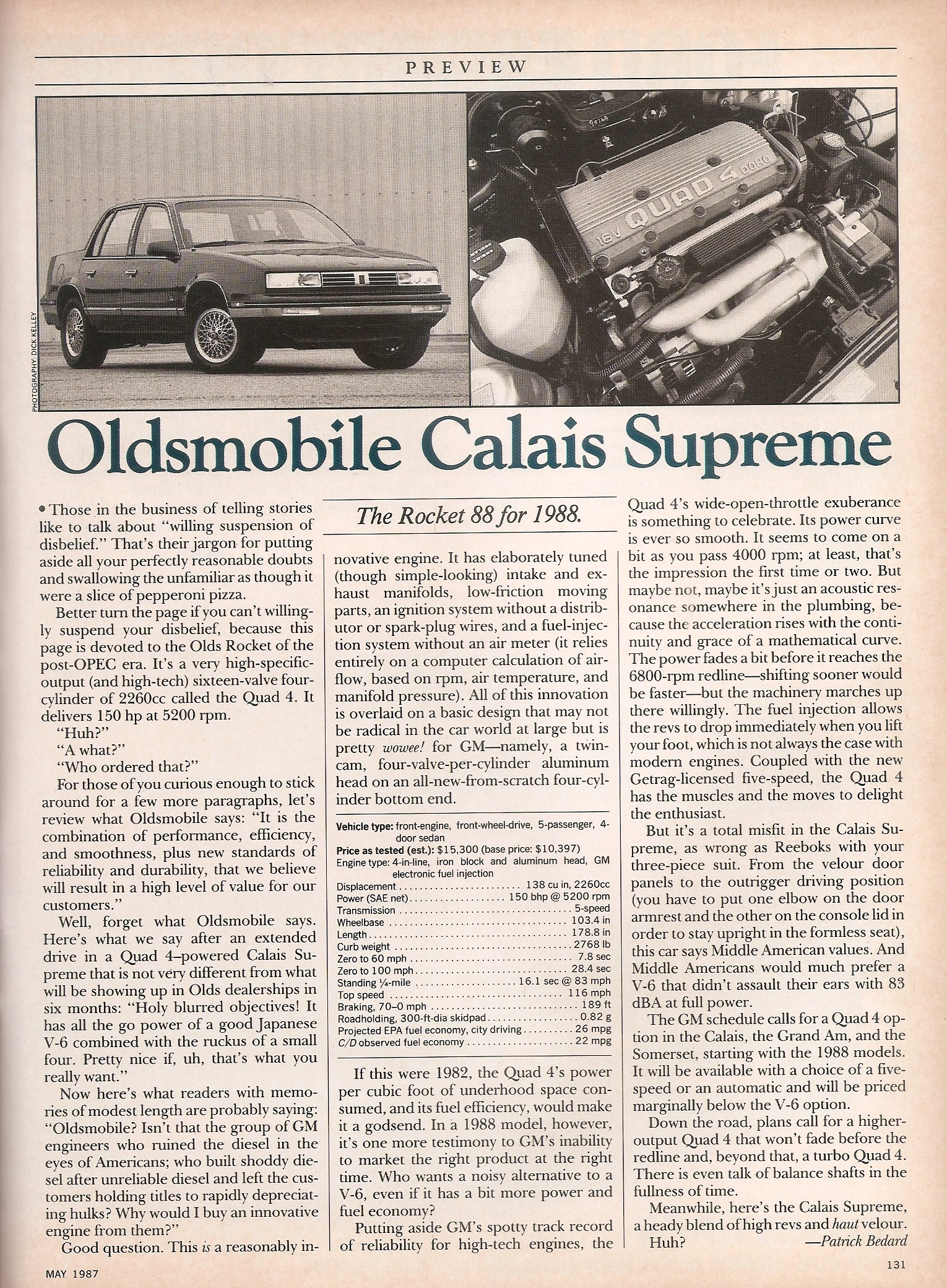
However, C/D editor Patrick Bedard, previewing one of the “1987½” cars (a Calais Supreme four-door sedan with an early production Quad 4 and 5-speed), expressed no small amount of skepticism, both about the engine and about its suitability for the Calais:
Here’s what we say after an extended drive in a Quad 4-powered Calais Supreme that is not very different from what will be showing up in Olds dealerships in six months: “Holy blurred objectives! It has all the go power of a good Japanese V-6 combined with the ruckus of a small four. Pretty nice if, uh, that’s what you really want.”
… If this were 1982, the Quad 4’s power per cubic foot of underhood space consumed, and its fuel efficiency, would make it a godsend. In a 1988 model, however, it’s one more testimony to GM’s inability to market the right product at the right time. Who wants a noisy alternative to a V-6, even if it has a bit more power and fuel economy?
Putting aside GM’s spotty track record of reliability for high-tech engines, the Quad 4’s wide-open-throttle exuberance is something to celebrate. Its power curve is ever so smooth. It seems to come on a bit as you pass 4000 rpm; at least, that’s the impression the first time or two. But maybe not, maybe it’s just an acoustic resonance somewhere in the plumbing, because the acceleration rises with the continuity and grace of a mathematical curve. The power fades a bit before it reaches the 6800-rpm redline—shifting sooner would be faster—but the machinery marches up there willingly. The fuel injection allows the revs to drop immediately when you lift your foot, which is not always the case with modern engines. Coupled with the new Getrag-licensed five-speed, the Quad 4 has the muscles and the moves to delight the enthusiast.
But it’s a total misfit in the Calais Supreme, as wrong as Reeboks with your three-piece suit. From the velour door panels to the outrigger driving position (you have to put one elbow on the door armrest and the other on the console lid in order to stay upright in the formless seat), this car says Middle American values. And Middle Americans would much prefer a V-6 that didn’t assault their ears with 83 dBA at full power.
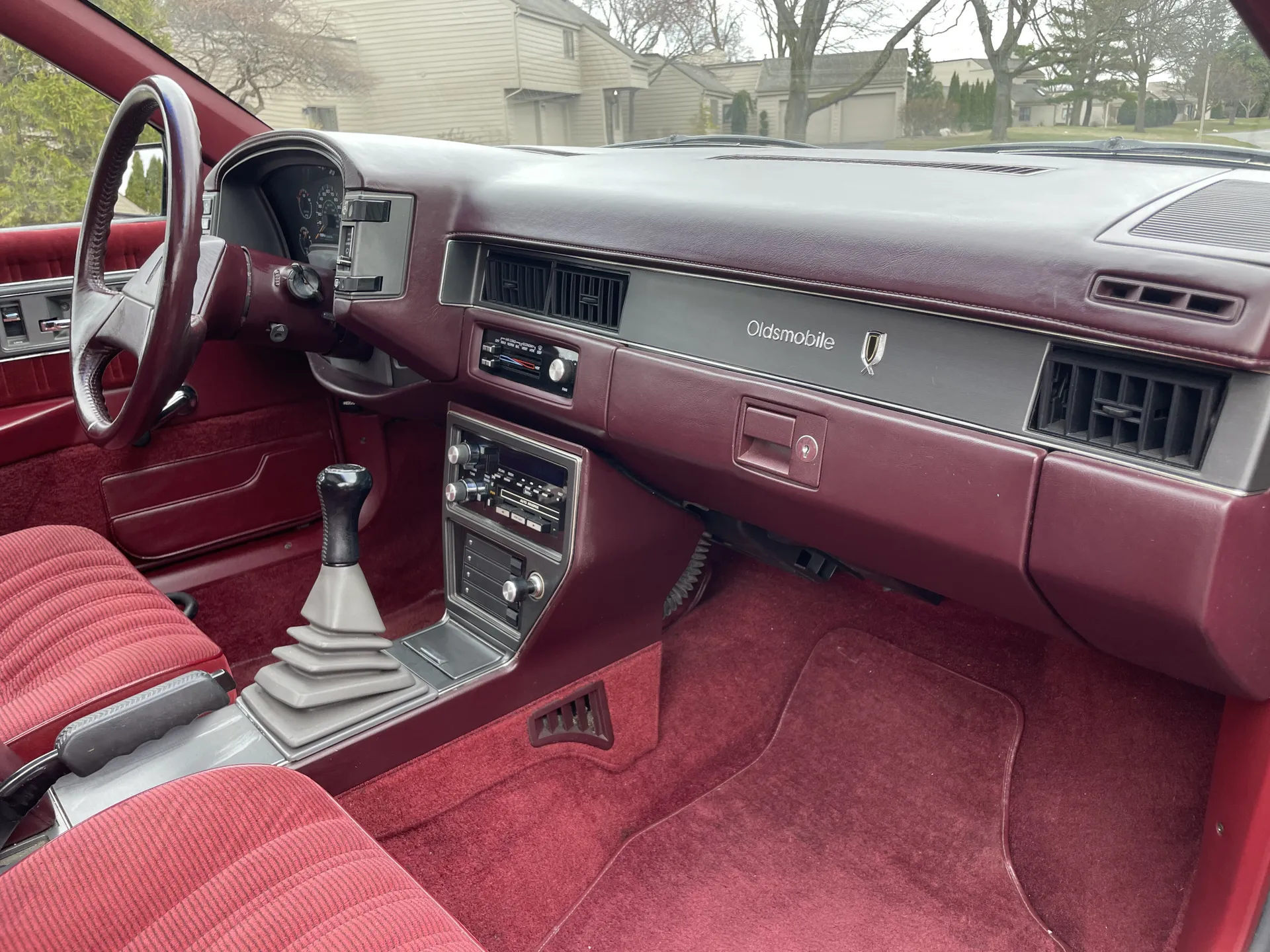
Not all testers were happy with the 5-speed manual transmission, which, as Bedard notes, was built by GM under license from Getrag. Popular Science editor Dan McCosh “found the overall drivability of the Calais disappointing, with the car’s heavy clutch, notchy gearbox, and tendency to stumble when taking off from a standing stop.” After driving a 1988 Pontiac Grand Am SE with the same powertrain, C/D‘s Don Sherman added that the gap between 2nd and 3rd was awfully wide, meaning that the high-revving engine lost a lot of enthusiasm once you shifted out of 2nd gear. (I don’t think any of the car magazines tried the Quad 4 with automatic, but Oldsmobile said it was 1.2 seconds slower to 60 mph than with the 5-speed.)
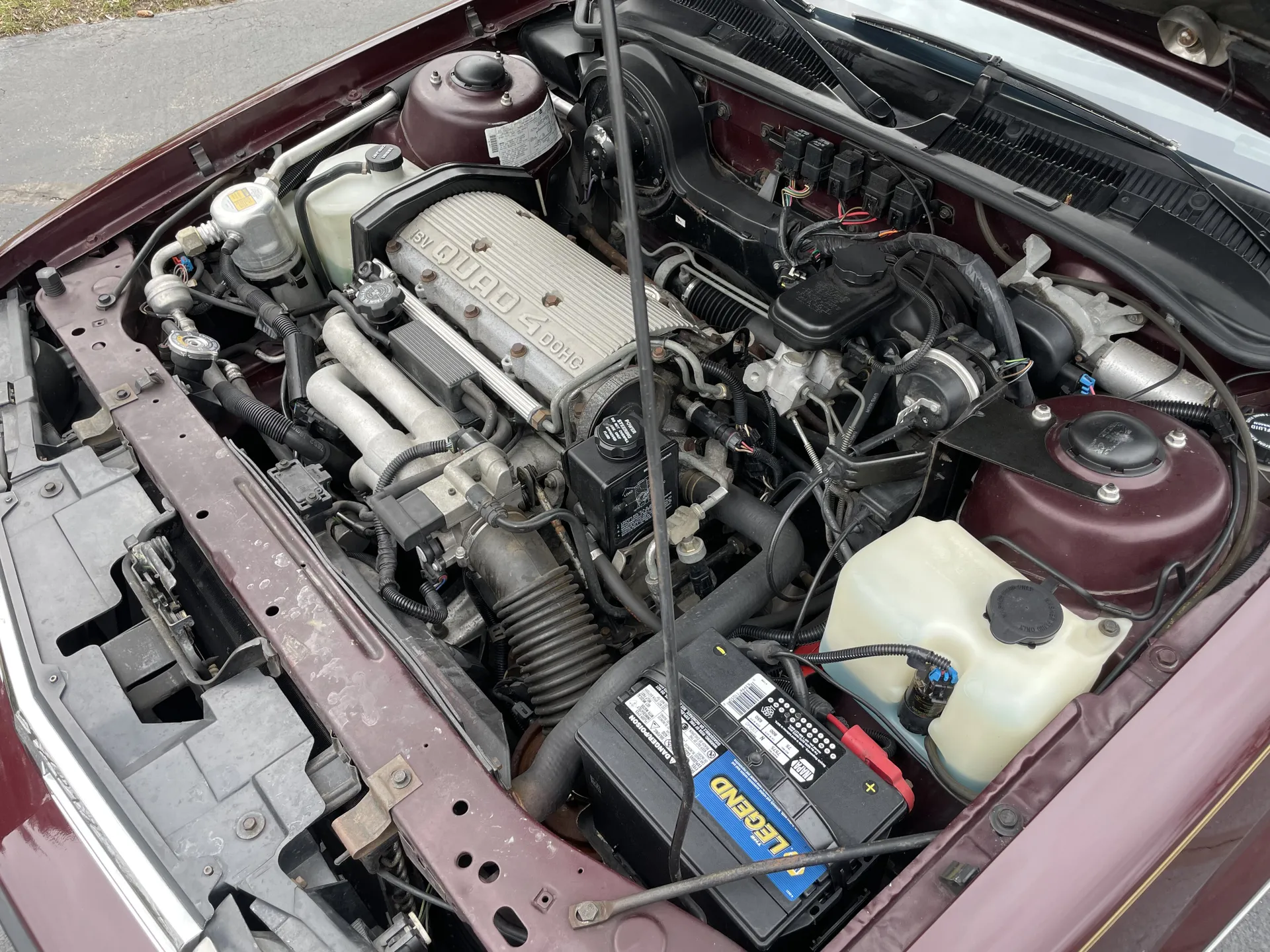
Consumer Guide said the Quad 4 was “GM’s best-ever 4-cylinder engine, though that isn’t much of a compliment.” They suggested that Calais shoppers compare it with the V-6 before deciding. “You’ll lose a little power with the V-6, but gain some peace and quiet,” they said.
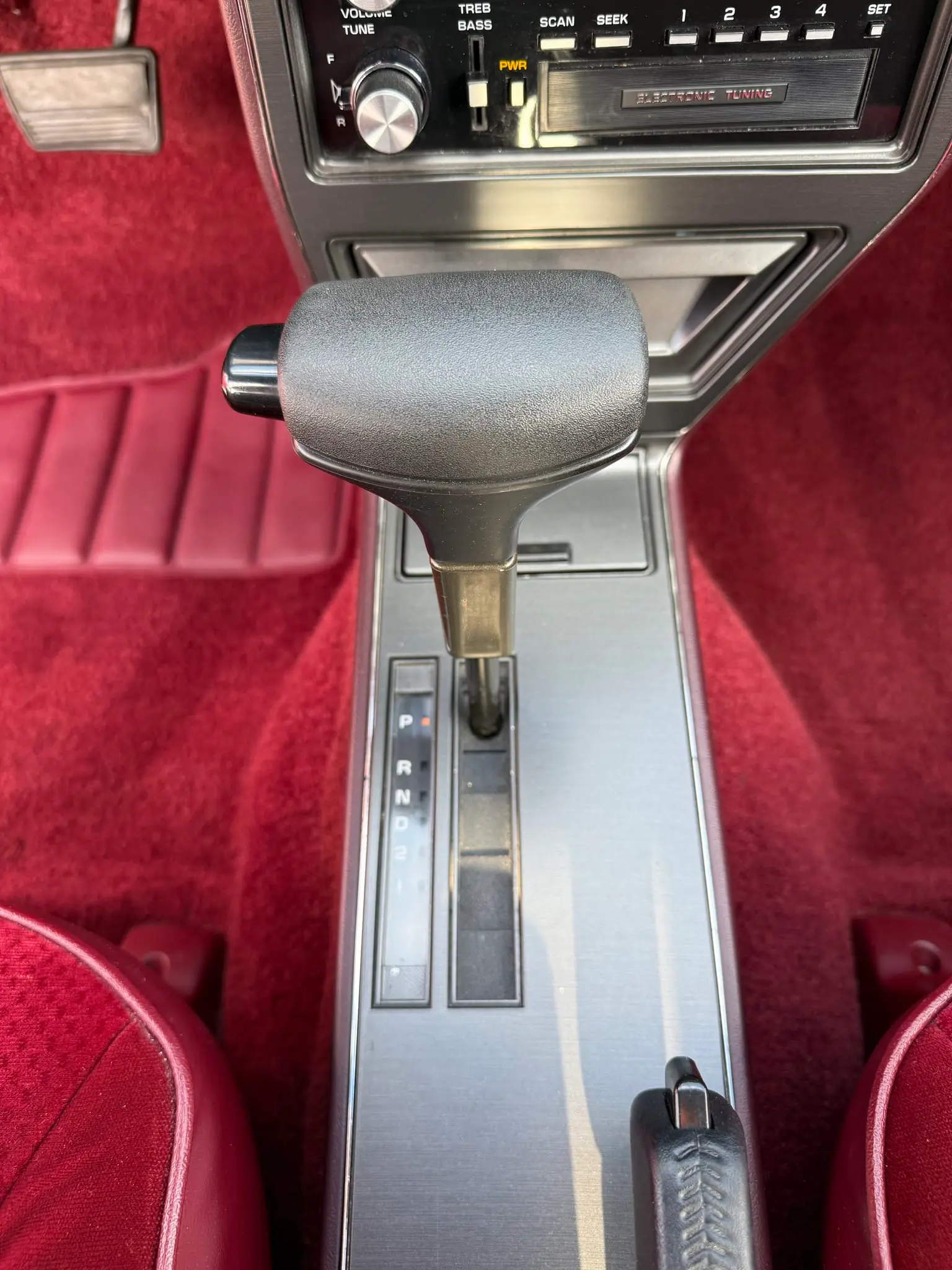
You might assume most people interested in the Cutlass Calais would shun the Quad 4 and 5-speed in favor of the smoother V-6 and automatic, but you’d be only half right. Oldsmobile built 110,276 Calais coupes and sedans for 1988; according to Automotive News, only 8,555 of those had 5-speed manual transmissions, and just 3,254 had the Quad 4 engine (only 2.95 percent of production). However, Calais V-6 production totaled only 11,936 (10.82 percent). Most Calais buyers took the base engine, the familiar pushrod 2.5-liter Tech IV, formerly known as the Iron Duke.
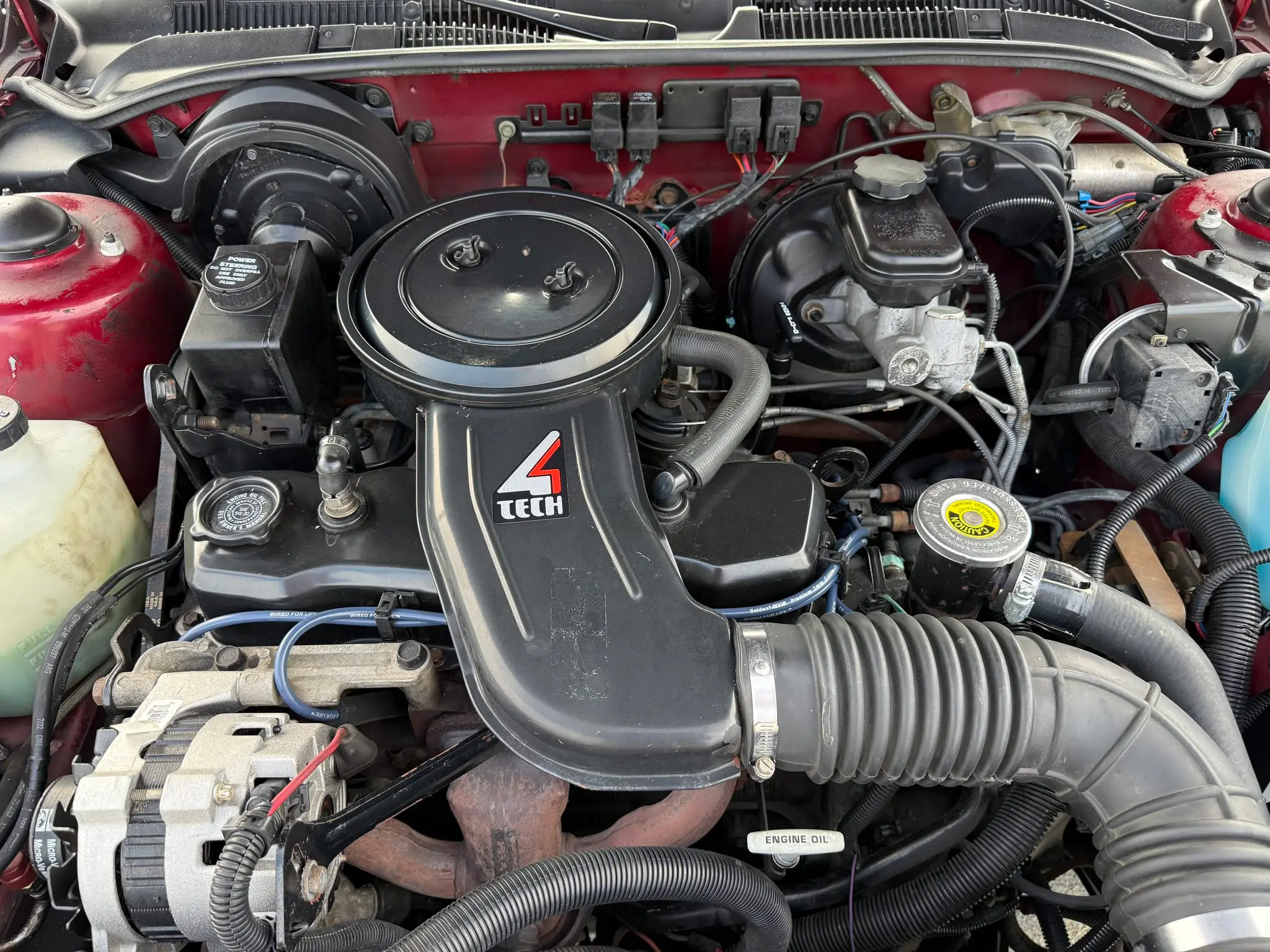
The Tech IV still wasn’t very powerful — it was rated at 98 hp and 135 lb-ft of torque in 1988 — but it now had balance shafts with either transmission, making it somewhat less unpleasant to live with than before. It was less fuel efficient than the Quad 4 (with automatic, EPA estimates were 23/31 mpg, 20/29 mpg adjusted), but it had adequate grunt and it didn’t cost extra. Calais buyers were not very interested in the pricey International Series models, or even the SL; in 1988, the cheapest base Calais sedan and coupe accounted for 73.3 percent of production. The cost of the optional engines was about the same as air conditioning, so base Calais buyers seem to have ordered that instead.
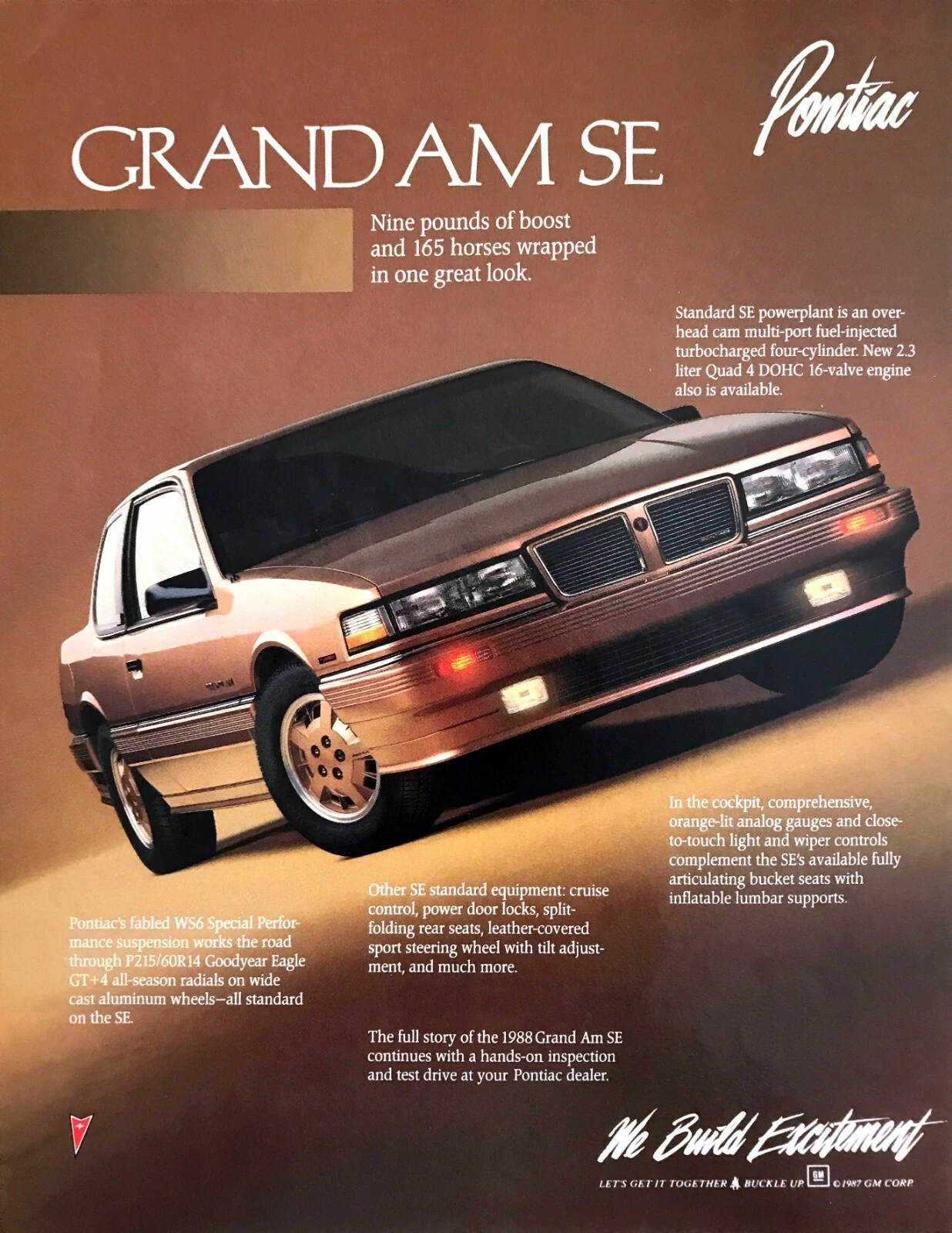
Car and Driver was more enthusiastic about the Quad 4 in the Grand Am SE, whose sportier accoutrements and more supportive seats made the twin-cam engine feel less out of place than it did in the Olds. However, the Quad 4 was even louder and buzzier in the Grand Am than it had been in the Calais. Said C/D‘s Don Sherman:
Unfortunately, the Quad 4 is not yet completely at home in the Grand Am: the GA’s structure sometimes amplifies the engine’s boomy voice instead of quieting it. As you wind through the rpm range, one component after another sings along in sympathetic resonance, and the resulting cacophony can be unnerving. We measured a full-throttle sound level of 84 dBA, which verges on pain. During our testing, we buzzed the Q4 up to 5000 rpm with the transmission in neutral and watched the speedometer needle rise to 35 mph as if by magic. That’s some kind of excitement.
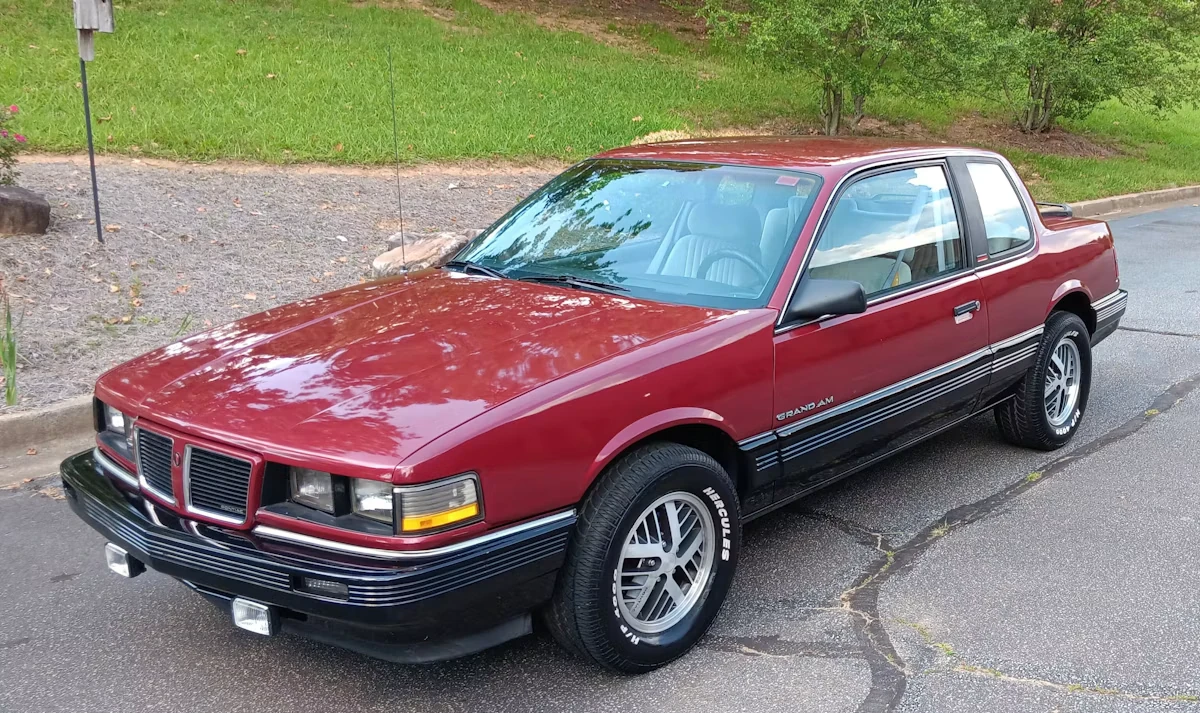
Nevertheless, Pontiac buyers liked the Grand Am, and they were enthusiastic about the Quad 4 engine. The Grand Am outsold the Cutlass Calais by more than 2 to 1 in 1988, and 25 percent of Grand Am buyers chose the Quad 4. Although the Quad 4 wasn’t as powerful as the still-optional 2.0-liter turbo engine (which wasn’t offfered on the Calais), it got much better gas mileage and was easier to live with than the turbo if you didn’t mind the noise. (Pontiac didn’t offer the V-6 on the Grand Am for 1988.)
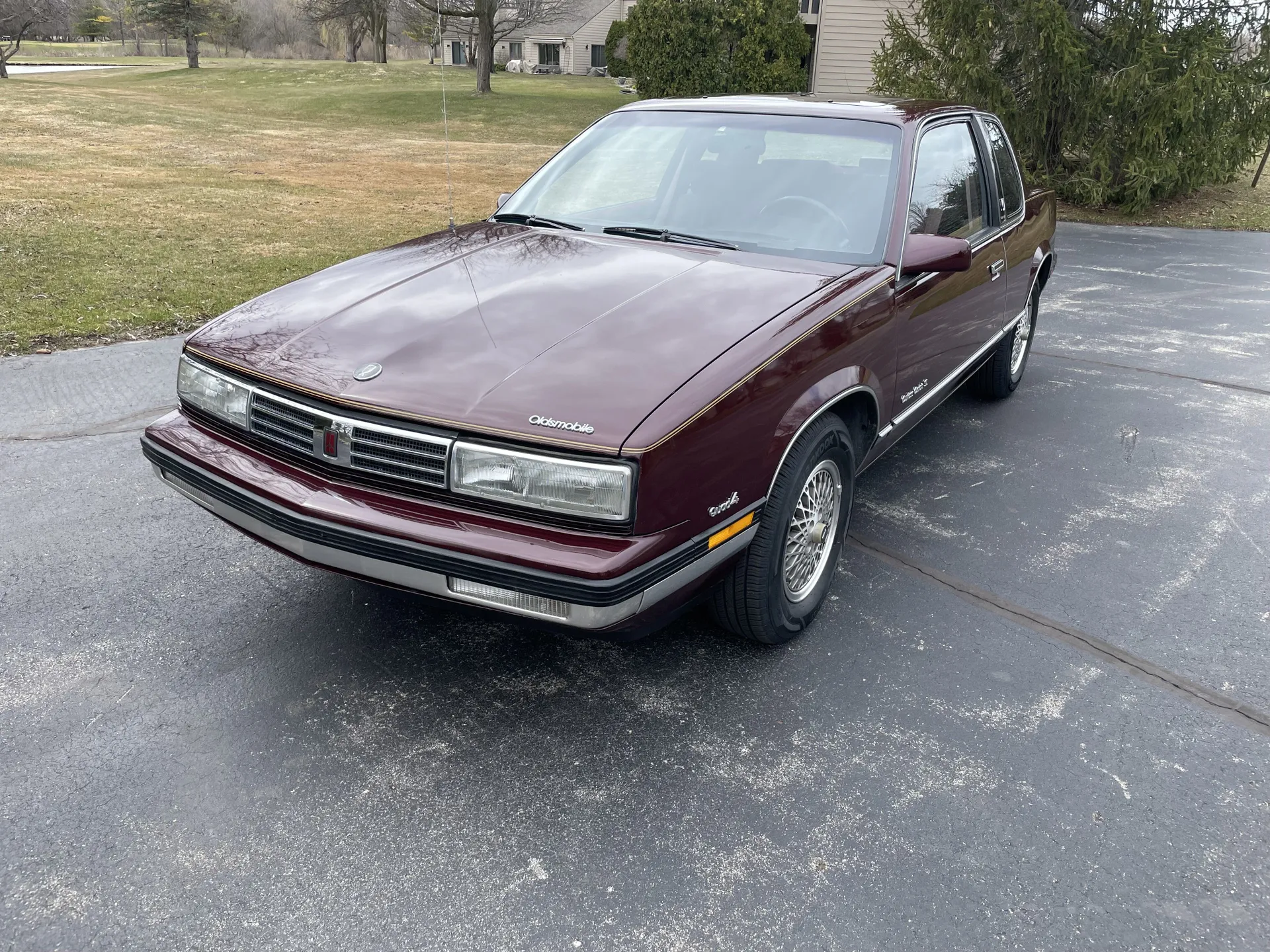
A 1988 Calais with the Quad 4 engine and 5-speed is certainly rare, especially in this kind of condition. (This car has about 67,300 miles, still with its original paint and upholstery.) With the FE3 suspension, it goes and handles respectably well for its era, and the 26 mpg EPA combined adjusted mileage is very good for an ’80s-tech car with this kind of acceleration. (My 1991 Honda Prelude Si 4WS was thirstier and not as quick, although it was more refined.) These cars came out when I was in high school, and I would probably have been more tolerant of the engine’s noise and buzziness back then than I would be now.
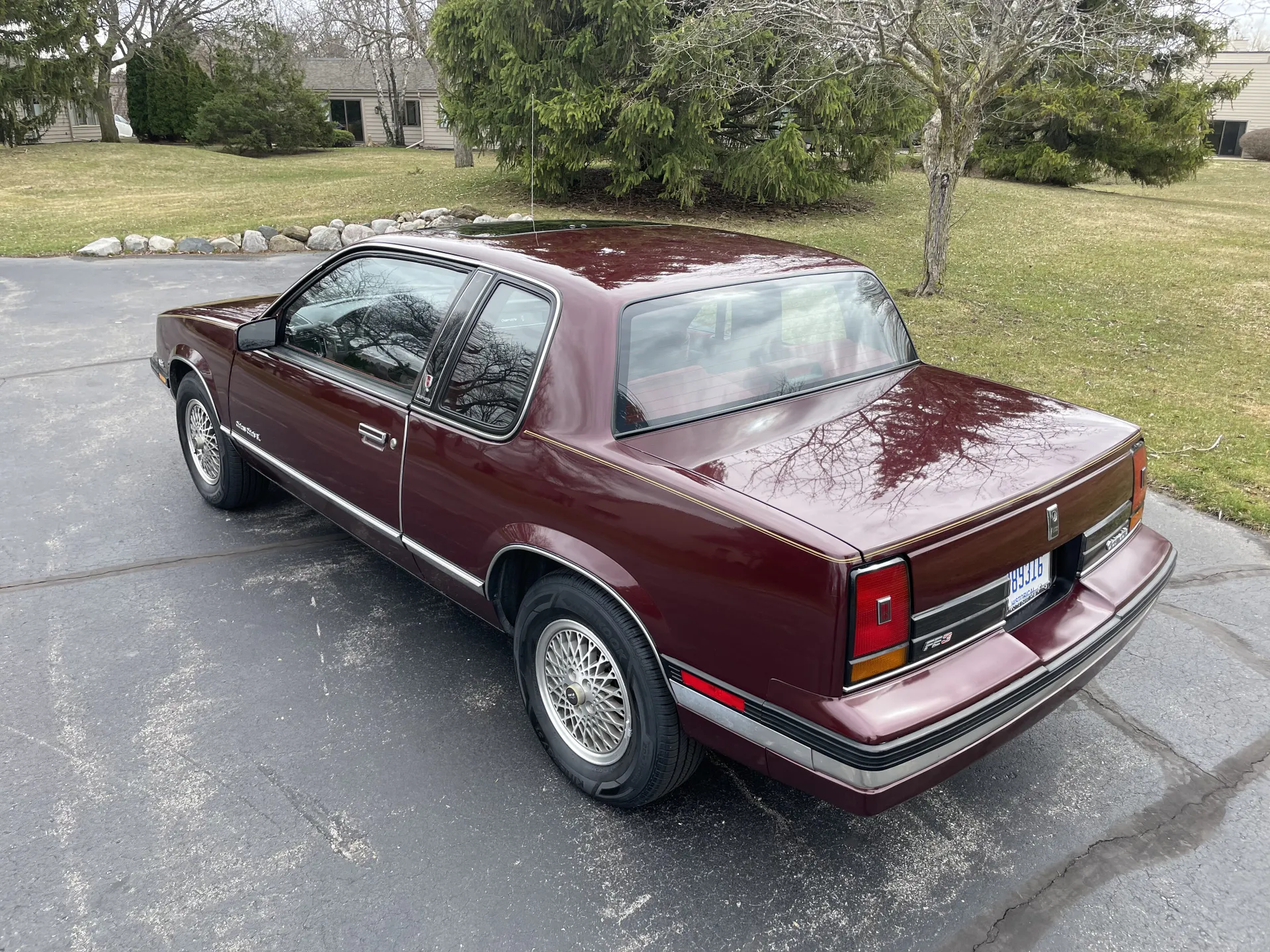
However, whatever the car’s virtues, I just can’t get over the awkward styling. The late Irv Rybicki, who was VP of GM Design Staff when these cars were designed, had a lot to answer for, but the N-bodies were among the worst efforts of his tenure. I don’t love the contemporary Grand Am (which was very common when I was a teenager), but Pontiac stylists managed to make the best of a bad situation. To my eyes, the Calais coupe does not have a single good angle, and it’s not the kind of shape that can pull off the bright red velour upholstery that so troubled Pat Bedard.
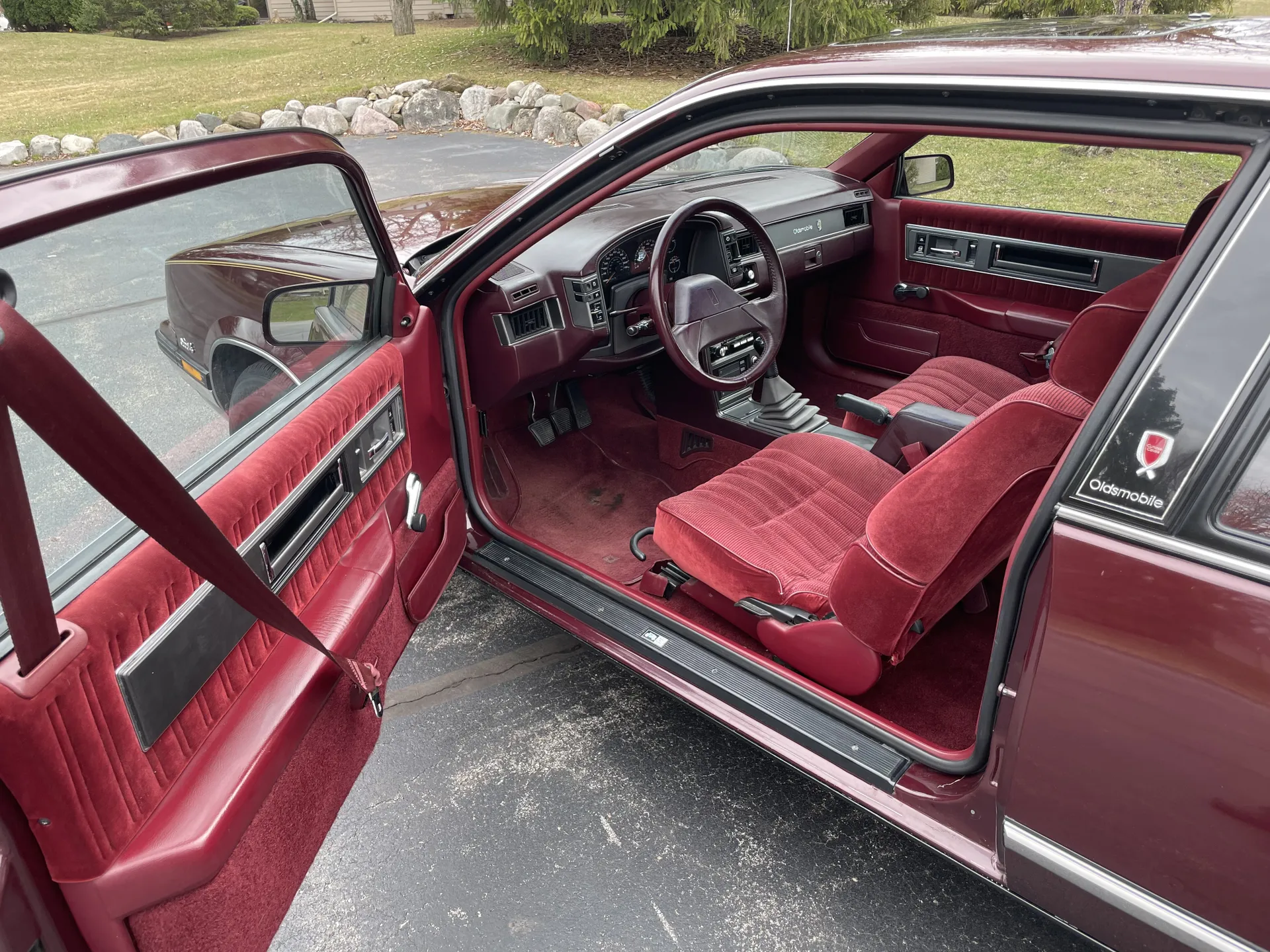
I’m also not crazy about the door-mounted belts (added to meet federal passive restraint requirements), which contemporary testers hated. I prefer them to motorized belts, which have a tendency to try to decapitate shorter passengers, but I’d much rather have the shoulder harness anchor on the B-pillar where it belongs.
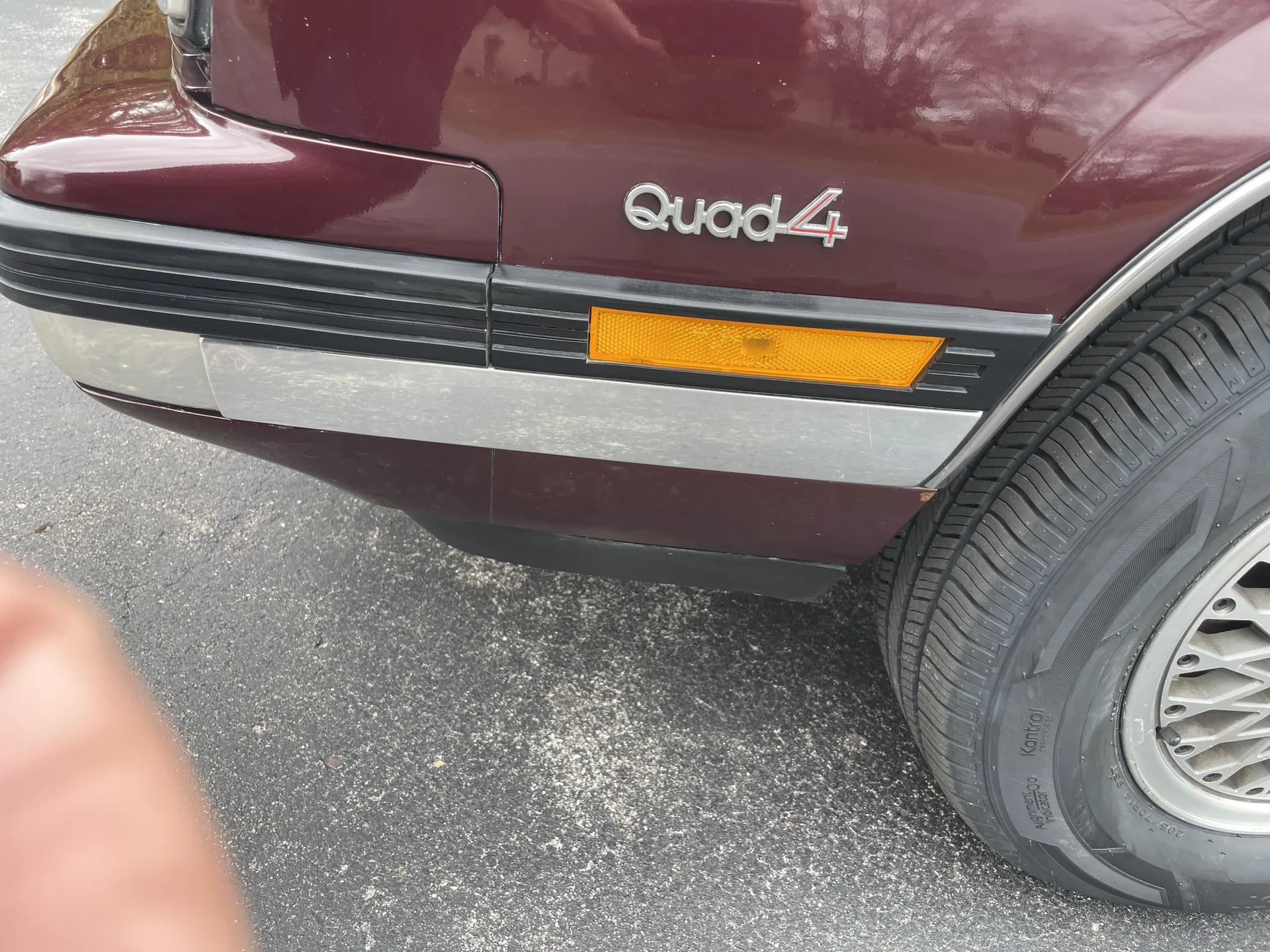
As for the Quad 4, it always seemed like it needed either a more suitable platform or a thorough noise, vibration, and harshness reduction makeover. It never really got the former, and while GM kept chipping away at its NVH problems, the competition kept getting more refined. The Quad 4 could produce plenty of power, so it was raced with fair success, and the Oldsmobile engineers who designed it insisted it was one of the most durable engines they ever built, but in 1993, GM recalled 500,000 1987–1991 Quad 4 cars to repair a head gasket problem and offered extended warranty coverage on many Quad 4 cars in an effort to bolster buyer confidence. A mixed record, in other words.
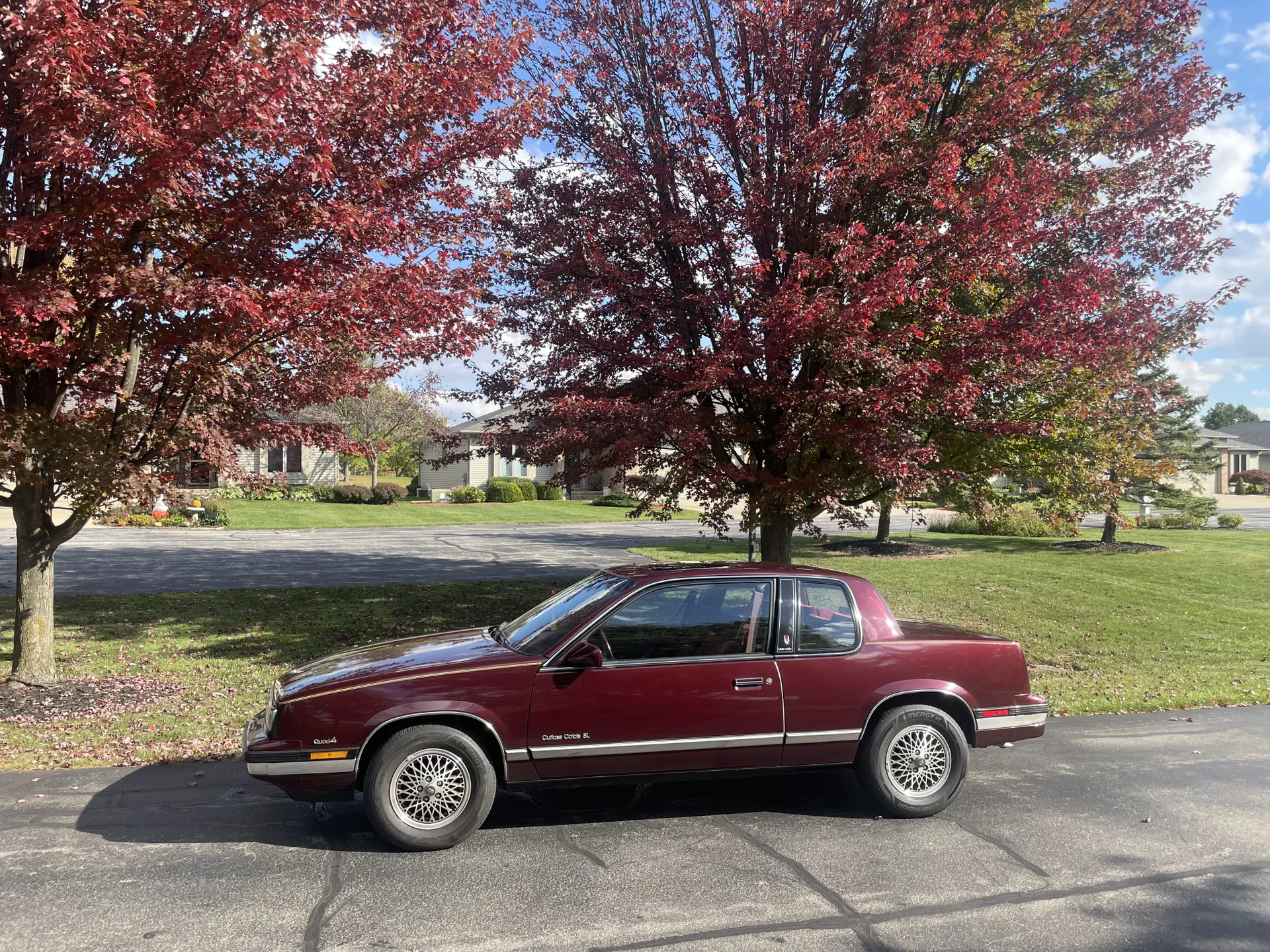
To me, that makes this the wrong engine in the wrong car, but if you have a hankering for what Bedard called “a heady blend of high revs and haut velour,” this Calais is still on sale at Hemmings for an asking price of $9,900.
Related Reading
Curbside Classic: 1985 Oldsmobile Calais Supreme Coupe – GM’s Deadly Sin #35 – Peak GM Malaise (by Paul N)
Vintage Review: 1985 Oldsmobile Calais Supreme – GM Deadly Sin #26 – Car And Driver Predicts Death (by GN)
Car Show Classic: 1985 Oldsmobile Calais Supreme – A Happy Baby (by Jon Stephenson)
Curbside Classic: 1987 Oldsmobile Calais Supreme – Poor Unfortunate Soul (by TooBadItsBav)
1988 Oldsmobile Cutlass Calais: A Low-Mileage Example Of A Forgotten Commuter Coupe (by Aaron65)







And then there were none.
Fair thee well Oldsmobile.
Hemmings says the dash is in “excellent” condition, so I assume the tach isn’t broken. So… does the photo of the Rallye Instrument Cluster really show an idle speed of 2600 rpm?
One of the videos there shows the tach needle seem to settle on some arbitrary speed with the engine off. When the engine starts, the needle goes to a normal idle/fast idle speed, but as soon as the key is turned off, the needle jumps back to 2,600 or 3,000 rpm. I’m not sure what to make of that, but it seems like some kind of short.
I think most GM tachs of this era didn’t fall to zero when you shut off the engine for some reason.
This one is going beyond that: With the engine running, it reads what I assume is the correct just-started idle (1,000 to 1,100 rpm), but when the ignition cuts out, it *jumps* to 2,500 to 3,000 rpm.
My 87 Flame Red Grand Am had the composite headlights and called out LE on the B-pillar. Thinking that 88 might be a base model with a couple upgrades, including the LE rims.
But I say we pin that one on Hagerty or the seller.
I hadn’t thought to check the VIN, but you’re right, it’s a base Grand Am coupe, not an LE. I’ll fix the caption.
These cars came out when I was in high school, and I would probably have been more tolerant of the engine’s noise and buzziness back then than I would be now.
You would be right about that. My friends and I were recent high-school grads when one of us, Ric, was gifted a 1988 Grand Am with the Quad4 and 5 speed. His father had special ordered it for him and he was expecting something along the lines of that SE. What showed up at the dealer, however, was a base Grand Am with base suspension, 13-inch wheels, plastic wheel covers, no tach and few options beyond air and a stereo. It didn’t matter – we all loved it (none of our parents could afford to buy us new cars) and didn’t notice the noise at all. Big, fat 15- or 16-inch Corvette-looking wheels solved the wheel problem and looked awesome.
As I said to him, “Ric, this Grand Am is Damn Grand”.
I had a ’88 Calais and the Quad4 was a rough & noisy disappointment til I drove through a deep puddle and blew it up. A friend had an earlish 90’s Gran AM with one and it seemed much smoother
The Grand Am LE I mention above was Tech4 equipped. Believe me, if given the opportunity to have an additional 50hp with the trade-off of rougher revs (than the Tech4?) I’d have LEAPT at the chance.
While the engine had some serious flaws, the intake manifold is a work of art. I miss the days when automakers didn’t have to hide everything under a black plastic cover.
Mixed feelings about these. Kind of like watching your mother-in-law go over a cliff in your new Mercedes.
Based on reading about it, I thought I might like the Quad-4. Then our government fleet got a few Pontiacs equipped with this engine coupled to an automatic. The performance was pretty good by the standards of the time. However the engine had an agricultural implement feel to it.
I never drove one of these after they installed balance shafts. I wonder if they did any good.
Still hard to look at never mind which badge is attached
From this article “Car and Driver‘s Jean Lindamood thought Oldsmobile had not “gone far enough in its move to lower the average age of its customers,” and wondered if Oldsmobile would go under in 20 years “because all of its customers have died.” Yes ……it did yes they did and so did Lindamood-’nuff said Time marches on
Sorry, I remember these and none of it fondly. It’s a major dorkmobile with zero appeal. Putting the Quad 4 into some was interesting, but that engine didn’t meet expectations.
These sat too low, had too much fake luxury touches a-la-personal luxury coupe era, and were too damn small. There were so many better looking, better designed competitors in 1988 that offered so much more.
We had a fleet in our rental inventory so we charged more for them than we did the J Cars, Tempo/Topaz cars, and either the Nissans, Mitsubishi or Mazdas, which were all more enjoyable, (except the Tempo/Topaz, but those were dirt cheap).
I never liked the N bodies. Sorry.
These cars came into the family garage regularly back in the day. The quality of the N body was nothing to write home about and many came in for repairs right after the warranty was up. I have driven a few Quad 4 equipped cars and if you kept it below 4000 RPM it wasn’t bad at all. However, going over that made the Iron Duke sound quiet. I get it that GM was trying to save money, but the lack of balance shafts in the Quad 4 was a terrible oversight that ended up dooming the program.
Another 80s pretty decent looking car from the front bumper to the B-pillar.
If I had one I would cut off the horizontal part of the trunklid and slammed a Denali badge on it.