
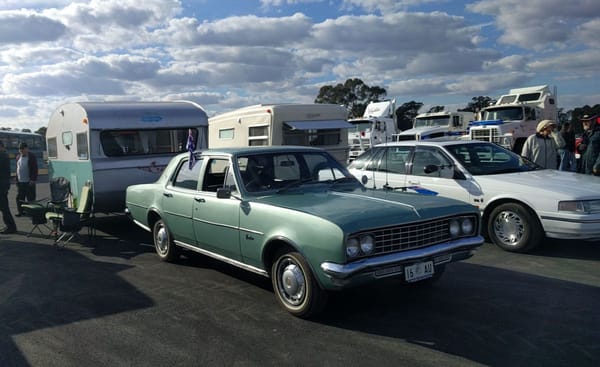
(first posted 10/20/2018) Recently I shared this Holden Brougham that was hooked to the front of a classic caravan at the Historic Winton race meeting, and I took the opportunity to get some photos of the car with the idea of delving a little further into its story.

The Brougham was Holden’s flagship, having been introduced in May 1968 as a response to 1967’s Ford Fairlane and Chrysler Valiant V.I.P. The Fairlane had the same physical relationship to the Falcon as in the US (5” additional wheelbase), however the market position was quite different in Australia. The V.I.P. shared the standard Valiant’s body initially; it would add 4″ of wheelbase for the 1969 VIP model.

GM, Ford and Chrysler were still selling full-size North American sedans at this time – Chevrolet and Pontiac in the case of GM, the Impala, Laurentian and Parisienne all in the form of CKD kits from Canada due to an historical import tariff advantage with a fellow British Commonwealth country. The cars were very well-specified with a 327/Powerglide standard; there was no room for lower-trim cars as Holdens filled that demand.

The Holden car had grown steadily with each new generation, but after the Valiant and then 1966 Falcon lifted the bar further, the 1968 HK model Holden (introduced in January that year) was a substantial 5” increase in wheelbase to 111” (matching Falcon and Valiant), a 3.7” jump in overall length and 1.8″ in width over the previous HR model. Curb weight went up around 400 lb – this was a much more substantial car.
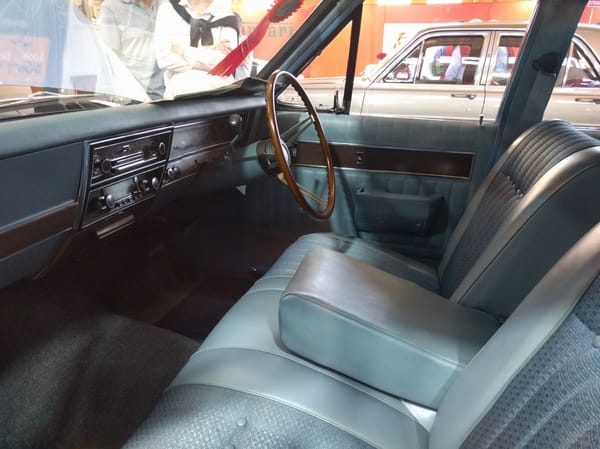
The interior is where this was most evident, with the 1.8” increase in width going straight into making life more comfortable for any centre passenger, front or rear.

The existing Holden body styles of sedan, wagon, ute and panel van carried over, as were the 161 (2.6L) and 186 ci (3L) six-cylinder engines. Trim levels were the very basic Belmont, Kingswood and Premier. The interior shown above is from this Premier, which also had a unique roof with a more upright rear window.
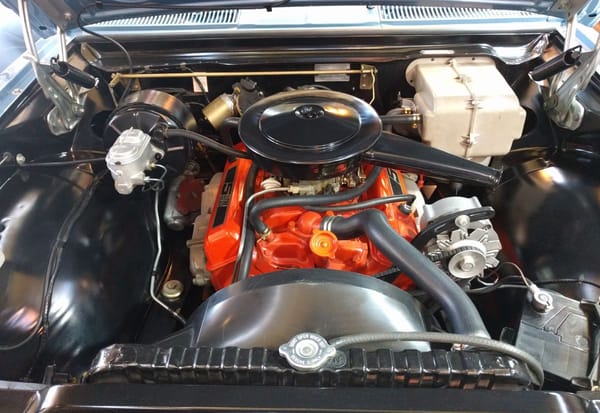
There were some big new additions to the Holden range, starting with a V8 engine available to match the Valiant and Falcon. Holden somehow convinced the GM brass in Detroit that they needed to build their own V8, however it was not ready by the start of 1968 so a 307ci Chevy (pictured above) was used to initially.
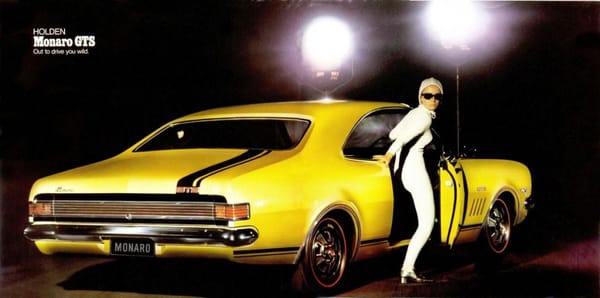
The Monaro was the first Holden coupe, and it definitely made its mark but is really a story for another day.
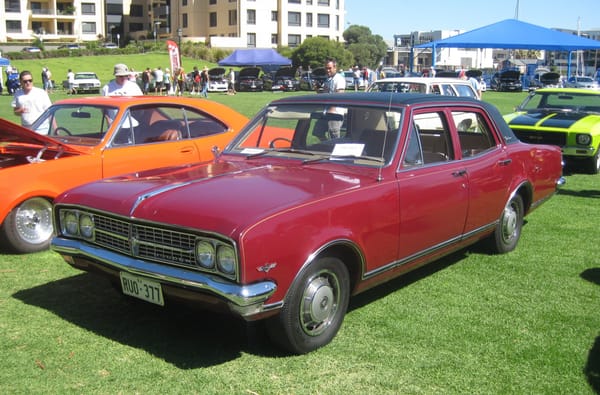
Also debuting in July 1968 was the Brougham. I don’t know if Holden had any knowledge that Ford would be releasing the Fairlane in March 1967, but 16 months is a pretty impressive response time. In this light it is understandable that there wasn’t a corresponding wheelbase increase. ‘Standard’ cars traditionally had much shorter rear overhangs in Australia for a reason, because they were used like SUV’s are today.
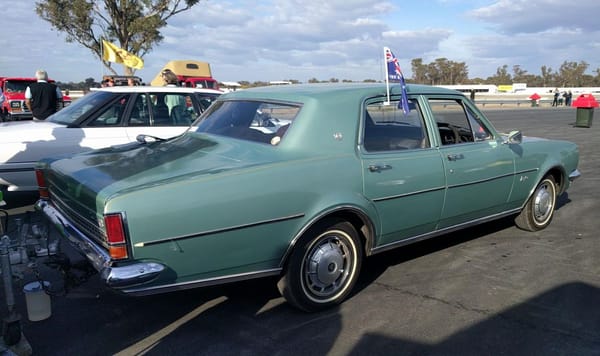
To gain the size necessary to compete with the Fairlane, Holden instead just stretched the boot (trunk) by nearly 8” for a total length of 192.1” from 184.8” of the standard cars. This took boot (trunk) space up to a claimed 32 cu.ft. The squarer roofline of the Premier was used to liberate some additional rear headroom. Most would have had vinyl on top.

The interior was made quite a bit plusher, note the large panels of burl walnut. Paul commented on the under-dash air conditioner in his Classic Capsule article – these cars were developed just slightly too early have adopted flow-through ventilation. You can’t see the inch-thick underfelt or the nice cut-pile carpets that also extended to the boot. I think the round instruments of this HT facelift model are partly a wider trend, but surely show the influence of the sporty Monaro.

The radio is an interesting piece; it has radio station call signs to mark the stations rather than frequencies. In the eastern states at least it was normal to have just the ‘local’ stations shown rather than the 80+ stations on the faceplate here. Unless you were familiar with interstate stations surely it wouldn’t help much anyway.
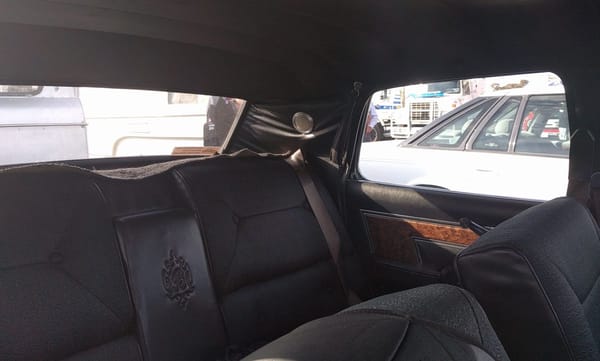
Interestingly the rearward travel of the front seat was restricted to ensure legroom for those in the back. The top of the rear seats are protected against our notorious UV rays, which is good because this looks immaculately original with just some shrinking of C-pillar vinyl trim to give away the car’s near-50 year age.

The brochure didn’t really address the lack of additional legroom, but did drop the 32 cu ft boot/trunk capacity. The model chosen bears a resemblance to Sir Robert Menzies, who was Prime Minister of Australia for 17 years, up to 1966. With the chauffeur, the brochure does present a certain image for the car, which was unlikely to have been matched in reality. Anyone employing a chauffeur in late-1960s Australia probably owned a much fancier car than a mere Holden, no matter how much GM-H would like to believe otherwise.
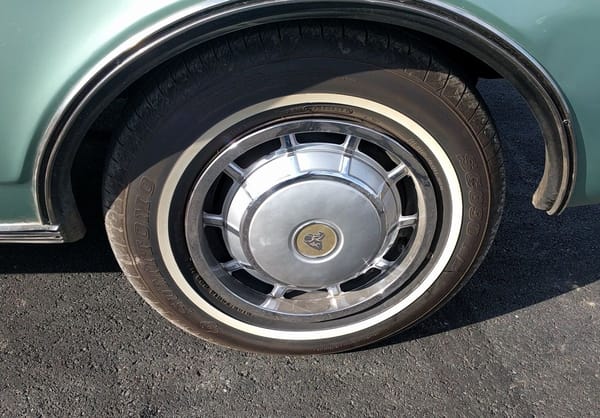
The wheel covers are an interesting design, being a more elaborate version of those on lower models. Do they look familiar to American eyes? The V8 was standard, together with automatic transmission, power steering and power front disc brakes.

The HT facelift of May 1969 saw some extra differentiation for the Brougham over the rest of the range, with the extra grille below the bumper. The new Holden 308 V8 debuted in the Brougham slightly ahead of the rest of the range. Because it had a 4-barrel carburettor the 308 was rated at 240 hp at 4800 rpm and 315 ft-lb at 3000 (compared to the –barrel 307’s 210 bhp at 4600 and 300 ft-lb at 2400).
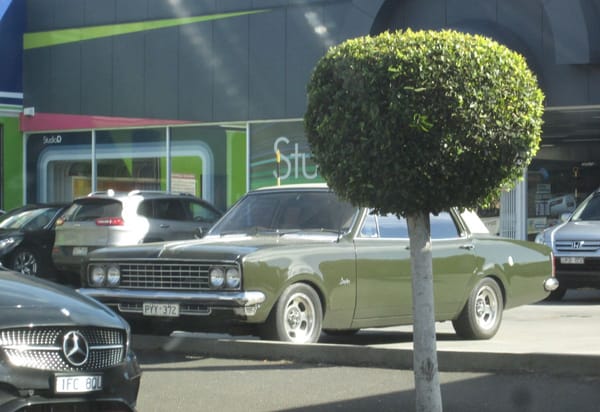
I’m not sure what was changed for the HG model of July 1970, apart from the 2-speed Powerglide transmission being replaced by Holden’s new 3-speed Trimatic (TH180) automatic. Either way, sales were still pretty low. I haven’t seen any figures but all accounts state that sales were a fraction of what the Fairlane did, and that the Brougham only continued because there were completed body shells in stock. Apparently some leftovers were even crushed when production ended.
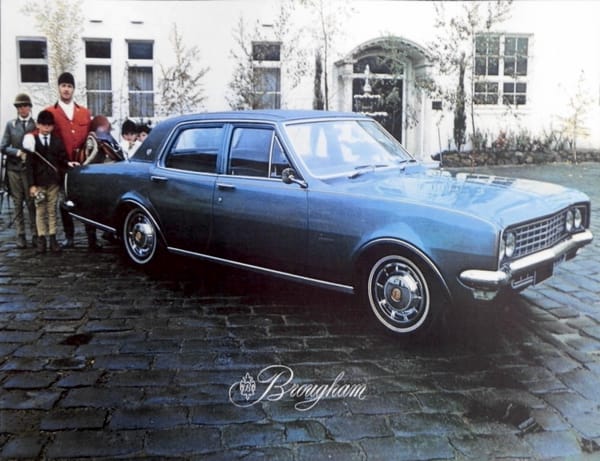
So the Brougham was an interesting if ultimately unsuccessful car, and it did serve the purpose of flying the flag for Holden in the emerging local luxury car market. This was important because US cars were losing their place in the market; the 1968 GM models were the last with assembly continuing into 1969 and sales lasting until 1970, while Ford and Chrysler continued for just a few more years.

The 1971 HQ Holden series featured a long-wheelbase sedan, in Statesman and Caprice form, which went from strength to strength until an entirely different set of circumstances saw it on hiatus from 1984-1990, after which it continued on until the end of Holden production in 2017.
Related Reading:
Curbside Classic: 1980-85 Statesman WB by General Motors-Holden – What a Beaut
CC Global: A Celebration of Holdens On The Day the Very Last One Rolls Off the Line























just watched this aussie car guy and his thoughts on Holden
I’ve seen a few of his videos on YT. Sorry, but IMHO he seems like a real blowhard.
I have tried to watch this guy, but he comes across as the stereotypical Angry Old White Male who hates everything invented past his youth.
He is quite the whiner.
I might mute the sound and just watch the beard.
…fail. YouTube foolies. The actual narrator/self-impressed blowhard in the video appears to be beardless.
The minute I figure out how his race fits into his video I’ll let you know.
Does he have to swear so much? Not even clever swearing and the premise of s….ville barely even makes sense.
Er, how to say, it’s not unknown for Australians to swear. His words here – shit, crap, arseholes and pricks – would barely pass muster as swearing in a church, which hardly any of the population attend anyway. Put us down as sweary non-God-botherers, perhaps. North American prissiness on this issue mystifies folk here.
His presentation boorishness can be a bit wearing (and the jokes a trifle repetitive) but the wording is actually articulate and precise and the content generally spot-on. All of the brand equity, resale and reliability points made here are entirely correct for Australia.
He’s very good on any engineering and science-related car stuff. If you can tune out the “comic” bluster, his vids are always factual and rational, with personal opinions always clearly identified.
One of his better videos IMO, and pretty sound advice.
I’ve generally found him a bit long-winded and not as funny as he thinks he is to watch much, and he is not always right in what he says. Overall it is typical youtube attention-grabbing over quality.
I don’t know if if he’s right or not, I don’t mind swearing on videos aimed at adults who are into cars, We use terms like Sh*tbox and P. O. S. all the time. I will admit to laughing at “three pointed swastika” 😉.
That’s some rear overhang! Would have fit right in on the drag strip – reminds me of the modified wheelbases on mid-60’s SuperStock racers here in the US.
Paul’s post on the Brougham from 2014 made that connection too!
http://www.curbsideclassic.com/blog/1968-holden-brougham-a-new-philosophy-of-luxury-booty-augmentation/
I am continually fascinated by the parallel evolution of cars ‘down under’. The cars are easily identifiable as members of their families; second cousins who share quirks and identifying characteristics but who are all right handed unlike everyone in your family who are left handed.
Quite often, I like the cars better than the ones I know better.
I can’t place the wheel covers, but the HT steering wheel is a modified ’68 Olds 98 piece.
In fact, the whole car has a Olds vibe, with the front strongly resembling a ’65-’66 Olds 98 and the dash aping the ’67-’68 Olds design.
GM parts bin to the rescue, or, why reinvent the wheel – no pun intended!
Maybe the hubcaps are supposed to resemble the ones used on the 67 Eldorado?
It always intrigues me when I see a family resemblance between non-US GM vehicles and what we got in the US, particularly from the era before there was global platform sharing.
These look like 7/8 scale models of what Oldsmobile offered in the mid- to late-60s.
Beat me to the punch… I thought ’65 Olds here including the massive rear overhang . The wheel covers even look like something Olds would have thought of. The grille/bumper area says Impala, though.
That extra-long rear end was a favorite GM trick, seen most often in the Pontiac Star Chief/Bonneville sedans of the 50s and early 60s. Some of those more elongated butts were more successful than others. This one hits me as being in the middle of the pack.
IMHO this car suffers from the same disease as the post 1970 AMC Matador/Ambassador sedans. There is that ill-defined beltline rise from B pillar to C pillar and the too-upright trailing edge of the rear door window. But those traits are not as pronounced on this car and it comes off better.
Sorry, I cannot ID those wheelcovers as having any US origin.
Middle of the pack from a US perspective maybe, but I’m sure it caused brains to explode over here. I’d need to check actual numbers but I don’t there would have been a local car with a longer overhang than this, or at least not by much.
It may just be me, but it looks like the Holden designers tried to build a better Buick Skylark.
And I watched a few AutoExpert videos but gave up about #3 because most of the advice seemed outdated and he definitely let a few brand prejudices show through.
On posts like these I usually babble somehow or other about Australia’s amber rear turn signals (mandatory from ’59 or ’60), but I’ve not previously pointed out a related unusual aspect of many Australian-market vehicles’ rear lighting systems.
Take a look at the Holden Brougham in the pic I’ve attached here. Red brake/tail lights…amber turn signals…where are the reversing (“back-up”) lights? The answer is that the amber rear turn signals were used for that function as well. The wiring was done up just like American combination brake/turn lights, only instead of the turn signal switch feeding the brake lights steady power from the brake light switch, the turn signal switch feeds the rear turn signals steady power from the reversing lamp switch. Unless a turn signal is activated, in which case that side is fed pulsed power from the turn signal flasher. Here’s a short vid I shot when I set up the rear lights this way on a truck I used to own.
Amber reversing lamps used to be legal in various places in Europe, in the UK, in Australia, in New Zealand, and in a few other places. No country I’m aware of still permits them on new cars; New Zealand stopped for 1995 and I think Australia around that time, too, though by then most all vehicles had the international-standard red tail and brake, amber turn, and white reverse lamps.
Yeah, I wondered, too, how the motorists communicate their intention with others when there’s no white reverse lamps. Do they stick their arms out of windows and make the gesture or what? Some of Swiss-registered Volkswagen T3 Transporter lacked white reverse lamps in the taillamps (!), which piqued my curiosity. See photo below.
Ah, during my first trip to Australia in 1987, I saw a Mini stopping on the street and reversing into the parallel parking space. The amber turn signal indicators illuminated continously as the motorist shifted into reverse gear and pulled into the space.
White reverse lamps were required from 1973.
Thanks!
That makes it easier for me to pinpoint the Mini’s age: it must be built before 1973…
In Australia…? Are you quite sure? I don’t think that is correct.
Valiants, at least, carried on with the amber turn/reverse setup right on through to the last 1981 CM model, as in the photo attached here.
And here’s an ’80 Holden wagon with that same setup.
Taking a look at the laws: in the second edition of the ADRs (Australian Design Rules, the Australian national vehicle safety standards), the very first rule is ADR 1, “Reversing Signal Lamps”, which permits white or amber light. In the third edition, there’s a new version of ADR 1 dated 2005 which requires white light.
And it appears I was wrong about New Zealand; they allow the amber turn/reverse setup on vehicles made before not 1995, but 27 February [i]2005[/i], which is the same year the 3rd-edition Australian rule took effect. So it looks like Australia allowed reversing lamps to be amber through 2005, though I’m pretty sure by then most vehicles had white ones.
Actually I’m not sure, in the face of clear evidence. Perhaps in reality any new cars introduced after 1973 usually had them – the 1976 Valiant facelift is an exception to that. I wonder if they re-used an existing lamp?
Well, the VH, CH, VJ, CJ, VK, CK, CL, and CM Valiant, Charger, and Chrysler-by-Chrysler models spanning the ’71-’81 year range pretty much all had different rear lamps, introduced on those models and not used on anything else, and all with the two-colour setup (red/amber, no white) so it was not a case of an existing old taillamp design reused on a newer model. I think Chrysler, Ford, and GMH used that setup as much as they did for the same reason their American parent companies used (and still use) combination red brake/turn lamps: cheaper that way.
Holden is another exception, but Ford did roll out white reverse lamps. Wagons and utes that kept the old tail lights would have lasted until 1979.
Black interior-rear shot just after the interesting-radio shot: rear shoulder belts! Standard equipment, or a later add-on? Australia was home to some of the earlier front 3-point belt equipment requirements; some Australian states started requiring them in the mid-1960s, but I haven’t looked into the rear-belt rules.
Rear outboard passenger shoulder belts became standard on Holdens with the 71 HQ model, Carpet was a big deal in OZ Holdens NZ Holdens all had carpet, Vauxhalls for 66 the PC Cresta model had flow thru ventilation Aussies buying Holdens had to wait untill 71 and the HQ series, Those broughams are rare in NZ overly expensive new for what you got they didnt sell well.
I know that one at the paint shop. Belonged to the owner’s grandfather I believe.
Totally in agreeance with the Olds comments above, and in fact think the 65 is what gave the Holden stylists the idea that extending the trunk might work.
Can I just mention that these barge-arsed bodges were not nice to drive? All HK-HG’s had wind noise, vague steering, tipsy body roll, massive understeer, poorly-tuned seat springing and quite ordinary performance that only stopped when they rusted away (in a salt-free dry country). They weren’t close to being a competitor for a properly-engineered posh car. Amusingly, the brochure appears to have photographed one outside the Melbourne Club (one of those super-snob private male clubs from colonial times, still existent). There wouldn’t be a single Old Boy who’d have been seen dead in the back seat of such a splashy thing. Sir Robert Menzies was wafted about only in the finest that Mother England could manufacture, old chap.
The Bruff Hams looked silly to me even as a youngster, and age has not given them any further dignity. It has, however, given them a price: at least a $50k entry price for a good ‘un now. Though not from my pocket, ever.
They could have off-loaded those left-over shells, stripped of the fineries, as the Br’um taxi – seating for five passengers, luggage for eleven.
“seating for five passengers, luggage for eleven” LOL
I wonderif any crazy person grafted the Brougham rear end onto a Monaro, back in the day? Of course with the value of Monaros no one would butcher one now.
I did see an article about a guy who grafted the back of a ute onto a Monaro to create an ‘extra cab’ version.
I enjoyed your post. I have actually enjoyed the old crabby guy on You Tube. It seems he exaggerates a little in my opinion. But he gives me a different perspective sometimes and that’s not a bad thing in my tiny isolated bubble.
There is a fair bit of carry-on for entertainment’s sake IMO and some areas he has some prejudices but for the most part his info is not bad.
Most people over here would agree that the proportions are awkward
Enjoyed reading about the Holden Brougham, but have to correct a couple of comments. The Holden Brougham was NOT manufactured by “Holden”. More correctly the Holden Brougham was manufactured by General Motors Holden (GMH). “Holden” was a brand sold by GMH. Holden was just one of the makes that GMH assembled.
During the 1960s, GMH also assembled Pontiac, Chevrolet and Vauxhall passenger cars. Holden was simply the GMH entry level brand.
Accordingly, the Holden Brougham was never the ‘flagship’ of the GMH passenger car range. This title belongs the Chevrolet and Pontiacs assembled by GMH until early 1970.
GMH assembled its last Pontiac Laurentian in 1963. From 1964 until 1970 GMH assembled Pontiac Parisiennes. GMH assembled its last Chevrolet Belair in 1966. From 1967 until 1970 GMH assembled Chevrolet Impalas in 4 door sedan and sport sedan versions. From 1967 until 1970 GMH only assembled sport sedan versions of the Pontiac Parisienne.
The major point here is that GMHs Holden brand did not offer a GMH Flagship model until at least late 1970. Mind you the former GMH has today been replaced by General Motors Special Vehicles (GMSV) and GMSV again offers the Chevrolet brand which has replaced the former Holden brand.
GM in Australia has turned full circle and are back to where they were pre 1948. Great article nevertheless
The Holden Brougham was NOT manufactured by “Holden”. More correctly the Holden Brougham was manufactured by General Motors Holden (GMH).
Where did the author (or any of the commenters) say that it was? I just reread the text (and the comments) three times and cannot find the words you find so offensive that resulted in your pedantic comment. As to the rest of your comment, the author clearly pointed all of this out:
“So the Brougham was an interesting if ultimately unsuccessful car, and it did serve the purpose of flying the flag for Holden in the emerging local luxury car market. This was important because US cars were losing their place in the market; the 1968 GM models were the last with assembly continuing into 1969 and sales lasting until 1970, while Ford and Chrysler continued for just a few more years.”
Did you actually read the article? Or do you just enjoy correcting people even when there’s nothing to correct?
This person comments every so often here, with his pompous and entirely boring corrections about GM car-making in Oz. He’s the type who’s emptied car clubs the world over.
For the record, GM Holden – proper name who gives a flying – did assemble a really small number of Cheviacs and Ponti-rolets until ’70. From a marketing perspective, and doubtless amusingly to US readers, these Chevs were top-of-the-line for Oz.
The silly Brougham was the top Holden in the eyes of most, and the “posh” Chev or Ponty weren’t considered the top of the Holden range, but the top of what you could buy from a Holden showroom.
These were a curiosity, at best.
Outside of a Holden dealership, they were seen as simply a Premier with a longer boot, more of an extended-deck sedan you might say, and not really a serious competitor to the Fairlane. It might have been different if they’d released the B’ham first, then the lesser cars (Wow! The Premier’s got that fancy Brougham roof!), but that’s not how it happened. The fact that they looked just like a Premier from the front (until they added the lower grille section) didn’t help any.
Marketeers can tie themselves in knots over what’s a brand name versus a model name, but they’re artificial constructs. Aussies are a no-nonsense people. Yes it’s true that GMH (we all just called them Holden, of course) sold the odd big Chevrolet and Pontiac, but they were a very rare sighting. I don’t have the sales figures at hand but we’d be talking low hundreds annually, and declining. And 1968 was the last model year GM sold those cars here as a regular offering, so clearly (in the public eye) this was meant to take over their market slot. Either that or GM were abdicating the large-car segment – I can’t imagine that. But if so, GM management was delusional; Chevrolet and Pontiac had a decades-long history of being seen as increasingly upmarket cars beyond their status in the US and Canada, and no Holden could possibly hope to have that cachet back in 1968. Even if it did look like an Olds 98. No matter how fancy the interior. No matter how high the price. We all knew what a Holden was. It was no Chevrolet. Not then.
GM must have recognised this, eventually. When the first Statesman came out replace the Brougham in 1971, they took pains to point out it wasn’t a Holden, it was a Statesman. Oh? Really? It wasn’t hard to see the shared panels; even the model code was the same. That kind of spin might work in management, but not out on the street. Even the press mocked this kind of word-play. Eventually GM gave in and stopped the silly business and called it what it was.
But the Brougham? Rare then and now, and much valued nowadays.
I didn’t realize till fairly recently that Holden tried to pass off the ’71 Statesman as some sort of separate entity, bereft of Holden identity. As you’ve implied, for pragmatic Aussies, how bloody stupid! Your local taxi, trimmed-up and with a long boot (the longer wheelbase not being obvious)really? At least it wasn’t plain absurd, like the over-booted Brewham.
Actual Broughams seem to have survived in obscene numbers. I guess they were bought by those old enough to have the dough and yet too old to know they were going soon to be unable to drive it, so the majority sat in the sheds of mourned grandpas till recently-ish.
I think the B’hams were saved early on for their curiosity value. A family relative had one stashed away in an old farm shed twenty-odd years ago, all there but covered in dust and bird droppings. No doubt one of his technically-minded sons has it now. Might even be back on the road.
I had no idea front seat rearward seat travel was restricted to preserve leg room in the back in these, talk about a cheap cynical flip you to the poor driver, as a 6 footer with stupidly long legs I find that insulting.
Good on underdog Chrysler for extending the 69 VIP through the back doors making the actual important bits of the car, where everyone sits, longer.
I have to admit I have sort of liked the look of these over the years, but knew they were a bit cynical but not how cynical GM-H actually was.