
Text by Patrick Bell.
Chryslers and Imperials are the focus today as we take a look at a few from the 1960’s and 1970’s. They were known as a company of fine engineering, and that was well represented by what these models offered on the higher end of the scale.
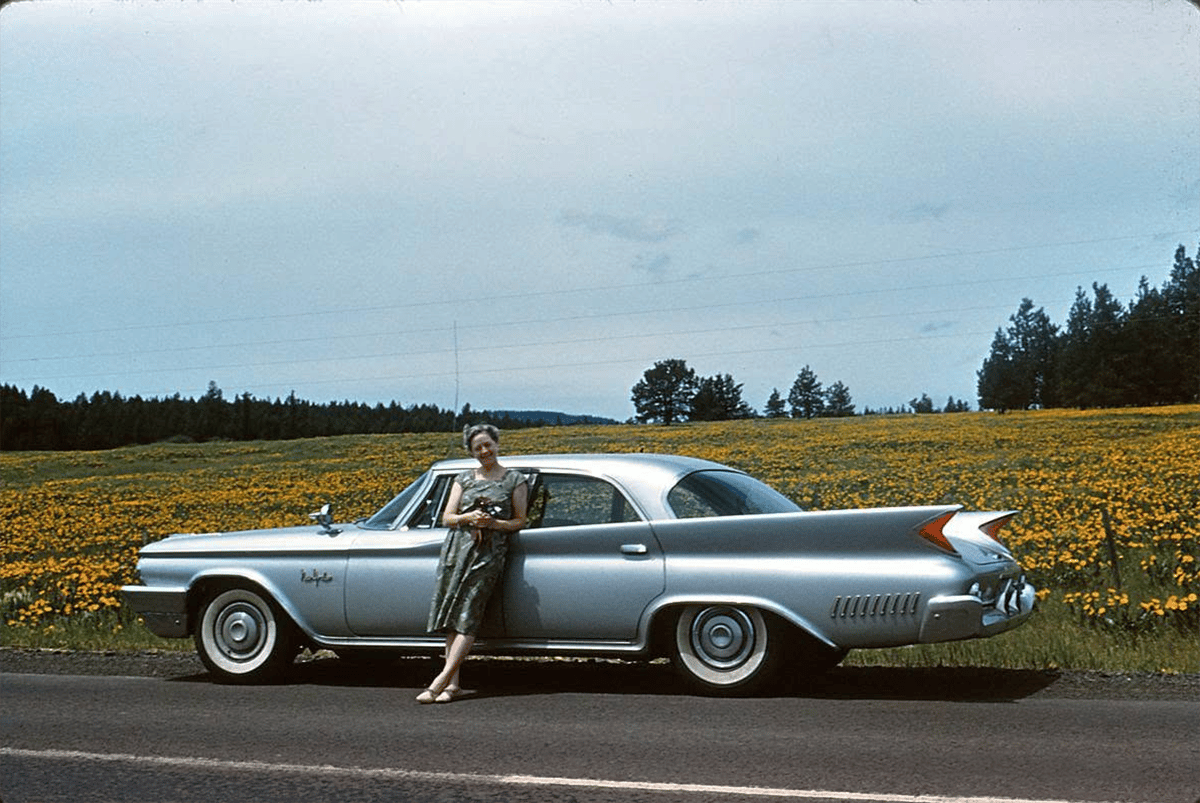
We begin with a lady leaning on a 1960 New Yorker 4 door sedan. The New Yorker was the long time senior series, and this sedan was the most popular New Yorker that year. Standard power came from a 413 cubic inch V8 with 350 horsepower.
Image notes state this was taken in June of 1961 near Anatone, Washington, in the extreme south east corner of the state. The lady appeared to be holding a camera, so they likely were taking pictures of the field of sunflowers.

Here was a 1960 Imperial Crown convertible with a load of passengers and a crease on the lower quarter panel. The Crown was the mid level trim series of three in the Imperial line, and the only convertible model available. And it was a rare one, with only 618 units produced that year. The powertrain was shared with the New Yorker.
In the left background was a 1959 Cadillac Coupe, and to the right a 1956 Dodge Custom Royal 4 door sedan.

A man and a dog were posing with a 1960 Saratoga 2 door hardtop. The mid level Saratoga was in its last year as it was replaced by the Windsor in 1961 when the Newport arrived as the entry level model. The Saratoga line used the 383 ci V8 with 325 hp for power, and this 2 door hardtop was actually the least popular Saratoga that year.
I don’t recognize the car behind it, and a 1957 Chevrolet Two-Ten or Bel Air wagon was in the background.
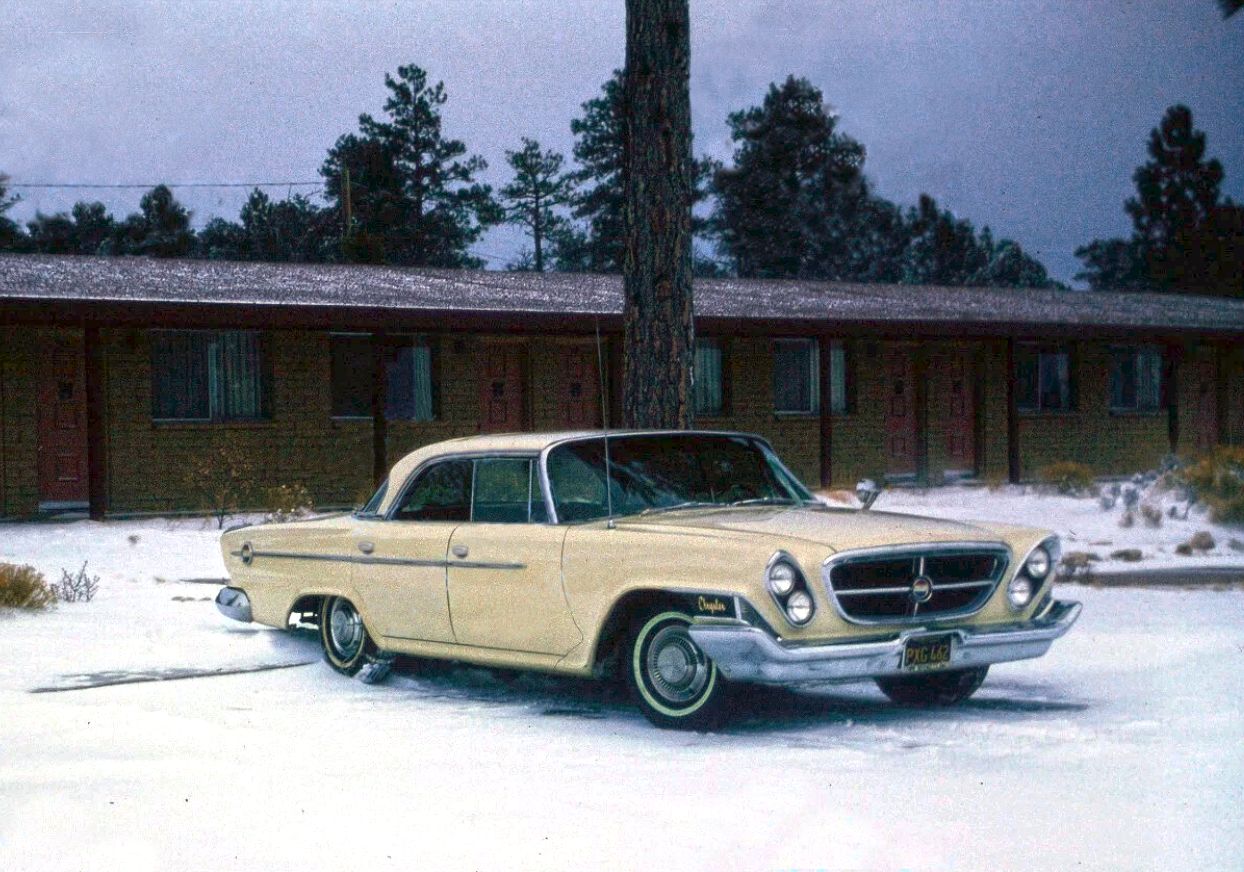
And a 1962 300 4 door hardtop from California. The 300 replaced the Windsor in 1962 as the mid level series. It was available in 4 door sedan and hardtop, plus convertible and 2 door hardtop body styles. The standard power was a 383 V8 with 305 hp, and two versions of the 413 V8 were optional. The letter series model was still offered in hardtop and convertible for those who wanted a serious performance car.
The car above was equipped with tire chains, and was at a roadside type motel that looked like it may have been closed for the season. The chains may have been a worse case scenario situation as there was not enough snow to need chains.

A 1962 Imperial Custom 4 door Southampton was shown here in a nice shade of blue. The Custom was the “most conservatively priced” series of three, and was for the customer that did not need frivolities such as power windows, seat, or armrests in the seats, all which were standard on the Crown series. The Southampton name indicated a hardtop model, and was a holdover from the 1950’s. It had become moot since they no longer offered any pillared sedans. The name went away after 1963.
There were three other cars partially visible through the trees, but the only one I can ID was the 1961 or 1962 Buick Special behind the swing set on the right.

This lady was posing with a 1966 Newport 4 door sedan that was a tow car for a large travel trailer. The Newport was the entry level series, and the sedan was the least expensive and most popular Chrysler of the year. Standard power was the 383 V8 with 270 hp, but since this was a tow car it may have had either the 383 V8 with 325 hp, or the 440 TNT V8 with 350 hp which were optional.
There was a full fendered motorcycle on the back of the Airstream that I will leave for someone else to ID, and there was not enough showing of the pickup on the left edge to take a guess.

And another 1966 Newport 4 door sedan that was left idling, most likely by the man that was walking back to it on a drizzly day. It had one of the 383 V8’s for power, as you see only a single exhaust.
It front of it was a 1970-1972 International Travelall with a boat on top. In the distant left was a 1967-1969 Ford F-250 Styleside long bed with a cabover camper, and on the other side and in front of it was a 1965 or 1966 Chrysler Town Sedan, a six window version that was offered in both the Newport and New Yorker series.

This one was a 1965 New Yorker 4 door hardtop, the most popular New Yorker that year. Standard power on the New Yorker was a 413 V8 with 340 hp, with a 360 hp version optional, and 1965 was the last year for the 413.
It is difficult to see, but there was a whip antenna mounted on the quarter panel.

The fuselage era began in the 1969 model year, and shown here was a 1971 Newport 2 door hardtop with a British Columbia license plate used from 1970-1972. The 1971 model year began with the Newport in the entry level position with the 383 V8 as standard equipment. Later in the year they debuted the Royal as the least expensive model that had a 360 V8 for standard power.
On the right edge was a 1969 full size Pontiac.

1972 brought an overdue reskin to the fuselage cars as seen in this 1972 Newport Royal 4 door sedan. According to the sales brochure the standard power was now the new 400 V8, which was an updated 383. But other sources indicate the 360 V8 was still the standard engine.
The featured car was the least expensive and most popular Chrysler of the year, and appeared to be equipped with the optional vinyl roof.

A 1975 Newport or Newport Custom was visiting El Morro National Monument in Bluewater, New Mexico. It had a Wisconsin license plate, so it was quite a ways from home.
A restyle came about for the 1974 model year, which was just in time for the first oil crisis. Large cars suddenly fell out of fashion, so sales took a hit, and the 1975 sales were about the same as 1974. The 400 V8 with a 2 barrel carburetor was listed as standard, with the 360, 400 with 4 barrel, and 440 V8’s all on the option list.


Here are a two shots of a 1978 New Yorker Brougham 4 door hardtop that was in its last year prior to the downsized model. The Imperial’s last year was 1975, and the New Yorker Brougham took over its style and position for the 1976 model year. 1978 was also the last year for the 400 V8, which was standard, as well as the optional 440 V8. The large car era had passed.
The car shown had a 1979 Iowa license plate issued in Clinton County, where the seat is a city of the same name. The bug shield, front mud guards, and deck lid mounted antenna were all aftermarket items.

The 1975 Cordoba was Chrysler’s entry in the burgeoning personal luxury coupe market. It also was the first of the “new small Chryslers”. It did very well in its first generation (1975-1977) with over 453,000 units sold.
The car above was a 1976 model that had a 1977 issue Illinois license plate. It also had the optional Landau Vinyl Roof, remote control outside mirror, and the full wheel covers were standard equipment.
Thanks for joining us and have a great day!























The ’78 New Yorker, caught at the height of the CB radio craze!
Chrysler went from being a sleek missile in 1960 to this frumpy-looking thing. This is why in the late ’70s, I did not believe in “progress”.
Well said! While both are big cars one “ Looks like it’s moving when it’s standing still” and gives off vibes of an imperial star destroyer. The other looks weighed down, And seems well described by a word I thought of many years ago “bloatardic”.
I thought that the Imperial/New Yorker Brougham was a great looking car for its time. It’s crisp and dignified. The story is that Chrysler had decided to end the Imperial after 1973. Elwood Engel presented his new Plymouths, Dodges, and Chryslers for 1974, then uncovered his final model.
“This is the car that you have decided not to build for 1974.”
Chrysler needs this 1960 New Yorker in their 2027 lineup ASAP! They are a one trick pony now. At this point if they built a really good toaster it would be a boost to the brand.
Thank you for the Chrysler lineup. Most of my Dad’s family were MoPar prone, so growing-up in the 1960’s I was surrounded by them. And travel trailers. The ‘66 Newport sedan is parked in front of of a “Streamline” trailer, in the center as you stated, an Airstream, and on the left is a Holiday Rambler, all top-quality travel trailers.
Didn’t Joe Kennedy Sr. dictate Chrysler ?
My uncle’s flawless 1962 Newport and our neighbor’s flawless ‘65 Newport convinced my dad to get a ‘70 New Yorker. It was a major disappointment of a car. He traded that in hoping a 1974 Dodge Royal Monaco would redeem Chrysler – nope – another huge disappointment! The Fuselage Chrysler era wrecked them.
The post Exner Chrysler era right up to 1969, were golden, based upon my contemporary experiences.
I’ve heard that buying a Chrysler product in the 1970s — with the possible exception of the Dart and Valiant — was a game of Russian Roulette. You either got a really good one or a complete disaster. One of my grandmothers had the former (a Valiant) and the other the latter (a Fury II).
My parents bought a new Fury III 4-door hardtop from Young-Jenkins Chrysler/Plymouth in Killeen, Texas. That car was a pure lemon that caused my parents to never buy a Chrysler product again, and the Fury replaced a ’65 Dodge Coronet 440 2-door hardtop. The salesman said the 383 had a trailer towing package, yet the car overheated many times even when it wasn’t towing (a ’67 Econoline dad bought in whimsy in ’72.). The car also had a few other issues, including some build issues (the side trim on the passenger side was epoxied on, whereas the driver side used the factory clips…the “extra” clips were found in the bottom of the passenger side front door after a trip to a body shop to replace the door after a Cadillac backed into it) and a persistent dieseling issue. Chrysler Plymouth dealers in four states couldn’t solve the overheating problem, but an independent radiator shop did– our 383 Fury left the factory with a radiator for a 225-powered Fury,
Car and Driver did a story on the used car market in ’78. The story also had a list of the lowest resale values for used cars. Among the various Cadillacs listed, was the Fury–after three years, the Fury retained 26 percent of its original value.
We’ve seen that Travelall before in a parking lot shot. https://www.curbsideclassic.com/vintage-snapshots-and-photography/built-to-work-vintage-photos-of-trucks-and-their-lifestyle-1950s-1960s-1970s/
Good catch! I thought it looked familiar.
The first and third image have my all-time favorite tail light lenses. The fins look great on both the 2 and 4 door bodies. Thanks for the parade.
Seeing that Cordoba is a reminder of the versatility of Chrysler’s B-body platform. Hard to believe the Cordoba shares its underlying bones with a 1962 Plymouth.
Seeing the tire chains reminded me of a couple a pairs my dad kept forever. We never, that I knew of, used them.
Around “69-70ish”, they were disposed of.
Even today, not everyone has a 4×4 or AWD. Chains are still legally required in some Western states. FWD and all season tires are not enough in the mountains.
The 1975 Cordoba was one of the best cars I ever owned. Being the first year, it had a lot of attractive standard features whereas the 1976 model my brother bought wasn’t as well-appointed. Mine came with an eight track player and the sound was wonderful.
The 1969 full size Pontiac shown was the same colour as the one I owned – dark green with black vinyl roof.
The cream colored 1966 Newport tow car is a six-window Town Sedan, not a standard sedan.
You very well could be correct, it is a tough call. However, I think I will stick with the sedan.
The older I get the more I understand the “MoPar or NO car” stance of the MoPar Men I used to meet .
I really like the flamboyance of the fins and so on, not quite enough to buy one tho’ .
The little Red Motocycle is a HONDA CT200 or perhaps an early CT90, hard to tell the first few years of the trail bikes they all had the Earles leading axle front forks .
-Nate
My dad always had Chrysler cars when I was growing up. 66 New Yorker. Then a 70. He liked them for towing campers because of the leaf springs and that big block Mopar!
Those big 60s Chryslers wore like iron remember many of the being used as daily transportation well in too the 80s .
Yes–in the 1990s in the small municipalities where I lived (Hanover Township and Morris Plains NJ) there was a white ’61 Newport, a blue ’64, a dark teal ’65. I would see them in local parking lots. Old man owners. In the ’80s there was also a light blue ’60 Imperial and even a ’57 Imperial (dark green)!
In ’66 there were two 440’s. The first was 350hp with single exhaust and the TNT had higher compression, cam and dual exhaust.
I’ve owned many mopar cars. My favorites were a 54 New Yorker Deluxe Newport hardtop, a surprisingly fast, good handling car for it’s time, a 57 Plymouth Belvedere equipped with the optional complete Fury performance package, that was very close in performance and roadholding to a 76 Porche 928 I owned briefly several years later, and a 69 Chrysler 300 I ordered with export suspension, the most comfortable car I’ve owned before or since, with ample performance, exceptional handling, and 23 mpg on the highway. Just for fun I entered it in a sports car rally in early 1969. My novice navigator gave up in the first 15 minutes, and my 19 ft 69 Chrysler still came in 12th out of 60 cars entered, timing with cruise control and seat of pants estimating. That was my perfect car, but a party-going Mercury hit it while it was parked one night. There haven’t been any really great cars since.
My parents loved their 1960 Chrysler Windsor with its unique style and very fast Golden Lion 383. It rode, handled, performed and lasted into the 1970s. These days I am still a MOPAR collector car enthusiast with a 1955 Plymouth V8. A Chrysler Plymouth Imperial dealer was on my newspaper delivery route so I enjoyed sitting in many used Chrysler and Imperials.