
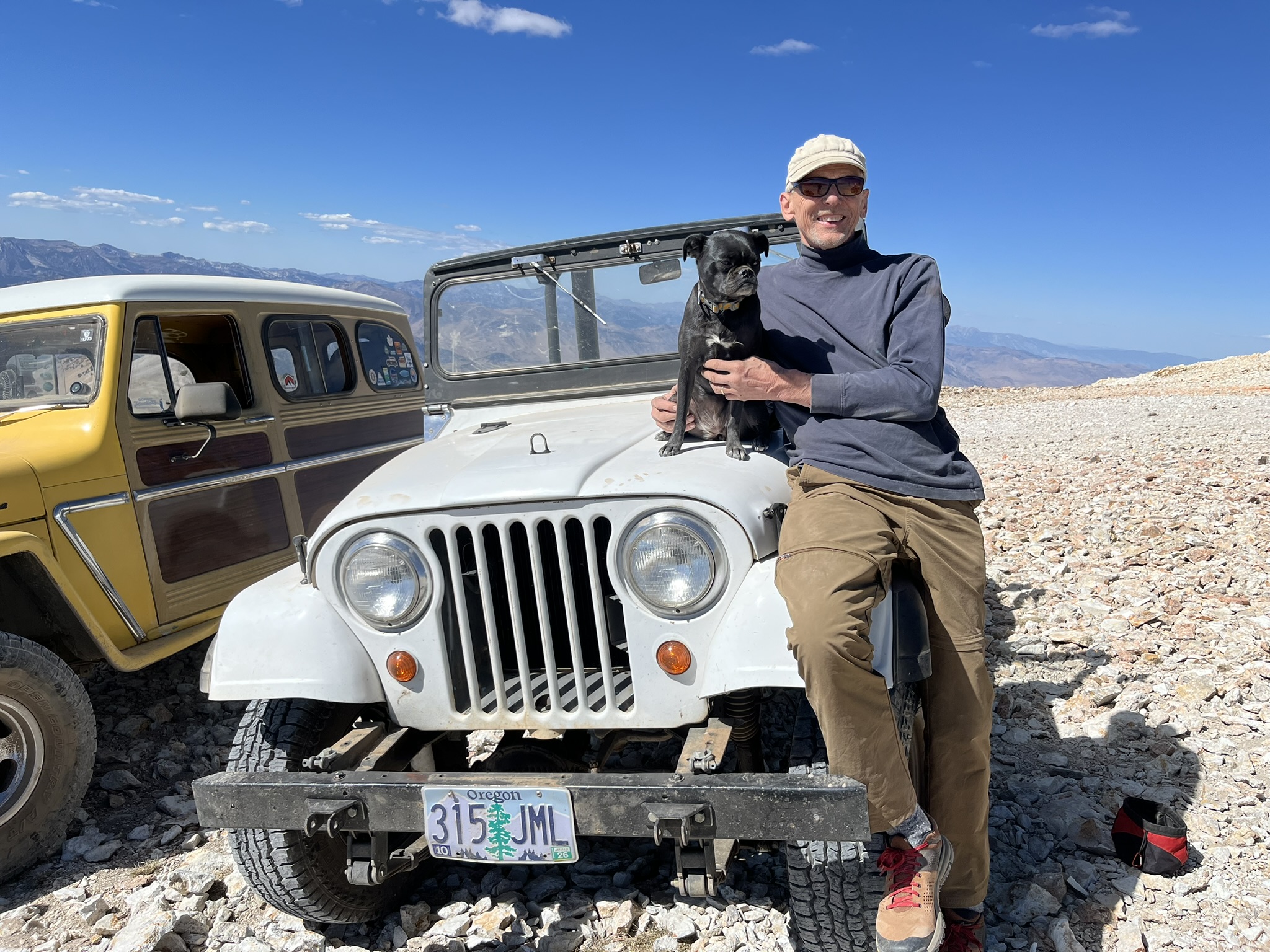
I didn’t see this one coming, although there have been intimations of it going back…all the way to 1958. I had invited myself to ride with my friend Alan in his flat-fender Jeep on the Old Willys Forum’s Eastern Sierra Fall Color Run. Alan has been going to a number of these vintage Jeep group runs for several years and I was a bit jealous. What’s more appealing than driving an old Jeep up high in the Sierra amid golden aspens for a week, not far from where I had climbed Mt. Langley and Mt. Whitney a month earlier.
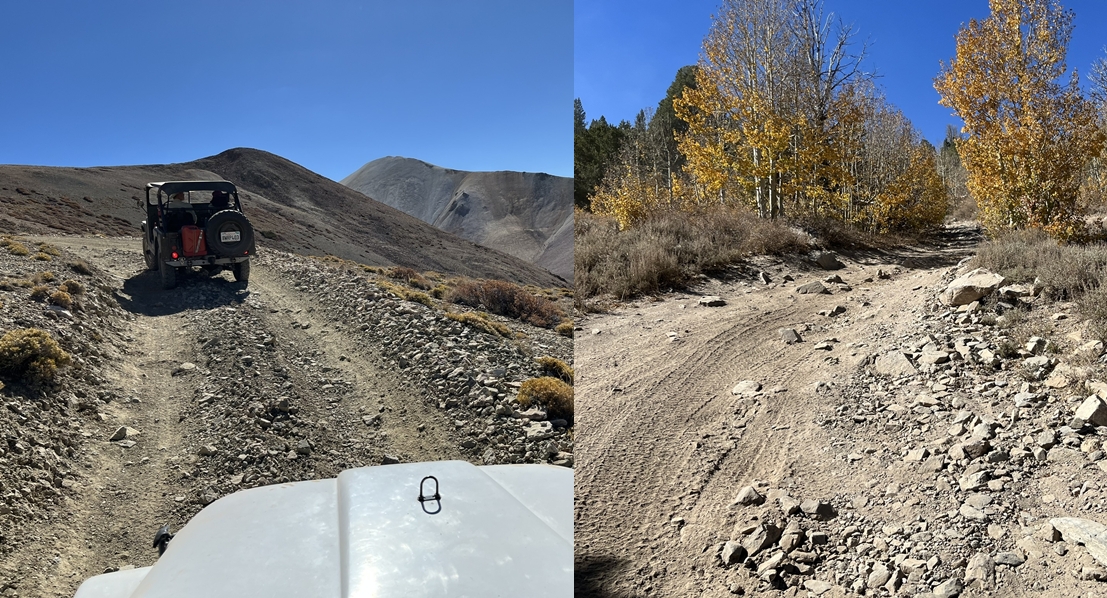
I was planning to head down there in my van on Oct. 3. Exactly two weeks earlier, I was sitting at home and the thought suddenly hit me: I’d rather drive than ride. So I went on Facebook and instantly found my new-old ’66 Jeep, which I bought and brought home the next very day. And then came two frantic weeks getting it ready. Would it make it up 11,654′ Mt. Patterson, the grand finale of the trip? The picture above answers that question—but that doesn’t mean there weren’t any issues along the way.
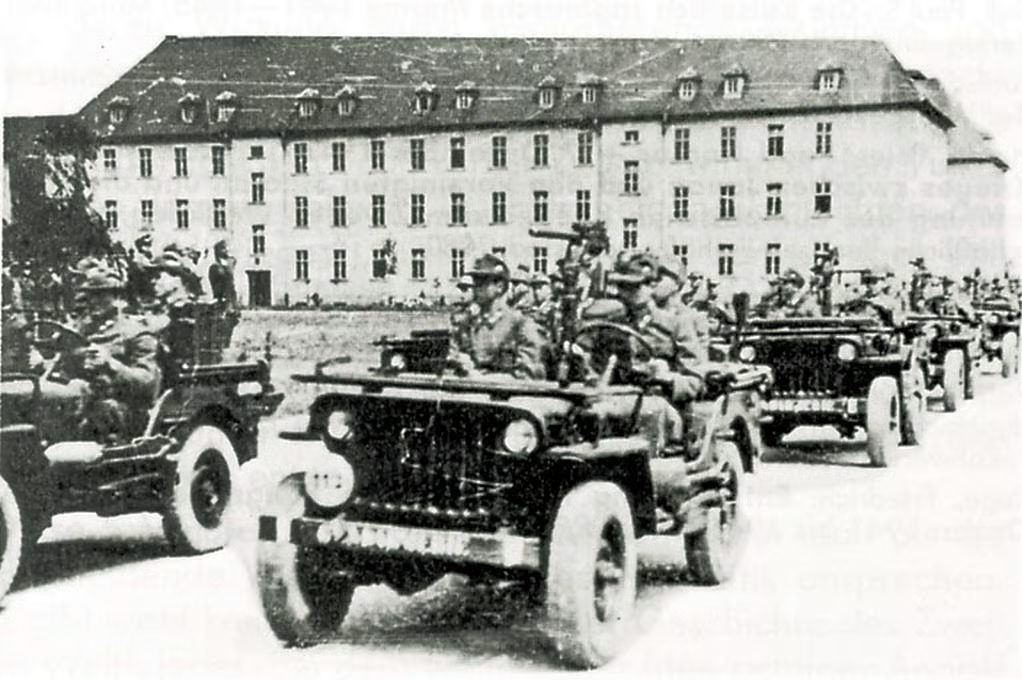
I can credit my early influential Jeep exposure to its original purpose: the winning of WW II. The US Army left behind enough of them for the tiny post-war Austrian military to adopt as their own. One day in 1958 or so we were out on a hike in the mountains abutting Innsbruck and a small convoy of these Austrian Army Jeeps came up the rough little road we were on and passed us. The sound of their gruff four cylinder engines as the gears were shifted and their ability to climb the steep alpine track instantly etched itself in my mind. From then on, I “was” a Jeep every time we hiked up in the mountains, constantly making blubbering engine sounds that rose and fell with endless gear shifts. I did not endear myself with the rest of my family being a Jeep.
From then on, Jeeps have always had a special place in my vast automotive mental storehouse. As a lover of the outdoors and avid hiker, the ability to go just about anywhere on wheels just really resonated with me. I used to drive my VW Beetle on old mining roads in Colorado, pretending it was a Jeep. But life in the big city, a demanding career and a rapidly growing family conspired against properly fulfilling that (and a few other) automotive desires and fantasies.
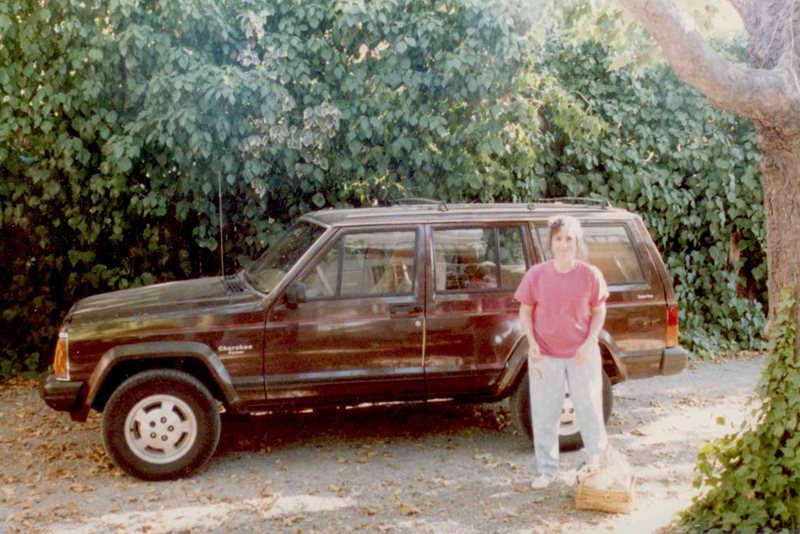
Then in 1985 we needed (and could finally afford) a new family car. Stephanie and I both fell for the new Jeep Cherokee, as it could be both a kiddie-hauling mommy-mobile during the week and afford some getaways on the weekends and vacations. Its chapter in my Auto-Biography is here. Did we take it into the Sierra for some serious off-roading? No, for one reason or another, which in retrospect I somewhat regret, but we did take it on some fun outings on dirt forest roads in the San Gabriel and Santa Susana mountains near LA as well as a lot of great trips in it all over the Southwest, some of which also encompassed some mild off-roading. A drive up a very remote trail into the backside of Bryce Canyon is the most memorable.
After we moved to Oregon in 1993, the Cherokee became my car, and son Ted and I started using it to explore all over the wilds of Central and Eastern Oregon. Yes, there were a few challenging moments, but it was mostly “overlanding” than more serious off-roading.
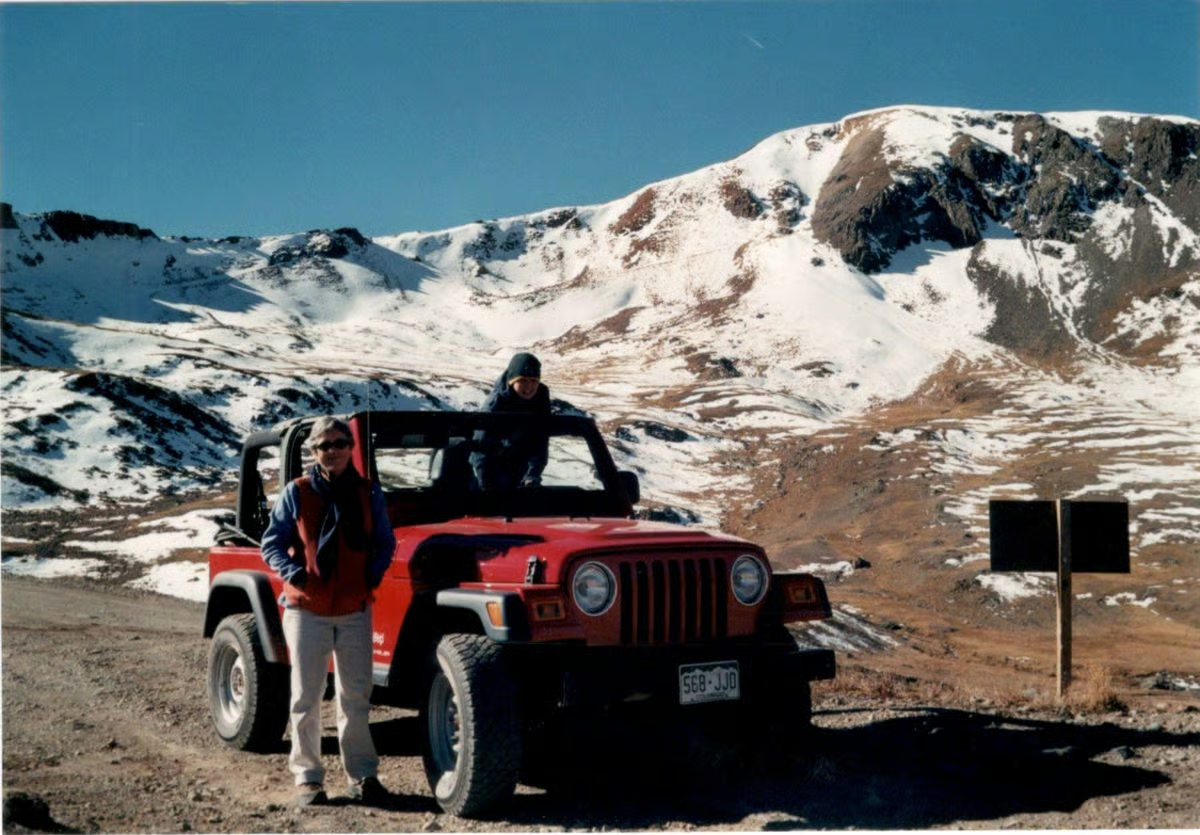
Perhaps the most influential event that led to my buying this Jeep happened in 2003 when we rented this Wrangler (TJ) in Silverton, CO. and took an epic trip over Engineer Pass (12,470′) and then back via another splendid route that I’ve now forgotten. It was mid-October and below freezing when we stated out but as the sun warmed things up I stopped and folded the top back. Driving that Jeep up high into the mountains was truly a delight, and…this was a basic version with the AMC 2.5 four, which was plenty stout for me. It is something of preview of coming attractions. I really need to get back to some of these Colorado passes.
Then in 2021 I was invited to join my son and a few friends on a weeklong overlanding trip in Northern Nevada (“EXBRO5”). They all had serious 4x4s but I decided that I would take my Scion xB, somewhat as a joke – who needs 4WD? I cut off the lower body cladding, jacked it up, put larger tires on it and…it did great! It was more challenging to drive than their trucks, but that’s precisely what I like: challenge = fun. Especially in an underpowered vehicle, something I have a special affinity to.
I only had to be pulled out of one deep irrigation ditch.
The following year I was invited back for another go, this time in Eastern Oregon (“EXBRO6”), but on the condition that I get a real 4×4 as the terrain was going to be more challenging. So I picked up this ’03 Tracker for $2500, put some bigger tires on it and conquered rough and rocky Burma Road. That was really only section that might have stopped the xB, but the Tracker acquitted itself well and was deemed the most fun to drive of all of the cars on the trip. Small is beautiful!
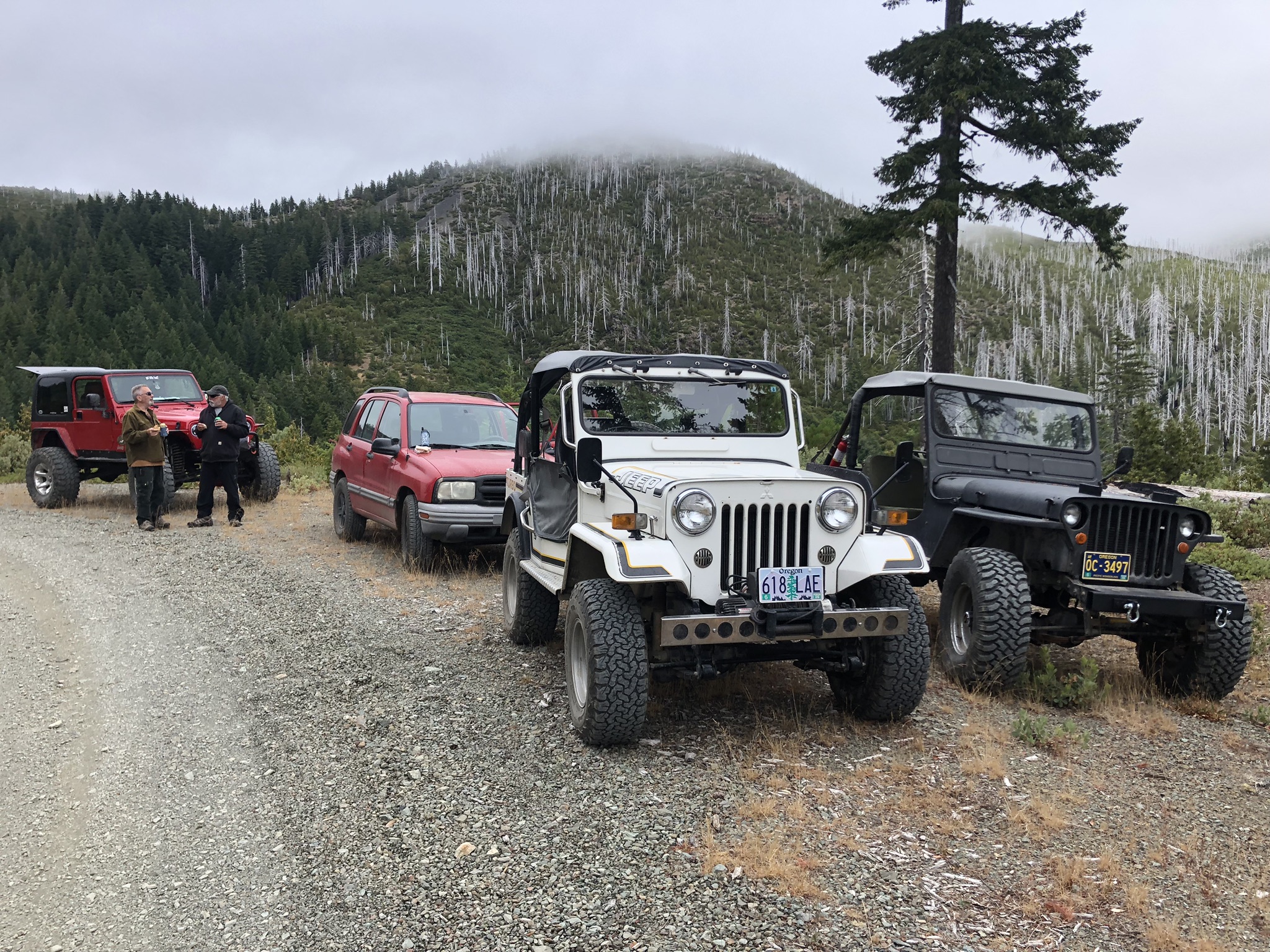
I almost sold the Tracker but decided that we’d keep it at our Port Orford property as there are endless forest roads to explore even if not exactly serious 4WD material. My friend Alan, who lives just up the road from our property there, grew up with Jeeps in Montana and has three flat fender Jeeps including this one on the right, which is a serious mongrel. It’s got a stronger CJ5 frame, a Buick 225 V6, a truck 4-speed transmission with super-low first gear, air lockers, and other components to take on anything, including the Rubicon this past summer. He invited me to come along on this little outing in the mountains near Port Orford with some other Jeepers; I felt a wee bit out of place with my Tracker. That white Jeep is a Japanese Mitsubishi with a turbo-diesel.
His stories of various group trips in Colorado and such were whetting my appetite. But there’s a part of me that’s too practical and restrained…I have too many vehicles already…(5).
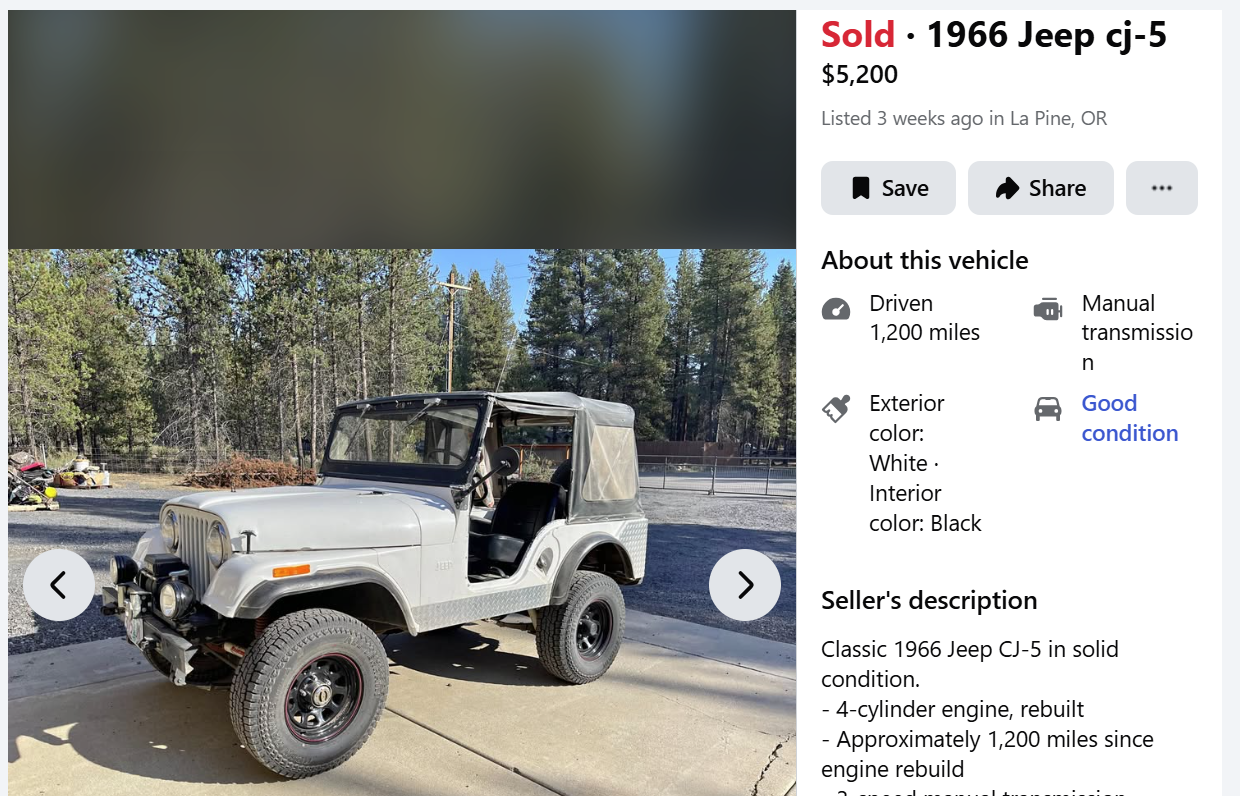
Fast forward to the evening of September 18. I had agreed to meet Alan near Bridgeport, CA. for that Fall Color Trip for old Willys. Then I suddenly had the thought that I’d rather drive than ride with him for the week, so I opened my laptop, went to Facebook marketplace, searched for Jeep CJs and was confronted with about 25 ads in my geographic region. They were either abandoned projects, beaters, Frankensteins, or overpriced (and over-modified). I was looking for something solid but mostly original. And then this one jumped out at me, a ’66 CJ-5 with the Hurricane F-head four. That instantly interested me, as of course I have a thing for underpowered vehicles as well as the unusual F-head engine. My post “The History of the Curious F-Head Engine” is a staple on Google searches.
1200 miles on an engine rebuild. Solid condition. New tires, no rust. Sounds good. The ad was only a couple of hours old. Part of me really wanted this and another part kept saying NO! I forwarded the ad to Dimitry (“dman”) and he responded with this text:
Hmm. 4 cylinders? Check. 3 speed? Check. Clean? Check. Do it.
So I did it. I contacted the seller and told him I’d drive out to La Pine the next day (with cash in my pocket).
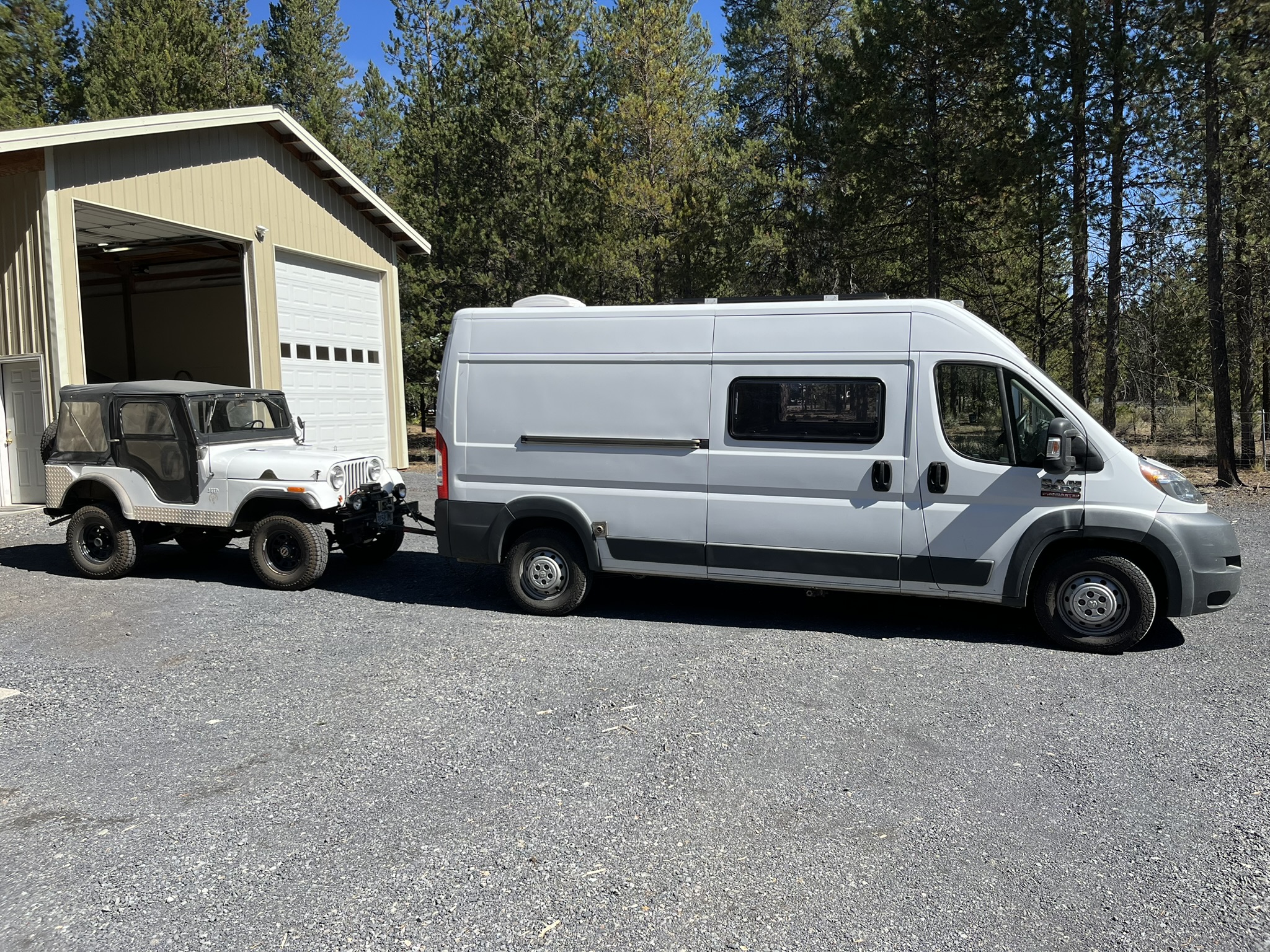
The Jeep was everything (and more) as claimed in the ad; very solid, clean and it looked like a lot of work had been done to it in the recent past. The seller was older and said he couldn’t get into it anymore, and that he had bought it four years ago and put less than 1000 miles on it puttering around the dirt roads of the area (in Central Oregon). He didn’t do anything to it; he bought it from a guy who had done all the work (or had it done). There was no insurance on it, but he let me take it for a short spin in the neighborhood. The steering felt decidedly odd, with no self-centering at all and the gap between second and third gear was huge. But it ran well, everything else felt fine and I liked the growl of the little four. And of course it’s white! Now I have four white cars.
The seller also threw in a tow bar and a few boxes of spare and old parts, so I offered him a bit less than his asking price, which seemed pretty good for such a solid Jeep. He accepted, I hooked it up and drove to nearby Finley Butte, for a brief drive up its steep dirt road.
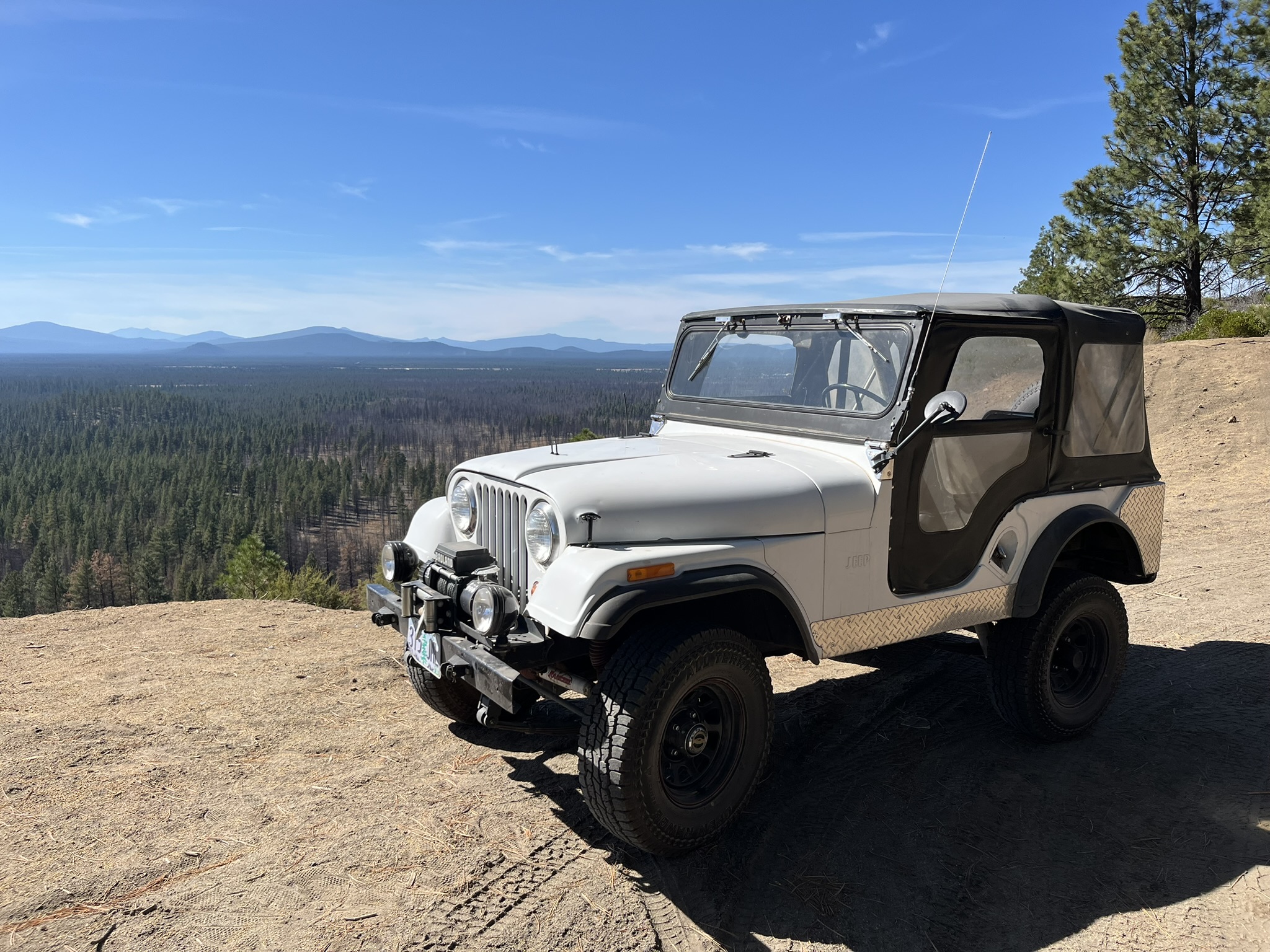
Low range was tested and everything else checked out, but that steering…it obviously had no positive caster, undoubtedly due to the 2.5″ lift springs that had been put on it.
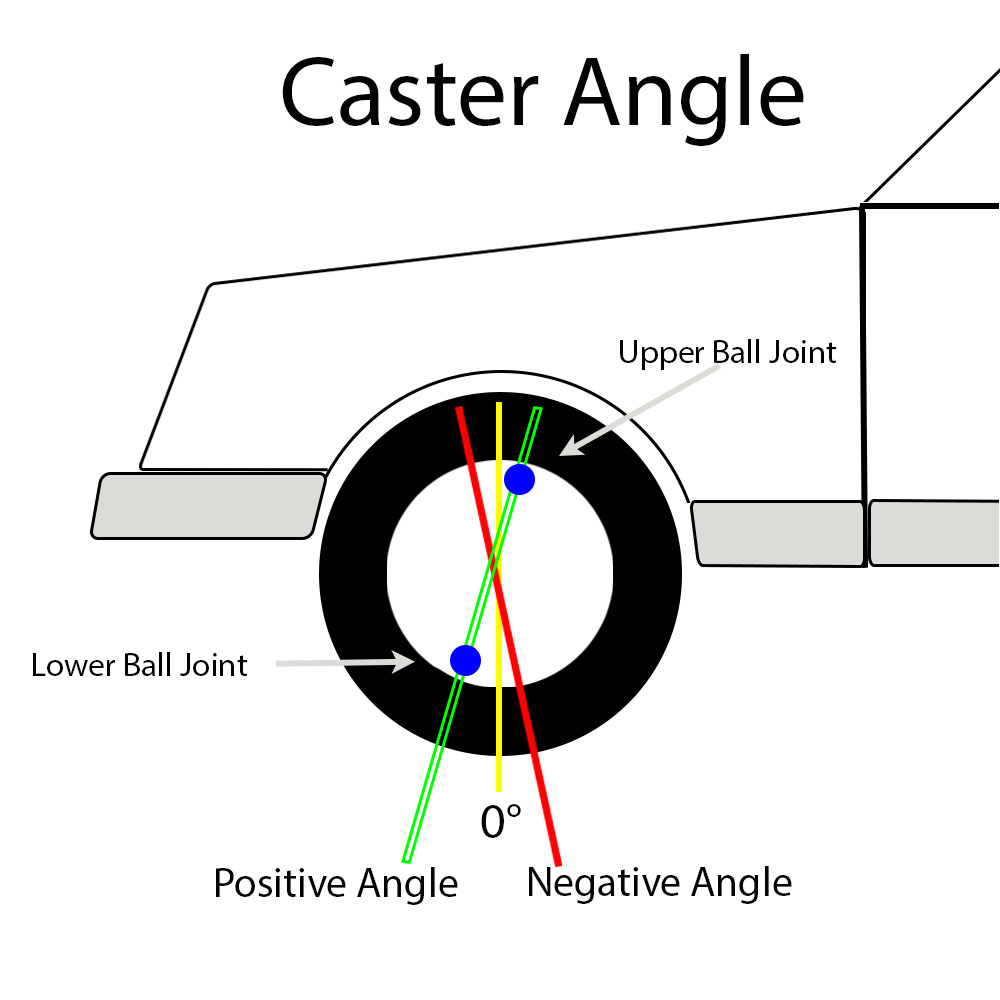
Positive caster (the leaning inclination of the front wheels’ axis seen from the side) is absolutely essential for an automobile, as without it there’s no self-centering and the steering constantly feels like it wants to dart left or right and to keep on going left or right in a turn. Driving it requires intense and constant vigilance, and the need to start returning the wheel once a turn was entered with the same force as going into it. We are so totally used to the self-centering aspect of steering that it feels very odd to not have it and have to return the steering to center with the same degree of input as initiating a turn.
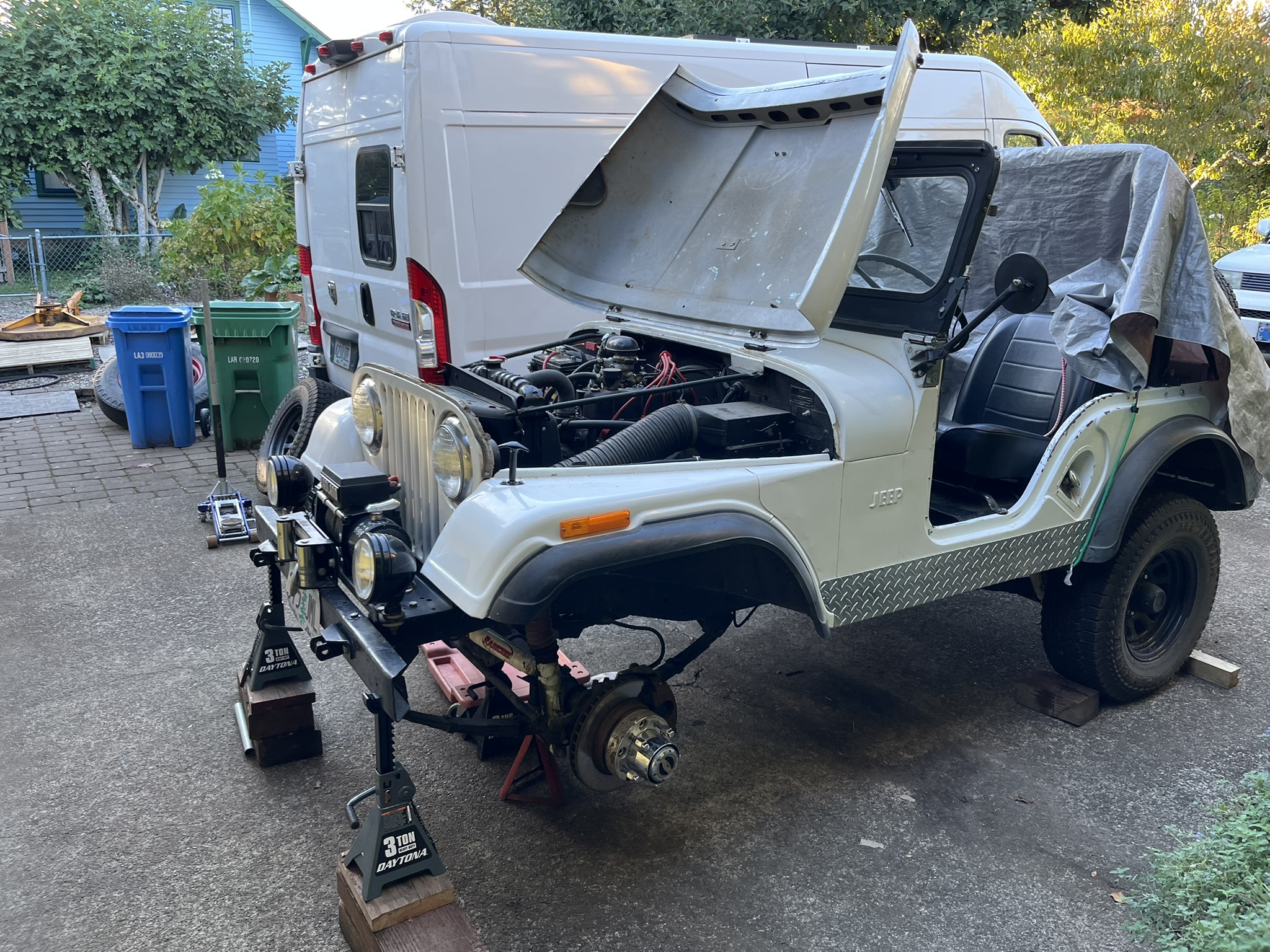
This is not uncommon in lifted CJs, as the lift springs are more heavily curved and throw off the caster of the solid front axle. Fortunately, there is a ready fix, as in caster shims. Having read up on the issue on forums, I had my front end alignment checked which showed just under one degree of positive caster. The recommendation is for 5.5 to 7.5 degrees of positive caster. I didn’t want to go overboard, so I ordered some 4 degree shims from Amazon, took the springs off and set to work.
And yes, this has had a disc brake conversion along with larger drums in the back. I approve!
I decided to remove the very heavy winch in the front. It and the massive steel plate it sat on must have weighed some 150 lbs or more. When you have an underpowered vehicle, weight is the enemy!
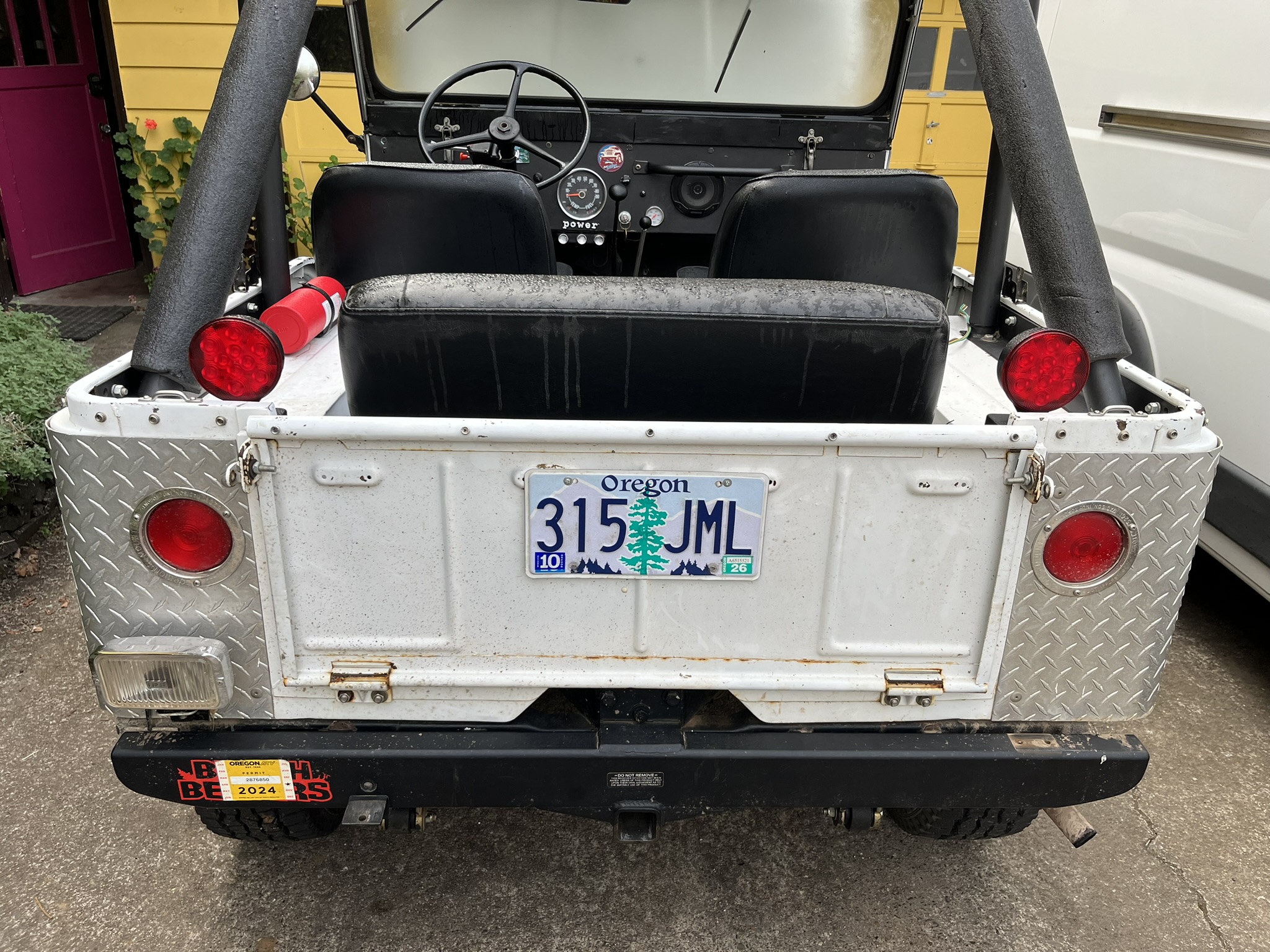
Jumping ahead a bit, I had to take off the spare tire at our camp in the Sierra when someone pointed out that the main steel bracket holding it on had a clean break through it. I drove without a spare (there were others who had them) and have since removed that very heavy swinging affair. Another 100-150 lbs lost. That’s some 10% of the Jeep’s listed curb weight (2,274 lbs.) I swear I can tell the difference in its performance. I’m researching lighter ways to mount the spare and carrying tire goop in the meantime. I may well take that diamond plate off too, as it can’t be light either. Those are towing lights in the bed.
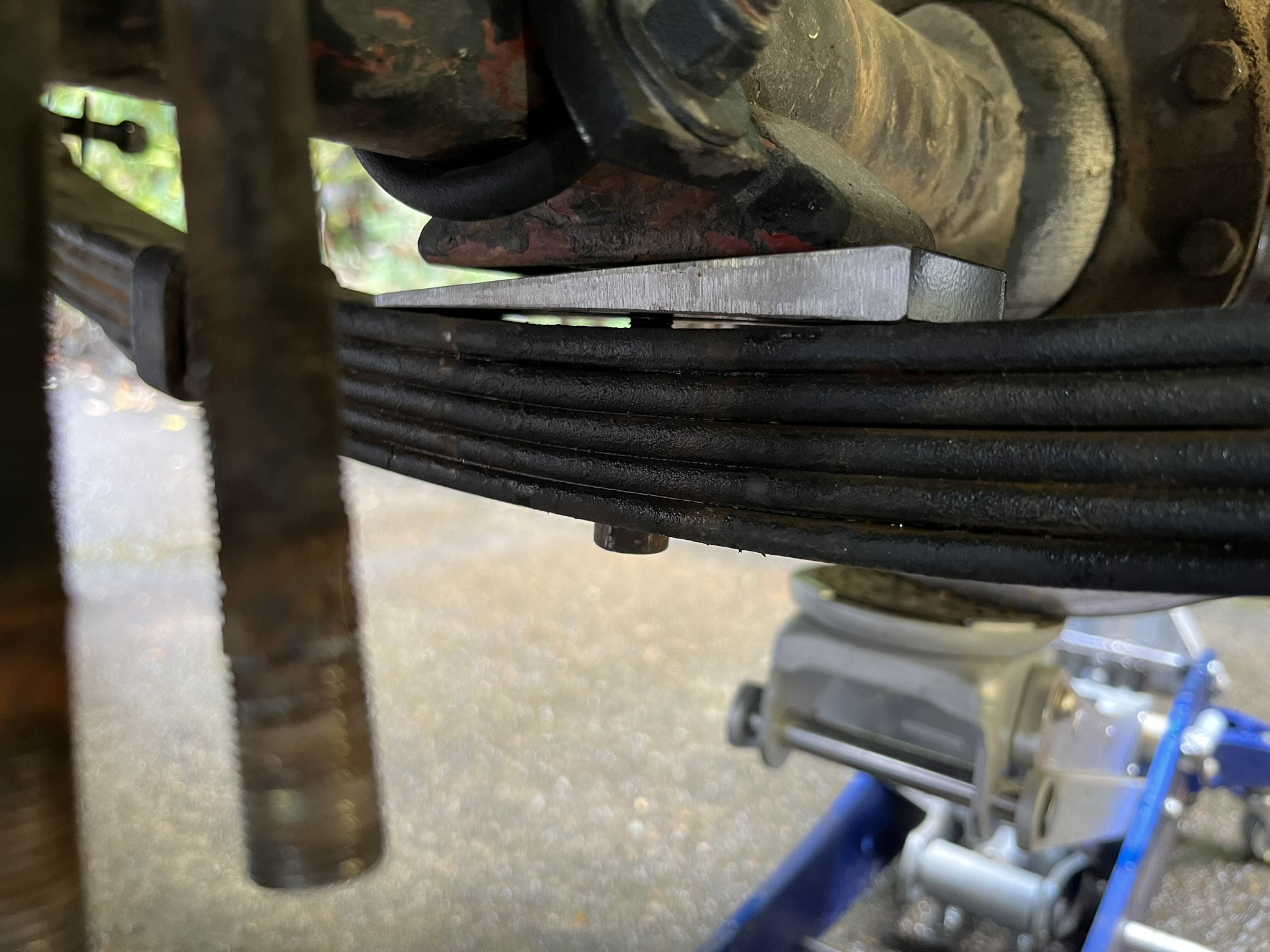
Here’s the caster shim in place before tightening down the U bolt hangers. I also removed the smallest leaf spring on the bottom as I’m not a fan of overly-stiff springs. I am still debating whether to return to stock springs; I don’t like the look of the lift, but it does make it very easy to get underneath on a creeper. Lifts are put on these CJs to make room for big tires; mine are 30″ tall; there’s room for bigger ones. The stock 600-16 tires were 28.3″ tall. The taller tires throw off the gearing; more on that shortly. With its super-short 81″ wheelbase, ground clearance with stock springs is not a real issue.
The result of adding the caster shims is an improvement, but it’s still not nearly enough. The guys on the tour tell me 8 degrees is about right, and I’m only at about 4.8 degrees. So self-centering is only barely felt (or imagined). I’ve learned how to compensate, but I would not let someone take this on the highway. One can’t relax for a second…I will put in bigger caster shims if I keep the lifted springs; if I go stock, the issue is likely moot.
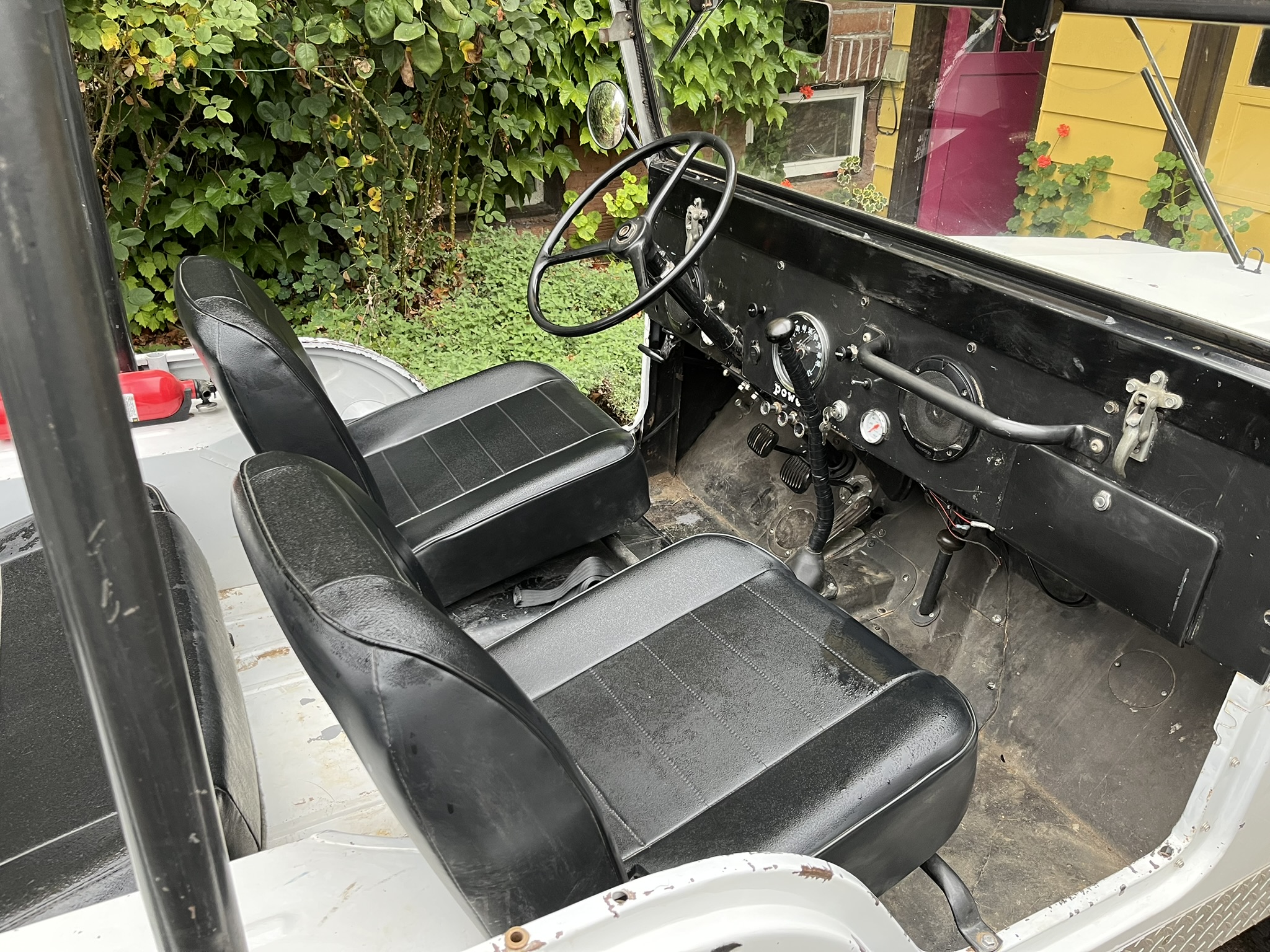
There’s two other steering issues: the original Ross steering is very low geared (17.9:1) with over 4.5 turns lock-to-lock. That makes for very light steering but also very rapid noodling in tight curves. That is, if you can make a tight curve in one pass, as the closed knuckle Dana 25/27 front axles have very limited turning radius. Shockingly so, considering the minute wheelbase. My 159″ wb FWD Promaster turns tighter; seriously. This is why upgrades to open-knuckle Dana 30 axles are popular, as well us upgraded steering boxes, like the variable ratio Saginaw. And of course some upgrade to power steering. I’m going to stay stock for the foreseeable future; it adds to the very vintage feel.
It came with these new seats, BTW, and they are quite comfortable.
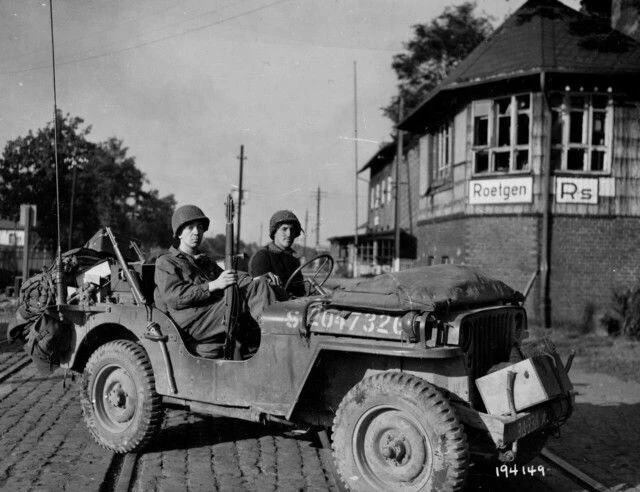
The other big issue is gearing. Now this is a subject that is undoubtedly the most extensively debated, pondered, modified and relevant to Jeeps, especially the old ones. I’m going to try to keep from falling down the Jeep gearing rabbit hole, but here’s the very broad strokes. Contrary to popular belief, the WW2 MB/GPW was not designed to be a serious off-roader. Sure, it could handle lots of challenging terrain compared to 2WD vehicles, but it was designed to be a multi-purpose 1/4 ton light truck. And in Europe, there was very limited need for 4WD, as the continent was heavily built up and there were roads almost everywhere. This is why the German (and other European) military had almost no 4WD vehicles; the Jeep was more a reflection of American than European terrain.
The MB’s 4.88:1 axle ratio and 1.97:1 Low range ratio substantially limit its ability to deal with the kind of steep, rocky and muddy terrain Jeepers seek out. And this is why Willys quickly changed that in its post war CJ-2, which had 5.38 axles and a 2.43 Low range, substantially improving its ability in challenging conditions. Of course, those 5.38 axles also limited its highway speed. The CJ-5 had its Low range ratio reduced further to 2.46:1. Even lower aftermarket Low range gears are a common upgrade (“Terra Low”).
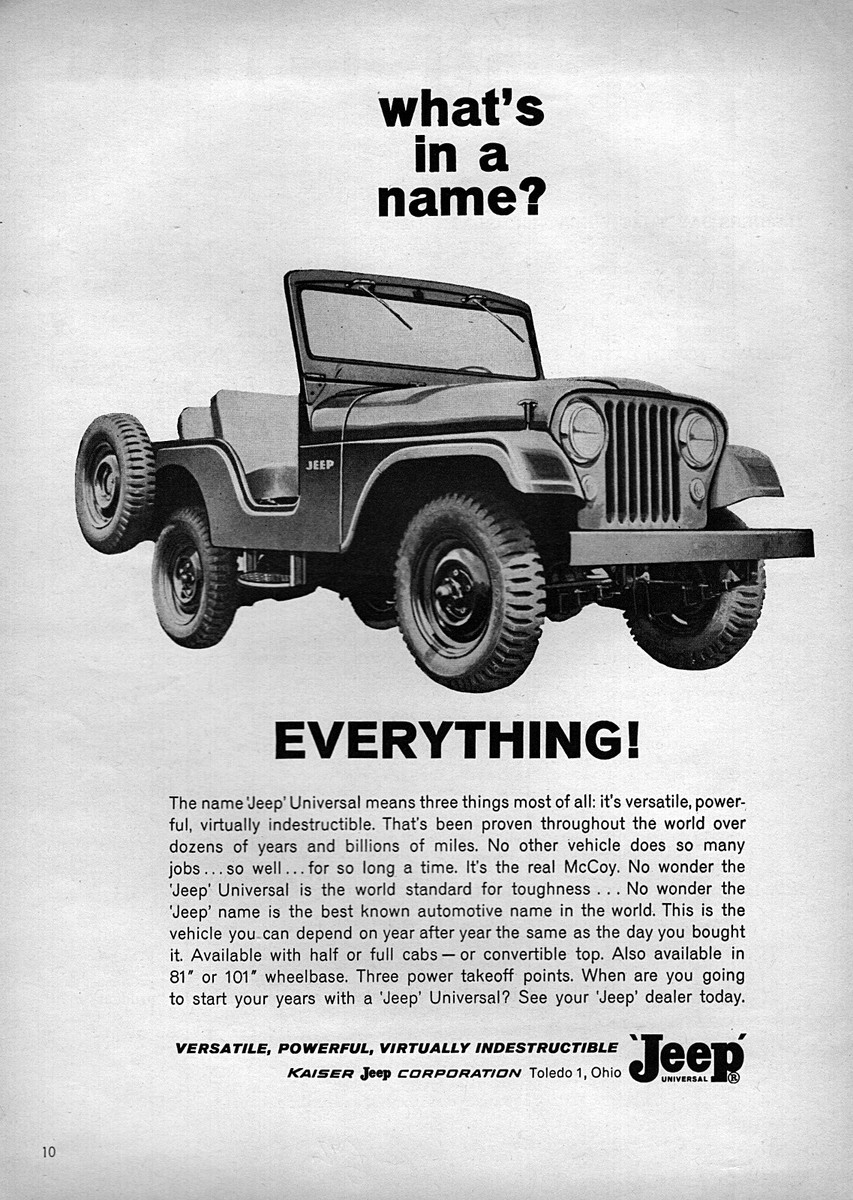
Seeing that the Jeep Universal was increasingly being used on paved highways, in 1963 the standard axle ratio was increased from 5.38 to 4.27 (5.38 was still optional). In order to compensate for that higher gearing, the first and second gear ratios in the three-speed Borg-Warner T90 transmission were changed, from 2.77 to 3.339 (first) and from 1.55 to 1.85 (in second). That leaves a very big gap between second and third (direct); a rather yawning gap with the 30″ tires on mine. This explains in part why the Buick V6 was so welcome when it arrived in 1966, as its much greater torque masks this to a large extent. And why engine swaps of all kinds, including Chevy V8s, were/are so popular.
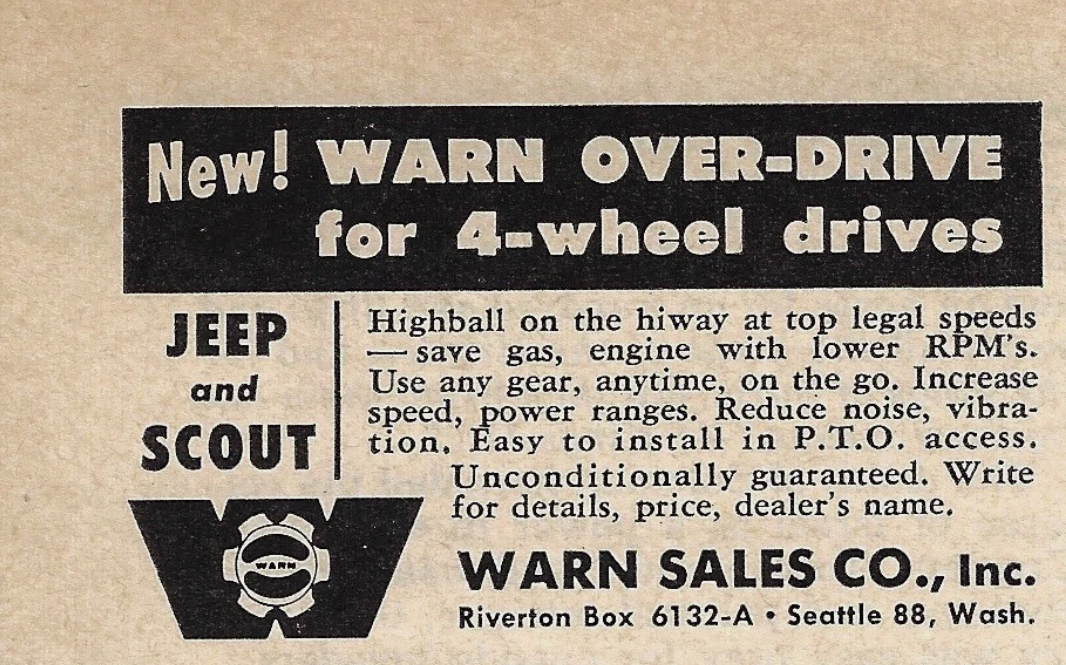
This serious issue of being either under or over geared was addressed back in 1958 by Chet and Norm Thompson who developed a very clever overdrive unit that fit into the rear of the Dana T-18 transfer case. It was sold to Warn, and was and still is a popular addition to older Jeeps that use the T-18 (up to 1972) transfer case. It was made possible only because the post-war Jeep was designed to be used in agricultural use, so it has a provision for a PTO (Power Take Off) from the rear of its transfer case.
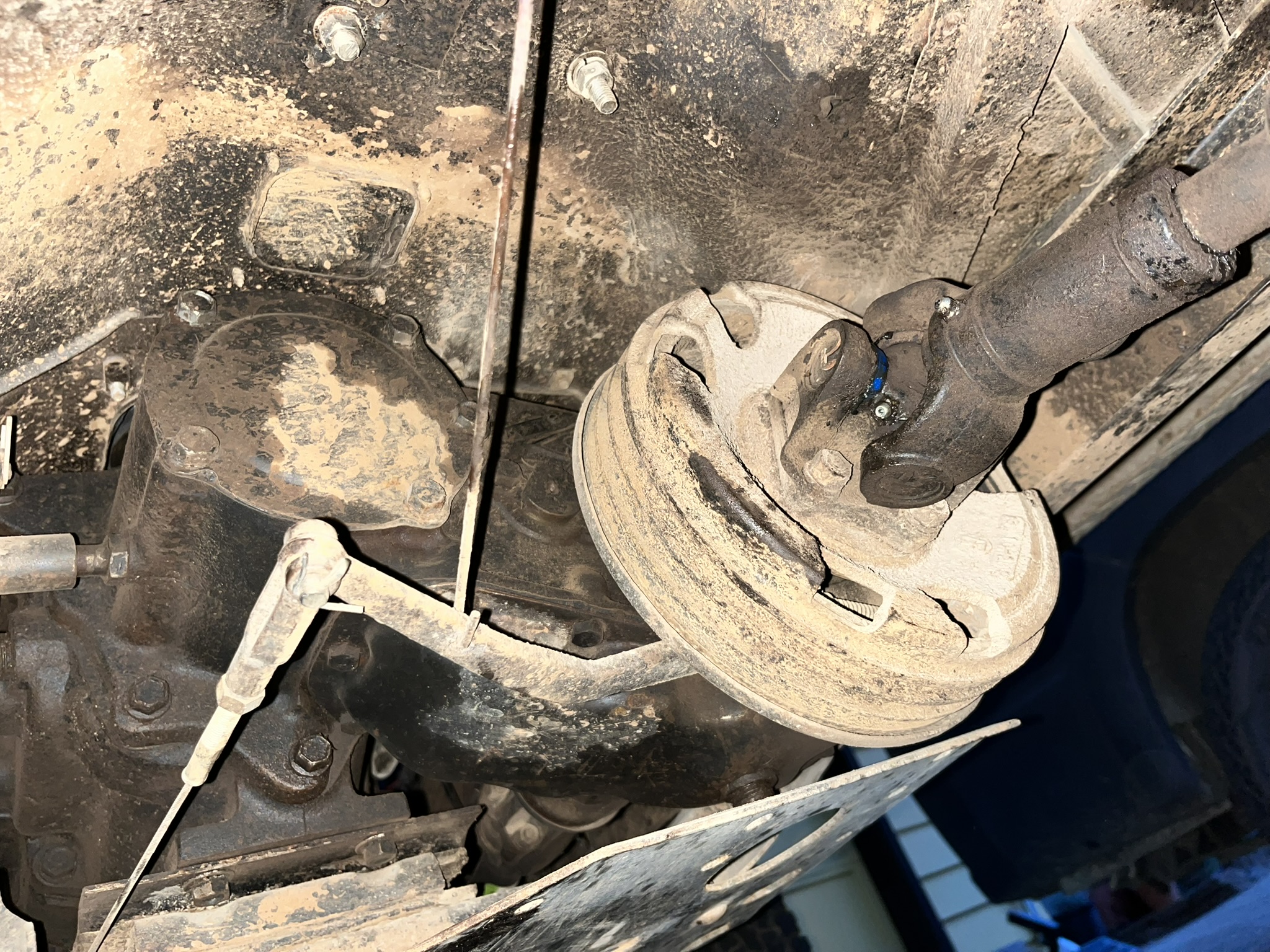
The PTO mounts into the case where that five-bolt cover is on my Jeep. The parking-emergency brake is on the right. I was referred to Hermtheoverdriveguy who has been rebuilding these Jeep overdrives for decades and now also makes a completely new unit under his ATV brand. Fortunately he’s located just a bit north of Portland, so I zipped up and picked up a new unit and a shift kit.
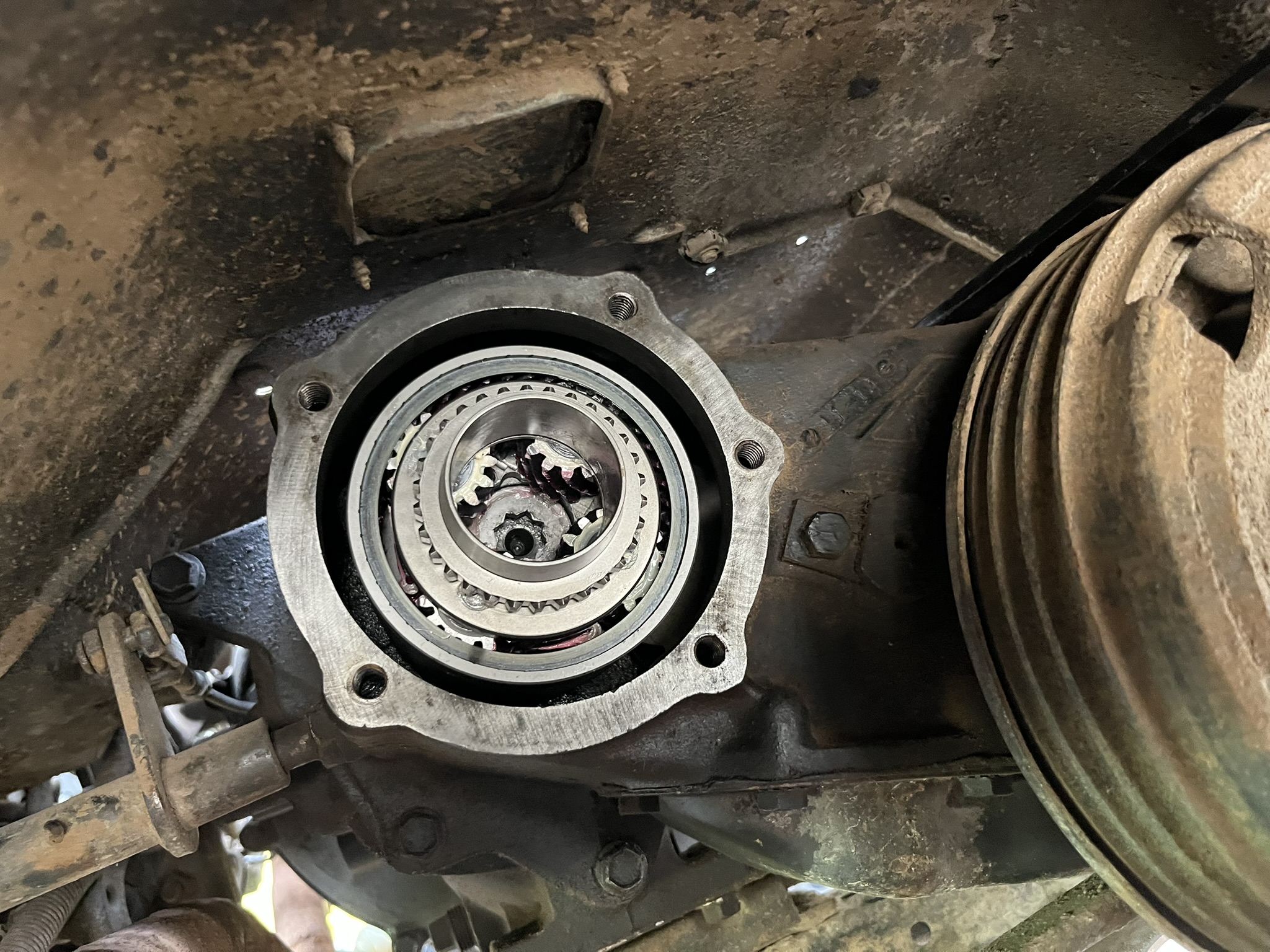
After removing the PTO cover, the main large “bull” gear is removed and the epicyclic overdrove unit slides right into the transfer case. It provides a 25% overdrive.
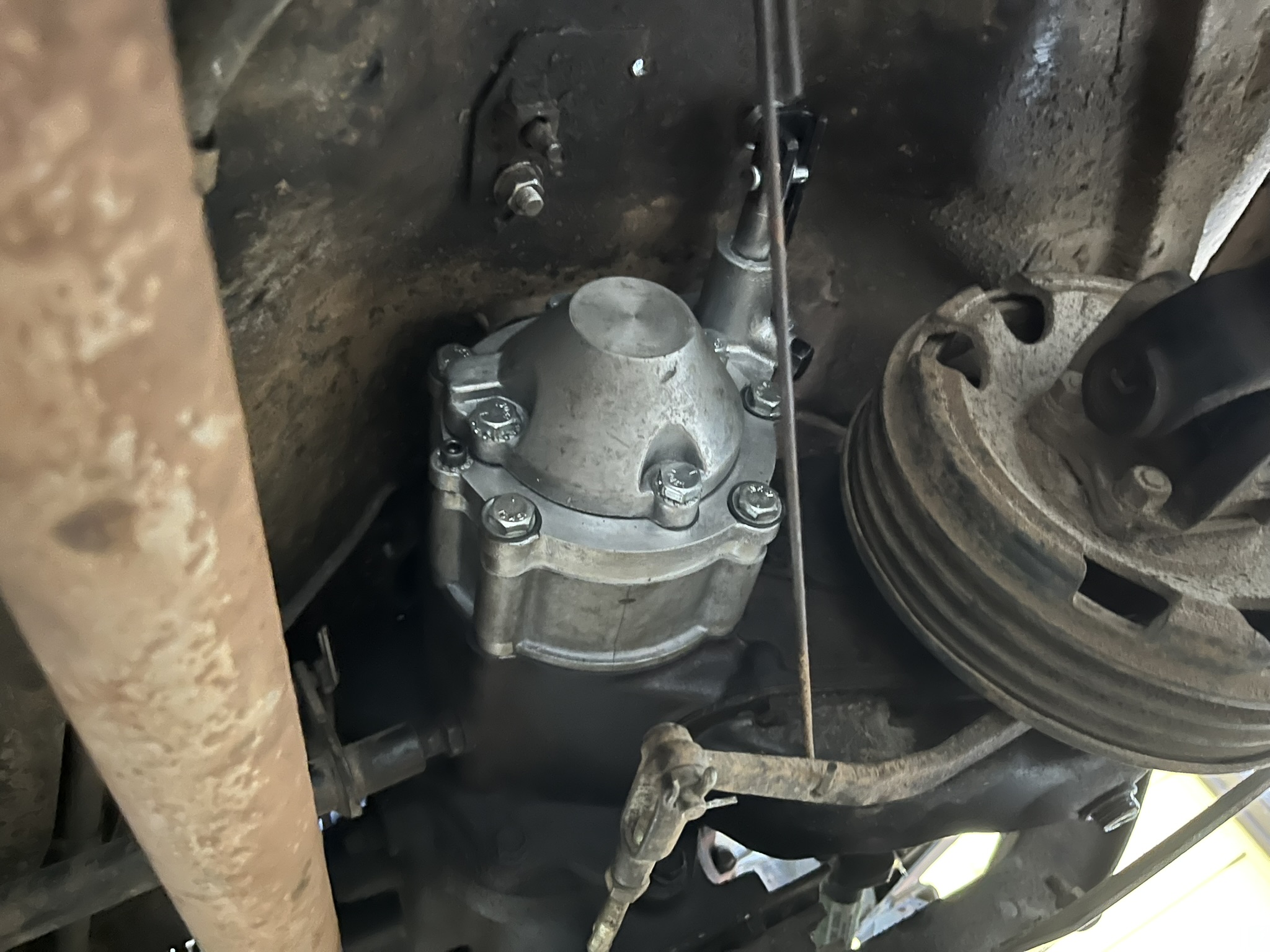
Then the case with the synchronizer and shifter is bolted on. The synchro ring is virtually identical to the ones used in the transmission.
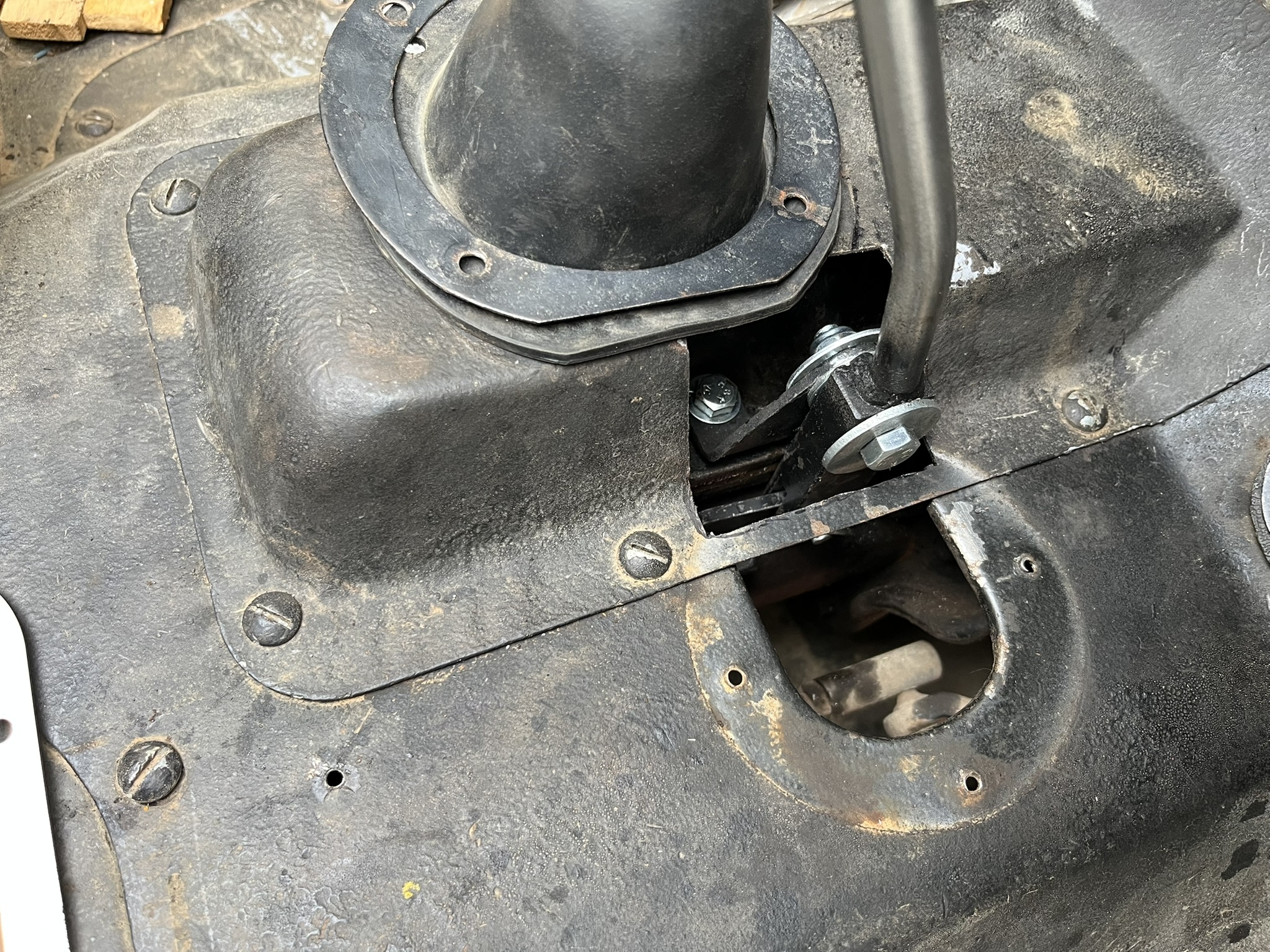
The shifter bolts to the shift tower of the transmission and some of its cover needed to be cut away. It took a bot of improvising.
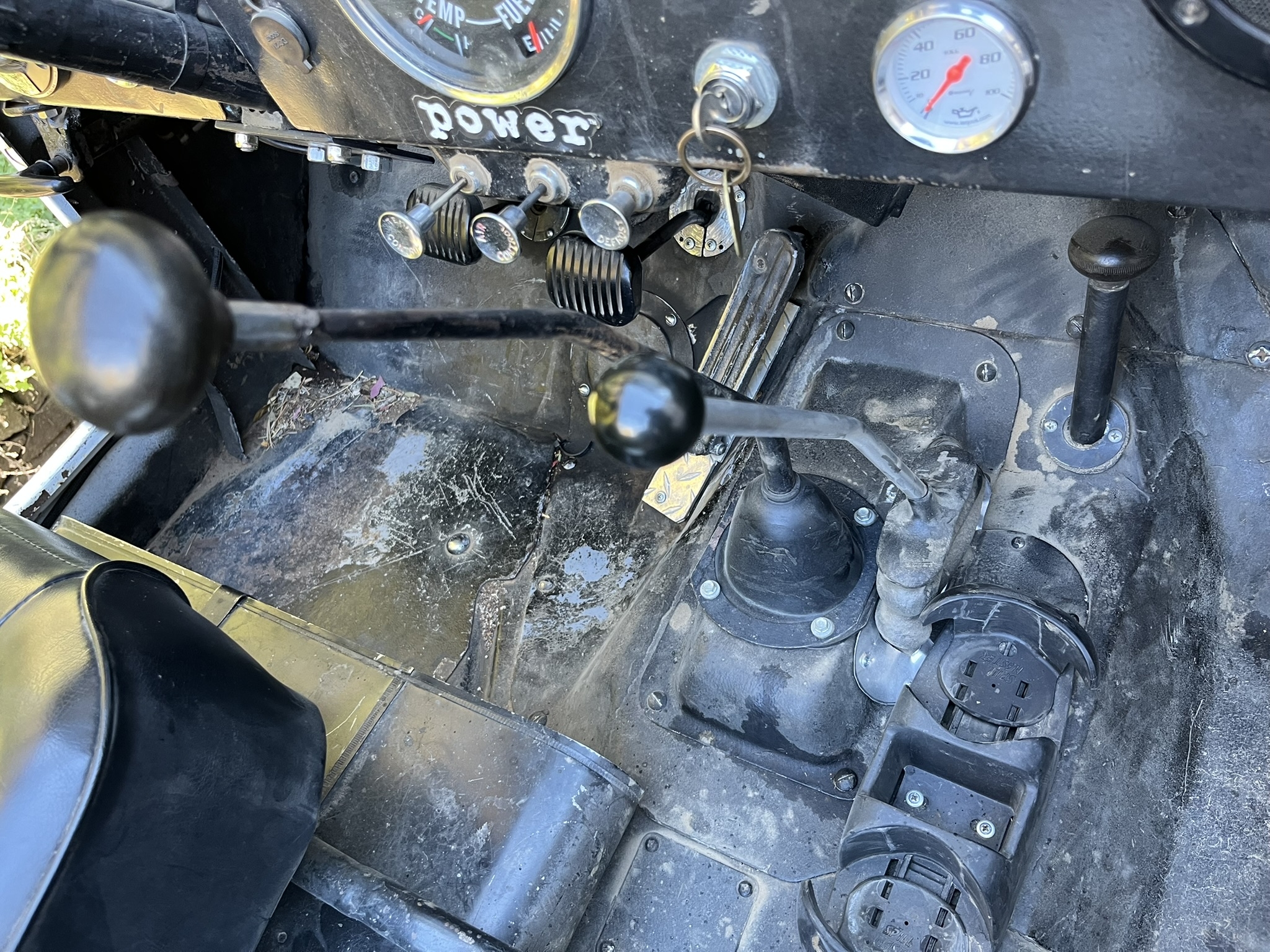
There’s a small boot that goes over the shifter lever. Unlike the Borg-Warner overdrive, which has freewheeling, these units require the clutch to always be used when shifting; forward for overdrive, back for direct, with neutral in between. That took a bit of getting used to from my routine with the BW unit in my F100, which allows essentially clutchless driving except for when starting off.
But what a difference this overdrive makes. The huge hole between second and third is perfectly filled with 2-OD, making a pleasant gear for bopping around in the 20-35 mph range. But with my 4.27 axles and 30″ tires, it’s essentially useless in third gear. Yes, it can be engaged on a very slight downhill, or maybe maintain speed on a perfect flat stretch, but the little four just can’t pull it off. This is why I still would like to have 5.38 axles. But that requires the whole axle, as the Dana 27 doesn’t support the 5.38s. Speaking of highway driving, it purrs along happily between 55-60 mph, so long as it’s flat or almost so, but I’ve seen 65 a few times.
But in Low range, it works well in all gears, allowing a shift up and down between first direct and overdrive in difficult terrain without having to stop, due to the non-synchronized first gear. And it gives six nicely spaced gears, with 3-OD in Low range going up to 35 or more mph. I spent more time in Low range on the trip than most of the others because shifting into first without stopping as almost impossible, and momentum is everything when you’re underpowered. But, yes, I still want 5.38 axles, to increase the crawl ratio for really challenging moments. Or a combination overdrive and underdrive, which I hear someone might be working on. That would solve all my gearing problems.
Update: I’m beginning to wonder if I really do have 4.27 axle gears. According to an online Jeep gearing calculator, based on my axle and transmission gears and 30″ tires, 2000 rpm should equal 42 mph. I drove it today and it was right about at 50 mph. No wonder it’s hard to get underway on a bit of a hill in first gear. I’m going out tomorrow to check for certain (turning the driveshaft and counting wheel rotations).
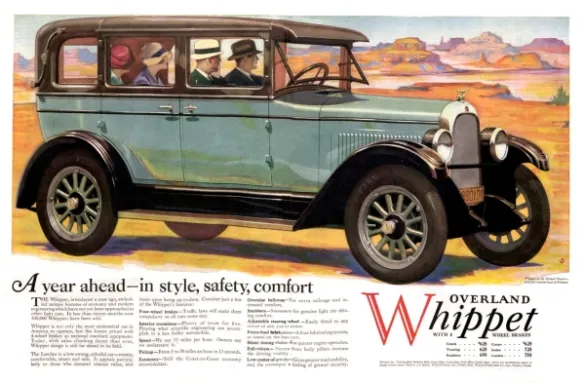
Having fixed (or sort of fixed) those two big issues, let’s talk a bit about that Hurricane F-head four. It is a very direct descendent of the 1926 Willys Whippet’s engine, with the same basic block with 134.2 cubic inches (2.2 L), making it 100 years old this year! Older even than the Ford Model A engine. It had 30 hp back then, and it made Willys the the second best selling manufacturer in 1928 after Chevrolet and Ford. Of course that success was short lived after the Model A came out.
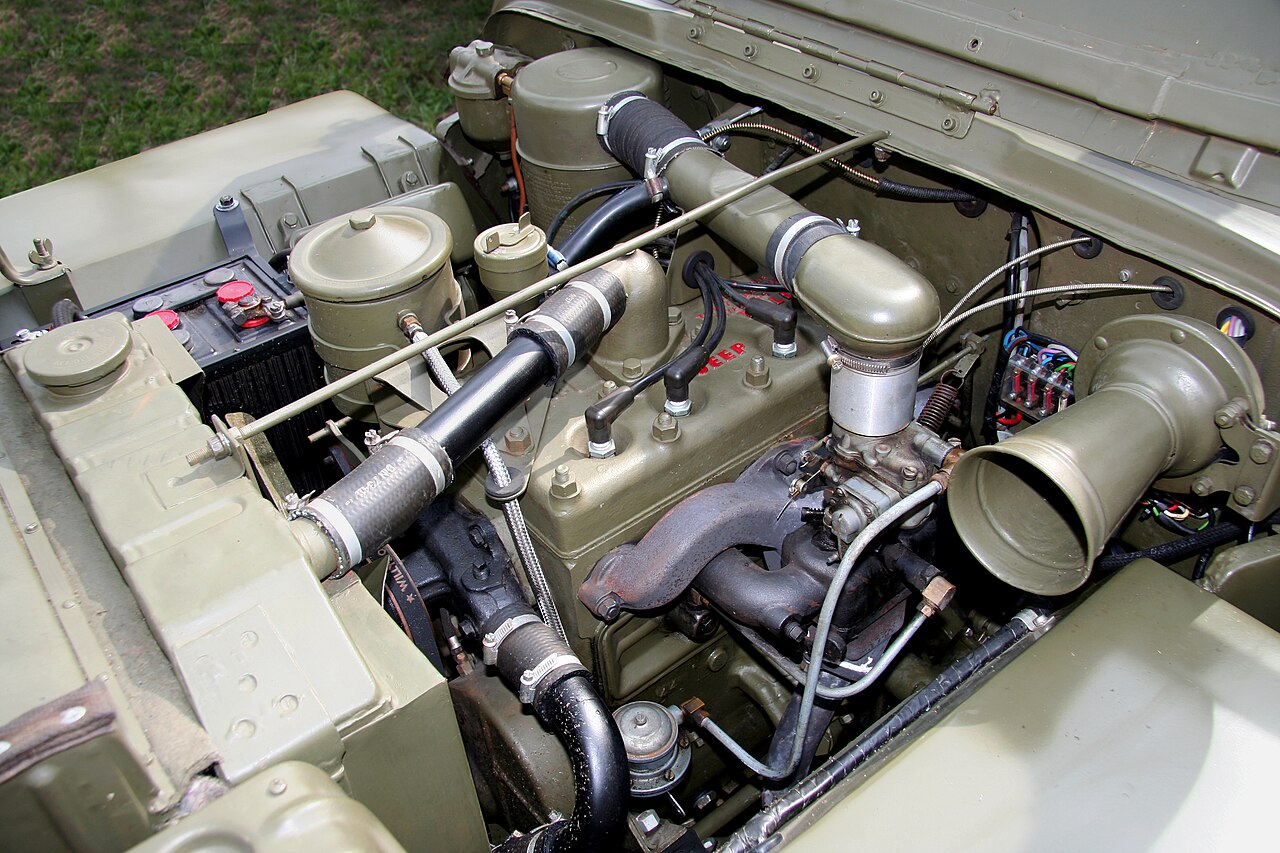
The legendary engineer Barney Roos seriously massaged the flathead Willys four in 1938-1939 to double its power to 60 hp by installing a fully balanced crankshaft, aluminum pistons, insert bearings, a new lubrication system and improved valvetrain. The revised engine was dubbed “Go-Devil” and installed in the 1939 Willys before becoming infinitely famous in the WW2 Jeeps. And it was made all the way until 1962, still being installed in the 2WD DJ.
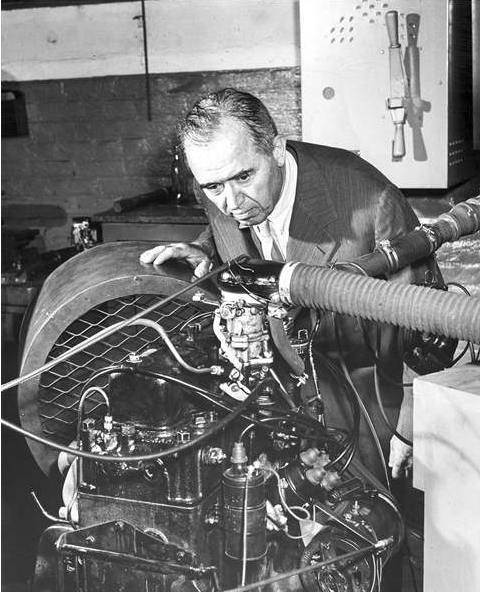
In order to increase power further, for 1950 Roos designed an F-head for it, with massive 2″ overhead intake valves to improve breathing. The side exhaust valves were carried over, with a 1.47″ diameter. The F head was both a cheaper and simpler solution and also allowed a larger intake valve than could have been used in a full ohv configuration due to the very small 3.125″ bore.
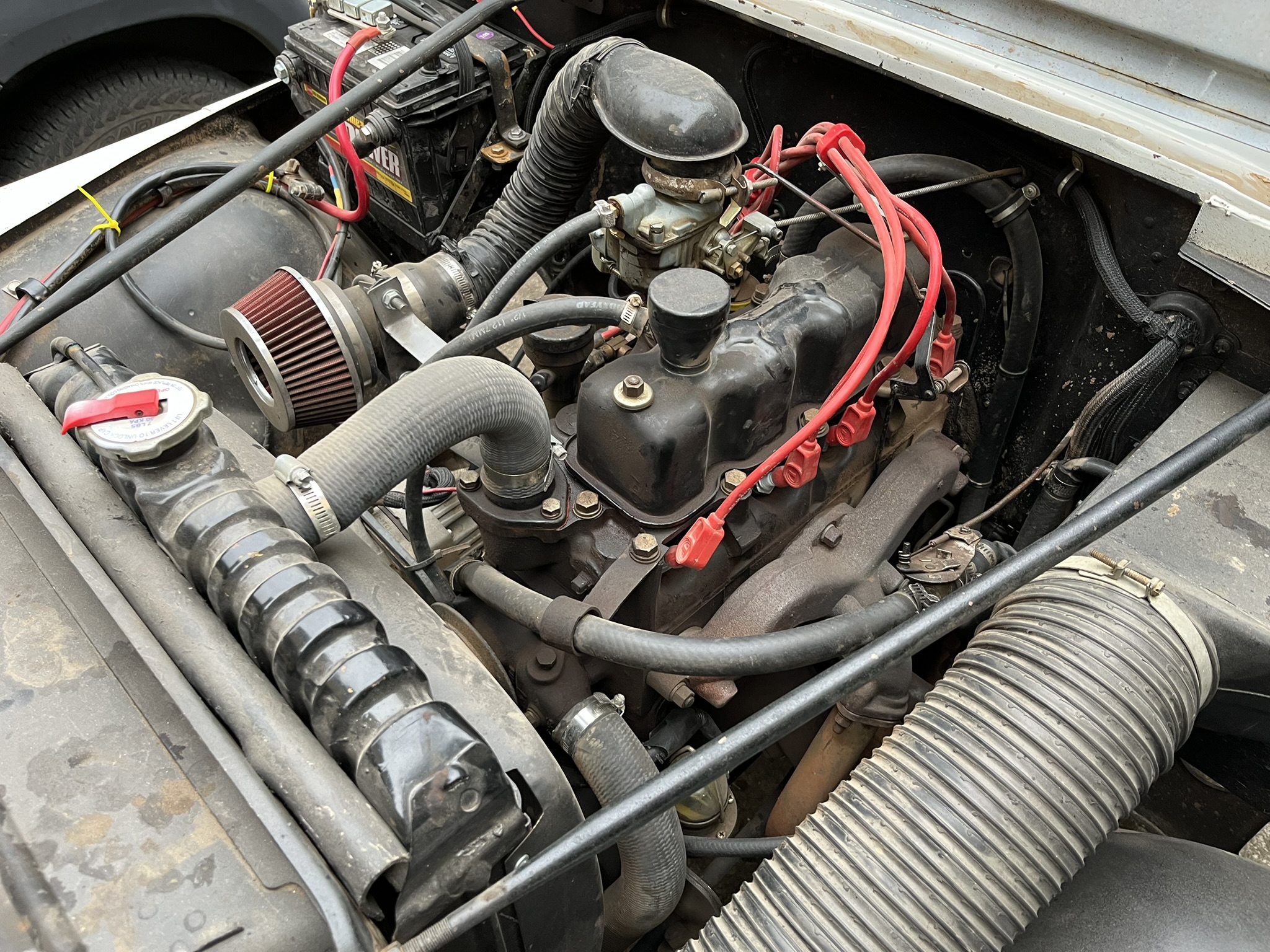
The result is a 75 (gross) hp rating at 4,000 rpm and 114 lb.ft. of torque at 2,000 rpm. I’m guessing its net hp is probably in the 65-68 hp range, as there wasn’t much to be unhooked when running a gross hp test on these. As to its 4,000 rpm hp power peak, I have a rather hard time imaging actually using that, as by about 3,000 rpm it is making itself very well heard (and felt). It essentially has the power characteristic of an old-school non-turbo diesel engine of roughly similar size, say a Mercedes 240D (67-72 hp; 104 ft.lbs. torque).
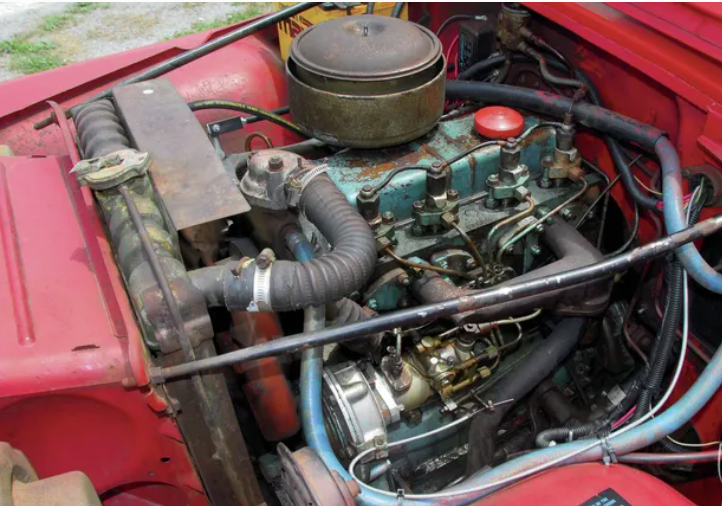
Speaking of diesels, the CJ-5 was available with one; the Perkins 4-192 (192 CID; 3.15 L) was optional from 1961 through 1968. It cranked out 62hp at 3,000 rpm and 143 lb-ft of torque at 1,350 rpm, so performance was roughly on par with the gas four but it had even more lugging power at low rpm and got better mileage, not surprisingly. It was mostly targeted to the export market but some were sold in the US too. I’d have sprung for one of those!
With its massive 4.375″ stroke, the Willys four will keep chugging along down to some 800-900 rpm under load, which can be very useful at times. It is a tractor engine if ever there was one.
As to the claimed 1200 miles on a rebuilt engine in my Jeep, I have every reason to believe it, not just from an external visual point of view (shiny newish bolts, etc.) but from the acid test: a compression test. The factory specs for new are 130-140 psi. Mine came in at between 142 and 144 psi on all four cylinders. It has excellent oil pressure, even at idle. It starts instantly and it runs about as well as one could imagine this hoary old hunk of cast iron to run. And it is solid; it weighs 475 lbs, or some 100 lbs more than the Buick V6 with almost twice the displacement.
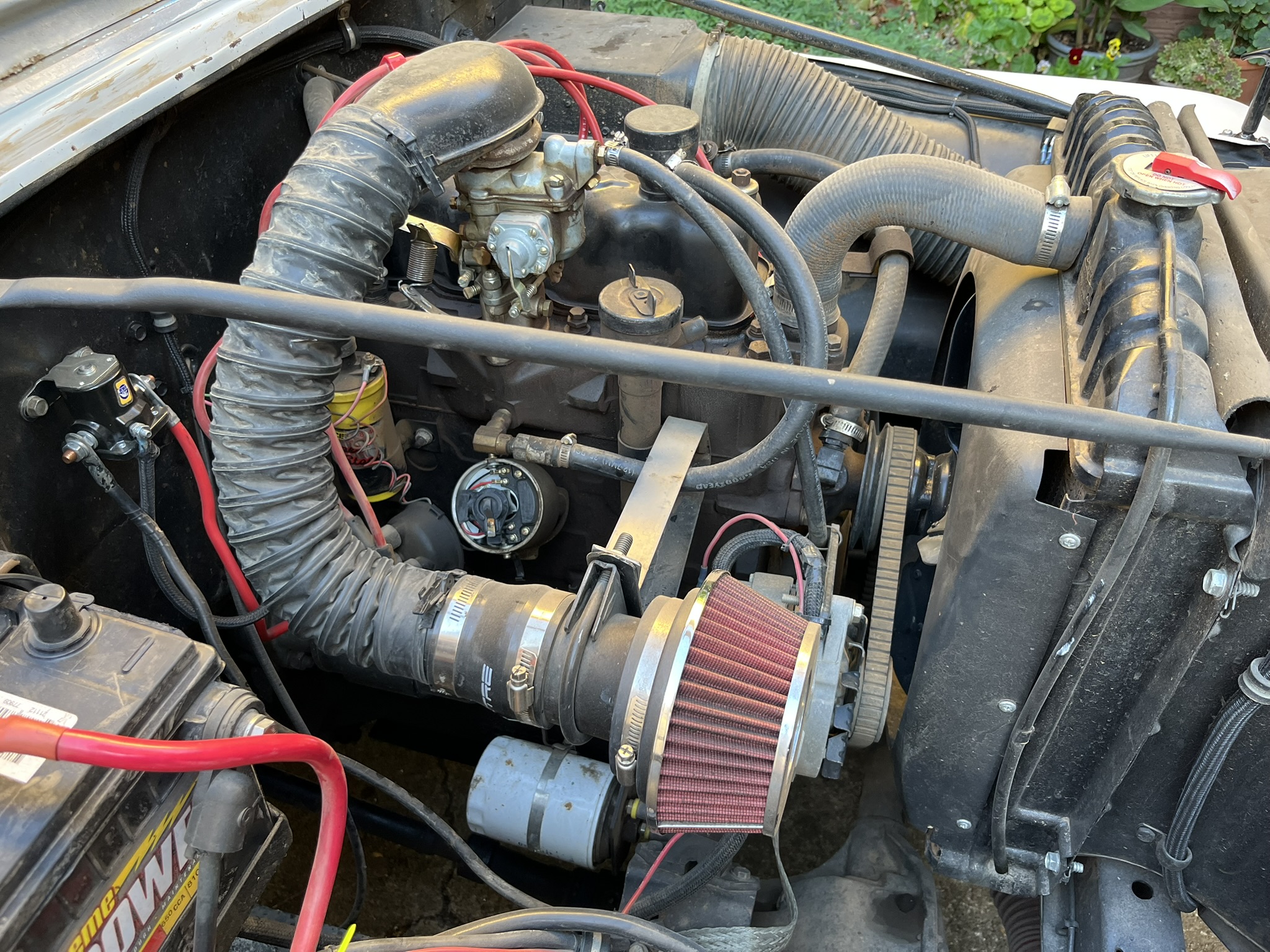
The carburetor is an aftermarket Solex, a popular replacement for the original Carter YF, which came with the Jeep and probably needs a serious rebuild. The air cleaner is non-original as well as the spin-on oil filter.
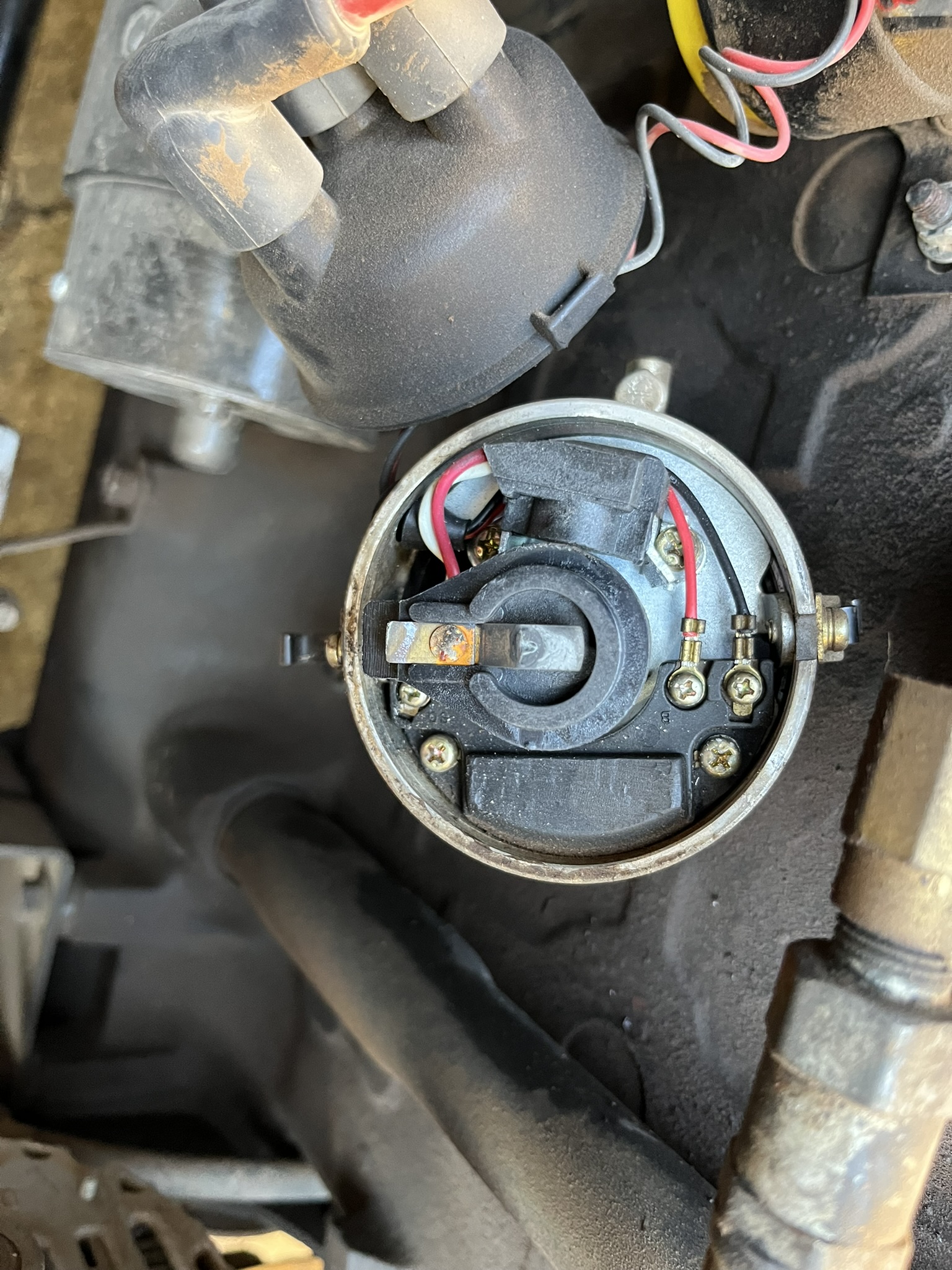
The distributor is also aftermarket, a OMIX-ADA fully electronic unit. This is a complete distributor, not a drop in module like a Pertronix. It works great. Obviously there some who are skeptical but then some have been in use for 15 years now. Curiously, my Jeep came with two more of these in boxes, along with the original Autolite unit. I brought a spare along on the trip just to be safe.
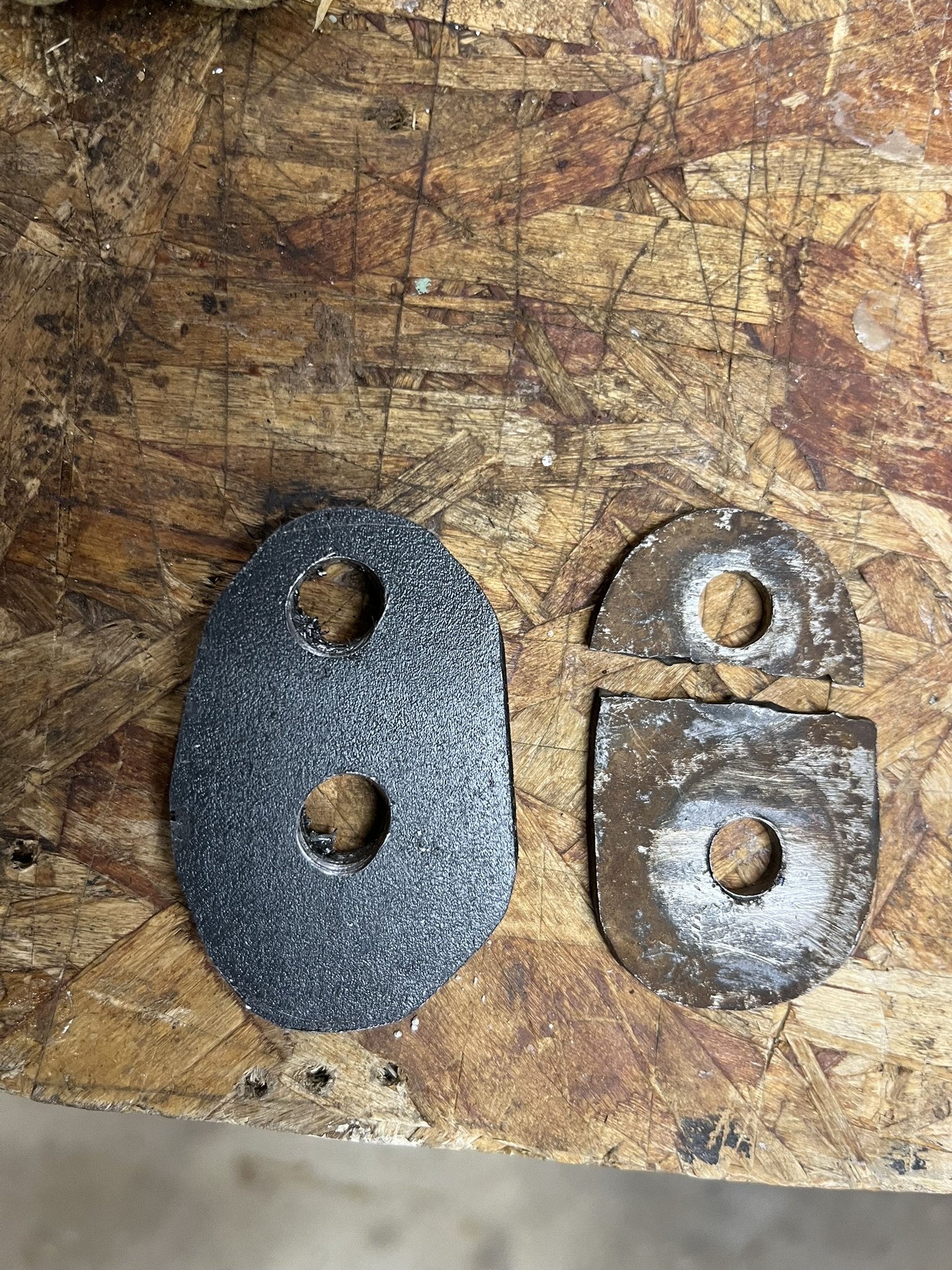
The alternator was shaking like crazy at idle and when I looked closer at its mount I noticed that the small mount spacer was broken in two. I crudely fabricated a much thicker one. Given the inherent vibrations of this engine, I don’t want the alternator to fall off.
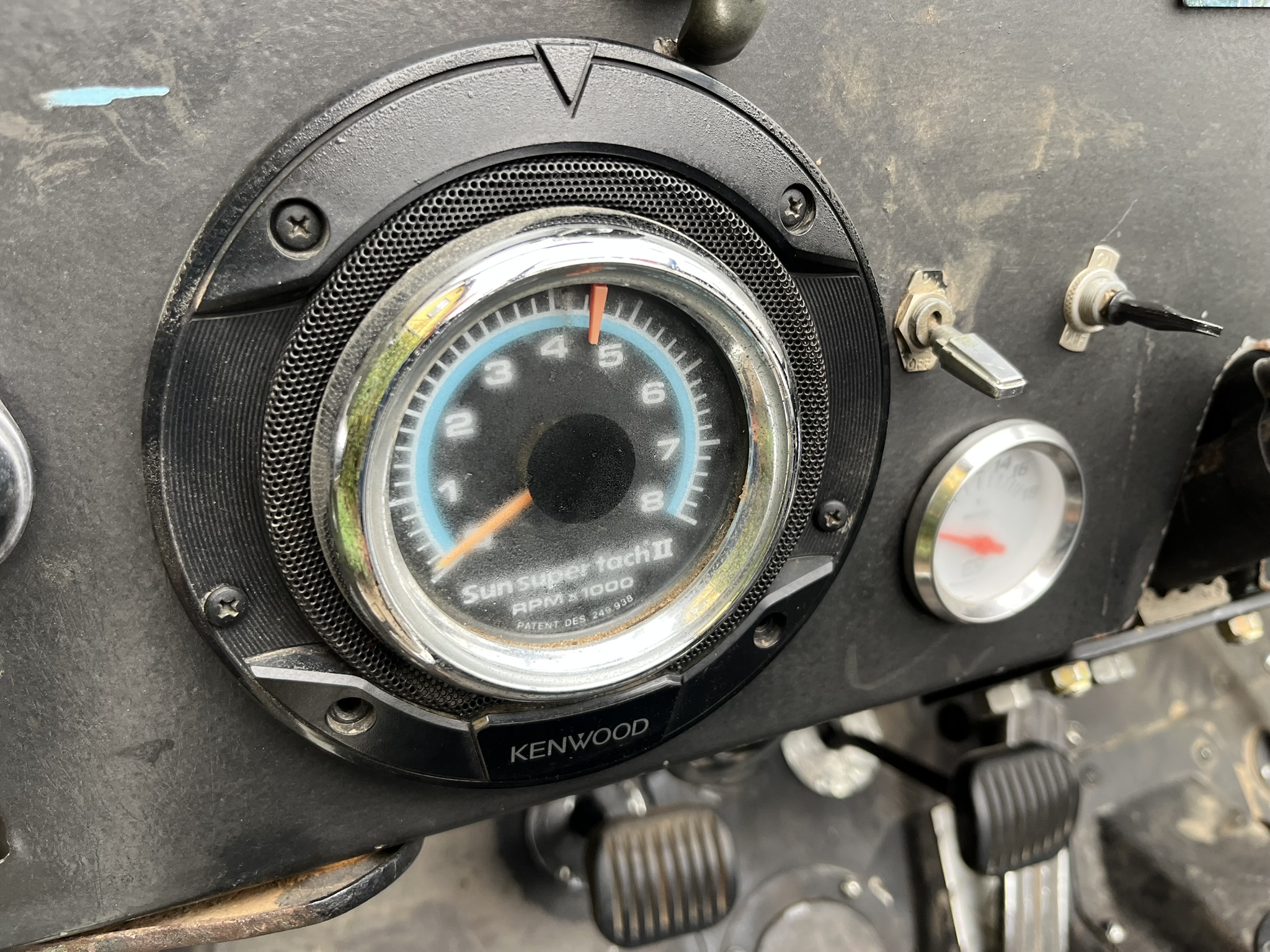
I had a couple of days left before leaving to tidy up a few other issues, including tearing out a radio/CB unit and antenna, and installing the Sun tach from my F100 into one of the speaker grilles. I did an oil and filter change and a complete chassis lube (there’s a LOT of fittings) as well as greasing the speedometer cable (it still flutters below 35 mph). I drove it around town and to our nearby hiking open space. I enjoyed driving it in the beautiful warm late summer weather we’ve been having; even if the steering wasn’t yet right the overdrive made it so much more pleasant to drive.
I was planning to leave on Saturday (10/3). On Thursday the starter drive suddenly refused to engage, the motor just spinning away. Oh no! I took it out and the Bendix drive was jammed solid. I called our Auto Service Parts depot, the biggest parts place in the area and asked about a replacement. “Sorry, there’s not even a listing for these in the computer” (they are available from some old Jeep supply dealers). But she gave me the number of a starter and alternator rebuilding shop. I took it to them, an old school shop with rows of starters and alternators piled on the shelves. One of the two proprietors confirmed that the drive was jammed. He looked up the part and said that IF the freight delivery came through, they could have it for me tomorrow (Friday). IF. So now my whole trip hung on a freight delivery.
But then an hour or so later, he called me and said that he had found a very good used drive unit on their shelves and I could come and pick up the starter. Whew!
On Friday I packed my recovery kit and plenty of tools, overalls, and the usual assortment of little odds and ends like wire, zip ties, Gorilla tape, extra oil and water, and…crossed my fingers. I hooked up the Jeep behind the van, disconnected the rear U joint for the long 550 mile trip and on Saturday morning hit the road, not without a bit of trepidation. That was not misplaced, as it turned out.
But as I drove down, this is what I was anticipating.
Stay tuned for Part 2.
Related CC reading:
The History of The Curious F-Head Engine by me
Curbside Classic: Willys Jeep CJ-5 (1955-1963) – The Making Of An Icon by me
Curbside Classic: 1945 Willys Jeep MB – The Icon Of Freedom by me























This looks really fun, and you got a good one for sure. I have almost no Jeep experience, so I learned a lot here. I had no idea that lifted Jeeps had to run so much caster, and that overdrive unit is a lot easier to install than I expected; kudos to the guy who found that niche and designed it.
Nice Jeep, and well-bought, I think. I hope you have gobs of fun with it!
A wonderfully engaging write-up, and I learned a great deal from you today, Paul. Thank you again for all the times you’ve been my “teacher”!
Power can be cured with mild boost.
True that. A bit easier said than done, but it has been done. Right now optimizing the gearing is more important.
Well that’s a darn good read and a very well chosen classic. Takes me back to the long rides in the CJ2A not too mention my own Willys misadventures.
Disk brakes removes one of the scariest parts which is good. From my recollection the gearing was never right simply because there wasn’t enough of them. There were some challenging hills for the CJ2A where low first was too low and it didn’t have the grunt to do low second. Any hard pulling with my Willys pick up required low. At the time I think the SM420 or T19 44 speed swaps were the best idea but I look forward to hearing about your experience with the overdrive unit.
Very cool that a 60 year old vehicle is heading off road still!
From my recollection the gearing was never right simply because there wasn’t enough of them.
That’s the heart of the problem; the three speed simply doesn’t cut it for the reasons you stated unless a big high-torque engine has been swapped in. The overdrive is a very effective BandAid in most situations and yes, those old truck four speeds are popular, but what it really wants is a modern five (or six) speed with a low first gear. The Aisin-Warner AX15 (used in more modern Jeeps and many others) with a lowered first gear (by Novak) would be an even better swap, although it can get a bit complicated with the clutch. If I was to swap in a transmission, that’s what I’d go for rather than one of those very heavy old truck 4-speeds.
What a cool Jeep, Paul! I am sure you will have a lot of fun with.
I have always disliked lift kits. If done properly they are okay (I guess) but the case of this Jeep shows the problem with lift kits. I am also not a huge fan of big tires. Just like it is said in the text, big tires change the overall gear ratio to one that is too high, making smooth takeoffs difficult.
When I was a kid, my dad drilled it into me that a car was perfect from the factory and that we should endevour to keep it that way. My present car is an example: it is completely stock except for the invisible performance tune.
Agreed. I’m looking to go back to the stock style wheels and tires and stock springs. I wouldn’t mind a 1.25″ or even 1.5″ lift, but those aren’t even available unless custom ordered. Big tires are of course helpful in some really difficult terrain but I’m not looking to do that; I’m happy to stick to terrain a stock Jeep can handle.
Thanks for the interesting story. I see lots of older and newer Jeeps running around but don’t know much about them. The F head design was used by Rolls Royce on their earlier engines so you’re in good company. I don’t have any interest in running around off road, but I’m looking forward to part two.
How fun! The CJ-5 has long been my favorite of the Jeeps, and you found a really nice one. Though I will confess that I would have preferred a newer one with the AMC six for the extra torque. OK, a 304 would be fun too.
This was a very educational read for a guy not well schooled in these. I can’t wait to read how it acquitted itself!
Your “buy an old Jeep and have it ready for a jeep event” adventure reminds me of auto journalist David Tracy’s Moab projects which have included a rusty flat fender Jeep, a rotten DJ5 and most recently building a Willy MB completely from parts bought off eBay. Being CC and buying your Jeep in La Pine means you did it with no rust and minimal drama.