
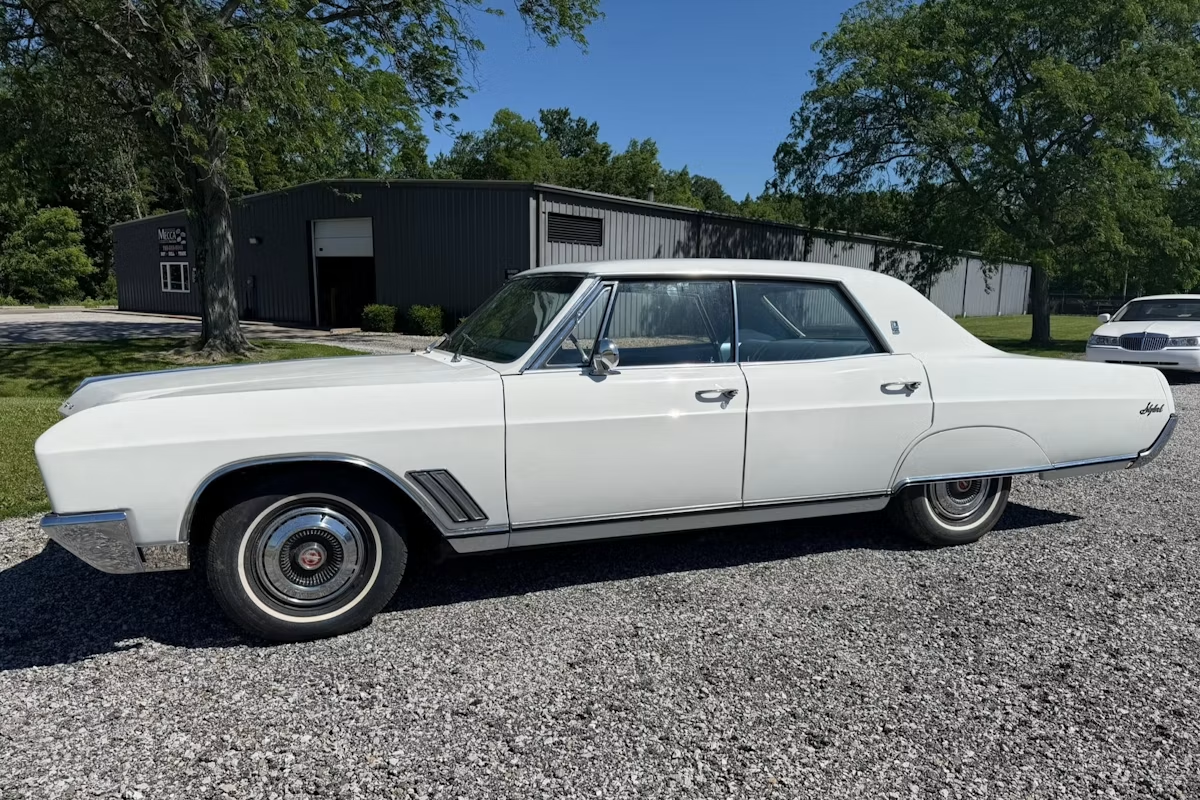
In the 1950s and 1960s, full-size four-door hardtops were almost universally great-looking cars that sold very well, but for some reason, that magic never quite spread to General Motors intermediates. Whether it was because of their comparatively truncated length or a price tag that started crowding models on the full-size side of the showroom, sales were tepid, at least by GM standards. Maybe it’s that relative rarity that makes them so intriguing today, as this 1967 Skylark so eloquently suggests. It was bought new by the seller’s grandmother, and is now being auctioned on Hagerty Marketplace in Bloomingdale, Indiana.
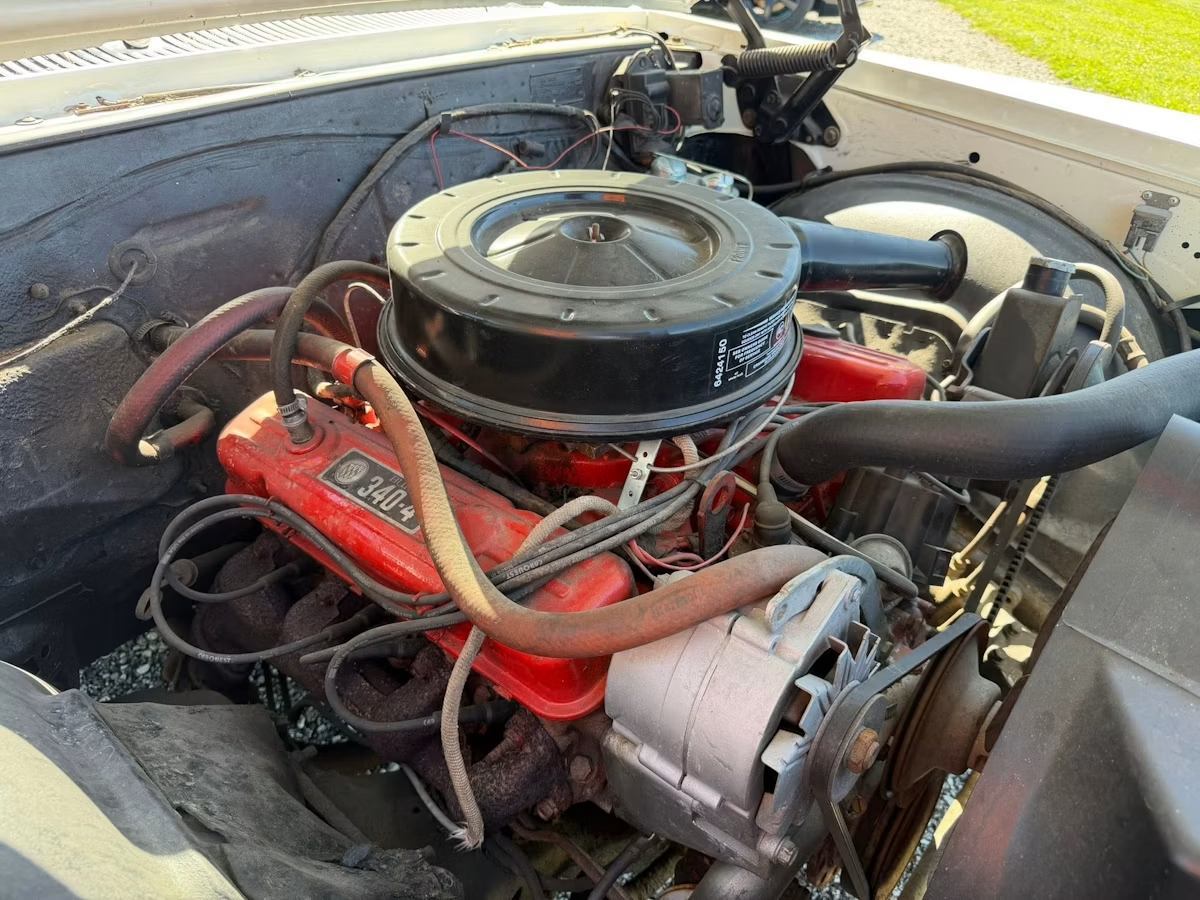
Owning a 1960s Skylark is a lot like having a secret handshake: There are a lot of little secrets that elicit nothing but blank stares, even from car people. One of those “secrets” is the engine, a 340-cubic-inch Buick small-block V8. You can imagine the confusion; the only 340 that most people have heard of is Chrysler’s giant-killing small block. But Buick fans know that it was also a two-year-only enlargement of the little 300, which grew to 350 cubic inches in 1968.
This hardtop has the top dog, the 260-horsepower four-barrel variant with a premium-fuel-drinking 10.25:1 compression ratio. Trust me as the owner of a ’65 Skylark with the 300 four-barrel; the two-speed automatic, tall highway gears, and a fairly high compression ratio conspire to ensure that you can’t get away with anything but the good stuff at the pump. Still, the little Buick will reward you will plenty of torque and reasonable fuel mileage (around 17 on the highway). The Super Turbine 300 automatic also had, for the last time in 1967, a “switch-pitch” torque converter that used an electromechanical switch on the carburetor to do exactly what it said: switch the pitch of the stator blades in the torque converter for a more aggressive stall speed during heavy acceleration (and at idle for less creep).
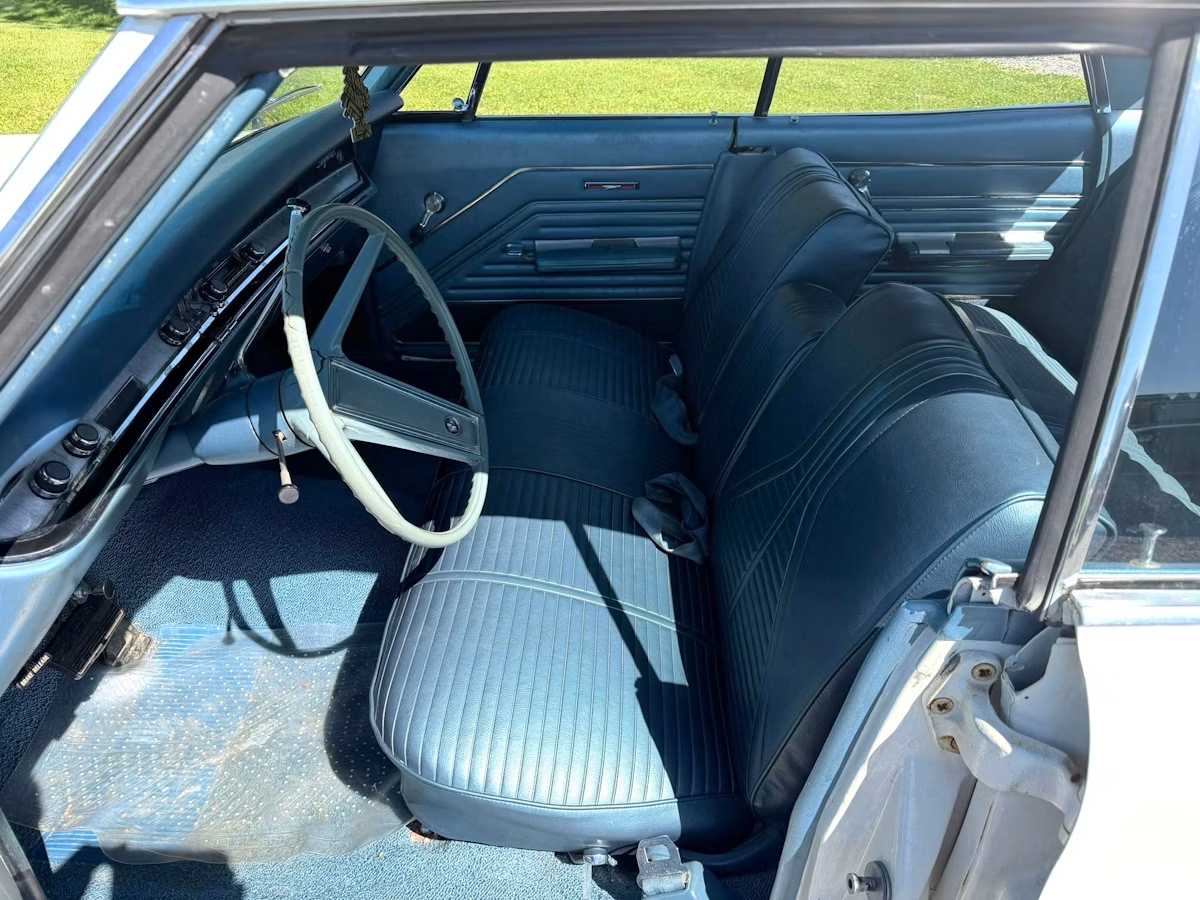
The seller of this Skylark recently inherited it from his grandmother, who purchased it new. Unfortunately, there is no documentation to verify that claim, but the mileage is claimed to be an original 76,300. Given that the upholstery looks original, that may very well be accurate; all-in-all, it doesn’t look like a 176,300-mile car.
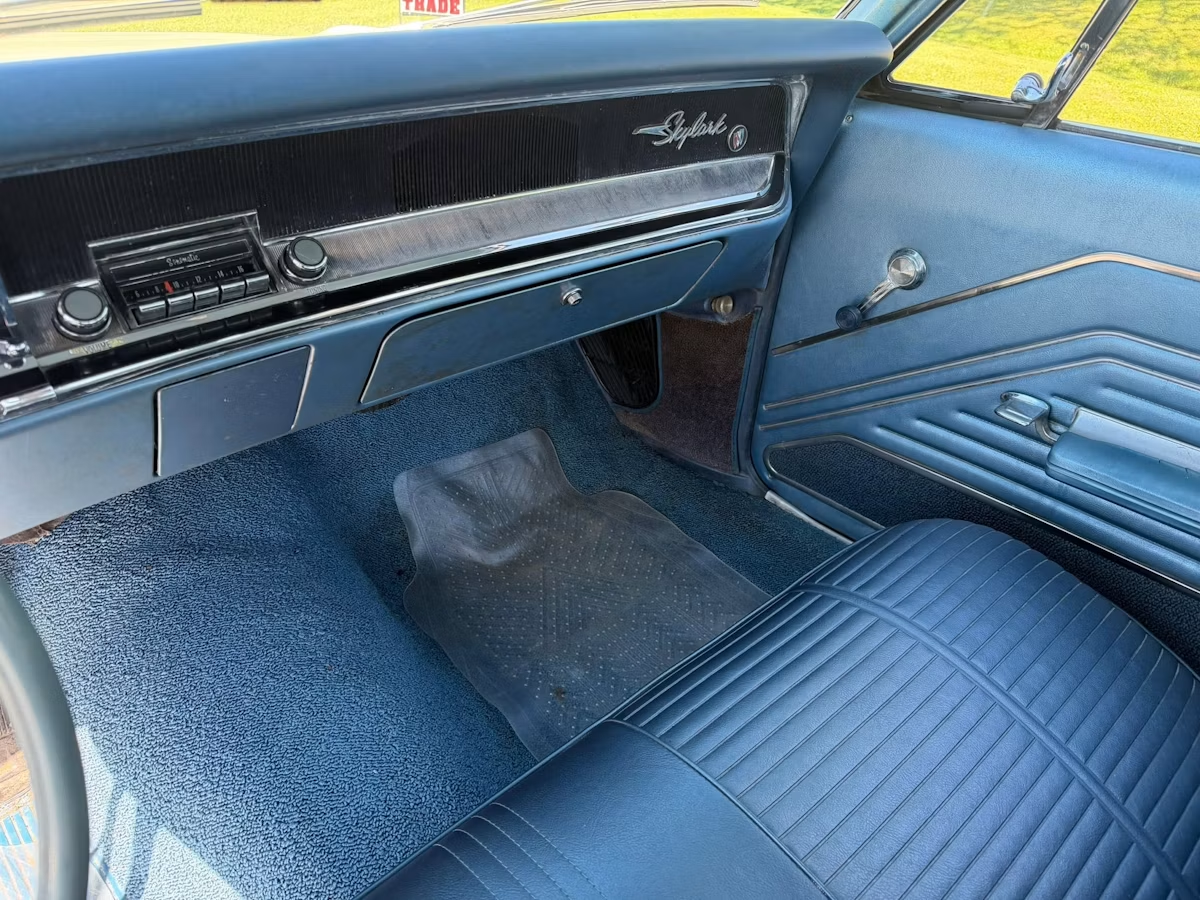
There is some fading on the kick panels and discoloration on the dashboard, but this blue interior is still inviting potential new owners to jump in and drive across a state line or two. It has a new master cylinder, radiator, and tires, so it should stop, stay cool, and roll.
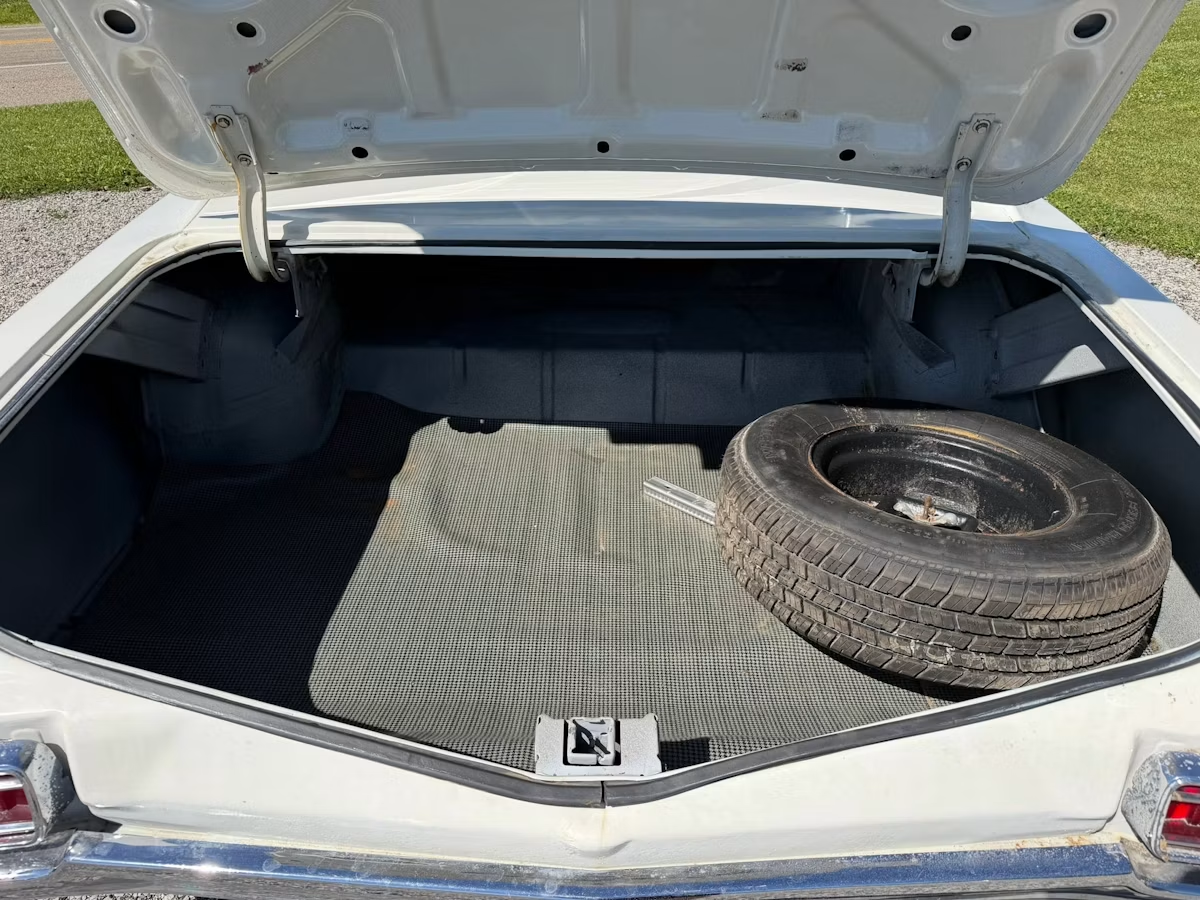
The trunk on the intermediate Skylark is gigantic, which makes one wonder why anyone would need a full-size car.
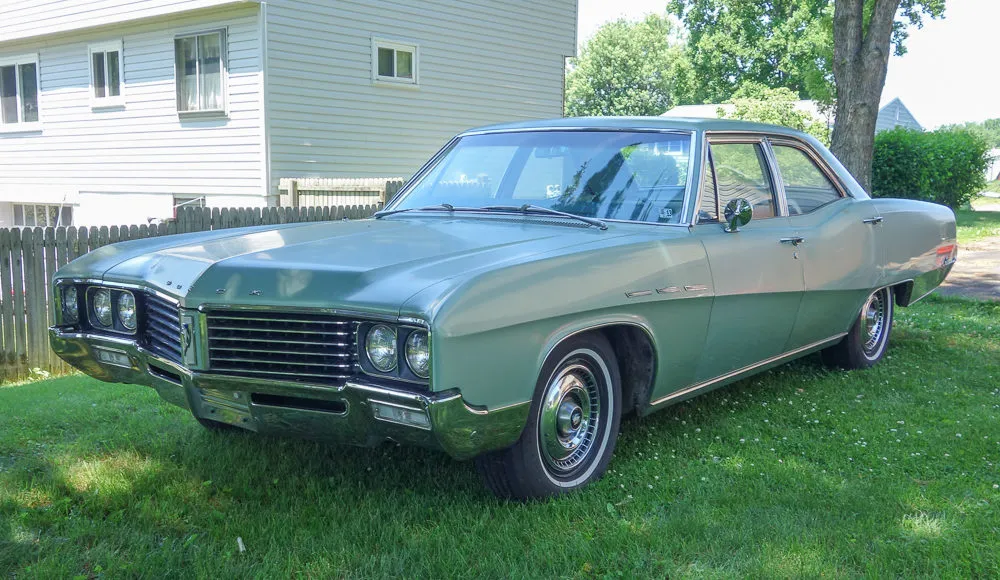
But many thought they did. Buick sold 9,123 Skylark four-door sedans and 13,673 four-door hardtops like our feature car, at $2,767 and $2,950 respectively. Meanwhile, the LeSabre four-door sedan cost a mere $52 more than a Skylark hardtop, and sales bore that out at 36,220 units. The LeSabre Custom four-door hardtop sold 32,526, the Wildcat 15,510, the Electra 225 12,491, and the Electra 225 Custom a whopping 40,978. People liked four-door Buicks; they just didn’t buy that many of them in a smaller size.
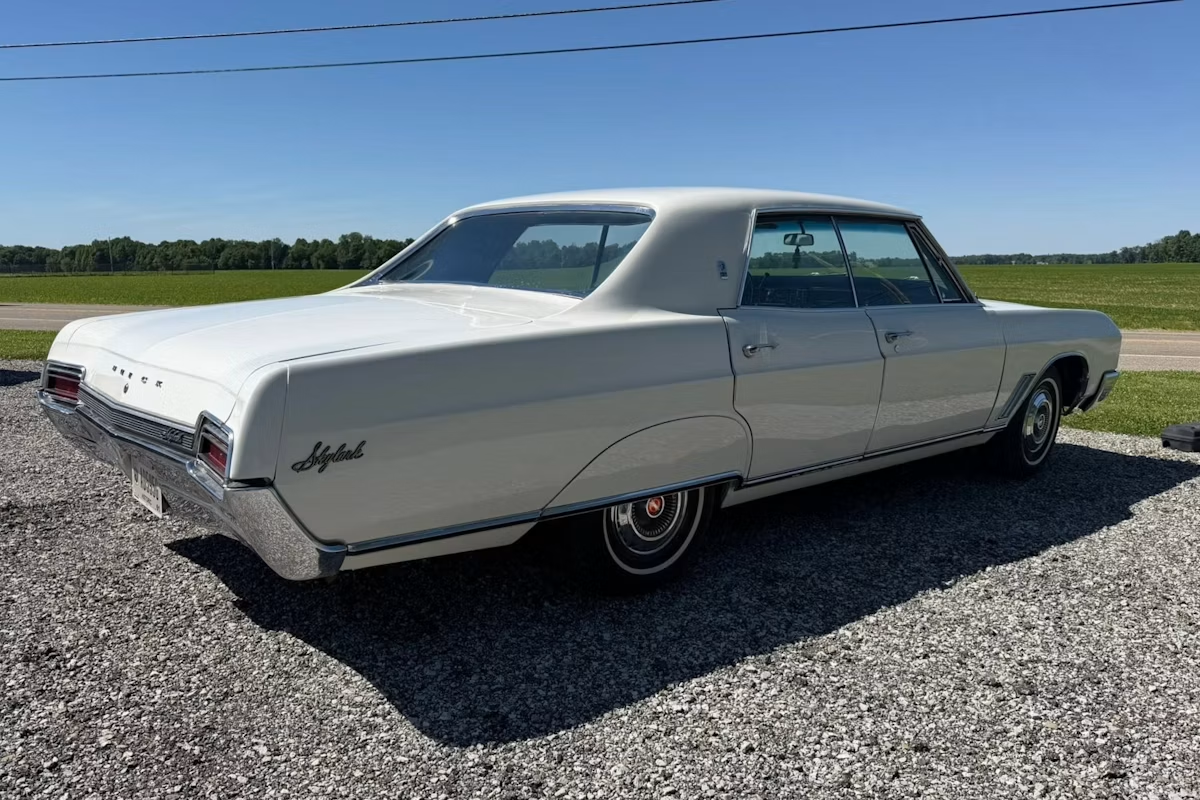
Maybe it was the fender skirts, which certainly looked more appropriate on the four-door hardtop than they did on the two-door (which by the way was much more popular at 40,940 cars sold). Whatever the case may be, the Skylark four-door hardtop deserves a reappraisal for what it is, a deftly styled example of a car that should have been more popular than what it was.
Related Reading
Road Trip Outtakes: 1967 Buick Skylark – Canada Dry (by Ed Stembridge)
Curbside Find: 1967 Buick Skylark – 2-Door Hardtop Looking Good, By The Curbside (by StuartH)
Curbside Find: 1967 Buick Skylark On A Front Lawn – A-Body Lawn Ornament (by Rich Baron)
All Those Glamorous Hardtops, Appendix: How Common Were Four-Door Hardtops? (by Aaron Severson)










“Whatever the case may be, the Skylark four-door hardtop deserves a reappraisal for what it is, a deftly styled example of a car that should have been more popular than what it was.”
The choice for buyers was rather overwhelming that year. Besides the full-size Buick four door hardtops buyers could select from, there was also Pontiac and Oldsmobile A-body four-door hardtops worth looking over, not to mention their full-size four door hardtop offerings, including the Chevrolet Caprice. There was only so much market for the multitude of four door hardtop options that were available in 1967.
When I was about 9 years old my Dad bought a 1965 Buick Special, 4 door that was White with a Gold color top. It had a Wildcat 310 motor in it. THANK YOU, THIS BROUGHT BACK SOME BEAUTIFUL MEMORIES
I like this car a lot! I had to look up Bloomingdale – west central Indiana, not far from the Illinois line, and very, very rural. A turquoise version with a black vinyl roof has appeared several times at an annual show I attend, one county north of Indianapolis. I love the 4 door hardtop with fender skirts.
It’s a pity that there are no photos showing all four windows rolled down to emphasize this very attractive but long gone body style.
I agree; I was surprised by that when I was looking through the original ad.
1960’s and 1970’s Buick’s were some of the most attractive GM vehicles ever! They had a discreet elegance about them! I noticed the fender skirts on this Skylark,very nice!
I’ve only seen those four-door hardtops with fender skirts including one at a show I saw in 2000. I can’t say I’ve seen one without them.
Lost those dowdy, skirts!!
I’m not a fan of fender skirts, but they do kinda work well here. The trim extension helps..
Opposite for me. Combined with the oversize C pillar, they make the whole back end of the car way to heavy.
Geez, it’s not like they didn’t promote Buick intermediates in the 67 fold out brochure. 75% of the real estate is dedicated to the Skylark and Special !
This is a very attractive car, and I like the white over blue color combo.
GM in 1967 did make lap belts for the front and rear outboard seating positions as standard equipment. I wonder if the rear belts are buried beneath the seat cushion in this car.
Funny you mention that about rear seat belts. In the 1980’s when I worked at a gas station, I had a customer with a ’69 Ford Galaxie, which would have had rear seat belts front and rear as standard at the time. She told me she wished it had rear seat belts as her two young kids were getting old enough to transition from a rear-facing car seat in the front to booster seats in the back. I explained to her, it should have rear seat belts as federal law required them by 1969 when her car was built, so I told her I’ll quickly look for them behind the seat if she had time to wait. She did and sure enough, both sets of seat belts were buried under the seat cushion, never having been used before, still in their protective plastic sleeves. It was obviously overlooked by the dealer during the Pre-delivery Inspection/Dealer Prep.
Never seen one with fender skirts. Nice look! And a 340 V8! Would’ve guessed a 350.
Then, GM’s divisions had brand-unique engines further making each brand more special from the rest. Pre-bean counter days!
These second-gen A bodies were among the best GM designs of the 60s, along with the first-gen Rivera and the second-gen Corvair.
And as you note, about the biggest car you really need.
The sales figures are interesting. I’ve often thought Chrysler made a mistake in not bringing out a B body intermediate in 1965 alongside the Belvedere and Coronet, and a 4 door hardtop for all brands as at least for that first year, it was already designed. But now I wonder if they would have had any more success in this just-shy-of-luxury sector than Buick.