
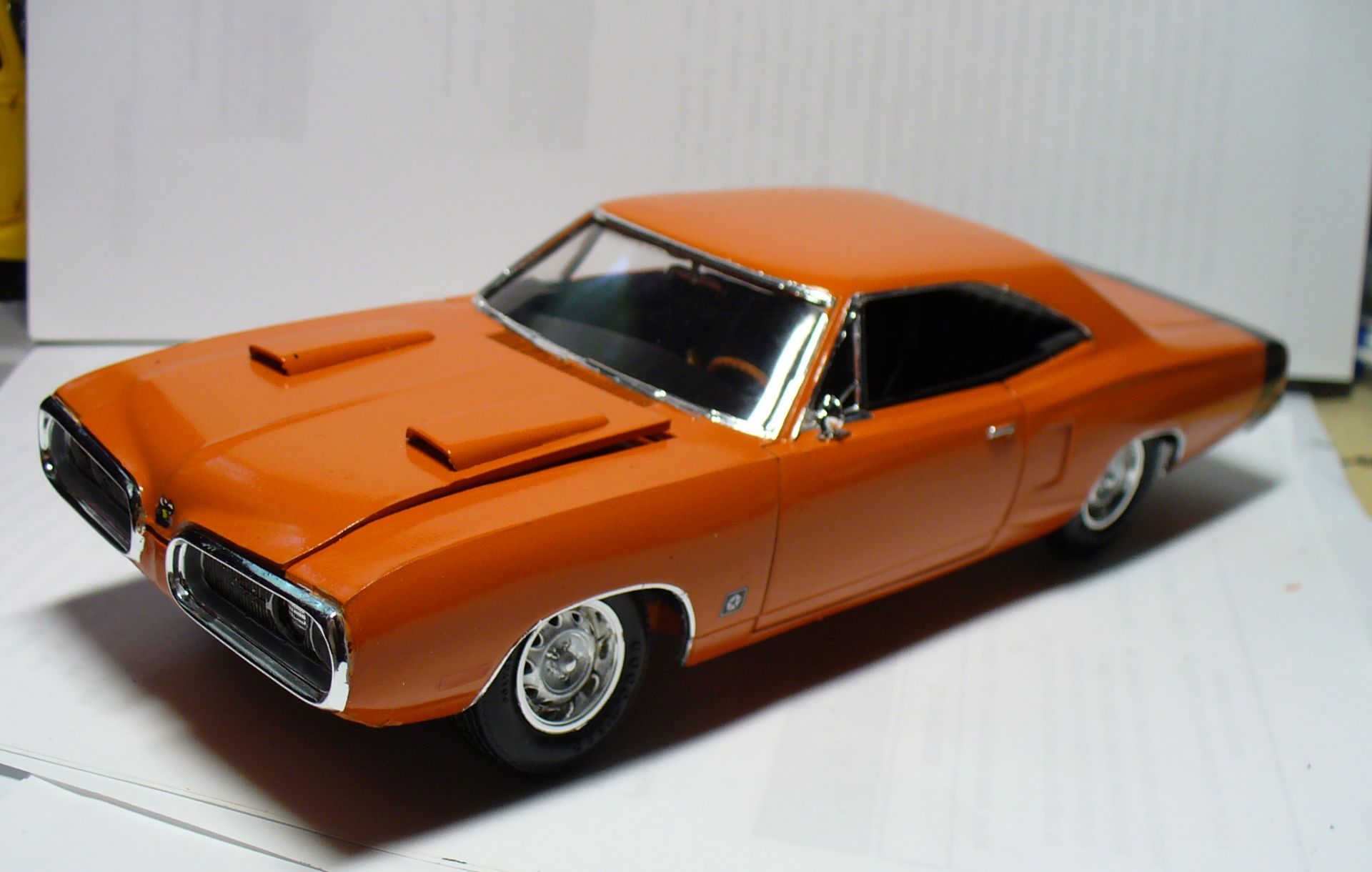
We’ve looked at the second-gen Chargers before, but there were a lot of other B-body Mopars from Plymouth and Dodge that we didn’t cover then.
These fall neatly into two year groupings, ’65-’67 (I only have ‘67s), and the smoother, curvier ’68-70 rebody. While there are kits of various ’65 and ’66 Mopar intermediates now, from Moebius, I haven’t built any of them. And I’m omitting the ’71-74 years, as they were all Chargers – which we’ll cover soon.
1967 Dodge Coronet R/T

As we know, Dodge’s ’62-4 shrunken full-size cars gave rise to an intermediate for 1965. Larger than most, true, but then a Dodge was historically a larger car. I’ve found it interesting the way Mopar has varied the size of its cars now and then, taking them out of the mainstream – usually it seems to dubious results. As largish intermediates, these seemed to have sold well, some 184,609 for 1967. Add Dart and Polara figures to that and the accountants would have been happy.

To put them into perspective, the wheelbase on these cars was only two inches shorter than a full-size Plymouth Fury, and the overall car only ten inches shorter. That seems awfully close to full-size. The multi-creased bodysides, while making for a rather attractive car, looked rather out of step by 1967, when a smoother look (a la Lincoln Continental) was increasingly becoming the ideal.

This later edition of the Monogram kit came with optional larger wheels and tyres, for a more modern modified look.
’66-7 Dodge Charger

By now we’ve seen the ’68-’70, so no need to rehash them. But for the first generation they were basically a fastback Coronet with an especially nice interior. Large fastbacks were a thing, briefly – think ’67-8 Chevy (but not AMC Marlin!). Something about this shape really captivated me. Hidden headlights fitted in well with the simple fine-vertical-bar grille.

This silver is close to a bare metal look, and really shows off the shape.
MPC made an annual kit of the Charger, and although it was reissued from time to time, I never seemed to find one. So when Monogram added the first-gen Charger to their muscle car lineup, I jumped.

Several times, in fact!

1968-70 Dodge Coronet R/T, Super Bee.

The new ’68 body was still large, but by now other intermediates were bulking up too. The smooth sheetmetal looked much more modern, though the rear windshield on two-doors took on an odd shape. Not awful, just unexpected as in “Whatever gave them that idea?” There is a ’68 Coronet model now, a revision of the old MPC tool, but there wasn’t when I built these ‘69s.
These Super Bee 440 Six Packs were one of Monogram’s muscle car kits from 1983. It’s a much easier build, simpler than many of today’s kits.

The first issue was moulded in a metallic blue plastic, and came with a sachet of Turtle Wax to polish the plastic. Nice idea, but as with their other kits that provided this, you still wound up highlighting the flow marks in the plastic. I tried it, and eventually painted the plastic instead.

This convertible was a later reissue of the MPC annual kit, reboxed as the ‘Mission Impossible’ car. I built it in ’72. For a long time there we didn’t get factory stripes on the decal sheet, so I painted these freehand. Don’t ask me to do that now.

Ah, 1970. The year Dodge stylists seemed to go crazy! The two separate lights/grille pods with a body-colour panel between made for one strange front end – not so bad on the hardtop but it was a bit too wild for the sedans and wagons, but they got it anyway. AMT got the old MPC body (they’d owned them since ’85) and adapted it to their nineties-style chassis with all the goodies.

There are problems in getting the bucket-style interior (with side walls and floor moulded as a unit) to fit with a chassis designed for separate side walls. You wind up with interference between the interior’s centre tunnel and the floorpan’s centre tunnel, but with some cutting and filing, and more than the usual amount of perseverance, it can be made to work. I think I wound up cutting out the floor of the interior bucket entirely, fixing the front seats and console to the floorpan, then dropping the sides/rear seat assembly over that.

Then I guess they figured that they had this pro-street chassis made for a ’69, so they might as well use that too, and adapted it to the ’70 body. By this time I’d built them in Panther Pink and Go Mango, so this one had to be Plum Crazy.

Someone in Mopar accounting must have queried the cost of producing two totally different intermediate coupe shells for the Coronet and the Charger, plus the Plymouth shell, because for ’71 and beyond the Coronet name only meant sedan or wagon, and the only coupe was the Charger – which looked nothing like a Coronet. So after years of the Charger being something really special, distinctive, and luxurious, the name was downgraded (they’d say the appeal was widened) to apply to all intermediate Dodge coupes. The idea of a strippo Charger seemed an oxymoron, but…that was Mopar.























Peter: Once again you manage to tickle me with the most delightful feathers ever, LOL! I once lusted after a ’67 Coronet (Didn’t get it); later on I did acquire a ’66 Sport Fury. One of my HS buds had a white/red ’69 Super Bee, and another had a black ’70 ‘C’ striped one. The ’70 Super Bee with the ‘C’ stripe was one of the coolest looking cars, but (for me) it was always a toss up between the twin scooped hood, or the power bulge scoop as to which looked the best, I liked both of them!! Now, if only the lead photo car had the ‘C’ stripe….Thanks again for a WONDEFUL display of your work!! 🙂
Ah, thank you, Moparman. Once I started looking for B-bodies, I was amazed to see how many I’ve built over the years. They kind of sneaked up on me. And we’re not quite through with the B-bodies yet.
The first time I saw a photo of the ’70 Dodge (in my American Car Spotter’s Guide) I thought “No way! They put that front end on a car?” Once you factor in the variety of hood treatments and stripes (not to mention those colours) it’s amazing when you look back to see the degree of variety offered to the customer.
Great models as always Peter.
I read an interesting article the other day in Motor Trend that Dodge is fixing to do another Super Bee, this time on the new Charger platform using Stellantis’ 3.0-liter Hurricane Engine.
In an effort to get MOPAR fans to realize that the inline 6 is really a great performer, they’re tagging this one with the old Super Bee name. Apparently, there are still diehard MOPAR fans that will accept nothing but nothing but a HEMI V8, but the times, they are a changin’.
Thanks Rick. Have to chase down that herd of Mustangs for another story, won’t I?
That’s interesting about Stellantis and the Super Bee. Having made such a fuss about the Hemi for the last twenty-odd years, now they’re a victim of their own advertising! Of course six in a row go just fine – speaking of which, isn’t it interesting the way the straight six is making a comeback?
As Paul once said of the Straight Six, it is one of the smoothest engines that there is, citing something to do with firing orders and natural balance… (maybe I need to go back and bone up on that).
Anyway, my only experience with one was in my 1979 Fairmont Futura. It had the 200 cid (3.3L) I-6, but this was deep in the malaise era, where this engine had like 85 horsepower, which may’ve even been less than the 2.3L I-4 at the time! “That 1BBL carburetor could really deliver the fuel mixture!”, he says sarcastically.
Sadly, all I remember is its disappointing lack of power (I was 19, so there’s that), and really didn’t appreciate any “inherent smoothness” as I probably should have at the time.
Now I want a car with one! – Maybe when I retire and my wife and I go down to 1 car (well, 1 car plus my Mustang, God willing), Mazda will have a nice hybrid CUV with one.
Maybe it’s just me but I find a wild cosmetic resemblance between the new Charger and the AUSTRALIAN Valiant Charger far more than anything from the US mopar back catalog, and the hot inline 6 is even more of a throwback to its “Hemi 6”. The latest SuperBee even reminds me of the VH Pacer graphics
As for the changin times and its prospects, yet another $80,000 Charger on top of 1-2 flops of this generation’s much criticized and very expensive Charger doesn’t leave me all that confident in the Stellantis direction of things. I’ve counted 10 Daytonas and Six Packs(albiet they are pretty fresh) in the Chicagoland area. Meanwhile I can’t throw a handful of pea gravel in the air and not hit a late LX Challenger or Charger with a pentastar or basic Hemi 5.7. This Superbee I suspect will be another speedbump before either it regresses back to V8 power or the whole Dodge brand simply disappears.
Good point, Matt. How ironic that they’ve picked up so many styling and graphic themes from the VH and used them 55 years later!
Those VH Pacers were very, very uncommon back in the day – everyone was buying Chargers instead! Sneaky the way the Pacer’s stripe visually shortened the tail, fixing one of the main complaints about the VH, that it was too big.
I’m afraid I’m beginning to see Stellantis as the place where ailing brands go to die. I hope it isn’t so, but the signs don’t seem good. They’re pulling out of Australia (not enough sales) and to be honest I don’t think most folk here will even notice; it’s not like they have even one good seller. Are any of their brands doing well in Europe?
I was wondering that, I was scouring Google trying to find pics of VH pacers besides that one but most were either old grainy pics or of models(although relevant in context in hindsight!), Chargers are much easier to find clear pics of! IIRC the original 68 Bumblebee stripes on Dodges was concocted for the same reason to trick the eye into seeing a shorter tail than they had!
That’s my fear with Stellantis, right now at least around here as far as new product, Ram and some Jeeps seem to sell, Chrysler seems dead apart from rental Pacificas, Dodge is the aforementioned 10ish Chargers and the very odd Hornet, Alfa never, Fiat never. All of which seemed more prevalent if not downright common 10 years ago.
Yes Matt, Australia was a strange place in the early seventies. Chrysler made the classic American-management mistake we’ve seen so often of assuming that what worked for the US would work here. They weren’t reading the room.
Not only did they upsize the Valiant, (4.5” wider) the styling made it look even bulkier than that, at a time when many Aussies felt the Big Three cars were getting too big, and sales of midsize cars (that meant the two litre fours) were booming. For contrast, the popular HQ Holden was only ¼” narrower, but 5.2” shorter – and styled to look small.
Many Aussies who didn’t really need a big back seat bought the SWB Charger. It was still wide, but 13” shorter, having got rid of the long drooping tail that spoiled the VH sedan. It far outsold expectations, being much more commonly seen than the Ford or Holden hardtops – or the Valiant sedans!
So I’m not surprised you had trouble finding that picture.
It is a real shame about the new Charger, I think think it looks about as good as a modern car can without being completely retro like the Challenger was. I like the return of the Fratzog emblem. And watching video road tests of them, they seem like great cars to me.
Another resemblance to our Aussie Chargers is the awesome straight 6 howl they make.
I had a 70 Coronet 440.
Thing rode like a rock.
But had a very quiet and super smooth running 318.
I put a riser spacer under the carb hoping for claimed increase with mpg, but in reality I don’t think it did a thing.
Nice look. Mean looking and very sporty front clip.
Very sporty looking, even when the rest of the body wasn’t!
The idea of a model coming with a small packet of Turtle Wax is fascinating to me. Even if it’s not particularly well-suited to putting on plastic models (you’d know of course!), I know that as a kid I would have been thrilled to get a product like Turtle Wax in a tiny size.
It sure was a surprise, Jeff. It was only in the original issue of this and the Dodge Challenger TA. The box top said that it was molded in Metal Glow blue (just did a quick image search). It didn’t mention the Turtle Wax sachet, but you’ll find it mentioned in kit reviews of the time. Just enough to do the one model – and a sneaky bit of product placement for when we graduated to real cars?
Really nice selection here. The first gen. Charger in silver with a red interior is a great combination and used in Dodge advertising at the time with the Dodge girl.
I built one once and have a memory of it having metal axles.
I built some of those molded in color kits back in the day when living in a small flat, much less mess, and I was happy enough to have some models of my favourite cars and paid extra attention to the details, but mine didn’t come with the Turtle Wax.
Thanks jonco. That silver Charger – there are so many creases in the bodywork to catch and reflect the sunlight that I wondered what a bare steel shell would look like. I really needed a finer metallic component in the paint to pull that look off. The red just seemed a natural complement.
Models moulded in colour avoided having a shelf full of bare plastic – at a glance they looked painted even if they weren’t. Just so long as they weren’t moulded in red (terrible for bleed-through) of black (hard to cover).
Models including polish was a real thing in the 00s, I have a few 1:18 American Muscle Ertls that came with little packets of meguiars prominently displayed in box. I don’t think I ever opened any to dare try using on them.