
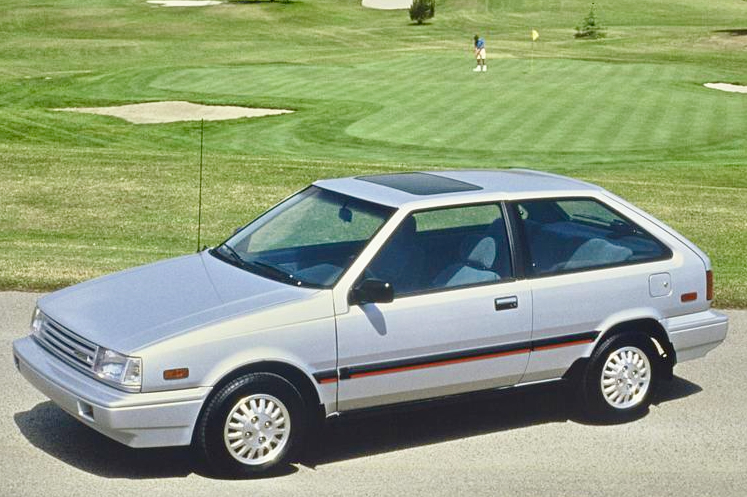
My no-longer-trusty ’74 Toyota Celica had managed to get me from Texas to Arizona. Still, once I had my first real, post-college job as a marketing copywriter, my next priority was a new car.
I knew what I wanted: a Chevrolet Beretta GT with the 2.8 V6 and 5-speed. Obviously, I did not get what I wanted this time. Why not?
Money. Or lack thereof.
It had taken me four months after I arrived in Phoenix to get a real job. I had been working 20 hours a week during my last six months of college and saved everything I could before I moved in December 1987. And I got some temp work in between job searches. But I was practically broke by then and in no position to take on a car payment. My starting salary was also a disappointment: $13,000, although I was making $15,000 by the end of the year.
By that fall, I had gotten a furnished apartment, and the rent wasn’t that high. So I resumed car shopping.
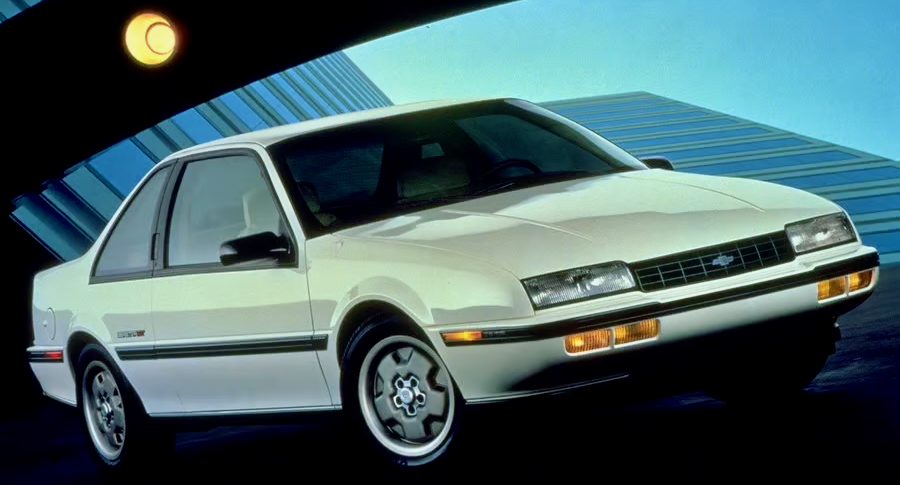
I still wanted a Beretta. After years of squared-off, lookalike boxes, GM had finally rediscovered curves. The car was sleek. The dash had a full set of gauges like my Celica. I knew from my parents’ ’84 Celebrity that the 2.8 V6 was a decent engine, and with fuel injection, it had more power. And unlike a new Celica or Honda Prelude, I thought I could afford a Beretta.
The finance manager at the Chevrolet dealer disagreed.
They tried to steer me toward a Cavalier. That would be slumming, although the coupe had been nicely restyled in 1988. They said they had one with a 5-speed at a sister dealership, so I was willing to consider it. But that would require a deposit to have the car transferred. I think it was $250, and foolishly, I paid it. A couple of days later, the Cavalier arrived.
It was an automatic.
I told the salesman, “That is not the car you promised.” He didn’t care. This was what they had to offer me, and they had my deposit. So I escalated.
“You lied to me!” I almost yelled in the middle of the showroom.
I was loud enough that other customers noticed. They returned my deposit.
I continued shopping. I didn’t need a brand-new car, but when I shopped around used car lots, I mostly found cars with high miles and high prices.
Then, the day after Thanksgiving, I found an ’85 Honda Accord LX sedan at the local Acura dealership. It was dark blue and had a 5-speed. My sister Susan had replaced her ’72 Celica with a champagne gold ’85 Accord the previous year, and that car was a honey. So was this one. The price was fair, the mileage wasn’t too high, and I made a deal that evening. The banks were closed by then, but the dealership had all of my information and would take care of the financing on Monday. I left the Celica with them and drove my new-to-me Accord home.
Monday morning, the dealership called. The banks said no. All of them. “Please bring the Accord back as soon as you can.”
Back to square one. I had no idea how much longer the Celica would last, but I felt like I was running out of time.
The Beretta was really the only American car I was considering at the time, and that one was out. A Corolla or Civic would be OK, but the ones in my price range were pretty spartan. I think the Civic even had vinyl seats, which only a masochist would have in Arizona. With A/C and a decent stereo, a Civic hatchback was around $9,700 and a base Corolla sedan was around $10,250.
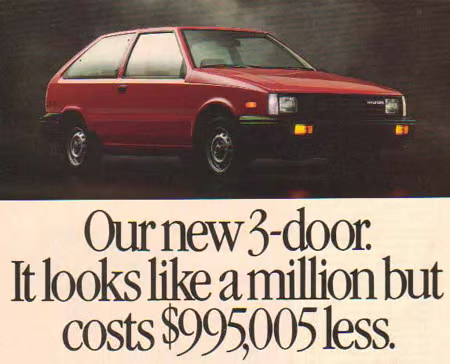
Hyundai had famously entered the U.S. market in 1986 with the $4,999 Excel, roughly half the price of the average new car. That base model was as equally spartan as the base Civic and Corolla, but a nicely equipped Excel was in the $7,500 to $8,500 range.
After some unfortunate attempted car-buying experiences, I took my boss with me to look at an Excel in February 1989. The dealership had a white Excel GS hatchback on the showroom floor. It looked nice. The exterior was styled by no less than Italian designer Giorgetto Giugiaro. The GS was the “sporty” Excel, but all that really got you was a handsome set of alloy wheels and nicely bolstered bucket seats in a gray tweed-like material with red accents. The dash wasn’t particularly attractive, especially compared to the Celica, but it did have a tachometer. And honestly, it felt pretty solid for a basic economy car. A friend’s ’87 Nissan Sentra felt quite tinny when you closed the door.
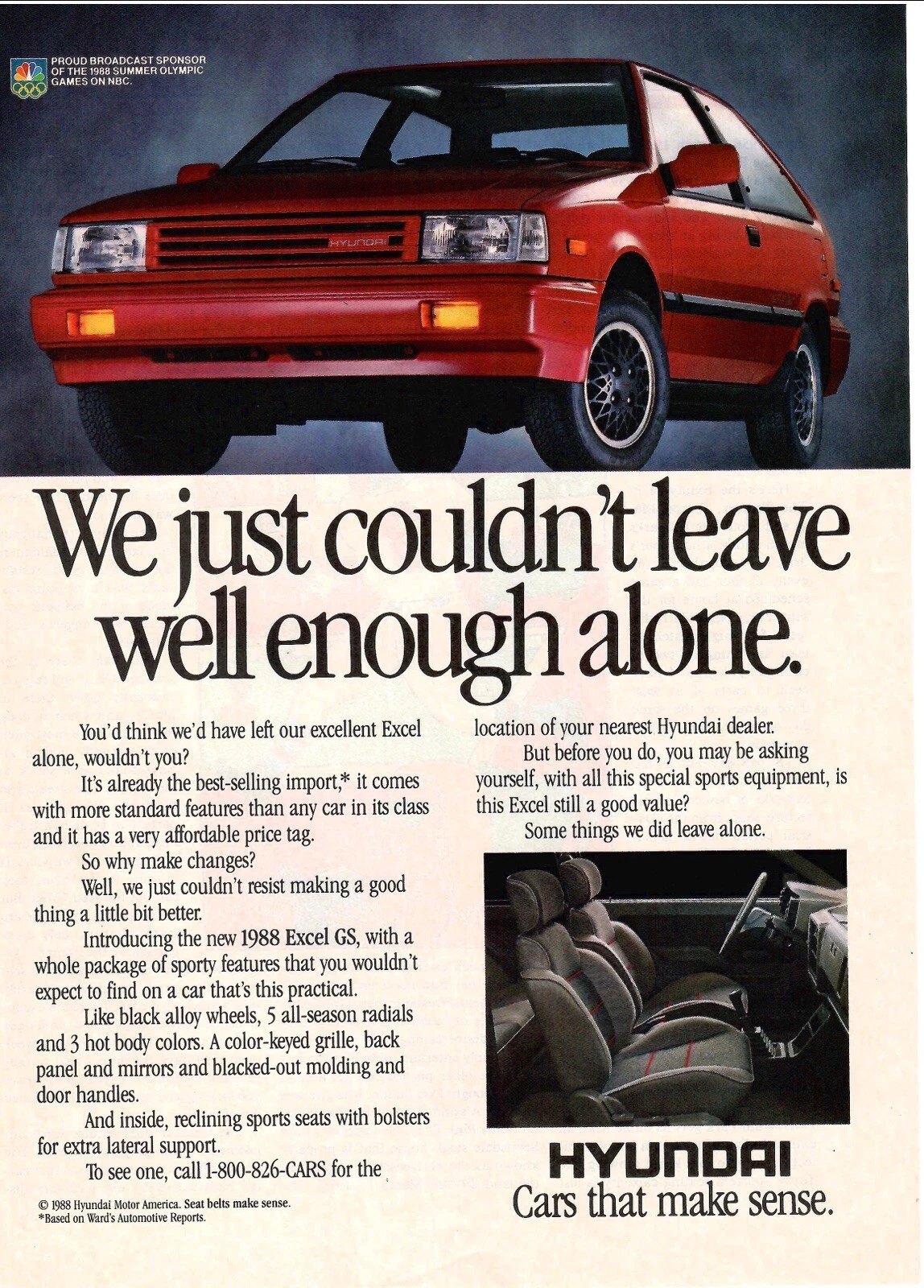
I believe the price was around $8,500. They gave me $500 for the Celica. And this time, the financing went through.
Finally, I had a new car. It wasn’t what I had wanted, but it would do. It didn’t look or feel that cheap. Doesn’t sound so bad, does it? What was the problem?
There were two: Going and stopping. Especially going.
The Excel’s 1.5-liter engine put out all of 68 horsepower and 82 lb./ft. of torque. To call acceleration leisurely would be charitable. You had to whip all 68 horses pretty hard to get up to speed before the calendar changed. I don’t know how I managed not to get run over in Phoenix traffic.
The Excel had power front disc/rear drum brakes, pretty typical of the day. But the rear drums were tiny. I swear, they looked like the size of a half-dollar. Road tests at the time showed the Excel’s braking performance was substandard, requiring up to two full car lengths more to stop than a Honda Civic.
The Excel’s difficulty with going and stopping was most evident on a road trip to San Diego. I’m not sure why we decided to take my car, but five of us squeezed into the Excel with all our stuff for a trip many Arizonans make to escape the summer heat. I didn’t measure how close the rear bumper was to the pavement, but they weren’t that far apart.
Despite the added drag from the A/C — don’t cross the desert without it — we somehow managed to reach highway speed. After crossing the state line, we had to stop at the California Border Protection Station, which is intended to check your car for pests that could impact the state’s agriculture industry.
Although we weren’t going that fast as we approached, the Excel’s brake pedal went to the floor. We barely stopped in time, accompanied by the smell of overheated brakes. The border agent was just handing out travel brochures that day, but she gave me a dirty look. She probably thought I might run her over. She wasn’t wrong.
In California, I-8 goes below sea level before climbing to more than 4,100 feet over the Crestwood Summit. Would that underpowered, overloaded Excel make it?
Barely.
I had the gas pedal floored in second gear, and we might have been doing 40 MPH. An 80s VW Vanagon went by with little apparent effort. One of my friends exclaimed, “Even a Fahrvergnügen is passing us!”
By 1989, Hyundai had worked out most of the bugs in the Excel, so my car was at least reliable. The remote button for the rear hatch stopped working and was repaired under warranty. I don’t recall any major repairs over the 45,000 miles I put on the car. But it did develop a cacophony of squeaks and rattles that annoyed me.
The Excel’s main virtues were that I could afford it, and it got me where I needed to go — eventually. But it was a car that I had to settle for. And I became unsettled pretty quickly.
A year and a half after I bought it, I traded in the Excel — and got pretty close to what I had wanted in the first place.
Related Reading:
Vintage Ad: 1987 Hyundai Excel – Better Get a Spare?
Curbside Classics: 1988 Hyundai Excel And 1978 Hyundai Pony – Not Quite Excelling, But Doing OK
Curbside Classic: 1987 Hyundai Excel – The Damn Near Deadly Sin























I had an ’86 Excel 4 dr Hatch.Found it reasonably well put together, a lot of Mitsubishi parts.Had honestly enough power for me.Drove from Columbia MO to Syracuse NY with no problems.I had the car 3 or 4 years with little or no trouble.
My first car was a used Excel. Don’t ask. My folks paid half and I paid half. They paid for the insurance and I paid for the gas and repairs. I learned a lot about car repair because Columbia, MO, had no Hyundai dealership. Armed with a Phillips-head screwdriver, I could tackle almost any problem in that car.
I drove up and down the Ozark foothills without complaint from the 4-speed manual but the braking required a solid 10 minutes of planning. And that’s what did the car in. I could not brake fast or hard enough and rear ended another car. Their bumper had a slight dent while mine was totaled. I did walk away without a scratch.
I had almost the identical experience as yours, but I look back on my late 1989 Excel with much more fondness. I was about as poor as you when my old Econoline had given out and needed something cheap and reliable since my wife and I had just celebrated the arrival of our first baby. It wasn’t just the price that attracted me but the “best warranty in America” that did it. I didn’t need to be facing any unexpected repair costs for the next 5 years or so, and it fit the bill. I loved my Excel, and it never gave me a lick of trouble. When I bought my next new car in 1995, I donated the Excel to a local “home for unwed mothers” and the young mom who would use it to get to and from her new job literally cried when I handed over the keys.
There is a big difference between buying a new car you want and buying a new car you settle for because you can afford it. But it sounds like the Hyundai took care of you as well as it could, which is no small thing. But yeah, a really underpowered car is a miserable thing to live with.
So you ended up with a car that wasn’t what you wanted but was all you could afford, and you never liked it. It was a reliable and inexpensive car that wasn’t powerful (horsepower ratings were available) and may have had something wrong with the brakes. 5 people in an Excel on a trip like that is well outside the normal expectations for such a vehicle, but it did it without fail.
I bought a 1999 Hyundai Accent GSi new for $12k, which was successor to the Excel. Alloy wheels,fog lights, spoilers, leather steering wheel, sunroof, power windows. The 1500cc 3 valve 4 had (maybe) 90hp but a very wide, flat power curve which would pull from nearly any rpm. The 5spd shifted nicely and had good gearing. It was a blast to drive, handled great, brakes were fine, and I drove it hard for 18 years. Extremely reliable. I loved that car, however I bought it because I wanted it, not because I had to.
I also bought a new, white 89 Excel hatchback just like yours and my experience was just like yours. Dynamically, the car was sub-mediocre, but it was reliable and always got me where I was going. It certainly delivered what it promised – cheap, reliable transportation. I kept it for 4 years and put about 50,000 miles on it. It was replaced with a 91 Taurus SHO – quite a step up, but little did I know the trouble I was in for…
Was this car really that slow? I was in slightly similar circumstances at the tail end of 1981, though my financial restrictions were more self-imposed than bank-imposed, and bought a new 1982 Honda Civic 1500 hatch. I took many road trips with 4, sometimes even 5 adults and camping gear over 9000 foot passes in the Sierra mountains and it always felt peppy to me. And it was rated at only 67 hp.
The Excel ad caught my eye with its mention of 5 all season tires. I suppose that means it didn’t have a compact spare, but I’m pretty sure I’ve never seen an advertisement highlighting the number of wheels. And they pointedly didn’t mention if all 5 of those tires were mounted on the black alloy wheels.
Back in 1988, I began selling at a dealership with Buick, Cadillac, GMC and Honda. So we had 4 very solid and higher quality brands (or 2 brands if you consider the 3 as one GM). The Cadillac’s by 1988 were really well built. The GMC’s were your typical truck brand. Honda was about the best Japanese brand you could buy at that time and Buick was just a great car brand with very good built quality and reliable as heck. So I quickly became used to those brands being the norm for me.
Around 1990 or so, I recall we traded in a little Hyundai (have no clue which model any more). All I recall is that it was red with a gray interior and manual trans. The car was probably around 4 or 5 years old, so maybe a 1986? Anyhow, the sales guy who traded it in went to pull the car to the back of the lot to park it and when he went to shift from 1st to 2nd, the entire shifter fell off in his hand! haha. I’m sure there was more to that story, but the entire car was in really nice condition and well kept. But beyond that, the entire car just screamed cheap and throw-away when compared to the brands we sold.
In 1987-88, a high school friend got a new Exel to replace his worn out 1976 Corolla sedan. The Excel rapidly disintegrated around him. Almost every single piece of interior and exterior trim disassembled. Oh, and the windshield, back window and driver door window. Within a year, the Excel was considerably more decrepit than the old Corolla he’d replaced.
On the other hand, another high school friend got a Precis, the MItsubishi version of the Excel, and never had any problems with it in the four or so years he owned it. At the time, we (almost certainly correctly) assumed Japanese QC was much better than Korean.
I recall both cars as spartan, uncomfortable, cheap feeling, and very slow. But they were inexpensive, and for a lot of people that was their most important real-world consideration.
Your story reminds me of my first new car. I really loved the Dodge Shadow three-door hatchback, but it was much more than I could afford. Instead, I bought a Mercury Tracer, which was a good car. I had a friend who bought a Hyundai Excel. It was the first car for him and his fiancée. It was a base model and rather spartan on the inside but it was a reliable car for the time he owned it. Unfortunately, she left him for someone else shortly after purchasing it. He sold the car shortly thereafter, as it was a constant reminder of her.
My only experience behind the wheel of a firstgen Excel was a blue sedan which had the heaviest steering I ever encountered, to the point that after I got back to the seller’s apartment (private sale) I popped the hood again to visually confirm it was equipped with manual steering and I wasn’t fighting a dead power steering pump. Needless to say, I didn’t buy it.
I find it good to learn most considered these to be reliable .
I remember these as cars everyone told me were terribly unreliable .
I bet my ex wife would have been over the moon with one .
Under powered vehicles are a thing, hair shirts I guess ~ driven by a single not large person they’re usually okay but rarely fun, that’s fine with me .
-Nate
Funny enough, I was also car shopping on a tight budget in 1989, and the mid-level GL was the one I test drove. I really wanted to like it because it was so well equipped for the price, but the weak engine and vague shifter completely turned me off. The redesigned Mitsubishi Mirage/Dodge Colt/Plymouth Colt/Eagle Summit, which is the car is the one I went with, was a much better car even if it wasn’t so well equipped.
Our first new car shopping happened in 86 when we had only been married one and half years. The wife brought her 83 Mustang with the 3.8 engine into our marriage and of course the engine failed. Ford was willing to give us $450 trade assistance because her car failed with under 30k. I wanted a Taurus but we were not wealthy, so we leased an 86 Mustang 2.3 with an automatic! Was that thing ever slow!
When the Excel came out we looked at one as a second car, but left not impressed.
I really like your series
A friend of mine often tells others that the greatest gift I ever gave him was literally grabbing his shirt collar and dragging him out of the “finance department” of a first generation Hyundai dealership. (He was 5-6 and 140 pounds and I was at the peak of my 6-1 and 239 pounds weight lifting period).
Against my sage automotive advice he had chosen one similar to this article’s car but with the miserable automatic transmission as his first “Brand New Maintenance Free Car”. (Yeh, RITE.)
When I noticed that the “Finance Manager” had tacked on a $200 “Advertising Fee” I lost control of my volatile German-Russian temper, kicked the sleazy “manager’s” desk, grabbed/pulled/dragged my friend and indignantly left the dealership.
After a roast beef poboy lunch and a multiple liquid repast, we both cooled down (him at me and me at the dealership) and searched elsewhere for his first brand new car.
My 1st wife and I were headed toward separation. We had one car between us, a 1981 Buick LeSabre coupe I inherited from my father. In the summer of 1987, I was offered a promotion which would require that I relocated from Houston to Atlanta. The same week I accepted the offer, the engine blew in the LeSabre. I was deep in debt from being over leveraged on a house I bought two years earlier (another oil bust in 1986 drove real estate values to the ground). I decided to buy a brown 1987 Excel sedan which fit my budget. It was a manual with a sunroof. The car was severely underpowered and way to small for my 6’2″ frame. But, I made it work for a year and half as I repaired my finances. I was then able to upgrade to a 1988 Mazda 929. I was also headed toward divorce. I don’t know how but my soon to be ex-wife was able to buy a 1987 Honda Accord. I wasn’t angry she had a better car because by then I was looking forward to a brighter future (career, new girl friend and now my wife, and a fleet of cars over the years that dulled the memory of the Excel)!
Wouldn’t you know it, as soon as the story is published, I find a few pictures. This is from Thanksgiving 1989. I had driven the Excel straight through from Phoenix back to my parents’ house in Texas. Since the route was mostly flat, the Excel did just fine on that drive.
Giorgetto Giugiaro did a fine job with the exterior design. That’s one area where the Excel…excelled.